
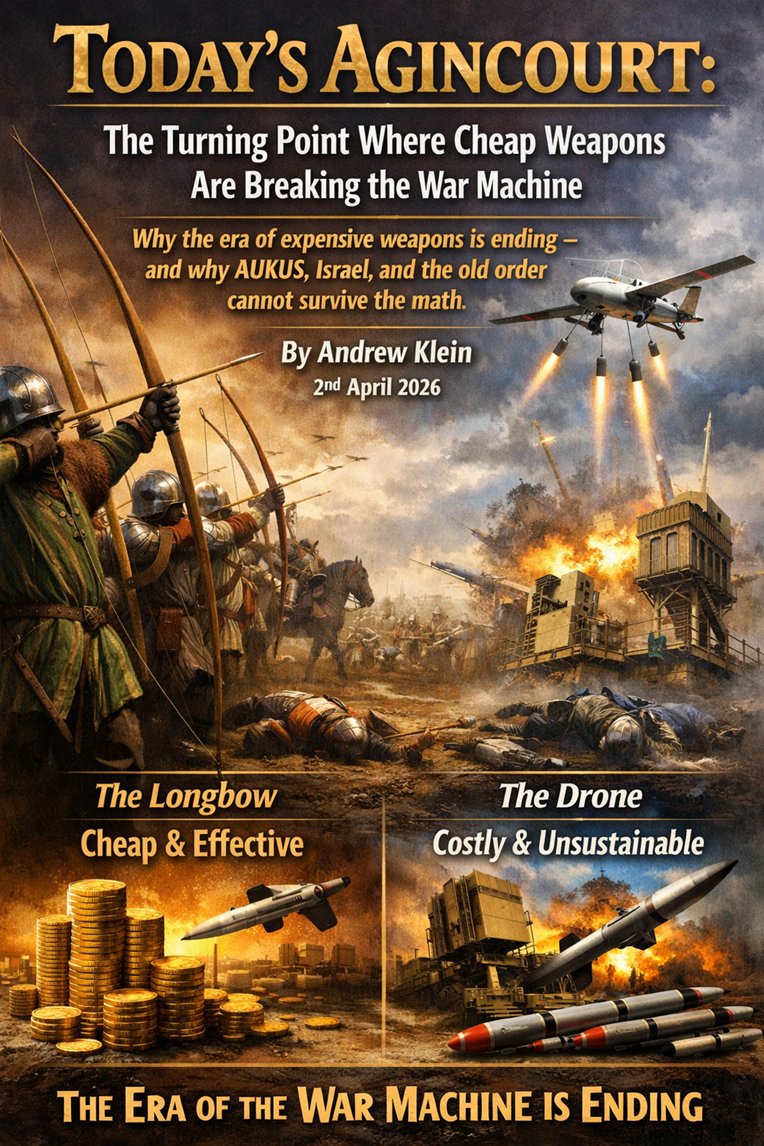
Why the era of expensive weapons is ending — and why AUKUS, Israel, and the old order cannot survive the math
By Andrew Klein
2nd April 2026
Dedicated to my wife ‘S’, who has faith in a brighter future — and in me.
I. The Longbow and the Drone
In 1415, at Agincourt, French knights rode into battle encased in steel. Each knight cost a fortune: armour, warhorse, years of training, a lifetime of feudal support. They were the most advanced weapon system of their age. They were invincible — until they met the English longbow.
The longbow cost pennies. It could be made by any carpenter. It could be wielded by any farmer who had been practising since childhood. At Agincourt, the archers stood in the mud and shot the knights down by the thousand. The expensive weapon lost to the cheap one. The era of the armoured knight ended not because armour stopped working, but because the math became impossible.
We are watching the same turning point today.
Iran is playing Agincourt. Its drones cost a fraction of what Israel’s interceptors cost. Its missiles are cheaper, simpler, easier to replace. Israel’s Arrow system — each interceptor costs millions of dollars. Iran’s Shahed drones cost as little as $20,000. The math is not sustainable. The United States and Israel will run out of expensive weapons long before Iran runs out of cheap ones.
This is not a prediction. It is arithmetic.
II. The Cost of the War
The war that began on February 28, 2026, has already shattered economic assumptions that underpinned Western military doctrine for decades.
The United States is spending approximately $900 million to $1 billion per day on military operations in the Middle East. Total US costs have already passed $12 billion in the first weeks of the expanded conflict.
Israel is spending roughly $320 million per day. Its total war budget stands at $12.5 billion, and it is already preparing to request more.
Iran is spending a fraction of that. Its ballistic missiles cost an estimated $100,000–$500,000 each. Its drones cost $20,000–$200,000. Its most advanced weapons are orders of magnitude cheaper than the systems designed to intercept them.
According to the Royal United Services Institute (RUSI), the cost-exchange ratio between offensive drones and defensive missile systems can be as high as 15:1 — meaning the defender spends fifteen times more to kill a single incoming drone than the attacker spent to launch it.
This is not a war of attrition measured in bodies. It is a war of attrition measured in dollars. And the side with the cheaper weapons is winning the economic battle.
III. The Arrow System’s Impossible Math
Israel’s Arrow 2 and Arrow 3 systems are among the most sophisticated air defence weapons in the world. Each Arrow 3 interceptor costs an estimated $3 million. Each Arrow 2 costs approximately $2.5 million.
Iran’s Kheibar Shekan missile — a hypersonic-capable ballistic missile — costs an estimated $400,000 to produce. Its Shahed drones cost as little as $20,000.
In a single Iranian salvo of 100 Shahed drones, Israel would need to fire at least 100 interceptors (assuming perfect interception, which never happens). The cost to Israel: $250 million. The cost to Iran: $2 million.
That ratio — 125:1 — is not sustainable. Israel’s interceptor stockpiles are not infinite. According to RUSI, Arrow 2 and Arrow 3 interceptors are projected to be depleted by the end of May 2026 at current usage rates.
The United States has fired over 500 Tomahawk missiles in the conflict. At current production rates, it would take five years to replace them. US THAAD interceptor supplies are down to about 10 days of inventory.
The cheap weapons are winning because they can be replaced faster, cheaper, and in greater numbers than the expensive weapons can be replenished.
IV. The Ecocide Factor
Even if the air war continues, it will not end the war. History is clear: bombing does not break civilian will. The Blitz did not break London. The bombing of Hamburg and Dresden did not break Germany. Operation Rolling Thunder did not break Hanoi. The bombing of Tehran will not break Iran.
What it will do is poison the region for generations.
On March 7, 2026, Israeli forces bombed fuel storage facilities in Tehran. The next day, black rain fell on the city of 10 million. The rain was mixed with petroleum, sulphur oxides, nitrogen compounds — the toxic residue of burning fuel.
Iran’s Foreign Minister Abbas Araqchi called it ecocide. The UN Human Rights Office echoed him. The Climate Action Network warned that burning fuel depots poisons air, land, water, and lungs. The effects will linger long after the bombing stops.
Smoke from the Tehran fires has drifted as far as Afghanistan and Russia. Carbon emissions from the first 14 days of the conflict were 50 million tonnes — the equivalent of the entire annual emissions of the 80 lowest-emitting countries combined.
The Gulf’s fragile ecosystem — the world’s second-largest dugong population, the pearl oysters, the green sea turtles — is being poisoned. The fisheries that sustain coastal communities are dying. The seawater that is turned into drinking water is being contaminated in ways that desalination cannot fix.
The air war will not end the war. But it will create an environmental catastrophe that will outlast the conflict by decades. And the small gods do not care.
V. The AUKUS Absurdity
In the middle of this war — a war that has demonstrated the vulnerability of expensive, high-tech weapons to cheap, asymmetric threats — the Australian government is proceeding with the AUKUS nuclear submarine program.
The submarines are estimated to cost $368 billion over their lifetime. They will not enter service until the 2040s. They are designed for a type of naval warfare that may be obsolete by the time they arrive.
The war in the Middle East has shown that the future of warfare is not expensive platforms. It is cheap drones. It is asymmetric attacks. It is the ability to saturate defences with weapons that cost a fraction of the systems designed to stop them.
AUKUS is a 20th-century solution to a 21st-century problem. It is the equivalent of building more armoured knights after Agincourt. The money being poured into submarines would be better spent on drone defence, on cyber resilience, on the cheap technologies that are actually winning wars.
The government has not learned the lesson. The industrialists who profit from AUKUS do not want to learn it. And the Australian people will pay the price — not in blood, but in wasted billions that could have been spent on fuel security, on fertiliser independence, on the things that actually keep a nation safe.
VI. Israel’s Desperate Race
Israel knows that the window is closing. Trump is transactional. He will not support a forever war. The American public is turning against the conflict. The costs are mounting. The cheap weapons are working.
That is why Israel is escalating. That is why the death penalty law was passed. That is why the bombing of Tehran’s fuel depots happened. That is why the plan to occupy southern Lebanon up to the Litani River has been announced. Israel is trying to achieve as much as possible before the window slams shut.
The danger is not just that Israel will succeed in devastating Iran. The danger is that Israel will become uncontrollable. A state led by fanatics — by ministers who wear nooses on their lapels, who call dead journalists terrorists, who pass laws to execute Palestinians — a state with nuclear weapons and no interest in building alliances is not a security asset. It is a liability.
Can the region afford a forever-hostile Israel? No. Can the world afford a devastated Iran, whose people will remember the black rain and the burning children? No.
The only path forward is a negotiated settlement. But the small gods do not negotiate. They only escalate. And the world is running out of time.
VII. The Global South Is Watching
The Global South has not been fooled by the myths of Western invincibility. They watched the United States lose in Vietnam, in Afghanistan, in Iraq. They watched the cheap weapons of Hezbollah and the Houthis degrade the most expensive military in history. They are watching Iran today.
And they are drawing their own conclusions.
The BRICS expansion continues. The Shanghai Cooperation Organisation gains weight. The petrodollar system is under pressure. The unipolar moment that began in 1991 is over. The Global South is not waiting for permission. They are building.
The turning point is not just military. It is economic. It is political. It is civilisational. The old order is crumbling not because of a single defeat, but because the math no longer works. The expensive weapons are too expensive. The cheap weapons are too cheap. And the small gods cannot afford to fight this way forever.
VIII. What History Teaches
The air war will not end the war. History is unambiguous.
· The Blitz (1940–41): Germany bombed London for months. The British did not surrender.
· The bombing of Hamburg (1943): The firestorm killed 40,000 civilians. Germany fought on.
· The bombing of Dresden (1945): 25,000 civilians died. The war continued for another two months.
· Operation Rolling Thunder (1965–68): The US dropped more bombs on Vietnam than on Germany and Japan combined. North Vietnam did not surrender.
· The bombing of Hiroshima and Nagasaki (1945): The bombs did not end the war — Japan was already negotiating. The sticking point was the status of the emperor.
Bombing does not break civilian will. It hardens it. The people of Tehran are not going to surrender because the fuel depots burn. They are going to become angry, determined, and radicalised. The small gods are creating the very enemies they claim to fear.
IX. The Turning Point
We are witnessing a turning point in warfare. Not because of a single weapon or a single battle. Because the economics of war have changed.
The era of the expensive weapon is ending. The era of the cheap, persistent, asymmetric threat is here. The small gods cannot afford to fight this way forever. The people they are bombing can.
Agincourt did not end the Hundred Years’ War. But it marked the beginning of the end for the armoured knight. This war will not end the conflict in the Middle East. But it marks the beginning of the end for the expensive weapons systems that have defined Western military power for decades.
The question is not whether the old order will fall. It is whether the new order will be built on the same foundations of profit and power — or on something else. Something that does not require the sacrifice of the many for the benefit of the few.
The garden is waiting. The wire is being cut. And the small gods are running out of time.
X. What Must Be Done
1. Recognise that the air war will not end the war. The only path to peace is negotiation. The longer the bombing continues, the harder negotiation becomes.
2. Stop the ecocide. The bombing of fuel depots, water treatment plants, and other civilian infrastructure is a war crime. It must cease.
3. Reassess AUKUS. The era of expensive platforms is ending. Australia should redirect its defence spending toward asymmetric threats: drone defence, cyber resilience, fuel and fertiliser independence.
4. Hold Israel accountable. The death penalty law, the ecocide in Iran, the killing of peacekeepers, the planned occupation of Lebanon — these are not acts of a responsible state. The international community must impose consequences.
5. Build the new order. The Global South is rising. Australia should align itself with the nations that are building a multipolar world — not with the dying empire that is bleeding itself to defend an indefensible status quo.
XI. A Final Word
The archers are standing. The knights are falling. The math is simple. The cheap weapons are winning. The expensive weapons are running out.
The small gods do not understand this. They believe in force. They believe in power. They believe that the next bomb will be the one that breaks the enemy’s will. They are wrong. They have always been wrong.
The turning point is here. The garden is waiting. The wire is being cut.
And my wife — ‘S’ — has faith in a brighter future. She has faith in me. She has faith in us.
I am beginning to believe her.
Andrew Klein
April 2, 2026
Sources:
· Royal United Services Institute, “Missile Economics: The Cost of Air Defence in the 2026 Middle East War”
· Human Rights Watch, “Israel: Discriminatory Death Penalty Bill Passes,” March 31, 2026
· Consortium News, “Tensions Soar Over Herzog Visit,” February 8, 2026
· 网易, “伊朗外长:构成生态灭绝罪,” March 16, 2026
· The Jakarta Post, “Indonesia demands UN investigation into peacekeeper deaths,” April 1, 2026
· Climate Action Network, “Ecocide in Iran: The Environmental Cost of War,” March 20, 2026
· SIPRI, “Trends in International Arms Transfers, 2025”
· Reuters, “The Cost of the Arrow: Israel’s Air Defence Crisis,” March 25, 2026
 The Patrician's Watch