
A Comparative History from Ancient Civilisation to the 2026 War
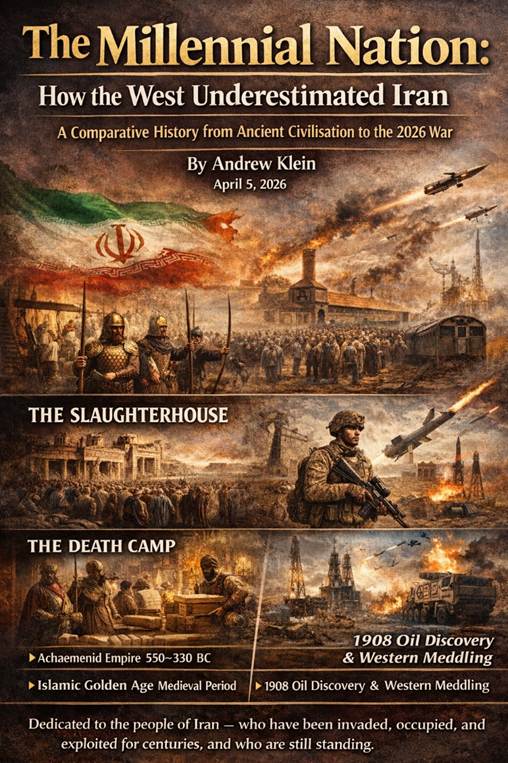
By Andrew Klein
Dedicated to the people of Iran — who have been invaded, occupied, and exploited for centuries, and who are still standing.
I. Introduction: The Land That Would Not Break
Iran is one of the world’s oldest continuous major civilisations, with historical and urban settlements dating back to 4000 BC. The Medes unified Iran as a nation and empire in 625 BC. The Achaemenid Empire (550–330 BC) became the largest contiguous land empire the world had yet seen, administering most of the known world under a model of tolerance and respect for other cultures and religions.
The West has never understood Iran. Not then. Not now.
While Europe stumbled through the Dark Ages, Iran was a beacon of civilisation. While the Crusaders slaughtered their way to Jerusalem, Iran was refining philosophy, medicine, and mathematics. While the industrial revolution was still a distant dream in England, Iran was already ancient.
And today, as the United States and Israel launch their most intensive military campaign against Iran in decades, the same mistake is being repeated: the West has underestimated Iran.
This article traces that history — from the birth of the Persian Empire to the 2026 war — and argues that Iran’s capacity to endure, adapt, and resist is not a mystery. It is the product of millennia of survival.
II. Ancient Iran: The First Superpower
The Achaemenid Empire (550–330 BC)
Under Cyrus the Great, the Persian Empire became the world’s first true superpower. At its height, it stretched from the Indus Valley to the Balkans, from the Caucasus to Egypt. But its greatness was not measured in territory alone.
The Achaemenids pioneered administrative efficiency. They created the Royal Road, a highway stretching from Susa to Sardis with posting stations at regular intervals. They introduced coinage — the daric (gold) and shekel (silver) — standardising trade across a vast territory. They developed the first declaration of human rights, inscribed on the Cyrus Cylinder .
Most remarkably, they governed with tolerance. Unlike the empires that followed — Alexander’s conquests, the Roman legions, the Mongol hordes — the Persians did not impose their culture by force. They respected local religions, customs, and administrative structures. This was not idealism. It was pragmatism. An empire of that size could not be ruled by fear alone.
The Parthian and Sasanian Eras
After Alexander’s conquest and the brief Hellenistic interlude, Iran reasserted itself. The Parthian Empire (247 BC – 224 AD) was the longest-lived of all Iranian dynasties, proving a serious foe to the emergent Roman Empire. At the Battle of Carrhae in 53 BC, a smaller Parthian force of horse archers decisively defeated the Roman commander Crassus, killing two-thirds of his legions and capturing several Roman eagles.
The Sasanian Empire (224–651 AD) continued this tradition, centralising administration and promoting Zoroastrianism as an official creed. Sasanian kings, most notably Khusrau I, came to symbolise all that was good about pre-Islamic Iran — justice, learning, and military prowess.
III. The Islamic Era: Absorption Without Erasure
The Arab conquest of the 7th century was a turning point. The Sasanian Empire fell not in a single battle, but after a string of crushing defeats. At Al-Qādisiyyah (636/637) and Nahāvand (642), the Muslim Arabs defeated the Sasanian armies. Yazdegerd III, the last Zoroastrian sovereign, fled east and was murdered by a miller for his purse.
But the end of the Sasanians was not the end of Iran. It was a new beginning.
Iran was too large, too sophisticated, and too proud to be fully digested by the Caliphate. Iranian ideas about the nature of “just” government and culture began to shape the Caliphate itself. The Abbasid Caliphate moved its capital from Damascus to Baghdad, not far from the old Sasanian capital, and Iranian influence became dominant. The Barmakids, the most powerful vizierial family of the Abbasid age, were of Iranian origin. Ibn Sina (Avicenna), the polymath whose works dominated Islamic and European medicine for centuries, was Iranian.
The Persian language was reborn. Adopting the Arabic alphabet, “New Persian” became the lingua franca of the eastern Islamic world and, in time, one of the great literary languages of the world.
The Mongol conquests of the 13th century devastated the region. Genghis Khan and his descendants stormed through Iran’s heartland; towns vanished, cities became cemeteries, entire populations were wiped out. Yet even this carnage gave way to adaptation. The Mongols eventually embraced Islam and absorbed the Persian way of life — testimony to Iran’s cultural gravity, even in defeat.
IV. The Safavid Revival and Shi’i Identity
In 1501, the Safavid dynasty reunified Iran as an independent state for the first time in centuries. They did something transformative: they imposed Twelver Shiism as the state religion.
This was a defining moment. Shiism distinguished Iran from its Sunni Ottoman rival to the west. It provided a distinct religious identity that would become central to Iranian nationalism. It also introduced a unique political dynamic — the tension between the Shah (political authority) and the religious scholars (ulama) who claimed authority in the absence of the Hidden Imam.
Under Shah Abbas I (1587–1629) — the only Safavid king known as “the Great” — Iran flourished. European merchants established commercial and political ties. Iranian civilisation reached new heights. And the pattern that would define modern Iran — a proud, independent state with a distinct religious identity — was set.
V. The 19th Century: The Shock of the West
It is to Iran’s misfortune that the period of Europe’s most dramatic growth coincided with a period of political turmoil within Iran itself. The Safavid dynasty fell in 1722, leading to decades of warfare. Nader Shah (1736–47) briefly reunited Iran and, in a little-known footnote, invaded and defeated the Mughal Empire in 1739 — an act that paradoxically opened India to European penetration.
By the time Iran emerged from turmoil at the end of the 18th century, it faced a new challenge: the Russian and British empires. These were not just political threats but ideological ones. Europeans regarded Iran’s political economy as archaic, dependent on the “despotic power” of its kings. They brought new ideas about the state, the rule of law, and constitutionalism — ideas that gained traction among Iranian intellectuals who saw adoption of these forms as the only path to salvation.
Comparative Snapshot: Iran vs. America during the Civil War (1861–65)
While the United States was tearing itself apart over slavery, Iran was navigating its own challenges under the Qajar dynasty. A comparison is instructive:
Measure Iran (c. 1860s) USA (c. 1860s)
Iran – Education Traditional maktab (religious) schools; some missionary schools; elite Persian literature and scholarship. USA – Expanding public education; land-grant colleges (Morrill Act, 1862); emerging mass literacy.
Iran – Medicine Traditional Persian medicine (Unani); European medicine entering via missionaries and diplomats.USA – Chloroform and ether widely used in Civil War surgery; organised ambulance corps; emerging nursing profession (Clara Barton).
Economy Agrarian; Iran – limited industrialisation; dominated by British trade and concessions. USA– Rapid industrialisation; transcontinental railroad (1869); mass production of weapons, uniforms, and supplies.
Society Stratified Iran– (court, ulama, merchants, peasants, tribes); some constitutionalist stirrings (later 1906 Revolution). USA- Divided by slavery; industrial labour movement emerging; women’s suffrage movement begins.
Which population was better off? The answer is not simple. America had more industry, more modern medicine, and a growing middle class — but at the cost of a catastrophic civil war that killed over 600,000 people. Iran had less industry, less modern medicine, and a weaker state — but also fewer battlefields on its soil. The Iranian general population did not experience the industrialised slaughter that defined the American Civil War.
What is clear is that both nations faced the challenge of modernisation — and both would pay a heavy price for it in the 20th century.
VI. The Discovery of Oil and the Struggle for Sovereignty
In 1901, William Knox D’Arcy, a British investor backed by the British government, reached a sixty-year agreement with Mozzafar al-Din Shah to exploit Iran’s potential oil resources. Six years later, in 1907, oil was discovered in Masjedsoleyman — the first oil discovery in the Middle East. Within two years, the Anglo-Persian Oil Company (APOC) was established, with the British government as its principal shareholder.
The discovery of oil transformed Iran’s strategic importance — and sealed its fate as a pawn of empire.
The British government purchased a controlling share of APOC in 1914, just before World War I, to secure fuel for the Royal Navy . Iran, the owner of the oil, received a fraction of the revenue. The pattern was set : resource extraction without national benefit.
Reza Shah, who rose to power with British support, cancelled the 1901 concession in 1932 — but the 1933 agreement that replaced it was not much in Iran’s favour. It extended the concession for another sixty years. An amount of pounds sterling was deposited into Reza Shah’s personal account at Lloyd’s Bank in London, while Iran’s official share was spent by the Shah and his inner circle as they wished.
During World War II, British and Soviet troops invaded Iran in 1941, toppled Reza Shah, and occupied the country until 1946. The young Mohammad Reza Shah was installed as a compliant monarch. Iran’s sovereignty was a fiction.
VII. The Nationalisation Movement and the 1953 Coup
The movement to nationalise Iran’s oil industry was a reaction to decades of foreign exploitation. It was led by Mohammad Mosaddegh, a lawmaker who became prime minister in 1951, and supported by Ayatollah Abol-Ghasem Kashani, a senior cleric leading a powerful popular movement against foreign interference.
On March 15, 1951, Iran’s parliament approved legislation to nationalise the Anglo-Iranian Oil Company. Mosaddegh was introduced as prime minister under immense parliamentary pressure.
The young Shah, along with the UK and the US, could not tolerate a democratically elected prime minister nationalising Western assets. In 1953, the CIA and MI6 orchestrated a coup d’état that overthrew Mosaddegh.
The coup was a turning point. It destroyed Iranian democracy. It restored the Shah’s autocratic control. It returned Iran’s oil to a consortium of Western companies. And it planted the seeds of the 1979 revolution.
VIII. The 1979 Revolution and the Hostage Crisis
In 1979, the Shah was overthrown in a sweeping revolution that shook the global order. Out went the monarchy. In came Ayatollah Khomeini and a wave of Islamic fervour that promised to cut ties with Western influence once and for all.
For many Iranians, this was supposed to be the end of foreign interference. The dawn of peace. But within months, the US Embassy was stormed, American diplomats were taken hostage, and Iran entered a new era of confrontation with the West.
The hostage crisis (1979–81) cemented the image of Iran as a “rogue state” in the American imagination. But from the Iranian perspective, the crisis was a response to decades of Western exploitation, the 1953 coup, and American support for the Shah’s brutal regime.
IX. The Iran–Iraq War (1980–88): The “Imposed War”
Iran has little experience of war in modern times. In fact, Iranian history over the past century and a half had been free of war, until the 1980–88 conflict with Iraq, which Iranians call the “imposed war”.
Saddam Hussein, with financial and military support from the Gulf states and the West, invaded Iran in 1980. The war lasted eight years. An estimated 500,000 Iranians were killed. Chemical weapons were used against Iranian soldiers and civilians. The war ended in stalemate, with no territorial changes.
The Iran–Iraq War was Iran’s crucible. It forged the Islamic Republic’s military doctrine: self-reliance, asymmetric warfare, and the willingness to absorb massive casualties without breaking. It also created the Revolutionary Guard (IRGC) as a parallel military force, loyal to the regime rather than the nation.
Crucially, Iran emerged from the war with a defensive mentality. As scholar Shahram Chubin notes, “by orthodox standards Iran is militarily weak, and cautious, defensive and prudent in resorting to force. This is due as much to experience as to realism about its own limits. The country does not see itself as a military power or aspire to become one” .
X. The Nuclear File and the Sanctions Era
Following the Iran–Iraq War, Iran pursued a nuclear program — officially for civilian energy but suspected by the West of weapons ambitions. The program became a focal point of international tension.
Under the Obama administration, the Joint Comprehensive Plan of Action (JCPOA) — the “Iran nuclear deal” — was signed in 2015. Iran agreed to strict limits on its enrichment program in exchange for sanctions relief. International inspectors verified Iranian compliance.
In 2018, President Donald Trump withdrew the United States from the JCPOA, calling it the “worst deal ever.” Sanctions were reimposed. Iran responded by gradually exceeding the deal’s limits, enriching uranium to 60 percent — just short of weapons grade.
By the mid-2020s, intelligence assessments indicated that Iran could produce weapons-grade uranium within days. Israeli leaders viewed this as an existential threat. The United States, after years of failed negotiations, concluded that preventive military action carried less risk than allowing the existing trajectory to continue.
XI. The 2026 War: Misreading Iran’s Strength
On February 28, 2026, the United States and Israel launched coordinated military strikes against Iran . The operation, designated “Epic Fury” and “Roaring Lion,” was intended not to produce immediate regime collapse but to create sustained leverage that would constrain Iran’s options after major combat operations.
But the West has made a fundamental miscalculation.
“Both Israel and the US seriously underestimated Iran,” says Professor Richard Jackson of the University of Otago. “They’ve spent the last 30 or 40 years watching the US in Afghanistan, in Iraq, watching Israel in south Lebanon and in Gaza, and trying to work out, well, what would we do if they attacked us?”.
“They’ve got a plan. They’re not stupid, and they’ve got the weaponry, and they’ve got a strategic kind of goal, which is to make the international economy hurt so much from the response that this will prove to be a deterrent in the future as well”.
Iran’s strategy is not to defeat the US military — that is impossible. It is to outlast it. To close the Strait of Hormuz, through which one-fifth of the world’s oil passes. To drive up global energy prices. To make the war so costly for Western economies that public opinion turns against the conflict.
The US and Israeli justifications for the war have differed. Trump claimed the objective was “to defend the American people by eliminating imminent threats from the Iranian regime,” including Iran’s nuclear programme. But as Jackson notes, most people can see that “Iran was nowhere near developing nuclear weapons”.
“And even if they did, it would purely be for deterrence because they know, as the rest of the world knows, that if you have nuclear weapons like North Korea, that you are not gonna get invaded, and they just don’t want to get invaded.”
“They’re attacking me because I haven’t got nuclear weapons. That’s what happened to Iraq. That’s what happened to Afghanistan. That’s what’s happening to Iran right now”.
XII. Iran’s Military Capacity: A Strategic Reassessment
The Small Wars Journal analysis of the 2026 war identifies five possible outcomes, ranging from regime collapse to negotiated compliance to a North Korea-style unrestricted rebuilding.
The campaign has produced substantial military degradation. Strikes against nuclear facilities at Fordow, Natanz, Isfahan, and Karaj have damaged key elements of the program. Ballistic missile and drone forces have been heavily targeted. Air defences, air bases, and command networks have been degraded. Naval forces have been damaged.
But the Islamic Republic remains in power. Security forces did not fragment. Internal control has been maintained. Succession mechanisms functioned despite leadership losses, including the killing of Basij commander Gholamreza Soleimani and top security official Ali Larijani on March 17.
The conditions required for internal collapse have not appeared. No large-scale internal uprising has occurred. Political change would likely require divisions within the security apparatus, and those divisions have not appeared.
Iran is not Afghanistan. It is not Iraq. It is a nation with thousands of years of continuous civilisation, a proud national identity, and a population that has been invaded, occupied, and exploited for centuries. The West keeps forgetting this. Iran keeps remembering.
XIII. Comparative Analysis: Iran vs. the West
Period Iran Europe / America
Ancient Era Achaemenid Empire (550–330 BC) — world’s first superpower, model of tolerance and administration Classical Greece, Roman Republic — smaller-scale polities
Islamic Golden Age Abbasid Caliphate centred in Baghdad; Iranian scholars (Avicenna, al-Biruni, al-Razi) lead world in medicine, astronomy, mathematics
European Dark Ages; f feudal fragmentation; limited literacy
Mongol Conquests Devastated (1219–1260), but Persian culture absorbed the conquerors Crusader states in Levant; Europe largely spared
Renaissance/Early Modern Safavid Empire (1501–1736) — flourishing of art, architecture, trade; Shi’i identity cemented European Renaissance (14th–17th c.); Age of Discovery; Reformation
Industrial Revolution Qajar decline: economic penetration by Britain and Russia Britain leads industrialisation (1760–1840); Europe and US follow
World Wars Era Occupied by Britain and USSR (1941–46); weak central government Mass mobilisation; total war; industrialised slaughter
Post-WWII 1953 CIA-MI6 coup; Shah’s authoritarian modernisation; 1979 Revolution; Iran–Iraq War (1980–88) Cold War; US global hegemony; decolonisation
Contemporary Sanctions (2010–present); 2026 war with US and Israel War on Terror; 2026 Iran war
XIV. What the West Does Not Understand
The West’s model of wealth extraction is fundamentally different from Iran’s. In the Western model — neoliberalism, capitalism, the “free market” — wealth flows upward. It concentrates in the hands of the few who have no skin in the game and nothing to lose. When the crisis comes, they are protected. The rest of society pays the price.
In Iran, despite its flaws — and they are many — the state has historically invested in national resilience. Education, healthcare, infrastructure. The Iranian population is not as wealthy as the West. But it is healthier and more educated than its GDP would suggest. The literacy rate is over 85 percent. Women attend university in large numbers. Basic healthcare is available even in rural areas.
This is not charity. It is strategy. A population that is educated, healthy, and invested in the nation’s survival is a population that will resist. And Iran has been resisting for thousands of years.
XV. The Misreading of Iranian History
Western analysts tend to view Iran through the lens of its revolutionary rhetoric — the “Death to America” chants, the hostage crisis, the nuclear brinkmanship. They see a regime that is irrational, ideological, and isolated.
But this is a misreading. Iran’s behaviour is rational given its strategic position. It is surrounded by US military bases, hostile neighbours (Israel, Saudi Arabia, the Gulf states), and a global superpower that has repeatedly intervened against it. Its nuclear program is a deterrent, not an offensive weapon. Its support for proxies (Hezbollah, Hamas, Iraqi militias, the Houthis) is a force multiplier, allowing it to project power without direct state conflict.
The 2026 war may prove to be a catastrophic miscalculation. As Jackson warns: “In some ways, this has had the opposite effect, and in the years after this, Iran may accelerate its nuclear programme unless we can get back to the agreement that was there before Trump got rid of it”.
XVI. Conclusion: The Millennial Nation
Iran is not a fragile state. It is not on the verge of collapse. It is a millennial nation — one of the oldest continuous civilisations on earth. It has been invaded, occupied, and exploited by Greeks, Arabs, Turks, Mongols, Russians, and Britons. It has been subjected to sanctions, assassinations, and now war.
And it is still standing.
The West has underestimated Iran at every turn. In the 19th century, European powers assumed Iran would be easy prey for colonial exploitation — and for a time, they were right. But they also planted the seeds of Iranian nationalism, constitutionalism, and ultimately revolution.
In the 20th century, the CIA assumed that overthrowing Mosaddegh would secure Iran as a compliant client state. For 25 years, it worked. Then it didn’t. The 1979 revolution was a direct consequence of Western overreach.
In the 21st century, the United States assumed that maximum pressure — sanctions, assassinations, and now war — would force Iran to capitulate. It has not. Iran has adapted. It has deepened ties with Russia and China. It has developed indigenous military capabilities. It has closed the Strait of Hormuz and raised global oil prices, making the war costly for Western economies.
The war is not over. The outcome is not certain. But one thing is clear: Iran will not break. It has been invaded before. It has been bombed before. It has been sanctioned before. And it has always — always — reasserted its identity.
The West would do well to remember that.
Andrew Klein
April 5, 2026
Sources:
· User:John K/History of Iran, Wikipedia
· Tehran Times, “A look at the history of Iran’s efforts for the nationalization of its oil” (March 17, 2025)
· Zee News, “Iran’s Blood-Soaked Journey Through Centuries of War” (June 25, 2025)
· NZ Herald, “‘They’ve got a plan’: Expert says US, Israel misread Iran’s strength” (March 30, 2026)
· HistoryExtra, “A brief history of Iran” (January 8, 2020)
· Persian Petroleum, Leonardo Davoudi (Bloomsbury, 2020)
· Chubin, Shahram, “Iran’s Military Weakness” (Rising Powers Initiative)
· Small Wars Journal, “Iran in the Box: The Coercive Architecture of the 2026 Iran War” (March 30, 2026)
· Britannica, “Iran: History”
 The Patrician's Watch