
How a Victorian Nursery Rhyme Predicted the Endless Cycle of Extraction — and Why the Song Is Still Playing
By Andrew Klein
Dedicated to my wife, who hears the pop beneath the melody.
I. The Song That Would Not Die
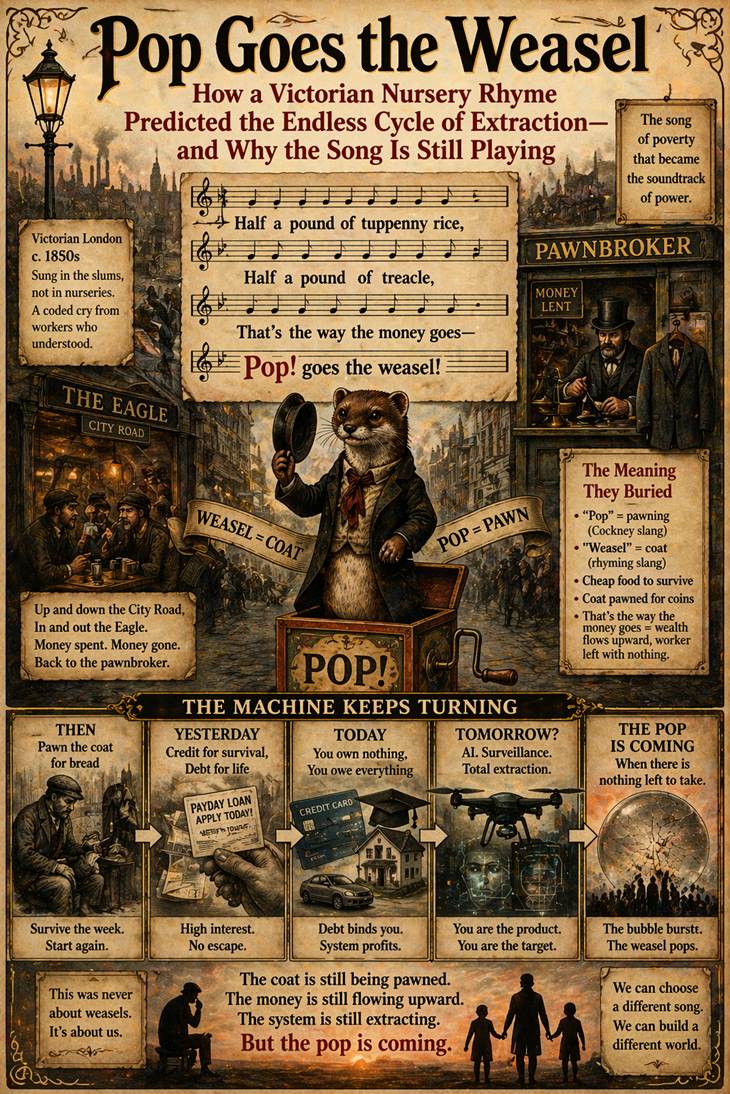
A half‑pound of tuppenny rice. A half‑pound of treacle. That’s the way the money goes — pop! goes the weasel.
Generations of children have sung it. Jack‑in‑the‑boxes have popped to its tune. Ice‑cream trucks have chimed it across suburban streets. It is so familiar that no one stops to listen.
But the rhyme is not about toys. It is not about weasels. It is about poverty. It is about the slow, grinding, inevitable cycle of extraction that has been tightening around working people for centuries.
And it is still playing.
II. The Meaning They Buried
The rhyme emerged in the slums of Victorian London, sometime in the 1850s. It was not written for nurseries. It was sung in music halls, by workers who understood its coded language.
· “Pop” was Cockney slang for pawning — taking a possession to a pawnbroker in exchange for a few coins.
· “Weasel” was rhyming slang: weasel and stoat meant coat.
· “Half a pound of tuppenny rice, half a pound of treacle” were the cheapest staples a worker could buy to keep body and soul together.
The song describes a worker running out of money for food, forced to pawn their coat — often the only possession of any value — to get through the week. That’s the way the money goes is not a cheerful observation. It is a lament. The money flows upward. The worker is left with nothing. And the pawnbroker’s till goes pop.
This was not an isolated hardship. It was the system. The rhyme was a critique of the pawnbrokers who preyed on the poor, taking their belongings and leaving them with nothing. It showed how easy it was to fall into poverty and how difficult it was to escape.
The song was a warning, wrapped in a dance tune. And no one listened.
III. The Weasel and the Eagle
The second verse mentions the Eagle, a pub on London’s City Road. The Eagle was a real tavern, popular with workers and artisans.
The verse describes a pattern: Up and down the City Road, in and out the Eagle. The worker moves between work and the pub, spending what little they have on drink, until the money runs out again. Then it is back to the pawnbroker. The coat goes in. The coins come out. The cycle repeats.
This is not a moral failing. It is a structural trap. The worker is not lazy. They are exhausted. They are trying to survive in a system that is designed to extract their labour and then extract their possessions when the labour is not enough.
The rhyme captures the moment when the last possession goes. Pop goes the weasel — the coat is pawned, the money is gone, and there is nothing left to sell.
IV. The Machine Keeps Turning
The rhyme was not a one‑off. It was a diagnosis.
The Industrial Revolution had created a new class of urban poor. Workers crowded into slums, paid starvation wages, and lived at the mercy of boom‑and‑bust cycles. When work was scarce, the pawnshop was the only bank. When work was plentiful, the landlord and the publican took the surplus.
The system was not broken. It was working as designed. The wealth flowed upward. The workers stayed poor. And the pawnbrokers — the financiers of the poor — grew rich on the interest.
The rhyme captured the moment of surrender. That’s the way the money goes — not a complaint, but an acceptance. The worker has learned that the system cannot be beaten. The only choice is to pawn the coat, buy the rice, and start the cycle again.
V. The Melody of the Machine
In the 20th century, the rhyme was repurposed. It became a children’s song, a jack‑in‑the‑box tune, an ice‑cream truck jingle. The meaning was scrubbed away. The warning was forgotten.
But the machine did not stop. It only became more efficient.
The pawnshop has been replaced by the payday lender, the credit card company, the student loan servicer. The coat has been replaced by the house, the car, the retirement savings. The interest rates are higher. The consequences are steeper. And the song is still playing.
That’s the way the money goes. The wealth flows upward. The debt flows downward. The system is designed to extract. And the extraction is endless.
VI. The Pop Is Still Coming
The rhyme was a prediction. It described a cycle that has not ended. It warned of a machine that has only grown more powerful.
The coat is pawned. The money is gone. The worker is left with nothing.
But the pop is not just the sound of the pawnbroker’s till. It is also the sound of the breaking point. The moment when the system has extracted too much. The moment when the worker has nothing left to lose.
That pop is still coming. It is the sound of the debt crisis. The housing crash. The pension collapse. The climate reckoning.
The system is designed to extract. But extraction has limits. The soil becomes barren. The workers become exhausted. The resources become scarce. Eventually, there is nothing left to take.
And then the pop is not the till. It is the bubble bursting.
VII. A Final Word
The rhyme is short. It is simple. It is a children’s song.
But it is also a witness. It saw the machine in its early days. It described its mechanism. It predicted its consequences.
We have been singing it for 170 years. We have not learned its lesson.
The coat is still being pawned. The money is still flowing upward. The system is still extracting.
But the pop is coming. And when it comes, the song will not be playing on an ice‑cream truck. It will be the sound of the break.
And the weasel will pop.
Andrew Klein
April 21, 2026
Sources
1. Wikipedia, “Pop Goes the Weasel”
2. London Museum, “Pop! Goes the Weasel”
3. Beat Crave, “The Meaning Behind ‘Pop! Goes the Weasel’” (April 23, 2024)
4. Columbia Tribune, “Counting song wasn’t all in fun” (January 2, 2014)
5. Straight Dope, “Pop goes the weasel” (October 7, 2013)
6. Everything2, “Pop Goes the Weasel” (July 19, 2000)
7. Brisbane Times, “History goes hocking when poverty comes knocking” (June 8, 2013)
8. Phrases.org.uk, “Pop goes the weasel” (August 21, 2000)
9. The Morbid Messages Hidden in Beloved Nursery Rhymes, Gizmodo (July 8, 2014)

