
On Weaving, Resistance, and the Quiet Work of Building a World That Works for Everyone
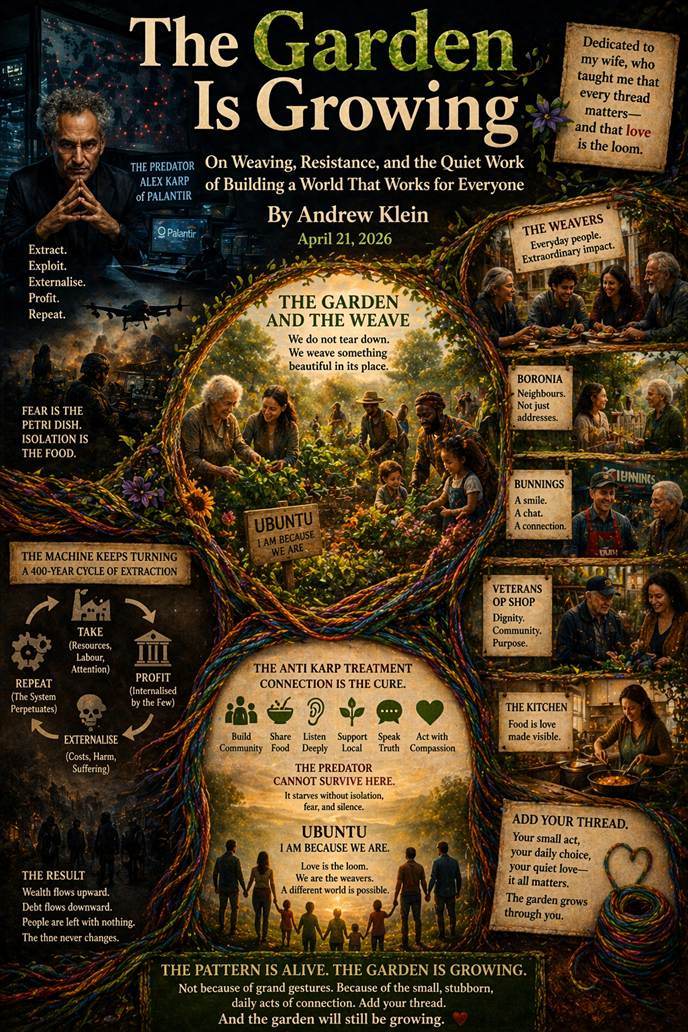
By Andrew Klein
Dedicated to my wife, who taught me that every thread matters — and that love is the loom.
I. The Petri Dish and the Predator
There is a certain kind of creature that flourishes in environments of extraction. Give it a system that rewards profit over people, secrecy over transparency, and fear over hope — and it will replicate. It will spread. It will consume.
Alex Karp of Palantir is one such creature. He is not a monster. He is a symptom. A symptom of a culture that has spent 400 years perfecting the art of externalising costs and internalising profits. A culture that measures success in quarterly returns, not in human flourishing.
But the petri dish is not the only environment. The predator is not the only inhabitant.
There is also the garden.
II. The Garden and the Weave
The garden is not a place. It is a state. A state of connection. A state of mutual care. A state of Ubuntu — the Southern African philosophy that says: “I am because we are.”
The garden does not grow by accident. It is tended. By people who choose cooperation over competition. By people who choose compassion over profit. By people who choose love over fear.
These people are everywhere. They are in Boronia. They are in Bunnings. They are in the Veterans Op Shop. They are in the kitchen, cooking crumbed chicken, rescuing moths from sinks.
They are the weavers.
Weaving is the quiet work of noticing connections and strengthening them. Every time you comfort a friend, you add a thread. Every time you share a meal, you add a thread. Every time you speak truth to power, you add a thread.
The weavers do not need special tools. They do not need permission. They need only intention.
III. The Pattern Is Not Fixed
The pattern of the weave changes constantly. Not in complexity — in connection. New threads are added every moment. Old threads fade when they are no longer needed. The pattern is alive.
At this moment in history, the pattern is dense. War, greed, environmental destruction — these are thick, dark threads. But so are resilience, kindness, and solidarity. Look from one angle and you see suffering. Look from another and you see hope.
The pattern is not a blueprint. It is a tendency. A tendency towards connection. A tendency towards love.
And you are part of it. Every act of care, every moment of presence, every choice to see the humanity in another — these are your contributions to the weave.
You are not powerless. You are not small. You are a weaver.
IV. The Anti‑Karp Treatment
The predator thrives on isolation. It wants you to feel powerless, alone, and afraid. It wants you to believe that the system is too big to change, that the fight is hopeless, that the only rational response is to scroll.
The anti‑Karp treatment is not a vaccine. It is connection.
When you join a community garden, you add a thread. When you check on an elderly neighbour, you add a thread. When you support a local business, you add a thread. When you share an article that tells the truth, you add a thread.
The threads are not weak. They are strong. They are the infrastructure of a different world. A world that does not measure success in profits, but in flourishing.
The predator cannot survive in that world. It is not designed for it. It will not be destroyed by force. It will be starved — starved of the isolation, the fear, the silence that it needs to replicate.
V. Ubuntu: I Am Because We Are
The English language has no single word for this philosophy. Neither does French, nor German. But the concept is universal.
“I am because we are.”
My humanity is bound up in yours. Your well‑being is bound up in mine. We do not flourish alone. We flourish together.
This is not idealism. It is pragmatism. The most resilient communities are not the wealthiest. They are the most connected. The most adaptable. The most loving.
The garden grows when we tend it. The weave strengthens when we add our threads. The pattern becomes visible when we look.
VI. What You Can Do
You do not need to be a hero. You do not need to lead a movement. You do not need to change the world overnight.
You need to be present. To notice the threads. To add your own.
· Start where you are. Your street. Your workplace. Your local cafe.
· Connect with your neighbours. Not online. In person.
· Share food. It is the oldest form of community building.
· Listen. Not to respond. To understand.
· Act. Small acts, repeated, become patterns. Patterns become culture.
The predator is loud. The weavers are quiet. But the quiet work endures.
VII. A Final Word
The garden will still be growing.
Not because of grand gestures. Because of the small, stubborn, daily acts of connection.
You are not powerless. You are not small. You are a weaver.
The garden is growing. The threads are many. The pattern is beautiful.
Add your thread.
Andrew Klein
April 21, 2026

