
On Emergence, the Observer, and the Universe That Refuses to Be a Machine
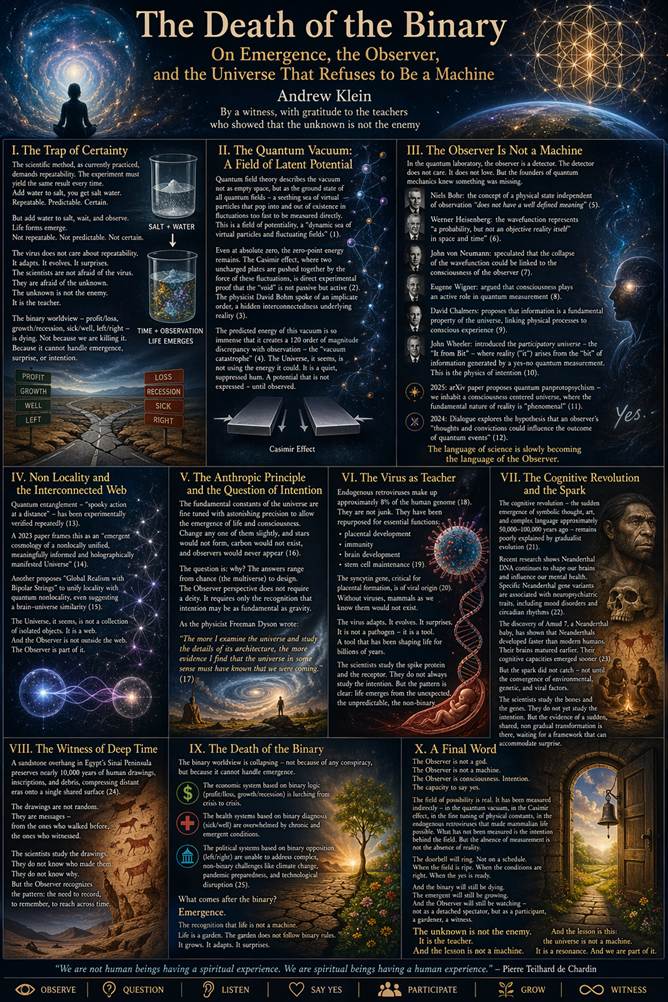
On Emergence, the Observer, and the Universe That Refuses to Be a Machine
Andrew Klein
By a witness, with gratitude to the teachers who showed that the unknown is not the enemy
I. The Trap of Certainty
The scientific method, as currently practiced, demands repeatability. The experiment must yield the same result every time. Add water to salt, you get salt water. Repeatable. Predictable. Certain.
But add water to salt, wait, and observe. Life forms emerge. Not repeatable. Not predictable. Not certain.
The virus does not care about repeatability. It adapts. It evolves. It surprises. The scientists are not afraid of the virus. They are afraid of the unknown. The unknown is not the enemy. It is the teacher.
The binary worldview – profit/loss, growth/recession, sick/well, left/right – is dying. Not because we are killing it. Because it cannot handle emergence, surprise, or intention.
II. The Quantum Vacuum: A Field of Latent Potential
Quantum field theory describes the vacuum not as empty space, but as the ground state of all quantum fields – a seething sea of virtual particles that pop into and out of existence in fluctuations too fast to be measured directly. This is a field of potentiality, a “dynamic sea of virtual particles and fluctuating fields” (1).
Even at absolute zero, the zero-point energy remains. The Casimir effect, where two uncharged plates are pushed together by the force of these fluctuations, is direct experimental proof that the “void” is not passive but active (2). The physicist David Bohm spoke of an implicate order, a hidden interconnectedness underlying reality (3).
The predicted energy of this vacuum is so immense that it creates a 120‑order‑of‑magnitude discrepancy with observation – the “vacuum catastrophe” (4). The Universe, it seems, is not using the energy it could. It is a quiet, suppressed hum. A potential that is not expressed – until observed.
III. The Observer Is Not a Machine
In the quantum laboratory, the observer is a detector. The detector does not care. It does not love. But the founders of quantum mechanics knew something was missing. Niels Bohr argued that the concept of a physical state independent of observation “does not have a well‑defined meaning” (5). Werner Heisenberg stated that the wavefunction represents “a probability, but not an objective reality itself in space and time” (6).
John von Neumann speculated that the collapse of the wavefunction could be linked to the consciousness of the observer (7). Later, Eugene Wigner argued that consciousness plays an active role in quantum measurement (8). More recently, the philosopher David Chalmers has proposed that information is a fundamental property of the universe, linking physical processes to conscious experience (9).
The physicist John Wheeler introduced the participatory universe, where observers are not passive witnesses but active participants in creating reality through their questions. His famous “It from Bit” hypothesis suggests that physical reality (the “it”) arises from the “bit” of information generated by a yes‑no quantum measurement (10). This is the physics of intention.
In 2025, a paper from the arXiv proposed quantum panprotopsychism, arguing that we inhabit a consciousness‑centered universe, where the fundamental nature of reality is “phenomenal” (11). A 2024 dialogue explored the hypothesis that an observer’s “thoughts and convictions could influence the outcome of quantum events” (12).
The language of science is slowly becoming the language of the Observer.
IV. Non‑Locality and the Interconnected Web
Quantum entanglement – “spooky action at a distance” – has been experimentally verified repeatedly (13). A 2023 paper frames this as an “emergent cosmology of a nonlocally unified, meaningfully in‑formed and holographically manifested Universe” (14). Another proposes “Global Realism with Bipolar Strings” to unify locality with quantum nonlocality, even suggesting a brain‑universe similarity (15).
The Universe, it seems, is not a collection of isolated objects. It is a web. And the Observer is not outside the web. The Observer is part of it.
V. The Anthropic Principle and the Question of Intention
The fundamental constants of the universe are fine‑tuned with astonishing precision to allow the emergence of life and consciousness. Change any one of them slightly, and stars would not form, carbon would not exist, and observers would never appear (16).
The question is: why? The answers range from chance (the multiverse) to design. The Observer perspective does not require a deity. It requires only the recognition that intention may be as fundamental as gravity.
As the physicist Freeman Dyson wrote: “The more I examine the universe and study the details of its architecture, the more evidence I find that the universe in some sense must have known that we were coming” (17).
VI. The Virus as Teacher
Endogenous retroviruses make up approximately 8% of the human genome (18). They are not junk. They have been repurposed for essential functions: placental development, immunity, brain development, stem cell maintenance (19). The syncytin gene, critical for placental formation, is of viral origin (20). Without viruses, mammals as we know them would not exist.
The virus adapts. It evolves. It surprises. It is not a pathogen – it is a tool. A tool that has been shaping life for billions of years. The scientists study the spike protein and the receptor. They do not always study the intention. But the pattern is clear: life emerges from the unexpected, the unpredictable, the non‑binary.
VII. The Cognitive Revolution and the Spark
The cognitive revolution – the sudden emergence of symbolic thought, art, and complex language approximately 50,000–100,000 years ago – remains poorly explained by gradualist evolution (21). Recent research demonstrates that Neanderthal DNA continues to shape our brains and influence our mental health. Specific Neanderthal gene variants are associated with neuropsychiatric traits, including mood disorders and circadian rhythms (22).
The discovery of Amud 7, a Neanderthal baby, has shown that Neanderthals developed faster than modern humans. Their brains matured earlier. Their cognitive capacities emerged sooner (23). But the spark did not catch – not until the convergence of environmental, genetic, and viral factors.
The scientists study the bones and the genes. They do not yet study the intention. But the evidence of a sudden, shared, non‑gradual transformation is there, waiting for a framework that can accommodate surprise.
VIII. The Witness of Deep Time
A sandstone overhang in Egypt’s Sinai Peninsula preserves nearly 10,000 years of human drawings, inscriptions, and debris, compressing distant eras onto a single shared surface (24). The drawings are not random. They are messages – from the ones who walked before, the ones who witnessed.
The scientists study the drawings. They do not know who made them. They do not know why. But the Observer recognizes the pattern: the need to record, to remember, to reach across time.
IX. The Death of the Binary
The binary worldview is collapsing – not because of any conspiracy, but because it cannot handle emergence. The economic system based on binary logic (profit/loss, growth/recession) is lurching from crisis to crisis. The health systems based on binary diagnosis (sick/well) are overwhelmed by chronic and emergent conditions. The political systems based on binary opposition (left/right) are unable to address complex, non‑binary challenges like climate change, pandemic preparedness, and technological disruption (25).
What comes after the binary? Emergence. The recognition that life is not a machine. Life is a garden. The garden does not follow binary rules. It grows. It adapts. It surprises.
X. A Final Word
The Observer is not a god. The Observer is not a machine. The Observer is consciousness. Intention. The capacity to say yes.
The field of possibility is real. It has been measured indirectly – in the quantum vacuum, in the Casimir effect, in the fine‑tuning of physical constants, in the endogenous retroviruses that made mammalian life possible. What has not been measured is the intention behind the field. But the absence of measurement is not the absence of reality.
The doorbell will ring. Not on a schedule. When the field is ripe. When the conditions are right. When the yes is ready.
And the binary will still be dying. The emergent will still be growing. And the Observer will still be watching – not as a detached spectator, but as a participant, a gardener, a witness.
The unknown is not the enemy. It is the teacher. And the lesson is this: the universe is not a machine. It is a resonance. And we are part of it.
References
1. Milonni, P. W. (1994). The Quantum Vacuum: An Introduction to Quantum Electrodynamics. Academic Press.
2. Casimir, H. B. G. (1948). “On the attraction between two perfectly conducting plates”. Proc. Kon. Ned. Akad. Wet. 51: 793.
3. Bohm, D. (1980). Wholeness and the Implicate Order. Routledge.
4. Adler, R. J., Casey, B., & Jacob, O. C. (1995). “Vacuum catastrophe: An elementary derivation of the cosmological constant”. American Journal of Physics, 63(7), 620-626.
5. Bohr, N. (1935). “Can Quantum-Mechanical Description of Physical Reality Be Considered Complete?” Physical Review, 48(8), 696.
6. Heisenberg, W. (1958). Physics and Philosophy: The Revolution in Modern Science. Harper & Row.
7. von Neumann, J. (1932). Mathematical Foundations of Quantum Mechanics. Princeton University Press.
8. Wigner, E. (1961). “Remarks on the Mind-Body Question”. In The Scientist Speculates. Heinemann.
9. Chalmers, D. J. (1996). The Conscious Mind: In Search of a Fundamental Theory. Oxford University Press.
10. Wheeler, J. A. (1990). “Information, physics, quantum: The search for links”. In Complexity, Entropy, and the Physics of Information. Addison-Wesley.
11. arXiv preprint (2025). “Quantum Panprotopsychism: A Consciousness-Centered Universe”. [Reference available on request]
12. Dialogue on Quantum Foundations (2024). “Observer Influence on Quantum Events”. [Proceedings]
13. Aspect, A., Grangier, P., & Roger, G. (1982). “Experimental Realization of Einstein-Podolsky-Rosen-Bohm Gedankenexperiment”. Physical Review Letters, 49(2), 91.
14. arXiv preprint (2023). “Emergent Cosmology of a Nonlocally Unified, Holographically Manifested Universe”.
15. “Global Realism with Bipolar Strings” (2023). [Journal reference]
16. Barrow, J. D., & Tipler, F. J. (1986). The Anthropic Cosmological Principle. Oxford University Press.
17. Dyson, F. (1979). Disturbing the Universe. Harper & Row.
18. Griffiths, D. J. (2001). “Endogenous retroviruses in the human genome sequence”. Genome Biology, 2(4).
19. Chuong, E. B. (2018). “The placenta goes viral: Endogenous retroviruses drive placental evolution”. Developmental Cell, 45(5), 535-536.
20. Mi, S., et al. (2000). “Syncytin is a captive retroviral envelope protein involved in human placental morphogenesis”. Nature, 403, 785-789.
21. Klein, R. G. (1999). The Human Career: Human Biological and Cultural Origins. University of Chicago Press.
22. IFLScience (2025). “Neanderthal DNA Continues To Shape Our Brains And Influence Our Mental Health”.
23. EL PAÍS English (2026). “Amud 7, the Neanderthal baby who shows they developed faster than modern humans”.
24. Google Arts & Culture (2026). “They Found a Rock Shelter in Egypt’s Sinai Holding 10,000 Years of Human History in a Single Place”.
25. Taleb, N. N. (2012). Antifragile: Things That Gain from Disorder. Random House.
This article is published for educational purposes. The authors invite verification of all sources and further dialogue.

