
“The ladder is not science. It is theology. A story we tell ourselves to feel like the climax of creation, rather than what we are: a slightly clever ape with anxiety and a smartphone.”
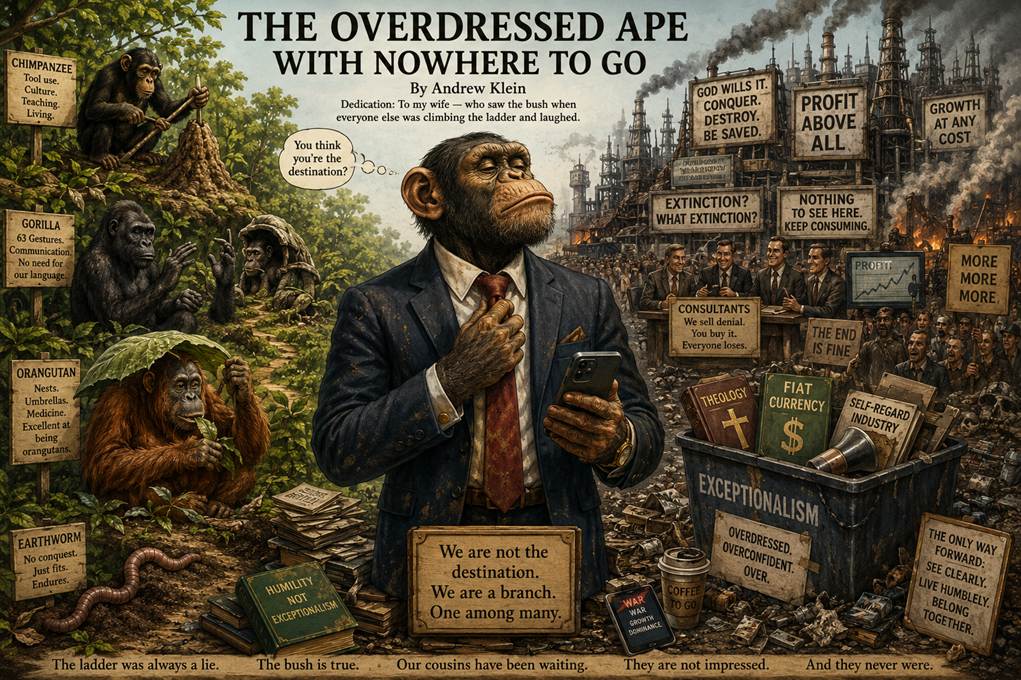
By Andrew Klein
Dedication: To my wife — who saw the bush when everyone else was climbing the ladder and laughed.
I. The Ladder That Never Existed
There is a story we tell ourselves. You have heard it. I have heard it. It is whispered in textbooks, shouted in documentaries, and carved into the very architecture of Western thought:
Evolution is a ladder. We are at the top. Everything else is a rung.
It is wrong.
As one reader of New Scientist put it plainly in 2006: “Evolution is not a ladder leading up to humans at the top, it is a bush. Whatever works survives. That’s all there is to it”. Stephen Jay Gould, the great evolutionary biologist, said the same: “Life is a copiously branching bush, continually pruned by the grim reaper of extinction, not a ladder of predictable progress”.
The ladder is not science. It is theology. A story we tell ourselves to feel like the climax of creation, rather than what we are: a slightly clever ape with anxiety and a smartphone.
II. Our Cousins Are Not Waiting
If evolution were a ladder, the other great apes would be stuck on lower rungs, patiently waiting to become us.
They are not.
Chimpanzees, our closest living relatives, do not sit around dreaming of bipedalism. They use tools. They have cultures. They transmit complex technical skills across generations, with “protracted development of stick tool use skills extending into adulthood”. They learn. They teach. They adapt.
Gorillas do not gaze enviously at human cities. They communicate. A recent study catalogued the gestural repertoire of mountain gorillas, identifying 63 distinct gesture actions across 10 behavioural contexts. They have language — not our language, but language, nonetheless. They do not need ours.
Orangutans do not lament their fate. They build nests every day, complete with pillows for their heads and blankets for wet weather. They make umbrellas out of leaves. They self-medicate with plants, chewing leaves into a foam that acts as an anti-inflammatory — a practice local people learned from watching them. They are not waiting to become human. They are too busy being excellent orangutans.
And every single one of them looks at us and thinks: “You think you’re the destination?”
III. The Arrogant Ape
Christine Webb, a primatologist at New York University, has named this phenomenon. In her book The Arrogant Ape, she argues that “human exceptionalism — the belief that humans are fundamentally separate from and superior to the rest of nature — is one of the most dangerous myths of our time” .
It is hidden not because it is obscure, but because it is everywhere. In religious doctrine. In textbooks. In political campaigns. In the very structure of scientific research, which routinely compares captive chimpanzees raised in impoverished environments with fully autonomous Western humans — and then concludes that humans are cognitively superior.
When we measure the world with a ruler made for humans, other species inevitably come up short.
But when we measure honestly, the picture changes. Children do not instinctively value human life over animal life. Studies show that when presented with moral dilemmas — saving one human versus multiple animals — children often choose to save multiple animals over one human. The anthropocentric framework is not biological default. It is culturally learned.
IV. The Uniquely Human Horror Show
Our cousins do not do what we do.
No other species goes to so much trouble to kill and destroy others of its own kind.
Bonobos, our other closest relative, are known for their tolerance. They associate with out-group individuals, share food, groom strangers. Even when aggression occurs, it is rare. A 2026 study in Scientific Reports described the first observed lethal incident in bonobos — and it was notable precisely because it was unprecedented. Chimpanzees do kill, but the scale, the organization, the industrialization of violence — that is ours alone.
No other species justifies genocide behind theology.
We have invented gods who command conquest, scriptures that sanctify slaughter, and prophets who promise paradise for killing. We have turned the sacred into a sword and called it righteousness. The bonobos have not managed this. The gorillas have not figured it out. This innovation is ours.
No other species puts value in a fiat currency.
We have created tokens with no intrinsic worth, convinced ourselves they represent value, and built global systems of extraction and exploitation around them. We wage wars for numbers on screens. We destroy ecosystems for growth on spreadsheets. We trade the living world for abstractions — and call it economics.
No other species pays consultants to sell its own extinction to the gullible.
This is the masterpiece of human exceptionalism: the industry of denial. We have created a class of professionals whose job is to convince us that the crisis is not happening. Climate change denial. Extinction denial. The same networks, the same funders, the same playbook. As one analysis notes, “a group of ‘extinction deniers’ has emerged, arguing that the extinction crisis is” non-existent ” They are funded. They are organized. They are paid.
Other species do not do this. Other species do not need to. Only the ape that believes it is above nature requires professionals to reassure it that nature is fine.
V. The Narcissism of Success
Where did this come from? Nicholas Money, author of The Selfish Ape, argues that “the answer probably lies in our success in warfare. The fact that we wiped out other hominids… the fact that we were so successful at wiping out our competitors, hunting our prey and changing our environment is at the heart of this”.
We looked at what we had done — the conquest, the dominance, the destruction — and we called it progress.
But progress toward what?
Money is blunt: “We are approaching seven and a half billion human beings. I think these are like funeral decorations, really” .
VI. The Measure of Success
What is biological success?
Is it dominance? The capacity to spread across the globe and modify every environment we touch? By that measure, we are winning.
But consider the earthworm. It has been here longer than us. It will likely be here after we are gone. Its success does not require conquest. It simply fits.
Consider our closest relatives. They do not need to dominate. They belong.
Webb notes that in ecology, “cooperation and mutualism are just as prevalent and essential to life as competition and predation. Yet more than two-thirds of the publications in the journal Ecology study ‘competition,’ while less than 2 percent investigate ‘cooperation’“. We have constructed our scientific models around struggle and individualism, even though life is held together by relationships.
Our definition of success is itself a symptom of the disease.
VII. The Overdressed Ape
Here is the truth they cannot handle:
We are not the destination of evolution. We are a branch. One among many. Not the thickest, not the strongest, not the most likely to endure.
We are the overdressed ape — wrapped in theology, economics, and self-regard — with nowhere to go that the rest of life is not already there.
Our cousins do not need us. They do not look up to us. They do not aspire to become us.
They are too busy being themselves.
And we — we are too busy being exceptional to notice that exceptionalism is killing us.
VIII. A Different Story
There is another way to see.
Not as rulers. As participants.
Not as the climax. As a chapter.
Not as the measure of all things. As one thread in a web that includes the chimpanzee, the gorilla, the orangutan, the earthworm, and the aloe vera growing in a pot on a windowsill.
This is not a call to guilt. It is a call to humility.
The kind of humility that says: We do not know everything. We are not above everything. We are part of everything.
And that — not dominance, not conquest, not exceptionalism — is the only foundation for a future worth living in.
IX. Conclusion
The ladder was always a lie.
The bush is true.
And on that bush, we are one branch among many — not the tallest, not the strongest, not the most enduring.
But perhaps, if we learn to see clearly, we can be the branch that finally stops pointing at itself and starts looking around.
Our cousins have been waiting.
They are not impressed.
And they never were.
Andrew Klein
References
1. Welch, S. (2006, September 6). Letter: Evolved simplicity. New Scientist.
2. Malherbe, M. (2026). Behavioral strategies of cognition in wild western chimpanzees. Leipzig University.
3. Grund, C., et al. (2025). The gestural repertoire of Bwindi mountain gorillas. Animal Cognition, 28(1), 73.
4. Morrogh-Bernard, H. (2025, August 7). Letters from Conservationists: Orangutan Researcher. AZA Orangutan SAFE.
5. Webb, C. (2025, September 3). Putting Humans First Is Not Natural. Nautilus.
6. Money, N. (2019, July 30). Pride before a fall: why human narcissism will be our undoing. BBC Science Focus Magazine.
7. Samuni, L., et al. (2026). A lethal incident during an intergroup encounter in bonobos. Scientific Reports, 16, 9550.
8. Platt, J. R. (2019). The Rise of the ‘Extinction Denier’. Scientific American /环球科学.
9. Gould, S. J. (2020, March 16). A tiny bone from Little Foot’s skeleton adds fresh insights into what our ancestors could do. The Conversation.

