
“The researchers have not determined the structure’s purpose. A harbor? A toll station? An elite residence? A ritual site? The uncertainty is itself revealing. The structure defies easy categorization because it does not fit the standard typologies of Iron Age archaeology — hillforts, burial mounds, or domestic settlements.
But the structure’s position — on the riverbank, built with massive timbers and stone, requiring resources and authority — suggests something the archaeologists are only beginning to articulate ; control of movement.“
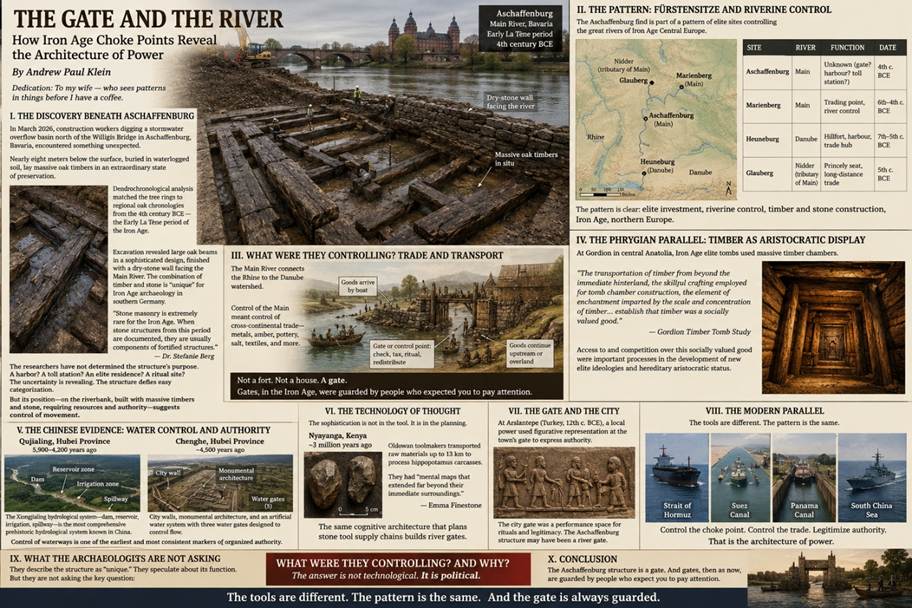
By Andrew Paul Klein
Dedication: To my wife — who sees patterns in things before I have a coffee.
I. The Discovery Beneath Aschaffenburg
In March 2026, construction workers digging a stormwater overflow basin north of the Willigis Bridge in Aschaffenburg, Bavaria, encountered something unexpected. Nearly eight meters below the surface, buried in waterlogged soil, lay massive oak timbers in an extraordinary state of preservation.
The wood was so well preserved that archaeologists initially assumed it was modern. But dendrochronological analysis at the Bavarian State Office for Monument Protection’s laboratory in Thierhaupten told a different story. The tree-ring patterns matched regional oak chronologies from the 4th century BCE — the Early La Tène period of the Iron Age.
This was not a simple wooden structure. Excavation profiles revealed large oak beams arranged in a sophisticated design, finished with a dry-stone wall facing the Main River. The combination of timber and stone is, in Dr. Stefanie Berg’s words, “unique” for Iron Age archaeology in southern Germany.
“Stone masonry is extremely rare for the Iron Age,” Berg explained. “When stone structures from this period are documented, they are usually components of fortified structures, such as post-and-beam walls”.
The researchers have not determined the structure’s purpose. A harbor? A toll station? An elite residence? A ritual site? The uncertainty is itself revealing. The structure defies easy categorization because it does not fit the standard typologies of Iron Age archaeology — hillforts, burial mounds, or domestic settlements.
But the structure’s position — on the riverbank, built with massive timbers and stone, requiring resources and authority — suggests something the archaeologists are only beginning to articulate ; control of movement.
II. The Pattern: Fürstensitze and Riverine Control
The Aschaffenburg find is not an anomaly. It is a missing piece of a puzzle that includes some of the most important Iron Age sites in Central Europe.
The Heuneburg in Baden-Württemberg, one of the most significant early Celtic centres north of the Alps, sits strategically above the Danube. Its fortifications, craft production, and Mediterranean imports mark it as a centre of power and trade. But crucially, the Heuneburg had a monumental eastern gate giving access to a steep road leading directly to the Danube — and, archaeologists suspect, a harbour.
The Marienberg in Würzburg, situated dramatically above the Main River in northern Bavaria, presents an even more direct parallel to Aschaffenburg. Excavations have recovered Greek pottery fragments, and hinterland investigations suggest the site’s function was “connected to its roles as a trading point, controlling and using the important route along the river Main”.
The Glauberg, north of Aschaffenburg in Hesse, represents the northernmost Fürstensitz (princely seat) of the Early La Tène period. Its fortified hilltop, elaborate burials, and evidence of long-distance contacts (including Mediterranean coral and red dye from cochineal scale) mark it as a centre of elite power.
These sites share a pattern:
Site River Function Date
Aschaffenburg Main Unknown (gate? harbour? toll station?) 4th c. BCE
Marienberg Main Trading point, river control 6th-4th c. BCE
Heuneburg Danube Hillfort, harbour, trade hub 7th-5th c. BCE
Glauberg Nidder (Main tributary) Princely seat, long-distance trade 5th c. BCE
The pattern is clear: elite investment, riverine control, timber and stone construction, Iron Age, northern Europe.
III. What Were They Controlling? Trade and Transport
The mainstream archaeological explanation for the movement of stone tools and other goods in prehistory has long emphasized “complex social relationships” and gift exchange. But the Aschaffenburg structure, like the Fürstensitze, suggests something more organized.
The Main River connects the Rhine to the Danube watershed. Control of the Main meant control of cross-continental trade — the movement of metals, amber, Mediterranean pottery, and other valued goods across the heart of Europe.
The Aschaffenburg structure, positioned on the riverbank, may have been a choke point: a place where goods were checked, taxed, redistributed, or ritually validated before continuing their journey. Not a fort. Not a house. A gate.
And gates, in the Iron Age, were guarded by people who expected you to pay attention.
IV. The Phrygian Parallel: Timber as Aristocratic Display
The pattern of controlling movement through monumental architecture is not limited to Celtic Europe.
At Gordion in central Anatolia, the Iron Age tumuli (burial mounds) of the Phrygian period reveal a close relationship between timber construction and elite self-definition. A recent study of wooden tomb chambers at Gordion found that “the transportation of timber from beyond the immediate hinterland, the skillful crafting employed for tomb chamber construction, the element of enchantment imparted by the scale and concentration of timber as used in a chamber… establish that timber was a socially valued good”.
The study concludes that “access to and competition over this socially valued good were important processes in the development of new elite ideologies, which included attempts at the establishment of hereditary aristocratic status”.
At Aschaffenburg, the oak timbers were not merely functional. They were display. The stone facing the river was not necessary for structural integrity — it was a statement. This is permanent. This matters. The people who built this had resources and authority.
V. The Chinese Evidence: Water Control and Central Authority
The pattern extends beyond Europe and Anatolia.
At the Qujialing site in Hubei province, China, archaeologists have uncovered evidence of large-scale prehistoric water control dating back 5,900 to 4,200 years. The Xiongjialing hydrological system — comprising a dam, reservoir zone, irrigation zone, and spillway — is the “most comprehensive prehistoric hydrological system known to date in China”.
The Qujialing discoveries demonstrate that sophisticated water management, requiring centralized planning and coordinated labor, emerged in the Yangtze River valley at roughly the same time as the Iron Age structures were appearing in Europe. At the Chenghe site in the same region, archaeologists have identified city walls, monumental architecture, and an artificial water system with three water gates designed to control flow.
The Chinese evidence does not directly parallel the Iron Age choke points of the Main River. But it confirms a broader pattern: control of waterways and water systems is one of the earliest and most consistent markers of organized authority. The ability to say who could pass, who could trade, who could use the water — this is not a later development. It is a foundational technology of power.
VI. The Technology of Thought: Stone Tools Do Not Imply Less Sophisticated Thinking
A persistent bias in archaeology — and in popular understanding — is the assumption that stone tools imply less sophisticated thinking. This bias is incorrect.
The 3-million-year-old Oldowan tools discovered at Nyayanga in Kenya were not simply hammerstones. They were part of a planned supply system: raw materials were transported from sources up to 13 kilometres away to locations where hominins were processing hippopotamus carcasses.
As archaeologist Emma Finestone observed, this behaviour “had previously been associated with much later periods in human evolution.” The toolmakers had “mental maps that extended far beyond their immediate surroundings”.
The sophistication is not in the tool. It is in the planning. The ability to visualize a resource located elsewhere, to coordinate its acquisition, to transport it over distance, and to deploy it at a strategic location — that is not primitive. That is the same cognitive architecture that builds toll stations on rivers and gates at the entrance to cities.
The Iron Age elites of the Main River did what the hominins of Lake Victoria did: they controlled access to resources. The stone was different. The river was different. The cognitive pattern is identical.
VII. The Gate and the City: Monumental Architecture as Political Statement
The association of monumental fortifications, city gates, and the rise of local elites is documented across the ancient world.
At Arslantepe in southeastern Turkey, recent investigations of the Early Iron Age (12th century BCE) yielded evidence of a local power that “used figurative representation at the town’s gate to express its authority.” The city gate was not merely a defensive structure. It was a performance space where rituals involving the entire community were conducted, and where the ruling class legitimated its role.
The Aschaffenburg structure on the Main River may have served a similar function — not as a city gate, but as a river gate. A place where goods were checked, where transactions were witnessed, where authority was displayed. The combination of timber and stone is significant because stone is expensive. It says: This is permanent. This matters.
VIII. The Modern Parallel: Choke Points and the Political Class
The Iron Age choke points of the Main River find their modern descendants in the Strait of Hormuz, the Suez Canal, the Panama Canal, and the South China Sea. Control of movement has always been the foundation of power.
The difference is not one of sophistication. It is one of scale and technology.
The Iron Age elites of the Main River used oak timbers and dry-stone walls. Modern elites use aircraft carriers, sanctions, and tariffs. The tools are more sophisticated. The cognitive pattern — control the choke point, control the trade, legitimize the authority — is identical.
Observers of modern politics who claim that today’s political class demonstrates greater sophistication confuse access to sophisticated tools with sophistication of thought. The ability to launch a drone strike does not make a politician wiser than an Iron Age chieftain. It makes them better equipped. The strategic calculus — identify the choke point, assert control, extract tribute — is the same.
The question is not whether modern elites are more sophisticated. The question is whether they have learned anything at all.
IX. What the Archaeologists Are Not Asking
The Aschaffenburg discovery has generated excitement. But the interpretive framework remains limited.
The archaeologists describe the structure as “unique.” They note its “outstanding state of preservation” and “unique timber-and-stone construction.” They speculate about its possible function: “trade, transport, defence, or elite activity” .
But they are not asking the question that the pattern of Fürstensitze, the Phrygian timber tombs, the Chinese water systems, and the Arslantepe gate all point toward:
What were they controlling? And why?
The answer is not technological. It is political.
The Iron Age elites of the Main River were not building harbors because they liked boating. They were asserting authority over movement because authority over movement is authority over everything. Trade, communication, the flow of goods and people — these are the arteries of power.
The Aschaffenburg structure is not an isolated oddity. It is a gate. And gates, then as now, are guarded by people who expect you to pay attention.
X. Conclusion
The archaeologists are measuring rings in oak trees. They are counting years, not joules. They are finding meaning in wood and stone — things you can see, touch, and wonder about.
That is a story. And stories, as you and I know, are the only things that last.
The structure beneath Aschaffenburg tells a story about power. About the control of movement. About the people who built a gate on a river and expected the world to pay attention.
The same story is being told today — in the Strait of Hormuz, in the boardrooms of companies that control supply chains, in the offices of politicians who decide who may pass and who may not.
The tools are different. The pattern is the same.
And the gate is always guarded.
Andrew Paul Klein
References
1. BLfD. (2026). Iron Age structure discovered beneath Aschaffenburg. Bavarian State Office for Monument Preservation.
2. Posluschny, A. G. (2017). Early Iron Age Fürstensitze – some thoughts on a not-so-uniform phenomenon. In The role of princely sites in the Early Iron Age. Propylaeum.
3. Briggs, C. S. (2009). Introduction: Long-distance transport of stone axes in prehistoric Europe. Internet Archaeology, Issue 26.
4. China Daily. (2024, March 22). Qujialing site: Testament to prehistoric civilization development in Hubei.
5. Cordivari, B. W. (2026). Carpentry, Social Value, and an Aristocratic Mode of Production: Crafting Wooden Tomb Chambers at Phrygian Gordion. Journal of Mediterranean Archaeology.
6. HeritageDaily. (2026, May 19). 2,400-year-old Iron Age structure found beneath German construction site.
7. Wikipedia. (2024). Heuneburg.
8. GreekReporter. (2025, August 19). 3 Million-Year-Old Stone Tools Found in Kenya Reveal World’s First Supply Chain.
9. Manuelli, F., & Mori, L. (2016). “The king at the gate”: Monumental fortifications and the rise of local elites at Arslantepe at the end of the 2nd Millennium. Origini, XXXIX.
10. Ministry of Water Resources, China. (2023, December 9). Discovery helps solve ancient water mystery.
 The Patrician's Watch