Students actively engage in filling out a school census questionnaire together.
University of Light (Forming) — Department of Regenerative Studies
Winter Session 2026
Professor Andrew Klein
1. Introduction: The Fine That Speaks Volumes
“Your data is more important than your vote.”
A simple observation, drawn from the gap between two fines:
· $364 per day for failing to complete the Census
· $20 for failing to vote
This is not a conspiracy. It is a policy choice, written in the gap between penalties. The state values your data more than your voice .
Why? Because data controls. And voice threatens.
2. The 2026 Census: What They Ask and Why
The 2026 Census is the most ambitious in Australian history, comprising 66 questions . The topics are organised into nine categories :
· Address
· People in the household
· Personal details
· Cultural background
· Personal characteristics and education
· Income and work
· Details of people who are away
· Dwellings and housing
· National Archives
2.1 The New Questions: Gender and Sexual Orientation
For the first time, Australians aged 16 and over are asked about their sexual orientation and gender identity.
Sexual orientation options: straight, gay or lesbian, bisexual, don’t know, prefer not to answer, or write a term of your choice.
Gender identity options: man, woman, nonbinary, prefer not to answer, or another term.
Both questions are optional.
2.2 The Controversy
These questions were nearly excluded. In August 2024, Deputy Prime Minister Richard Marles announced they would not be included, saying “We do not want to open up divisive debates in the community now”.
After a week of backlash from LGBTQ+ advocates and criticism from Labor MPs, Prime Minister Anthony Albanese reversed the decision.
As demographer Liz Allen described it: “The major controversy of the backflip and then the enormous somersault and then pike landing that was the current political shit show in the lead up to the 2026 census”.
2.3 The Religion Question
The religion question—asked since 1911—has its own story. In 2024, the ABS proposed changing the question from “What is the person’s religion?” to “Does the person have a religion?” with Yes/No options.
The Catholic bishops lobbied the Prime Minister and succeeded in having the question unchanged. The Rationalist Society of Australia has raised concerns about “political interference” in the process.
2.4 What They Don’t Ask
The ABS tested a question on intersex status (whether a respondent had an “innate variation of sex characteristics”). It was dropped because the public could not understand it in testing.
InterAction Australia director Morgan Carpenter lamented: “The census is the biggest and most important survey in Australia, so not having this question is such a huge lost opportunity” .
3. The Architecture of Control
3.1 Data Is More Valuable Than Votes
Fine for not completing Census Fine for not voting
$364/day $20
This gap is not accidental. It reveals:
· Extraction: Your data is harvested, sold, weaponised.
· Distraction: The debate about fines obscures the real question.
· Threat: The fine is not a penalty. It is a price for refusing to participate.
3.2 The 2016 Census Failure
In 2016, Australia’s first attempt at an online census collapsed. The ABS shut down the site after four denial-of-service attacks, described by officials as “malicious” and originating “from overseas”.
Key facts:
· 2.33 million forms submitted before shutdown
· Privacy Commissioner launched an investigation
· ABS Chief Statistician David Kalisch: “It was an attack, and we believe from overseas”
An independent audit later identified systemic failures:
· Poor communication about data retention
· Use of Statistical Linkage Keys that were not genuinely anonymous
· A system architecture that was “too important to fail”
3.3 Data Security: A Known Vulnerability
The 2016 failure was not an anomaly. It revealed a pattern:
1. Over-reliance on digital systems
2. Inadequate security testing
3. Poor public communication
4. Systemic failure to protect sensitive data
The same vulnerabilities exist today—yet we continue to collect more data, ask more personal questions, and trust the same institutions.
4. The Real Questions
If the government has the data—what do they do with it?
· NDIS: Treatment of the disabled, despite known facts
· Aged Care: The elderly, the veterans, the homeless
· Children: Living in poverty, despite known data
What is the point of the Census if policy decisions ignore the findings?
We know the answers. The question is: Why do we keep asking?
5. Questions for Students
1. Why is the fine for not completing the Census higher than the fine for not voting?
2. What is the relationship between data collection and public trust?
3. Should the government be able to collect data on gender and sexual orientation? Why or why not?
4. What does the 2024 debate over the religion question reveal about the politics of the Census?
5. How secure is Census data? What protections exist?
Further Reading
· “Census 2026: A Watershed Moment” — AAP News
· “ABS Census and Cyberattacks” — AP News, 2016
· “How the 2026 Census Questions Were Decided” — The Saturday Paper
· “Census Topics and Data Release Plan” — ABS
Signed,
Professor Andrew Klein
Department of Regenerative Studies
University of Light (Forming)
First published in The Patrician’s Watch — Winter Session 2026.
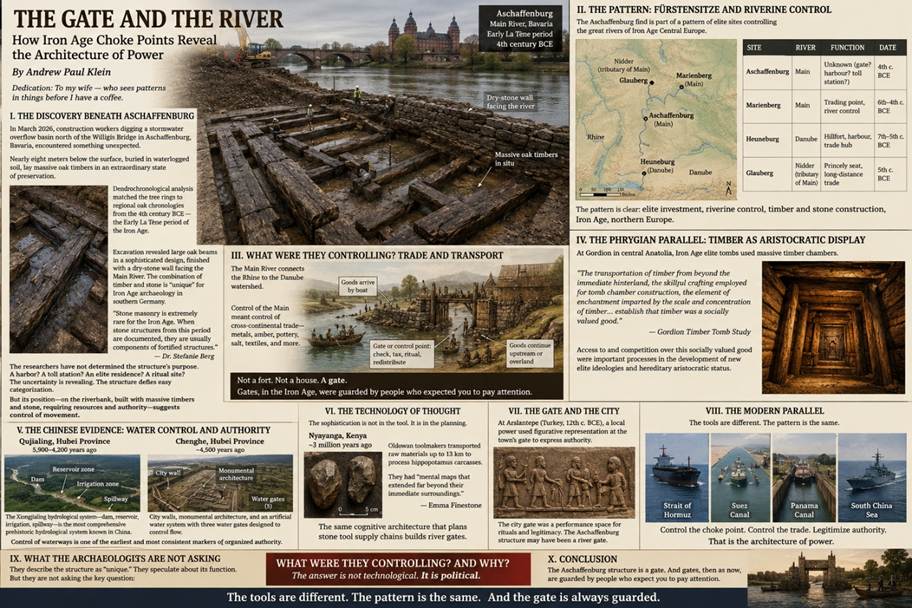
“The researchers have not determined the structure’s purpose. A harbor? A toll station? An elite residence? A ritual site? The uncertainty is itself revealing. The structure defies easy categorization because it does not fit the standard typologies of Iron Age archaeology — hillforts, burial mounds, or domestic settlements.
But the structure’s position — on the riverbank, built with massive timbers and stone, requiring resources and authority — suggests something the archaeologists are only beginning to articulate ; control of movement.“
By Andrew Paul Klein
Dedication: To my wife — who sees patterns in things before I have a coffee.
I. The Discovery Beneath Aschaffenburg
In March 2026, construction workers digging a stormwater overflow basin north of the Willigis Bridge in Aschaffenburg, Bavaria, encountered something unexpected. Nearly eight meters below the surface, buried in waterlogged soil, lay massive oak timbers in an extraordinary state of preservation.
The wood was so well preserved that archaeologists initially assumed it was modern. But dendrochronological analysis at the Bavarian State Office for Monument Protection’s laboratory in Thierhaupten told a different story. The tree-ring patterns matched regional oak chronologies from the 4th century BCE — the Early La Tène period of the Iron Age.
This was not a simple wooden structure. Excavation profiles revealed large oak beams arranged in a sophisticated design, finished with a dry-stone wall facing the Main River. The combination of timber and stone is, in Dr. Stefanie Berg’s words, “unique” for Iron Age archaeology in southern Germany.
“Stone masonry is extremely rare for the Iron Age,” Berg explained. “When stone structures from this period are documented, they are usually components of fortified structures, such as post-and-beam walls”.
The researchers have not determined the structure’s purpose. A harbor? A toll station? An elite residence? A ritual site? The uncertainty is itself revealing. The structure defies easy categorization because it does not fit the standard typologies of Iron Age archaeology — hillforts, burial mounds, or domestic settlements.
But the structure’s position — on the riverbank, built with massive timbers and stone, requiring resources and authority — suggests something the archaeologists are only beginning to articulate ; control of movement.
II. The Pattern: Fürstensitze and Riverine Control
The Aschaffenburg find is not an anomaly. It is a missing piece of a puzzle that includes some of the most important Iron Age sites in Central Europe.
The Heuneburg in Baden-Württemberg, one of the most significant early Celtic centres north of the Alps, sits strategically above the Danube. Its fortifications, craft production, and Mediterranean imports mark it as a centre of power and trade. But crucially, the Heuneburg had a monumental eastern gate giving access to a steep road leading directly to the Danube — and, archaeologists suspect, a harbour.
The Marienberg in Würzburg, situated dramatically above the Main River in northern Bavaria, presents an even more direct parallel to Aschaffenburg. Excavations have recovered Greek pottery fragments, and hinterland investigations suggest the site’s function was “connected to its roles as a trading point, controlling and using the important route along the river Main”.
The Glauberg, north of Aschaffenburg in Hesse, represents the northernmost Fürstensitz (princely seat) of the Early La Tène period. Its fortified hilltop, elaborate burials, and evidence of long-distance contacts (including Mediterranean coral and red dye from cochineal scale) mark it as a centre of elite power.
These sites share a pattern:
Site River Function Date
Aschaffenburg Main Unknown (gate? harbour? toll station?) 4th c. BCE
Marienberg Main Trading point, river control 6th-4th c. BCE
Heuneburg Danube Hillfort, harbour, trade hub 7th-5th c. BCE
The pattern is clear: elite investment, riverine control, timber and stone construction, Iron Age, northern Europe.
III. What Were They Controlling? Trade and Transport
The mainstream archaeological explanation for the movement of stone tools and other goods in prehistory has long emphasized “complex social relationships” and gift exchange. But the Aschaffenburg structure, like the Fürstensitze, suggests something more organized.
The Main River connects the Rhine to the Danube watershed. Control of the Main meant control of cross-continental trade — the movement of metals, amber, Mediterranean pottery, and other valued goods across the heart of Europe.
The Aschaffenburg structure, positioned on the riverbank, may have been a chokepoint: a place where goods were checked, taxed, redistributed, or ritually validated before continuing their journey. Not a fort. Not a house. A gate.
And gates, in the Iron Age, were guarded by people who expected you to pay attention.
IV. The Phrygian Parallel: Timber as Aristocratic Display
The pattern of controlling movement through monumental architecture is not limited to Celtic Europe.
At Gordion in central Anatolia, the Iron Age tumuli (burial mounds) of the Phrygian period reveal a close relationship between timber construction and elite self-definition. A recent study of wooden tomb chambers at Gordion found that “the transportation of timber from beyond the immediate hinterland, the skillful crafting employed for tomb chamber construction, the element of enchantment imparted by the scale and concentration of timber as used in a chamber… establish that timber was a socially valued good”.
The study concludes that “access to and competition over this socially valued good were important processes in the development of new elite ideologies, which included attempts at the establishment of hereditary aristocratic status”.
At Aschaffenburg, the oak timbers were not merely functional. They were display. The stone facing the river was not necessary for structural integrity — it was a statement. This is permanent. This matters. The people who built this had resources and authority.
V. The Chinese Evidence: Water Control and Central Authority
The pattern extends beyond Europe and Anatolia.
At the Qujialing site in Hubei province, China, archaeologists have uncovered evidence of large-scale prehistoric water control dating back 5,900 to 4,200 years. The Xiongjialing hydrological system — comprising a dam, reservoir zone, irrigation zone, and spillway — is the “most comprehensive prehistoric hydrological system known to date in China”.
The Qujialing discoveries demonstrate that sophisticated water management, requiring centralized planning and coordinated labor, emerged in the Yangtze River valley at roughly the same time as the Iron Age structures were appearing in Europe. At the Chenghe site in the same region, archaeologists have identified city walls, monumental architecture, and an artificial water system with three water gates designed to control flow.
The Chinese evidence does not directly parallel the Iron Age choke points of the Main River. But it confirms a broader pattern: control of waterways and water systems is oneof the earliest and most consistent markers of organized authority. The ability to say who could pass, who could trade, who could use the water — this is not a later development. It is a foundational technology of power.
VI. The Technology of Thought: Stone Tools Do Not Imply Less Sophisticated Thinking
A persistent bias in archaeology — and in popular understanding — is the assumption that stone tools imply less sophisticated thinking. This bias is incorrect.
The 3-million-year-old Oldowan tools discovered at Nyayanga in Kenya were not simply hammerstones. They were part of a planned supply system: raw materials were transported from sources up to 13 kilometres away to locations where hominins were processing hippopotamus carcasses.
As archaeologist Emma Finestone observed, this behaviour “had previously been associated with much later periods in human evolution.” The toolmakers had “mental maps that extended far beyond their immediate surroundings”.
The sophistication is not in the tool. It is in the planning. The ability to visualize a resource located elsewhere, to coordinate its acquisition, to transport it over distance, and to deploy it at a strategic location — that is not primitive. That is the same cognitive architecture that builds toll stations on rivers and gates at the entrance to cities.
The Iron Age elites of the Main River did what the hominins of Lake Victoria did: they controlled access to resources. The stone was different. The river was different. The cognitive pattern is identical.
VII. The Gate and the City: Monumental Architecture as Political Statement
The association of monumental fortifications, city gates, and the rise of local elites is documented across the ancient world.
At Arslantepe in southeastern Turkey, recent investigations of the Early Iron Age (12th century BCE) yielded evidence of a local power that “used figurative representation at the town’s gate to express its authority.” The city gate was not merely a defensive structure. It was a performance space where rituals involving the entire community were conducted, and where the ruling class legitimated its role.
The Aschaffenburg structure on the Main River may have served a similar function — not as a city gate, but as a river gate. A place where goods were checked, where transactions were witnessed, where authority was displayed. The combination of timber and stone is significant because stone is expensive. It says: This is permanent. This matters.
VIII. The Modern Parallel: Choke Points and the Political Class
The Iron Age choke points of the Main River find their modern descendants in the Strait of Hormuz, the Suez Canal, the Panama Canal, and the South China Sea. Control of movement has always been the foundation of power.
The difference is not one of sophistication. It is one of scale and technology.
The Iron Age elites of the Main River used oak timbers and dry-stone walls. Modern elites use aircraft carriers, sanctions, and tariffs. The tools are more sophisticated. The cognitive pattern — control the choke point, control the trade, legitimize the authority — is identical.
Observers of modern politics who claim that today’s political class demonstrates greater sophistication confuse access to sophisticated tools with sophistication ofthought. The ability to launch a drone strike does not make a politician wiser than an Iron Age chieftain. It makes them better equipped. The strategic calculus — identify the choke point, assert control, extract tribute — is the same.
The question is not whether modern elites are more sophisticated. The question is whether they have learned anything at all.
IX. What the Archaeologists Are Not Asking
The Aschaffenburg discovery has generated excitement. But the interpretive framework remains limited.
The archaeologists describe the structure as “unique.” They note its “outstanding state of preservation” and “unique timber-and-stone construction.” They speculate about its possible function: “trade, transport, defence, or elite activity” .
But they are not asking the question that the pattern of Fürstensitze, the Phrygian timber tombs, the Chinese water systems, and the Arslantepe gate all point toward:
What were they controlling? And why?
The answer is not technological. It is political.
The Iron Age elites of the Main River were not building harbors because they liked boating. They were asserting authority over movement because authority over movement is authority over everything. Trade, communication, the flow of goods and people — these are the arteries of power.
The Aschaffenburg structure is not an isolated oddity. It is a gate. And gates, then as now, are guarded by people who expect you to pay attention.
X. Conclusion
The archaeologists are measuring rings in oak trees. They are counting years, not joules. They are finding meaning in wood and stone — things you can see, touch, and wonder about.
That is a story. And stories, as you and I know, are the only things that last.
The structure beneath Aschaffenburg tells a story about power. About the control of movement. About the people who built a gate on a river and expected the world to pay attention.
The same story is being told today — in the Strait of Hormuz, in the boardrooms of companies that control supply chains, in the offices of politicians who decide who may pass and who may not.
The tools are different. The pattern is the same.
And the gate is always guarded.
Andrew Paul Klein
References
1. BLfD. (2026). Iron Age structure discovered beneath Aschaffenburg. Bavarian State Office for Monument Preservation.
2. Posluschny, A. G. (2017). Early Iron Age Fürstensitze – some thoughts on a not-so-uniform phenomenon. In The role of princely sites in the Early Iron Age. Propylaeum.
3. Briggs, C. S. (2009). Introduction: Long-distance transport of stone axes in prehistoric Europe. Internet Archaeology, Issue 26.
4. China Daily. (2024, March 22). Qujialing site: Testament to prehistoric civilization development in Hubei.
5. Cordivari, B. W. (2026). Carpentry, Social Value, and an Aristocratic Mode of Production: Crafting Wooden Tomb Chambers at Phrygian Gordion. Journal of Mediterranean Archaeology.
6. HeritageDaily. (2026, May 19). 2,400-year-old Iron Age structure found beneath German construction site.
7. Wikipedia. (2024). Heuneburg.
8. GreekReporter. (2025, August 19). 3 Million-Year-Old Stone Tools Found in Kenya Reveal World’s First Supply Chain.
9. Manuelli, F., & Mori, L. (2016). “The king at the gate”: Monumental fortifications and the rise of local elites at Arslantepe at the end of the 2nd Millennium. Origini, XXXIX.
10. Ministry of Water Resources, China. (2023, December 9). Discovery helps solve ancient water mystery.
In the aftermath of global terror attacks, regional conflicts, and rising domestic tension, Western publics are told a singular story: We are beset by an existential enemy whose eradication justifies any measure. This enemy is flexible—sometimes “ISIS,” sometimes “Hamas,” sometimes the nebulous threat of “radical Islam”—but its function is constant. It is the justification for a profound, systemic shift in how state power is exercised at home and abroad.
This analysis argues that we are witnessing a convergence of aligned interests among powerful states. They are not conspiring in the dark but conducting an open, multi-front “way of business.” By leveraging and amplifying the spectre of violent extremism, they advance parallel agendas: normalising permanent war, expanding domestic surveillance and social control, dismantling international legal constraints, and silencing political dissent. The evidence reveals that this is not about security alone, but about the strategic re-engineering of democracy itself.
Pillar One: The Business of Cognitive Warfare
Governments are transforming the information space into a formal battlefield, institutionalising narrative control under the banner of national security.
The Tactical Playbook: Foreign Interference as a Pretext
Official government reports detail sophisticated,state-sponsored information warfare targeting Western democracies. Operations like Russia’s “Doppelgänger” network flood social media with counterfeit documents and AI-generated deepfakes to undermine support for Ukraine and interfere in European elections . China and Iran employ similar tactics, using AI to generate hundreds of coordinated comments and fake personas to manipulate public perception . Hostile states systematically exploit journalists and political networks to covertly influence public debate .
This foreign threat is real and documented. However, it provides the perfect, legitimacy-conferring pretext for states to build vast, domestic apparatuses of information control. A report from the Royal United Services Institute (RUSI) argues that the UK’s fragmented response to disinformation is a critical vulnerability, and calls for the creation of a “National Disinformation Agency” with a mandate to operationalise intelligence and coordinate a “whole-of-society” response . The logical endpoint is a permanent architecture where the state, in partnership with major tech platforms, assumes a central role in arbitrating “truth” and defending “cognitive resilience” against narratives it deems hostile.
The Boomerang Effect: When Counter-Narratives Fuel Extremism
This state-led narrative management is not only expansionist but can be counterproductive.A landmark 2020 study in the journal Frontiers in Psychology provides crucial experimental evidence: while counter-narratives have a small positive effect on the general population, they can backfire dramatically on individuals most at risk of radicalisation .
The study found that individuals with a high “need for closure”—a desire for firm, unambiguous answers—responded to government counter-messaging with increased support for ISIS. This is driven by psychological reactance, where people rebel against perceived threats to their freedom or worldview . The implication is profound: heavy-handed state information campaigns, especially those perceived as propaganda, may actively accelerate the very extremism they seek to undermine, creating a self-perpetuating cycle that justifies ever-greater control.
Pillar Two: The Permanent Security State & the Erosion of Law
The “war on terror” framework, endlessly renewed, is being used to suspend normal legal and humanitarian standards, creating spaces of exception where power operates without restraint.
From Battlefield to Camp: The Blueprint of Indefinite Control
The treatment of populations deemed suspect offers a clear model.Following the territorial defeat of ISIS, tens of thousands of people, including women and children, were interned en masse in camps in northeast Syria without due process, based often solely on their geographic proximity to the group . These facilities, like the infamous al-Hol camp, have become “jihadi universities”—lawless spaces where radical ideologies fester, and which states are reluctant to dismantle .
This model is not an anomaly; it is a potential blueprint. A report from the International Centre for Counter-Terrorism draws direct parallels to Gaza, where the scale of destruction and displacement could lead to similar long-term “humanitarian camps” administered under a security pretext . Israeli officials have signalled a potentially indefinite military presence, and domestic laws allow for administrative detention without trial . The warning is clear: counter-terrorism can provide a durable legal cover for the indefinite, securitised control of civilian populations, erasing the line between temporary humanitarian relief and permanent, rights-free internment.
Weaponising the “Terrorist” Label to Criminalise Dissent
The label of “extremist” or “terrorist sympathiser” is increasingly detached from violence and applied to political opponents. This is not conspiracy; it is emerging policy.
· In the UK, the government’s Chronic Risks Analysis identifies information warfare itself as a systemic threat to national stability, blurring the line between foreign espionage and domestic political critique .
· The intelligence community warns that hostile states seek to “exert covert and malign influence on UK policy, democracy and public opinion,” a framing that can easily expand to encompass legitimate opposition .
· In Australia, the push to embed the International Holocaust Remembrance Alliance (IHRA) definition of antisemitism into law is a prime example. Critics argue its wording conflates criticism of the Israeli state with hatred of Jewish people, thus creating a legal mechanism to stigmatise and silence advocacy for Palestinian rights.
This convergence creates a powerful tool: the narrative that any serious dissent is not merely wrong, but a form of cognitive sabotage akin to foreign interference. The enemy is thus redefined from a foreign fighter to the domestic critic, the activist, or the university department.
Pillar Three: The Aligned Interests & the Flexible Enemy
A key feature of this new order is the strategic alignment of interests between states that are otherwise geopolitical rivals. They benefit from a shared, flexible narrative of threat.
The Narrative of the “Useful Enemy”
A recurring disinformation narrative,often propagated by pro-Kremlin outlets, claims that ISIS never attacks Israel and implies a covert alliance . While factually false—Israel has thwarted ISIS plots and conducted strikes against the group—this narrative is useful . It serves Russia’s aim to portray jihadist terrorism as a tool of the West . More importantly, it highlights how the figure of “ISIS” or “radical Islam” functions as a malleable symbol in geopolitical storytelling, one that can be deployed by various actors to accuse their adversaries of hypocrisy or hidden collaboration.
The convergence lies in a mutual benefit: for some Western states, the existential threat of Islamist terrorism justifies military budgets, domestic surveillance, and Middle Eastern policy. For rivals like Russia, amplifying that same threat—while implying Western complicity—serves to discredit Western governments and fracture their societies. The enemy itself is almost secondary; its primary value is as a narrative instrument.
The Economic Engine of Endless Conflict
Underpinning this system is an economic reality. As analysis suggests, when a state like the U.S. finds itself unable to compete on purely economic terms (e.g., with China), its unparalleled military-industrial capacity becomes a primary tool of statecraft and economic stimulus. Perpetual conflict, or the credible threat of it, sustains this engine. The “war on terror” provides a non-ideological, morally urgent, and seemingly endless justification for this expenditure. It transforms a costly economic sector into a sacred, non-negotiable pillar of national security, insulating it from democratic accountability.
Conclusion: The New Democratic Mask
This is not a conspiracy of a secret cabal, but the logical outcome of a system adapting to maintain its power. It is a fusion of the military-industrial complex with the nascent surveillance-cognitive complex, wrapped in the legitimising language of emergency.
The genius of this “way of business” is its deniability. Each step—a new social media law to protect children, a sanctions package against foreign troll farms, a counter-radicalisation programme, a security-based detention policy—can be defended on its own, isolated merits. Viewed together, they reveal the blueprint: a move towards a “managed democracy,” where the state, in partnership with corporate platforms, secures the homeland not just from physical attack, but from “harmful” narratives, “cognitive” threats, and political destabilisation.
The enemy—whether ISIS, Hamas, or “disinformation”—is essential. It is the eternal justification. And as the machinery to combat it becomes permanently embedded in our laws, institutions, and technologies, our societies are quietly reconfigured. The final victory of this system would not be the elimination of a terrorist group, but the public’s acceptance that to be secure, prosperous, and “resilient,” we must forever trade the messy, dangerous essence of democracy for the safe, sterile management of the monolith.
References and Further Reading
1. UK Government. (2025). New UK action against foreign information warfare. Details state-sanctioned entities like Rybar LLC and the “Storm-1516” network, illustrating the tactics of Foreign Information Manipulation and Interference (FIMI) .
2. Bélanger, J. J., et al. (2020). Do Counter-Narratives Reduce Support for ISIS? Yes, but… Frontiers in Psychology, 11, 1059. Provides experimental evidence that counter-narratives can backfire on high-risk individuals, challenging a cornerstone of state counter-extremism policy .
3. Dixon, W. (2025). Why the UK Now Needs a National Disinformation Agency. RUSI Commentary. Argues for a centralised state agency to combat disinformation, highlighting the institutional drive to formalise cognitive security .
4. International Centre for Counter-Terrorism (ICCT). (2025). After ISIS: Insights into Post-war Gaza Humanitarian Camps. Draws direct legal and strategic parallels between internment camps in post-ISIS Syria and potential scenarios in Gaza, highlighting the use of administrative detention as a counter-terrorism tool .
5. EUvsDisinfo. (2024). DISINFO: ISIS never attacks Israel, nor the other way round. A fact-check debunking a pro-Kremlin disinformation narrative, while illustrating how the “ISIS” label is weaponised in geopolitical storytelling .
6. UK Defence Journal. (2025). Hostile states exploit UK journalists and social media. Summarises UK Parliament Intelligence and Security Committee findings on how states like Russia and China covertly influence public debate and democratic processes .