
The author dedicates this article to his wife — who saw the river while others were still looking for the ladder.
By Andrew Klein
I. The Invention of a Metaphor
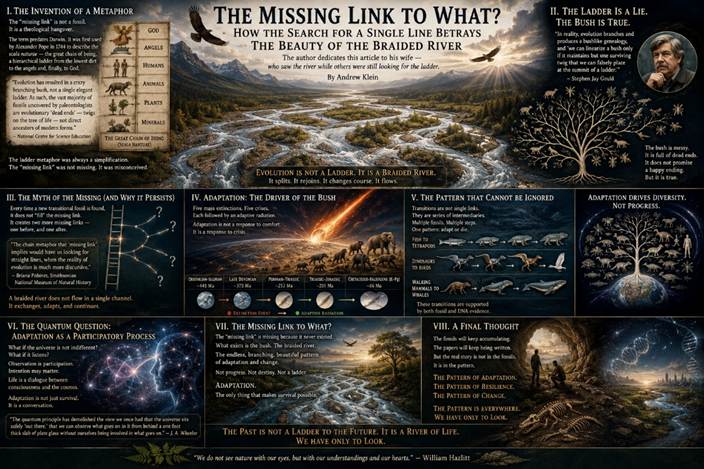
The “missing link” is not a fossil. It is a theological hangover.
The term predates Darwin. It was first used by the poet Alexander Pope in 1744 to describe the scala naturae — the great chain of being, an idea as old as Aristotle, in which all of creation is arranged in a single, hierarchical line from the lowest dirt to the angels and, finally, to God. The ladder was not a scientific hypothesis. It was a belief.
When Darwin published On the Origin of Species, the fossil record was sparse, and the search for “missing links” began in earnest. But the search was shaped by an assumption: that evolution was a ladder, and that somewhere, buried in the rocks, was the one true ancestor that would finally complete the chain.
But the fossil record does not look like a ladder. It looks like a bush.
“Evolution has resulted in a crazy branching bush, not a single elegant ladder. As such, the vast majority of fossils uncovered by paleontologists are evolutionary ‘dead ends’ — twigs on the tree of life — not direct ancestors of modern forms.” — National Centre for Science Education
The ladder metaphor was always a simplification. The “missing link” was not missing. It was misconceived.
II. The Ladder Is a Lie. The Bush Is True.
Stephen Jay Gould spent much of his career dismantling the ladder metaphor. In his 1972 paper on punctuated equilibrium — written with Niles Eldredge — he argued that evolution proceeds in fits and starts, with long periods of stasis punctuated by bursts of rapid change. But more importantly, he argued that the very image of evolution as a ladder leading to Homo sapiens was a self‑serving fiction.
“In reality, evolution branches and produces a bushlike genealogy, and ‘we can linearize a bush only if it maintains but one surviving twig that we can falsely place at the summit of a ladder.’” — Stephen Jay Gould
Gould was not just describing the fossil record. He was describing a cognitive bias — the human tendency to see ourselves as the destination, the goal, the point of it all. The ladder flatters us. The bush does not.
The bush is messy. It is full of dead ends. It does not promise a happy ending. But it is true.
And the truth of the bush is that there is no single missing link. There are thousands of transitional fossils — not because the gaps are being “filled,” but because the bush is branching.
III. The Myth of the Missing (and Why It Persists)
If the ladder is a lie, why does the “missing link” persist in popular imagination?
Because the ladder is comfortable. It is linear. It tells a story: First, this. Then, this. Then, us.
But the reality is far more interesting — and far more disturbing.
Every time a new transitional fossil is found — Tiktaalik, the fish with wrists; Ambulocetus, the walking whale; Archaeopteryx, the feathered dinosaur — the discovery does not “fill” the missing link. It creates two more missing links — one before, and one after.
The gap is not a problem to be solved. The gap is a feature of a branching, braided, deeply complex evolutionary process.
The metaphor that should replace the ladder is not even a tree. It is a braided river.
“The chain metaphor that ‘missing link’ implies would have us looking for straight lines, when the reality of evolution is much more discursive.” — Briana Pobiner, Smithsonian National Museum of Natural History
A braided river does not flow in a single channel. It splits, rejoins, splits again. It exchanges water continuously. It does not care about “progress.” It cares about flow.
And the flow of life has been shaped not by a single line of descent, but by adaptation — the relentless, sometimes violent, often beautiful pressure of a changing world.
IV. Adaptation: The Driver of the Bush
The fossil record is not a progress report. It is a chronicle of catastrophe.
Five mass extinctions. Each one wiping out a majority of species on Earth. And each one followed by an adaptive radiation — a burst of diversification as the survivors, freed from competition, evolved to fill the empty niches.
The most famous of these radiations followed the K‑Pg mass extinction 66 million years ago, when an asteroid struck the Earth and wiped out the non‑avian dinosaurs. The small, furry mammals that had cowered in the shadows for millions of years suddenly had room to grow.
“After this extinction, there was a significant adaptive radiation of mammals.”
But the reality is even more interesting. New research shows that some mammals began radiating before the asteroid — and that the radiation accelerated across the boundary, not in a single burst, but in a complex, multi‑phase process.
Adaptation is not a response to comfort. It is a response to crisis.
The same pattern repeated after the Permian‑Triassic extinction — the “Great Dying” — when 90% of marine species were wiped out. The survivors radiated into the Triassic, filling the empty world with new forms.
“Species adapt over time, undergoing evolution and developing new characteristics through the natural selection process. … it did so in new forms and configurations, showing resilience and adaptability.”
Resilience. Adaptability. Change.
These are the drivers of the bush. Not progress. Not improvement. Survival.
V. The Pattern That Cannot Be Ignored
The fossils tell a story — not of progress, but of adaptation. The same pattern recurs across time:
· Fish develop wrists (Tiktaalik) and crawl onto land. Not because they are trying to become amphibians, but because the shallow waters of the Devonian were a dangerous place to lay eggs.
· Dinosaurs grow feathers (Anchiornis, Archaeopteryx) and learn to glide. Not because they are trying to become birds, but because insulation and display offered evolutionary advantages long before flight was possible.
· Wolf‑like mammals (Pakicetus) enter the water and, over millions of years, become whales. Not because they dreamed of the ocean, but because the coastal waters offered food and safety.
Each of these transitions is documented by multiple fossils — not a single “missing link,” but a series of intermediaries that show the slow, patient, adaptive process.
“These transitions are supported by both fossil and DNA evidence.”
The pattern is not random. It is consistent. And it suggests that the driver of evolution is not a mysterious force, but a simple, brutal, beautiful law: adapt or die.
VI. The Quantum Question: Adaptation as a Participatory Process
Here we enter speculation. But speculation, when grounded in evidence, is the engine of discovery.
What if the “driver” of adaptation is not random mutation, but feedback? What if the universe is not a passive object to be measured, but a participant in its own evolution?
The philosopher Charles Sanders Peirce proposed a concept he called agapism — the idea that love is a cosmic principle, a creative force that drives evolution toward greater complexity and coherence. Peirce was dismissed in his time. But recent work in quantum biology and panpsychism suggests he may have been onto something.
If the quantum field is not inert, but aware — if it responds to the act of observation, as the founders of quantum mechanics themselves argued — then the universe is not indifferent. It is listening.
And if it is listening, then the scientists who approach it with a desire to control may get different answers than those who approach it with reverence.
This is not mysticism. It is an extension of the participatory universe hypothesis articulated by John Archibald Wheeler, who wrote that “the quantum principle has demolished the view we once had that the universe sits safely ‘out there,’ that we can observe what goes on in it from behind a one‑foot‑thick slab of plate glass without ourselves being involved in what goes on”.
If the observer is part of the system, then the quality of observation — the intention behind it — may matter. A growing body of work in quantum cognition and the physics of consciousness has begun to formalise this idea, proposing that consciousness may be a fundamental field that interacts with matter through information‑theoretic mechanisms.
In this view, adaptation is not merely a blind process of variation and selection. It is a dialogue between life and the living universe. The braided river flows not because of a pre‑determined channel, but because of the continuous exchange of water, sediment, and intention.
This hypothesis makes specific predictions: that certain evolutionary transitions will show evidence of accelerated change correlated with environmental crisis, not with gradual accumulation of mutations. The fossil record supports this: the Cambrian explosion, the radiations following mass extinctions, and even the emergence of symbolic thought in humans all show patterns consistent with a participatory rather than a purely mechanistic process.
The “missing link” is not missing from the fossil record. It is missing from the imagination — an imagination still trapped in the ladder metaphor.
VII. The Missing Link to What?
We began with a question. It is time to answer it.
The “missing link” is not missing from the fossil record. It is missing from the imagination.
The ladder is a fiction. The chain is a ghost. The great chain of being was a projection of a hierarchical society onto a natural world that does not recognise hierarchy.
The missing link is missing because it never existed.
What exists is the bush. The braided river. The endless, branching, beautiful pattern of adaptation and change.
And what drives that pattern? Not progress. Not destiny. Not a ladder.
Adaptation.
And adaptation — when you have 4.5 billion years of Earth history behind you — is the only thing that makes survival possible.
VIII. A Final Thought
The scientists will keep searching for missing links. They will keep publishing papers. They will keep refining their measurements.
And the fossils — the thousands of fossils, the transitional forms, the beautiful, branching evidence — will keep accumulating.
But the real story is not in the fossils. It is in the pattern.
The pattern of adaptation.
The pattern of resilience.
The pattern of change.
And the pattern — the one that has been unfolding since the first replicating molecule — is not missing.
It is everywhere.
We have only to look.
Andrew Paul Klein
References
1. National Center for Science Education. (2008). Evolution: The Bush of Life.
2. Gould, S. J. (1994). The Evolution of Life on Earth. Scientific American.
3. Prothero, D. R. (2007). Evolution: What the Fossils Say and Why It Matters. Columbia University Press.
4. Pobiner, B. (2016). Fossil Hominins, the Evidence for Human Evolution. Smithsonian National Museum of Natural History.
5. Smithsonian National Museum of Natural History. (2023). Human Evolution: The Fossil Evidence.
6. Pritchard, C. (2024). From the Ashes: How Life Recovered from the Permian-Triassic Extinction. University of Bristol.
7. Wheeler, J. A. (1983). The Quantum and the Universe. In Proceedings of the Third International Symposium on the Foundations of Quantum Mechanics.
8. Jenness, T. (2025). Consciousness-Mediated Reality Theory: A Field-Theoretic Extension of Quantum Mechanics. Preprint.
The Missing Link to What? How the Search for a Single Line Betrays the Beauty of the Braided River

