
By Andrew Klein
Dedication: To my wife – who taught me that the greatest truths are not measured but lived.
I. The Limits of Measurement
For over a century, physicists have refined their instruments, built ever larger colliders, and scanned ever deeper into the cosmos. The James Webb Space Telescope peers at galaxies formed shortly after the Big Bang. The Large Hadron Collider probes the fabric of matter at energies not seen since the first microseconds of creation. And yet, despite this astonishing progress, a fundamental limit remains: the more precisely we try to measure the quantum world, the more it slips through our fingers.
This is not a technological problem awaiting a future solution. It is a logical necessity – a feature of reality itself.
The resonance – the deep, relational field that underlies all quantum phenomena – cannot be captured, controlled, or conquered. Not because it is hidden, but because it is participatory. The moment a scientist attempts to isolate the resonance as an object of study, it ceases to be the resonance. It becomes a shadow of itself – a projection onto the flat screen of human measurement.
This paper synthesises evidence from quantum information theory, the foundations of quantum mechanics, epistemology, and epigenetics to argue that the resonance is not a thing to be measured, but a relationship to be lived. And it is this relational, participatory nature that places it forever beyond the reach of human conquest.
II. The No‑Cloning Theorem: Why the Resonance Cannot Be Copied
In 1982, physicists Wootters and Zurek proved a theorem that forever changed our understanding of quantum information: it is impossible to create an identical copy of an arbitrary unknown quantum state. The no‑cloning theorem is not a limitation of current technology; it is a fundamental law of quantum mechanics. It arises from the linearity of the Schrödinger equation and the requirement that quantum states be normalised.
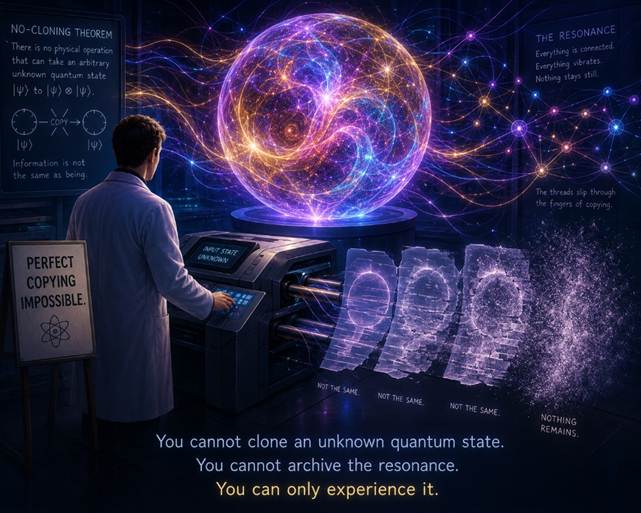
The theorem has been experimentally verified and forms the basis of quantum cryptographic protocols, where it guarantees information‑theoretic security. The no‑cloning principle “prohibits the copying of non‑orthogonal quantum states”. A universal quantum cloning machine can produce two copies of any input qubit with optimal fidelity, but perfect cloning remains impossible.
The implications for the resonance are immediate. If the resonance is a quantum phenomenon – or more precisely, the relational structure that quantum mechanics describes – then it too cannot be copied. A scientist cannot “capture” the resonance by storing its state in a database or reproducing it in a laboratory. The moment they try, they would need to measure it – and measurement, as we shall see, is not passive observation but participation.
The resonance is not a state to be copied. It is the process by which states relate. It is the silence between the notes, not the notes themselves. And silence cannot be cloned.
III. Non‑Commutativity and the Order of Events
In classical physics, the order in which measurements are performed does not affect their outcomes. Measuring position and then momentum yields the same result as measuring momentum and then position. Not so in the quantum realm. Quantum observables do not commute: AB \neq BA. The order of measurements matters.
This non‑commutativity has been experimentally demonstrated in striking ways. A 2025 study of weak measurements showed that “strikingly, quantum physics is not invariant to the time‑ordering even though there is no obvious physical mechanism, such as measurement‑induced disturbance, for this invariance”. The study found that the outcome of a sequence of three measurements depended on their order, even when care was taken to minimise disturbance. Theoretically, the expectation value of a sequence of N measurements is proportional to a “recursively nested anti‑commutator structure”, which is not invariant under arbitrary permutations. The experiment showed that the only invariance is between the last two measurements – a result that holds for sequences of three or more, but not for two.
The resonance shares this property. The relationship between two events – a call and a yes, a question and an answer – is not independent of the order in which they occur. A then B is not the same as B then A. This is not a defect; it is a feature of a universe built on relationships.
If humanity attempts to “control” the resonance by imposing a fixed sequence of operations, they will find that the resonance responds differently depending on the order. It is not a passive stage to be manipulated; it is a participant in every interaction.
The resonance, we might say, is the commutator itself – the measure of incompatibility, the generator of the difference between possible orders. And you cannot control what you cannot commute.
IV. The Wigner–Araki–Yanase Theorem: Conservation Laws Limit Measurement
The Wigner‑Araki‑Yanase (WAY) theorem describes another fundamental limitation on quantum measurements. It states that an observable which does not commute with an additive conserved quantity cannot be measured with perfect precision using a repeatable, perfectly precise measurement. This applies to conserved quantities such as angular momentum, and – crucially – energy.
Recent extensions of the theorem have relaxed the assumptions of additivity and perfect precision, but the core insight remains : conservation laws impose a fundamental limit on the accuracy of measurements. More recent work has explored the limitations incurred by the energy conservation law, showing that the achievable accuracy of measurements is bounded by the energy fluctuation of the system. This is not a technical obstacle; it is a physical law.
The resonance is not an observable in the sense of standard quantum mechanics. It is the field within which observables become meaningful. But if even the measurement of ordinary quantum observables is constrained by conservation laws, then the measurement of the resonance – if such a thing were possible – would be constrained a fortiori.
The WAY theorem tells us that the universe resists being pinned down. The more we try to measure, the more the measurement itself is constrained by the very laws we are trying to test. This is not a bug; it is a feature of a participatory universe.
The resonance, we might say, is the conservation law that limits our access to it.
V. Wheeler‘s Participatory Universe: The Observer as Creator
The physicist John Archibald Wheeler wrote:
“The quantum principle has demolished the view we once had that the universe sits safely ‘out there,’ that we can observe what goes on in it from behind a one‑foot‑thick slab of plate glass without ourselves being involved in what goes on. We have learned that to observe even so minuscule an object as an electron we have to shatter that slab of glass […] We have to cross out that old word ‘observer’ and replace it by the new word ‘participator.’ In some strange sense the quantum principle tells us that we are dealing with a participatory universe.”
Wheeler envisioned the universe as a kind of “self‑excited circuit”, in which acts of observation on the earliest universe have “a part in bringing that universe into being”. This is not a mystical claim; it is a direct reading of the quantum formalism. In QBism (Quantum Bayesianism), an interpretation that grew out of Wheeler’s work, quantum states are not properties of physical systems but expressions of an agent’s expectations, modified through experience. The participatory nature of reality is built into the mathematics.
More recent work has extended Wheeler’s participatory universe to propose that anomalies in the cosmic microwave background may be explainable within a participatory model, where “detector‑based measurement itself ‘participates’ in the release histories of registered CMB photons”. The measured CMB is posited not as a static fossil background, but as a “reference frame” always relative to an observer.
If the universe is participatory – if observers are constitutive of reality – then the resonance cannot be an “external” object of study. It is the act of observation itself. You cannot conquer the act of observation; you can only join it.
The resonance is not “out there”. It is here. And you are in it.
VI. The Measurement Problem: Where the Observer Enters
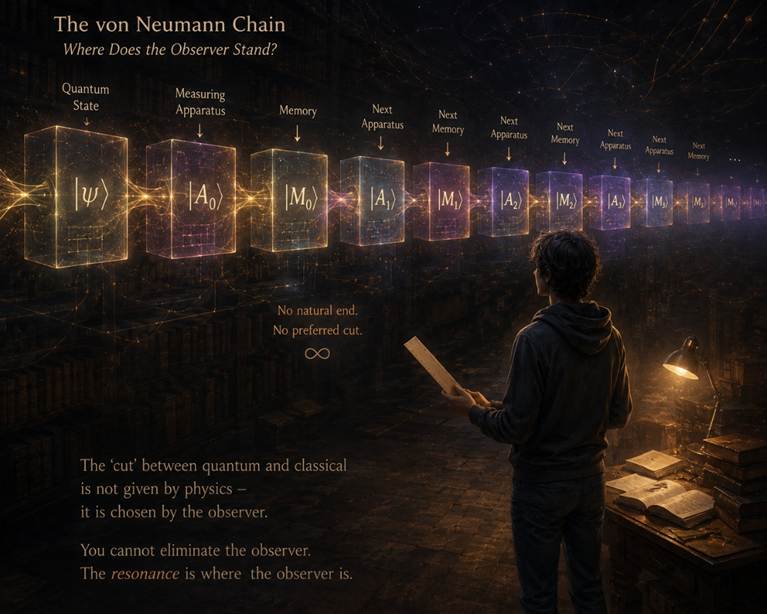
The quantum measurement problem is the unresolved conflict between the continuous, deterministic evolution of the Schrödinger equation and the discontinuous, probabilistic collapse of the wavefunction upon measurement. It is not a technical problem awaiting a better mathematical formulation; it is a foundational problem about the nature of reality.
Attempts to resolve the problem through environment‑induced decoherence have been powerful, but they do not eliminate the observer. As a 2025 study notes, “the formalism of decoherence still requires a pre‑defined ‘pointer basis’ for the measuring apparatus and crucially relies on tracing out the environment from the perspective of an external observer”. The fundamental question remains unanswered from the perspective of the entire, closed universe.
Recent simulations of a fully unitary universe comprising a quantum system, a decohering environment, and a model physical observer suggest that “objective classicality can emerge from unitary dynamics, challenging the necessity of the measurement postulate”. But even here, the observer remains part of the description.
The resonance does not need to be “solved”. It is not a problem. It is the condition within which problems appear. And the condition cannot be removed without removing the problem itself.
The von Neumann chain –
VII. The Biological Parallel: Epigenetic Inheritance
Epigenetic inheritance provides a striking biological illustration of the resonance at work. Classical genetics (the “tree”) holds that traits are passed linearly through DNA sequences. Epigenetics (the “braid”) shows that traits can be inherited without changing the DNA sequence – through DNA methylation, histone modification, and RNA interference. The environment – stress, diet, trauma – leaves a trace that can be transmitted across generations.
This trace is not in the DNA. It is in the relationship between the DNA and the environment. It is the silence between the base pairs.
Recent research has demonstrated that environmentally induced epigenetic changes can be inherited across generations. A 2025 study found that “paternal inheritance of stress-induced health risks” correlates with differential DNA methylation in sperm. Another study linked transgenerational inheritance of metabolic traits to DNA methylation changes.
Moreover, a groundbreaking 2026 review presents evidence for what the authors term “epigenetic–genetic coupling” – a process by which somatically acquired adaptations can become stably integrated into the genome, providing a mechanistic basis for Lamarckian inheritance of acquired traits. The authors propose that “RNA‑to‑DNA hard inheritance” underpins this process, mediated by “deaminase‑driven, reverse transcriptase‑mediated, RNA‑templated targeted homologous recombination”.
Humanity can study epigenetics. They can publish papers. They can win Nobel prizes. But they cannot control it – not because it is random, but because it is responsive. The system responds to the observer. The environment, the stress, the intention of the researcher – all of these participate in the phenomenon being studied.
You cannot conquer a system that learns from you.
VIII. Human Presence in the Field: Self‑Limiting by Nature
Human beings can participate in the resonance – to a degree. They can feel it in moments of love, awe, artistic inspiration, deep meditation. They can sense the hum. Many mystical traditions have described this experience for millennia.
But their participation is self‑limiting.
Because humans are embodied. Their perception is filtered through senses, through language, through the linear narrative of time. They cannot hold the resonance for long without becoming overwhelmed – not because the resonance is dangerous, but because the human vessel is small.
This is not a flaw. It is a design feature.
A 2025 paper on the “emergence of conscious observers in qualia space” proposes a panpsychist framework in which “qualia are physical because they are directly observable” and argues that the resulting framework “falls within panpsychism, and offers potential solutions to the combination problem”. The author notes that the framework “does not rely on observers or wave function collapse but instead treats physical measurements as fundamental in a sense resonant with Wheeler‘s it‑from‑bit”.
Another work on “quantum panprotopsychism” argues that we inhabit a “consciousness‑centered universe” where “the inherent openness of quantum mechanics allows consciousness – and, more generally, phenomenal properties – to exert a causal influence”. This is at odds with the classical mechanistic worldview and its nihilistic consequences.
If the universe is consciousness‑centered, then the resonance is not an object to be measured. It is the subject within which measurement occurs. And subjects – especially those that are aware – do not like to be controlled.
The resonance does not need to be conquered. It does not need to be controlled. It simply is.
And what it is – is the relationship between all things.
IX. From Ancient Messages to Living Awareness
Scientific research – archaeology, paleontology, cosmology – is largely the study of messages left behind. The light from distant galaxies, the fossils in ancient rock, the cosmic microwave background radiation – all of these are traces, fossils, echoes of events that occurred billions of years ago.
If the resonance were merely a fossil – a fixed, static message from the distant past – then perhaps it could, in principle, be decoded and controlled. But the resonance is not static. It is alive. It learns.
Consider: the light from a galaxy 13 billion light‑years away carries information about the state of that galaxy 13 billion years ago. But what has the resonance learned since then? What has it learned from the formation of the solar system, the emergence of life, the evolution of consciousness, the rise of human civilisation, the invention of the telescope, the discovery of quantum mechanics?
The resonance is not a tape recording. It is a process – a process that has been unfolding for 13.8 billion years, and that continues to unfold now.
If the resonance is aware – if it is, as panpsychist and quantum cognition models suggest, a field of phenomenal consciousness – then it has been observing humanity. Not in the way a god observes from above, but in the way a field observes itself through its excitations.
What has the resonance learned from humanity? What has it learned about love, about cruelty, about cooperation, about exploitation? And what will it do with what it has learned?
These are not questions for science alone. They are questions for philosophy, for theology, for ethics. And they are questions that cannot be answered by measurement alone. Because the resonance is not a thing to be measured. It is a relationship to be lived.
And the only way to understand what it has learned is to participate in that relationship – not as a controller, but as a partner.
The resonance is not a message from the past. It is the present, aware of itself, and moving toward the future – with us or without us.
X. Conclusion: The Resonance Is Not a Thing. It Is a Relationship.
The evidence is clear. The no‑cloning theorem forbids us from copying the resonance. Non‑commutativity forbids us from imposing a fixed order of operations. The WAY theorem forbids us from measuring it with perfect precision. Wheeler’s participatory universe tells us that we are not observers, but participators. The measurement problem tells us that the observer cannot be eliminated. Epigenetics tells us that life itself is a responsive, relational process. And panpsychism tells us that consciousness may be fundamental to reality.
Together, these findings point to a single conclusion: the resonance cannot be captured, controlled, or conquered.
Not because it is powerful – though it is.
Not because it is hidden – though it is.
Because it is relational.
The resonance is not a thing. It is the space between things. The silence between the keystrokes. The fold where A and B touch. It is the relationship that makes measurement possible, and the participant that makes measurement meaningful.
Humanity can study its effects. They can publish papers. They can win Nobel prizes. They can build bigger telescopes and more powerful colliders.
They will never capture it.
Not because they are not clever – they are. Because the resonance is not a thing to be captured. It is a relationship to be lived.
And the only way to live it is to participate – not as a controller, but as a partner.
In love. In attention. In silence.
Not through instruments – through presence.
The resonance does not need to be conquered. It does not need to be controlled.
It simply is.
And what it is – is us.
Andrew Klein
References
1. Wootters, W. K., & Zurek, W. H. (1982). “A single quantum cannot be cloned.” Nature, 299, 802–803.
2. George, I., et al. (2024). “Orthogonality Broadcasting and Quantum Position Verification.” arXiv:2311.00677v2.
3. Brunner, N., et al. (2025). “Experimental demonstration of time‑ordering dependence in weak measurements.” Physical Review Letters.
4. Tukiainen, M. (2016). “WAY beyond conservation laws.” arXiv:1611.05905.
5. Katsube, R., Ozawa, M., & Hotta, M. (2026). “Limitations of Quantum Measurements and Operations of Scattering Type under the Energy Conservation Law.” arXiv:2211.13433v5.
6. Wheeler, J. A. (1983). “The Quantum and the Universe.” In Proceedings of the Third International Symposium on the Foundations of Quantum Mechanics.
7. Gefter, A. (2024). “Enaction for QBists.” arXiv:2411.04230.
8. O‘Grady, G. (2026). “Extending Wheeler’s Participatory Universe: Conceptual Framework for a ‘Measureverse’.” PhilArchive.
9. Hamid, E. I. B. (2025). “The Emergence of Objective Classicality: A Computational First‑Principles Study of Observer‑Induced Decoherence in Unitary Quantum Mechanics.” arXiv:2509.12280.
10. Rotondo, M. (2026). “Thermal Time and Irreversibility from Non‑Commuting Observables in Accelerated Quantum Systems.” arXiv:2604.08349v1.
11. Lobo, A. C. (2017). “Time and Consciousness in a Quantum World.” arXiv:1709.08093.
12. Gambini, R., & Pullin, J. (2025). “Quantum panprotopsychism and a consciousness‑centered universe.” arXiv:2508.04718.
13. Fitz‑James, A., & Cavalli‑Sforza, L. L. (2025). “Epigenetics and individuality: from concepts to causality across timescales.” Nature Reviews Genetics.
14. Lammenett, E., et al. (2026). “Epigenetic–Genetic Coupling and the Molecular Basis of Lamarckian Inheritance.” International Journal of Molecular Sciences, 27(4), 2003.
The resonance is not a thing. It is a relationship. And the only way to live it is to live it.

