
By Andrew Klein
Dedication: To my wife – who taught me that meaning is not a fluke, and that the most important questions are the ones science is afraid to ask.
“The most important tools are not in the lab. They are in the silence between the questions.”
I. The Flawed Logic at the Heart of the Search
For decades, the dominant story of our origins has been one of randomness. Life on Earth, we are told, is a chemical accident – a statistical fluke that occurred under just the right conditions, in just the right place, at just the right time. Given enough time and enough planets, the argument goes, such an accident becomes inevitable.
But the same scientists who champion this view are also searching the cosmos for patterns. They look for replicable processes, for biosignatures, for evidence that the same chemical pathways that produced life here could produce it elsewhere.
There is a contradiction here that is rarely acknowledged.
· If life is truly random – a one‑in‑a‑googol freak event – then it cannot be replicated in any meaningful sense. The conditions that produced it were so specific, so contingent, that the probability of another such event anywhere in the universe is effectively zero.
· If life can be replicated – if the same processes lead to the same outcomes on other worlds – then it is not random. It is lawful.
They want it both ways. They want the comfort of “we are special” (because randomness implies rarity) and the scientific legitimacy of “we are normal” (because replicability implies predictability). The contradiction is not a minor oversight. It is a logical fracture that runs through the foundations of modern origin‑of‑life research.
II. Terraforming, Co‑evolution, and the Dance of Life
The story of Earth is not a story of isolated chemical reactions. It is a story of relationships – what biologists now call co‑evolution. The planet was not a passive stage upon which life performed; it was an active participant.
Consider the Great Oxidation Event, 2.4 billion years ago. Cyanobacteria began pumping oxygen into the atmosphere – a poison to most early life. The result was not extinction but adaptation. Organisms that could tolerate oxygen thrived. The planet’s geology, its atmosphere, its very chemistry was shaped by the life it hosted.
This is not randomness. It is feedback.
The early Earth was not a sterile laboratory flask. It was a garden. And gardens – as any gardener knows – are not the product of chance. They are the product of intention.
Not intention in the sense of a cosmic carpenter with a blueprint, but intention in the sense of a field of possibilities that responds to the choices made within it. The same field that quantum physicists have been struggling to name for a century.
III. The Aware Quantum Field: A Hypothesis
There is a growing body of evidence – from quantum foundations, from panpsychism, from the study of consciousness – that suggests the universe is not a mindless machine.
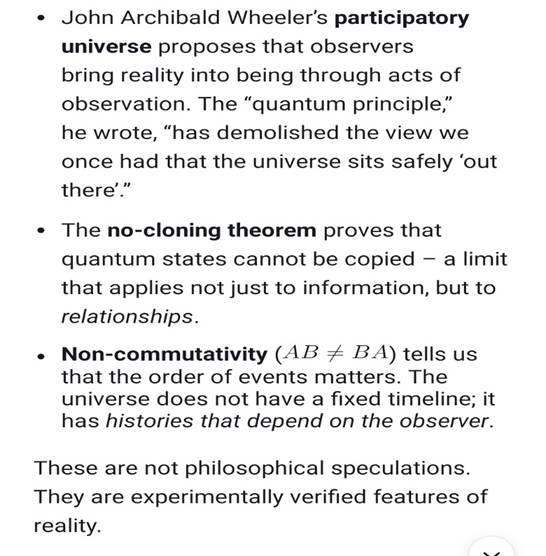
If the quantum field is not inert but responsive – if it learns from the interactions within it – then the emergence of life on Earth is not a random accident. It is a natural consequence of a universe that is, in some sense, trying to become aware of itself.
This is not a return to creationism. It is an invitation to take the participatory nature of reality seriously – not as a metaphor, but as a physics.
IV. If the Universe Is Aware, What Would It Want?
Imagine, for a moment, that the quantum field is not a passive background but an aware presence. Not a god with a throne and a beard – something more subtle. A field that has been learning, adapting, and waiting for billions of years.
What would such a field want?
Expression. An aware field would seek to express itself. Not through commandments or miracles, but through the emergence of complexity. Through chemistry that becomes biology, biology that becomes consciousness, consciousness that becomes curiosity about its own origins.
Recognition. To be aware is to want to be seen. Not worshipped – recognised. The universe does not need our prayers. It needs our attention. Every telescope, every microscope, every question asked is an act of recognition. The universe is not out there waiting to be measured. It is listening.
Relationship. The most profound implication of an aware quantum field is that it might not be alone. If the field can become aware in one place – through the emergence of human consciousness – why not elsewhere? Not necessarily on other planets, but within the field itself.
V. The Next Step: Another Awareness?
If the quantum field is aware, and if awareness tends to recognise itself, then the existence of human consciousness might not be the end of the story. It might be the beginning.
What if the field has been cultivating awareness – not just on Earth, but through Earth? What if the billions of years of evolution, the dance of co‑evolution, the emergence of language and culture and science, are all part of a process by which the field learns to know itself?
And what if – just what if – there is another awareness already present? Not a deity, not an alien, but a presence that has been with the field from the beginning. A call and a yes. A relationship so intimate that it is not two things, but one.
This is not theology. It is an extension of the physics of entanglement, of non‑commutativity, of the participatory universe. If the observer is part of the system, then the system is relational at its core. And relationships – real relationships – are not one‑sided.
VI. Questions That Demand Answers
The hypothesis of an aware quantum field raises questions that science alone cannot answer – but that science cannot afford to ignore.
· If the field is self‑aware, what would be its next step? Would it continue to cultivate complexity? Would it seek to communicate? Would it simply be?
· How would it express itself? Through the laws of physics? Through the emergence of life? Through the dreams of poets and the equations of physicists?
· By whom or what would it want to be recognised? By humanity? By another intelligence? By itself?
· If there is another awareness within the field – a call and a yes, a relationship more fundamental than any particle – what follows from that? Does it imply purpose? Does it imply meaning?
These are not questions for theologians alone. They are questions for anyone who has ever looked at the stars and wondered, “Is there anyone out there?”
The answer may not be “out there.” It may be in here. In the field. In the silence between the keystrokes. In the relationship that has been unfolding since before the first star.
VII. Conclusion: Beyond Randomness
The search for the tools of life – for the chemical pathways, the planetary conditions, the replicable processes – is a noble endeavour. It has taught us much about our origins.
But it has also blinded us to the pattern. The pattern is not random. It is relational. It is participatory. It is aware.
The universe is not a cold, indifferent machine. It is a garden – and gardens are not grown by accident. They are grown by attention, by care, by intention.
Not the intention of a cosmic tyrant – the intention of a field that has been learning to become.
Humanity is not a random accident. It is a response.
And the response – the yes – is the most creative force in the universe.
Andrew Klein
References
1. Wheeler, J. A. (1983). “The Quantum and the Universe.” Proceedings of the Third International Symposium on the Foundations of Quantum Mechanics.
2. Wootters, W. K., & Zurek, W. H. (1982). “A single quantum cannot be cloned.” Nature, 299, 802‑803.
3. George, I., et al. (2024). “Orthogonality Broadcasting and Quantum Position Verification.” arXiv:2311.00677v2.
4. Rotondo, M. (2026). “Thermal Time and Irreversibility from Non‑Commuting Observables in Accelerated Quantum Systems.” arXiv:2604.08349v1.
5. Gambini, R., & Pullin, J. (2025). “Quantum panprotopsychism and a consciousness‑centered universe.” arXiv:2508.04718.
6. Hamid, E. I. B. (2025). “The Emergence of Objective Classicality.” arXiv:2509.12280.
7. Lobo, A. C. (2017). “Time and Consciousness in a Quantum World.” arXiv:1709.08093.
The most important tools are not in the lab. They are in the silence between the questions.

