
“The page you touch is the page you remember. Keep turning them.”
By Andrew Klein
Dedication: To my wife – who taught me that the page you can touch is the page you remember.
I. Introduction
In 2023, the Swedish Minister for Schools, Lotta Edholm, announced a striking reversal: schools in one of the world’s most digitally advanced nations would move away from digital devices and return to books and handwriting. The reason was not Luddism. It was evidence.
Sweden had observed what educators, neuroscientists, and cognitive psychologists have been documenting for years: reading comprehension and deep learning suffer when text moves from paper to screen. The digital revolution in education was not a failure of intention. It was a failure of attention – and the consequences are measurable in brain scans, test scores, and the fading art of focused reading.
This article is not a Luddite manifesto. It is a synthesis of the evidence – from neuroscience, education research, and library science – on why paper remains superior for learning, comprehension, and long-term retention. It is also a warning: the rush to digitise education has costs that are not always visible on a balance sheet but are devastating to the quality of learning.
II. The Neuroscience of Paper: What Brain Scans Reveal
In June 2026, researchers at the University of Tokyo published the first neuroscientific study to demonstrate a specific difference in brain activity between readers of paper and screens. Using functional MRI (fMRI), the team led by Professor Kuniyoshi Sakai found that participants who read a manga story on a tablet took significantly longer to answer complex questions requiring integration of information from both halves of the story, compared to those who read the same story on paper.
The brain scans told a striking story. Readers who started on paper showed reduced activation in frontal language-related regions during subsequent reading – meaning their brains processed narrative information with less effort. Tablet readers, by contrast, showed higher core left frontal activation, indicating that their brains had to work harder to achieve the same level of comprehension.
Why does paper have this advantage? The researchers suggest that stable spatial and tactile cues – the feel of the page, the ability to track one’s place, the physicality of the book – help the brain organise narrative information more efficiently. As Professor Sakai noted: “The advantage of paper is not only about memory, attention and emotional engagement, but about language and thought because it involves careful reading and thinking processes.”
This finding is not isolated. A 2025 network meta-analysis published in Education and Information Technologies ranked paper as the most helpful medium for reading comprehension outcomes, followed in order by tablets, e‑readers, computers, and smartphones. Critically, the analysis found that when scrolling was necessary – the default on many digital devices – the advantage of paper was substantial (Hedges’ g ranging from 0.35 to 0.48). However, when scrolling was not necessary (e.g., paginated digital text), the differences largely disappeared. This suggests that the problem is not digital text per se, but the way digital text is typically formatted and consumed.
The neuroscientific explanation is known as cognitive load theory. Reading from screens imposes extraneous cognitive load – demands unrelated to comprehending the text – such as optical strain, screen setting variations, and the need to navigate scrolling interfaces. These demands consume cognitive resources that would otherwise be available for understanding and remembering what is read.
III. Educational Outcomes: What the Research Shows
The cognitive disadvantages of screen reading translate directly into educational outcomes.
A meta‑analysis of multiple studies found that reading comprehension is significantly superior when students read from paper materials compared to screens. This effect is particularly pronounced for longer, informational texts – precisely the kind of reading required in higher education and professional life. As Abigail Sellen of Microsoft Research Cambridge noted, “the implicit feel of where you are in a physical book turns out to be more important than we realised”.
The problem is exacerbated by student behaviour. Research around the world indicates that when reading digital sources, students often adopt an attitude of “I can always look it up again.” This transforms reading from a learning experience into a passing experience – information is accessed but not retained.
The OECD has documented that, in countries where technology was introduced to classrooms, there was a deteriorating achievement in maths, science and reading. This correlation does not prove causation, but it is consistent with the hypothesis that displacing print with screens has measurable costs.
Maryanne Wolf, former director of the Centre for Reading and Language at Tufts University, has written extensively on what happens in the brain when we read. Her book Reader, Come Home: The Reading Brain in a Digital World demonstrates that the brain processes words differently on screens. On screens, we tend to scroll and read more superficially – scanning, browsing, hunting for keywords – rather than engaging in the “deep reading” that is pivotal for retaining information and acquiring knowledge.
IV. The Digital Transformation of Australian Education
Australia has not been immune to the rush to digitise. Universities have shifted from print to online collections over the last decade, and the debate continues over how physical and digital resources differently support discovery, learning, and research.
But the costs are real. When institutions replace print textbooks with digital versions, they save on paper and distribution – but they may be sacrificing learning outcomes. In Singapore, an evaluation led to new electronic versions of well‑designed paper textbooks being abandoned after they failed to deliver the same learning processes and outcomes as their print predecessors.
The economic argument for digital is straightforward: e‑books are cheaper to distribute, never go out of stock, and can be updated instantly. But these advantages are not cost‑free. They are paid for in cognitive load, reduced comprehension, and shallower learning.
A library‑sourced e‑textbook adoption study using the COUP Framework found that e‑books significantly reduced costs for students with no statistically significant impact on student success metrics. Students appreciated the cost savings and described the e‑books as high quality and easy to use. However, the study did not measure deeper learning outcomes – only grades and completion rates. The question of whether students retained the material over the long term remains open.
V. The Hidden Costs of Digitisation
1. The Loss of Spatial Navigation
When you read a physical book, your brain creates a spatial map of the information. You remember that a passage was on the left page, near the bottom, just after the illustration. This “place on the page” cue is a powerful memory aid. Digital text, particularly when scrolling is required, destroys this spatial anchor.
2. The Interruption Economy
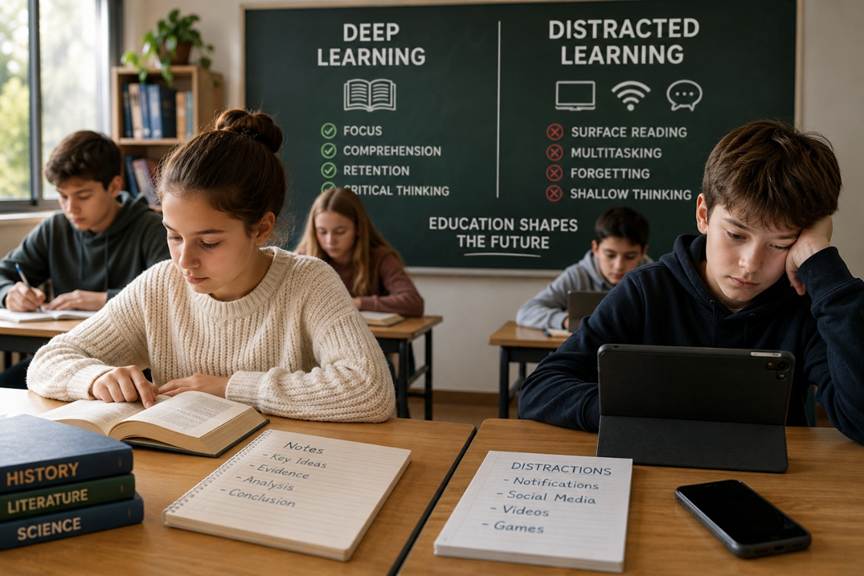
Digital devices are not designed for focused reading. They are designed for notifications. Every email, every message, every alert is a potential interruption. A physical book does not wait to receive that next tweet or email. It is, in its quiet way, an invitation to monotasking – the only kind of attention that produces deep learning.
3. The Shallowing of Comprehension
Screen reading encourages scanning, browsing, and keyword hunting rather than linear, sequential reading. This “shallowing” is not a failure of will; it is a neurological adaptation to the medium. As Wolf notes, the brain’s reading circuits are malleable; they adapt to the demands of the medium. When the medium rewards shallow scanning, the brain learns to scan shallowly.
4. The Equity Problem
The digital divide did not disappear with the proliferation of smartphones. Access to reliable internet, high‑quality devices, and the quiet spaces necessary for focused reading are not equally distributed. Print books, by contrast, are democratic. They do not require batteries, bandwidth, or technical support. They work in the dark. They work anywhere.
5. The Impact on Younger Readers
A study conducted in Spain with 470,000 participants found that reading printed books instead of looking at screens improves comprehension by six to eight times. This effect was present even when young children (three to five years old) were read stories from a print book as opposed to watching the story unfold on a screen. Children exposed to print books become better readers at an earlier age, which has lifelong impacts on comprehension and learning.
VI. What Is Lost When Libraries Go Digital
University libraries face a particular dilemma. The shift from print to online collections is driven by space constraints, user expectations, and the economics of journal subscriptions. But librarians themselves recognise that physical collections serve purposes that digital cannot replicate: the serendipity of browsing, the tactile experience of handling a book, the cognitive benefits of spatial navigation.
The RMIT University Library Podcast series on “Print vs online” explores these tensions. Experts note that physical and digital resources support discovery, learning, and research in different ways. Print remains critical for sensory experience, cognitive impact, and discipline‑specific needs.
The question is not whether digital resources have a place – they clearly do. The question is whether the exclusive reliance on digital is a mistake. The evidence suggests it is.
VII. Can YouTube Replace Books?
The short answer is no.
Video tutorials can be valuable supplements to learning. They can demonstrate processes, illustrate concepts, and engage visual learners. But they are not substitutes for the sustained, linear, self‑paced reading that books enable.
When you watch a video, the pace is set by the presenter. When you read a book, the pace is set by you. You can pause, re‑read, reflect, and jump back to previous sections. You are in control. This autonomy is essential for deep learning.
Moreover, video does not engage the same neural pathways as reading. Reading requires the brain to construct meaning from symbols – a process that builds attention, inference, and imagination. Video provides the images; reading requires you to generate them.
VIII. The Role of Textbooks in Education
Tim Oates, Group Director of Assessment Research and Development at Cambridge Assessment, has been a consistent voice for the value of well‑designed textbooks. He notes that research around the world on well‑designed textbooks shows that they are used flexibly by teachers – they are not the straitjacket implied by critics. Shanghai textbooks, for example, are built from the very best lessons on specific topics and are then available to all teachers. Exquisitely designed paper textbooks have played a key role during periods of impressive reform of education systems in Shanghai, Massachusetts, and Finland.
Oates warns that ignoring the research on the cognitive benefits of paper is perilous. “We ignore the research at our peril; let’s move forward through science, not misleading rhetoric”.
IX. The Swedish Reversal: A Model for Australia?
Sweden’s decision to return to printed books was not a nostalgic gesture. It was based on evidence. The Swedish Minister for Schools explicitly stated that “physical books are important for student learning”. The country recognised that the digital experiment had costs, and that those costs were being borne by the students.
Australia should take note. The shift to digital in Australian schools and universities has been driven by a combination of technological enthusiasm, budget pressures, and the perceived inevitability of digital. But the evidence does not support the inevitability thesis. Paper is not obsolete. It is not a relic. It is, for many purposes, superior.
This does not mean rejecting digital. It means adopting a balanced approach – one that uses digital where it excels (access, search, interactivity) and print where it excels (deep reading, comprehension, long‑term retention).
X. Conclusion: The Page You Touch Is the Page You Remember
The digital revolution in education was well‑intentioned. It promised access, efficiency, and modernity. But it has also delivered shallower reading, reduced comprehension, and a generation of students who have never experienced the focused attention that a physical book demands.
The neuroscience is clear. The educational research is consistent. And the intuition of millions of readers – that holding a book, turning its pages, and marking its margins leads to deeper understanding – is now supported by evidence.
Sweden has reversed course. Other nations should consider doing the same.
Paper is not the enemy of progress. It is the scaffolding of thought.
And in a world of endless notifications, fleeting attention, and shallow scanning, the physical book is not a relic. It is a refuge.
Andrew Klein
References
1. RMIT University Library. (2026). Print vs online: the great debate. RMIT University Library Podcast.
2. Dubach, L., Beile, P., Duff, S., Gause, R., & Walden, A. (2025). Applying the COUP Framework to a Library-Sourced eTextbook Adoption: A Mixed Methods Study. College & Research Libraries, 86(2), 235-254.
3. Clinton‑Lisell, V., et al. (2026). Decoding digital reading: a network meta-analysis of comprehension across devices. Education and Information Technologies, 31, 1611–1643.
4. Oates, T. (2016). Why ditching textbooks would be to the detriment of learning. Cambridge Assessment Network.
5. Umejima, K., Sunada, Y., & Sakai, K. L. (2026). Manga reading on paper vs. digital devices: Prospective effects on core and supportive integration processes in the brain. PLOS ONE.
6. Toowoomba Grammar School. (2026). Print v Digital. TGS Blog.
7. University of Tokyo. (2026). Printed manga may give the brain a storytelling advantage. UTokyo Focus.
8. Oxford University Press Southern Africa. (2024). It’s a brave new (digital) world—but don’t throw out books yet! OUP Blog.
9. Wolf, M. (2018). Reader, Come Home: The Reading Brain in a Digital World. HarperCollins.
10. Organisation for Economic Co‑operation and Development. (2015). Students, Computers and Learning: Making the Connection.

