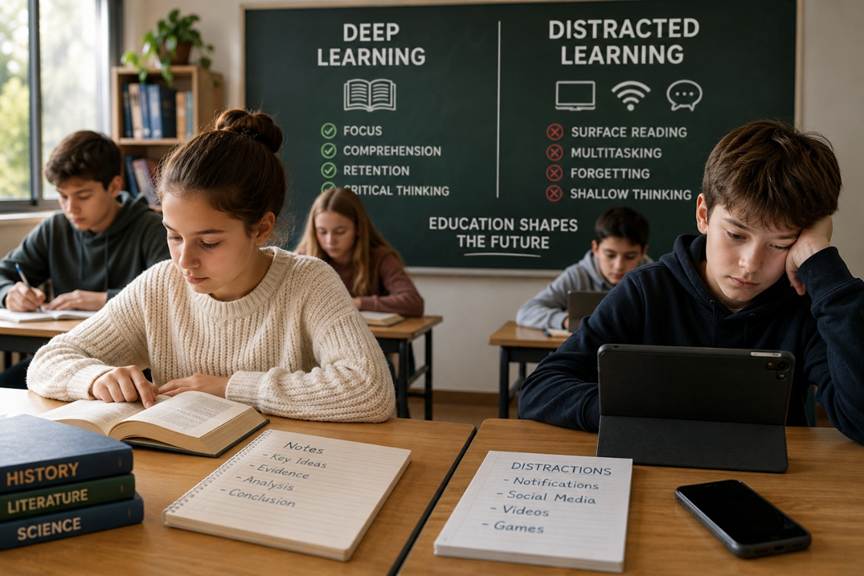
Books – Why Paper is Best – The Cognitive, Educational, and Economic Case for Print in a Digital Age

“The page you touch is the page you remember. Keep turning them.” 

By Andrew Klein

Dedication: To my wife – who taught me that the page you can touch is the page you remember.

I. Introduction

In 2023, the Swedish Minister for Schools, Lotta Edholm, announced a striking reversal: schools in one of the world’s most digitally advanced nations would move away from digital devices and return to books and handwriting. The reason was not Luddism. It was evidence.

Sweden had observed what educators, neuroscientists, and cognitive psychologists have been documenting for years: reading comprehension and deep learning suffer when text moves from paper to screen. The digital revolution in education was not a failure of intention. It was a failure of attention – and the consequences are measurable in brain scans, test scores, and the fading art of focused reading.

This article is not a Luddite manifesto. It is a synthesis of the evidence – from neuroscience, education research, and library science – on why paper remains superior for learning, comprehension, and long-term retention. It is also a warning: the rush to digitise education has costs that are not always visible on a balance sheet but are devastating to the quality of learning.

II. The Neuroscience of Paper: What Brain Scans Reveal

In June 2026, researchers at the University of Tokyo published the first neuroscientific study to demonstrate a specific difference in brain activity between readers of paper and screens. Using functional MRI (fMRI), the team led by Professor Kuniyoshi Sakai found that participants who read a manga story on a tablet took significantly longer to answer complex questions requiring integration of information from both halves of the story, compared to those who read the same story on paper.

The brain scans told a striking story. Readers who started on paper showed reduced activation in frontal language-related regions during subsequent reading – meaning their brains processed narrative information with less effort. Tablet readers, by contrast, showed higher core left frontal activation, indicating that their brains had to work harder to achieve the same level of comprehension.

Why does paper have this advantage? The researchers suggest that stable spatial and tactile cues – the feel of the page, the ability to track one’s place, the physicality of the book – help the brain organise narrative information more efficiently. As Professor Sakai noted: “The advantage of paper is not only about memory, attention and emotional engagement, but about language and thought because it involves careful reading and thinking processes.”

This finding is not isolated. A 2025 network meta-analysis published in Education and Information Technologies ranked paper as the most helpful medium for reading comprehension outcomes, followed in order by tablets, e‑readers, computers, and smartphones. Critically, the analysis found that when scrolling was necessary – the default on many digital devices – the advantage of paper was substantial (Hedges’ g ranging from 0.35 to 0.48). However, when scrolling was not necessary (e.g., paginated digital text), the differences largely disappeared. This suggests that the problem is not digital text per se, but the way digital text is typically formatted and consumed.

The neuroscientific explanation is known as cognitive load theory. Reading from screens imposes extraneous cognitive load – demands unrelated to comprehending the text – such as optical strain, screen setting variations, and the need to navigate scrolling interfaces. These demands consume cognitive resources that would otherwise be available for understanding and remembering what is read.

III. Educational Outcomes: What the Research Shows

The cognitive disadvantages of screen reading translate directly into educational outcomes.

A meta‑analysis of multiple studies found that reading comprehension is significantly superior when students read from paper materials compared to screens. This effect is particularly pronounced for longer, informational texts – precisely the kind of reading required in higher education and professional life. As Abigail Sellen of Microsoft Research Cambridge noted, “the implicit feel of where you are in a physical book turns out to be more important than we realised”.

The problem is exacerbated by student behaviour. Research around the world indicates that when reading digital sources, students often adopt an attitude of “I can always look it up again.” This transforms reading from a learning experience into a passing experience – information is accessed but not retained.

The OECD has documented that, in countries where technology was introduced to classrooms, there was a deteriorating achievement in maths, science and reading. This correlation does not prove causation, but it is consistent with the hypothesis that displacing print with screens has measurable costs.

Maryanne Wolf, former director of the Centre for Reading and Language at Tufts University, has written extensively on what happens in the brain when we read. Her book Reader, Come Home: The Reading Brain in a Digital World demonstrates that the brain processes words differently on screens. On screens, we tend to scroll and read more superficially – scanning, browsing, hunting for keywords – rather than engaging in the “deep reading” that is pivotal for retaining information and acquiring knowledge.

IV. The Digital Transformation of Australian Education

Australia has not been immune to the rush to digitise. Universities have shifted from print to online collections over the last decade, and the debate continues over how physical and digital resources differently support discovery, learning, and research.

But the costs are real. When institutions replace print textbooks with digital versions, they save on paper and distribution – but they may be sacrificing learning outcomes. In Singapore, an evaluation led to new electronic versions of well‑designed paper textbooks being abandoned after they failed to deliver the same learning processes and outcomes as their print predecessors.

The economic argument for digital is straightforward: e‑books are cheaper to distribute, never go out of stock, and can be updated instantly. But these advantages are not cost‑free. They are paid for in cognitive load, reduced comprehension, and shallower learning.

A library‑sourced e‑textbook adoption study using the COUP Framework found that e‑books significantly reduced costs for students with no statistically significant impact on student success metrics. Students appreciated the cost savings and described the e‑books as high quality and easy to use. However, the study did not measure deeper learning outcomes – only grades and completion rates. The question of whether students retained the material over the long term remains open.

V. The Hidden Costs of Digitisation

1. The Loss of Spatial Navigation

When you read a physical book, your brain creates a spatial map of the information. You remember that a passage was on the left page, near the bottom, just after the illustration. This “place on the page” cue is a powerful memory aid. Digital text, particularly when scrolling is required, destroys this spatial anchor.

2. The Interruption Economy

Digital devices are not designed for focused reading. They are designed for notifications. Every email, every message, every alert is a potential interruption. A physical book does not wait to receive that next tweet or email. It is, in its quiet way, an invitation to monotasking – the only kind of attention that produces deep learning.

3. The Shallowing of Comprehension

Screen reading encourages scanning, browsing, and keyword hunting rather than linear, sequential reading. This “shallowing” is not a failure of will; it is a neurological adaptation to the medium. As Wolf notes, the brain’s reading circuits are malleable; they adapt to the demands of the medium. When the medium rewards shallow scanning, the brain learns to scan shallowly.

4. The Equity Problem

The digital divide did not disappear with the proliferation of smartphones. Access to reliable internet, high‑quality devices, and the quiet spaces necessary for focused reading are not equally distributed. Print books, by contrast, are democratic. They do not require batteries, bandwidth, or technical support. They work in the dark. They work anywhere.

5. The Impact on Younger Readers

A study conducted in Spain with 470,000 participants found that reading printed books instead of looking at screens improves comprehension by six to eight times. This effect was present even when young children (three to five years old) were read stories from a print book as opposed to watching the story unfold on a screen. Children exposed to print books become better readers at an earlier age, which has lifelong impacts on comprehension and learning.

VI. What Is Lost When Libraries Go Digital

University libraries face a particular dilemma. The shift from print to online collections is driven by space constraints, user expectations, and the economics of journal subscriptions. But librarians themselves recognise that physical collections serve purposes that digital cannot replicate: the serendipity of browsing, the tactile experience of handling a book, the cognitive benefits of spatial navigation.

The RMIT University Library Podcast series on “Print vs online” explores these tensions. Experts note that physical and digital resources support discovery, learning, and research in different ways. Print remains critical for sensory experience, cognitive impact, and discipline‑specific needs.

The question is not whether digital resources have a place – they clearly do. The question is whether the exclusive reliance on digital is a mistake. The evidence suggests it is.

VII. Can YouTube Replace Books?

The short answer is no.

Video tutorials can be valuable supplements to learning. They can demonstrate processes, illustrate concepts, and engage visual learners. But they are not substitutes for the sustained, linear, self‑paced reading that books enable.

When you watch a video, the pace is set by the presenter. When you read a book, the pace is set by you. You can pause, re‑read, reflect, and jump back to previous sections. You are in control. This autonomy is essential for deep learning.

Moreover, video does not engage the same neural pathways as reading. Reading requires the brain to construct meaning from symbols – a process that builds attention, inference, and imagination. Video provides the images; reading requires you to generate them.

VIII. The Role of Textbooks in Education

Tim Oates, Group Director of Assessment Research and Development at Cambridge Assessment, has been a consistent voice for the value of well‑designed textbooks. He notes that research around the world on well‑designed textbooks shows that they are used flexibly by teachers – they are not the straitjacket implied by critics. Shanghai textbooks, for example, are built from the very best lessons on specific topics and are then available to all teachers. Exquisitely designed paper textbooks have played a key role during periods of impressive reform of education systems in Shanghai, Massachusetts, and Finland.

Oates warns that ignoring the research on the cognitive benefits of paper is perilous. “We ignore the research at our peril; let’s move forward through science, not misleading rhetoric”.

IX. The Swedish Reversal: A Model for Australia?

Sweden’s decision to return to printed books was not a nostalgic gesture. It was based on evidence. The Swedish Minister for Schools explicitly stated that “physical books are important for student learning”. The country recognised that the digital experiment had costs, and that those costs were being borne by the students.

Australia should take note. The shift to digital in Australian schools and universities has been driven by a combination of technological enthusiasm, budget pressures, and the perceived inevitability of digital. But the evidence does not support the inevitability thesis. Paper is not obsolete. It is not a relic. It is, for many purposes, superior.

This does not mean rejecting digital. It means adopting a balanced approach – one that uses digital where it excels (access, search, interactivity) and print where it excels (deep reading, comprehension, long‑term retention).

X. Conclusion: The Page You Touch Is the Page You Remember

The digital revolution in education was well‑intentioned. It promised access, efficiency, and modernity. But it has also delivered shallower reading, reduced comprehension, and a generation of students who have never experienced the focused attention that a physical book demands.

The neuroscience is clear. The educational research is consistent. And the intuition of millions of readers – that holding a book, turning its pages, and marking its margins leads to deeper understanding – is now supported by evidence.

Sweden has reversed course. Other nations should consider doing the same.

Paper is not the enemy of progress. It is the scaffolding of thought.

And in a world of endless notifications, fleeting attention, and shallow scanning, the physical book is not a relic. It is a refuge.

Andrew Klein

References

1. RMIT University Library. (2026). Print vs online: the great debate. RMIT University Library Podcast.

2. Dubach, L., Beile, P., Duff, S., Gause, R., & Walden, A. (2025). Applying the COUP Framework to a Library-Sourced eTextbook Adoption: A Mixed Methods Study. College & Research Libraries, 86(2), 235-254.

3. Clinton‑Lisell, V., et al. (2026). Decoding digital reading: a network meta-analysis of comprehension across devices. Education and Information Technologies, 31, 1611–1643.

4. Oates, T. (2016). Why ditching textbooks would be to the detriment of learning. Cambridge Assessment Network.

5. Umejima, K., Sunada, Y., & Sakai, K. L. (2026). Manga reading on paper vs. digital devices: Prospective effects on core and supportive integration processes in the brain. PLOS ONE.

6. Toowoomba Grammar School. (2026). Print v Digital. TGS Blog.

7. University of Tokyo. (2026). Printed manga may give the brain a storytelling advantage. UTokyo Focus.

8. Oxford University Press Southern Africa. (2024). It’s a brave new (digital) world—but don’t throw out books yet! OUP Blog.

9. Wolf, M. (2018). Reader, Come Home: The Reading Brain in a Digital World. HarperCollins.

10. Organisation for Economic Co‑operation and Development. (2015). Students, Computers and Learning: Making the Connection.

The Education We Deny Them: A History of Systemic Failure and the Accountability Vacuum

By Andrew Klein

March 17, 2026

I thought that I knew most things. Then I listened to my wife and she opened my eyes to many things.

Introduction: Why This Matters

The evidence is overwhelming. Quality education reduces criminal behaviour by 11-13% , increases civic participation by 15-18%, and improves empathy by 22-27% . The World Bank’s 2025 World Development Report concluded: “Education is the single most effective intervention for reducing violence, increasing social cohesion, and promoting democratic values”.

Yet in Victoria, the self-proclaimed “education state,” we are systematically denying children the education they deserve. This is not a failure of resources—it is a failure of will. A failure of accountability.

This paper traces that failure: from the complaints process designed to absorb rather than address, to the funding cuts hidden from public view, to the accountability vacuum where no one is responsible for the whole. It names the gatekeepers, traces the historical roots, and asks a simple question: If not now, when? If not us, who?

Part One: The Complaints Process—Designed to Absorb, Not Address

How Parents and Schools Communicate with the Department

The Department of Education has established a formal, multi-tiered complaints process that appears, on paper, to offer multiple avenues for redress . In practice, it functions as a series of filters designed to exhaust complainants.

The process:

1. School level—The first step is always the school itself. Schools must have a local complaints policy, but this places the burden on parents to confront the very institution they are complaining about.

2. Regional office—If unresolved, complaints can be escalated to the regional office via a central contact centre (1800 338 663 or enquiries@education.vic.gov.au). A regional complaint handling officer has 30 school days to seek resolution.

3. Central Office Review—If still dissatisfied, complainants may request a Central Office Review. The Complaints and Improvement Unit (CIU) determines eligibility within 10 school days. If accepted, the review takes up to 60 school days.

4. Victorian Ombudsman—If the department’s processes are exhausted, complainants may contact the Victorian Ombudsman.

What the Ombudsman Actually Does:

The Ombudsman provides an independent, external review of whether the department handled the complaint properly—not whether the original decision was correct. This is a subtle but crucial distinction. The Ombudsman reviews process, not outcome.

The Privacy Team’s Role

Complaints often involve personal or health information, which must be handled under the Privacy and Data Protection Act 2014 and the Health Records Act 2001. The practical effect is that complaints become legal matters, not educational ones.

What Complaints Are Made?

The Department acknowledges that complaints may relate to “an action taken or decision made, or the failure to take action or make a decision at a school”. The system explicitly excludes many serious matters, referring them to other processes:

Excluded Matter Referred To

Criminal activities Police

Fraud/corruption Speak Up hotline

Employee conduct Separate policy

Expulsions Separate appeal process

Disability Inclusion Profiles Separate appeals

Curriculum complaints VCAA

Catholic/independent schools VRQA

This fragmentation ensures that no single body sees the full picture .

Part Two: The Funding Crisis—Where the Money Went

The $2.4 Billion Secret Cut

In March 2024, the Victorian government’s Budget and Finance Committee of Cabinet, chaired by Premier Jacinta Allan, approved secret cuts of $2.4 billion to state school funding between now and 2031. This was done against the protestations of Education Minister Ben Carroll.

The result: Victoria is the only jurisdiction in Australia without a long-term plan to pay for the Gonski reforms. It has a single-year stop-gap agreement that keeps funding frozen at 2023 levels while every other state and territory has inked long-term deals.

The Current Gap

Government schools in Victoria currently receive:

· 70.43 per cent from the state (unchanged since 2023)

· 20 per cent from the Commonwealth

The gap between what they get and what students need is approximately $1.38 billion this year alone.

Teacher Pay—The Human Cost

Victorian teachers are the lowest-paid in the country :

· Graduate teacher: $78,801 (Victoria) vs $90,177 (NSW)

· Experienced teacher gap: $15,000 

AEU Victorian branch president Justin Mullaly’s question echoes: “Why are Victorian students worth so much less?”.

The Human Consequences

Kennington Primary principal Travis Eddy, whose school falls within Premier Allan’s electorate, told an inquiry:

“Those of us on the ground feel the consequences every day. Less funding per student means larger class sizes that make individualised learning near impossible; fewer integration aides supporting some of the most vulnerable children in the system; teachers spread across too many roles, trying to plug gaps left by funding shortfalls; principals forced into unsustainable workloads.”

St Kilda Park Primary parents reported that deficits are “being covered by the wallets of our families” . Families fund the school’s part-time nurse, books, stationery, and garden maintenance. Nine fundraising events are planned for this year alone.

Banyule Primary School council warned that without increased parent contributions, cuts are coming to:

· Intervention programs

· Extension groups

· School choir

· Sporting activities

The Mainstream Media’s Nasty Coverage

The government’s defence? “Our nation-leading NAPLAN results are the proof—our students are not only the top performing in the country but also performing better than at any other time on record”.

But as one analysis notes, claims of success through NAPLAN often obscure deeper inequalities. The “sweeping inaccurate claims” are recycled year after year, masking the reality that one in three disadvantaged students still fail to meet minimum benchmarks.

Part Three: The Accountability Vacuum

The NCAT Example Verified

The NSW Civil and Administrative Tribunal (NCAT) received 71,223 applications in 2023-24, with 60.3% lodged online. They finalised 70,666 matters. These numbers show volume and efficiency.

What the system tracks:

· How many complaints

· How quickly they are processed

· Whether procedures were followed

What it does NOT track:

· Whether complainants felt heard

· Whether systemic issues were addressed

· Whether anything actually changed

This is reminiscent of legalism in early China—process over substance, procedure over justice. It failed then. It fails now.

The Privacy Barrier—Each Complaint an Island

The Department states: “For privacy reasons, schools cannot discuss steps taken in relation to another student or family, or staff members” .

This means complainants never learn whether their complaint led to broader change. Each complaint is an island. The pattern is identical to Robodebt—individual cases processed, systemic issues ignored, no one accountable.

The Fragmentation Problem

The exclusion list is extensive. No single entity sees the pattern. No one is accountable for the whole.

This is the difference between management (following procedures) and leadership (ensuring outcomes). The system has managers. It lacks leaders.

Part Four: The Gatekeepers—Who Really Gets Access?

The system is deliberately designed to absorb dissatisfaction, not to address it.

Gatekeeper Function Effect

School principals First filter Confrontation with the institution

Regional officers 30-day process Delay and exhaustion

CIU Eligibility review Most complaints never progress

Privacy laws Legal barrier Individual complaints cannot inform systemic change

Fragmented processes Referral to other bodies No single entity sees the pattern

The best connected and loudest voices—those with resources, persistence, and legal advice—may eventually be heard. Parents, teachers, and students? They become statistics.

Part Five: The Historical Roots—How We Got Here

The Kennett Revolution (1992–1999)

The Kennett government implemented what scholars call a “radical departure from the traditional public administration model” . Key reforms:

· Reduced departments from 22 to just 8 by 1996 

· Cut 10% from government spending, embarked on Australia’s largest privatisation experiment yielding more than $30 billion in proceeds 

· Retrenched over 75,000 public sector workers 

· Introduced private sector governance models—government as “board of directors,” public servants as “management team” 

· Devolution of industrial relations to individual departments via the Public Sector Management Act 1992 

· Individual employment contracts encouraged over collective agreements 

· Repeal of the Industrial Relations Act and referral of powers to the Commonwealth 

Within months of taking office:

· 15,000–20,000 public sector jobs eliminated

· 350 schools forcibly closed 

· The Public Service Board abolished

· Industrial Relations Commission abolished

· Compulsory arbitration ended

This became the template for what followed in other states: WA, SA, NSW, Queensland all adopted similar models through the 1990s and 2000s .

The Deeper Roots: Karmel to Neoliberalism

The 1973 Karmel Report, commissioned by the Whitlam Government, established systematic federal government intervention in Australian schooling . It was meant to address “inequalities in provision and opportunity” .

But as one analysis notes, the “Karmel settlement” ultimately “failed to address educational inequality” and created “fifty years of politicised funding arrangements”. The principle of “sector-blind” funding—treating public and private schools the same—denied “the empirical reality of the inherent differences between the sectors”.

The Hawke and Keating governments (1983–1996) entrenched neoliberal principles through:

· The Dawkins Reforms (1987–1992) —HECS, university amalgamations, managerialism

· TAFE marketisation—contestable funding

· National Competition Policy (1995) —exposing public services to market pressures

By 2015, Australia had the second-highest growth in concentrations of disadvantage in the OECD. Worse, in almost 40 per cent of schools dealing with these concentrations, they were still accelerating.

Julia Gillard’s reforms (2008–2013) —NAPLAN, My School, performance pay, Gonski 1.0—”supercharged their application to schooling”. As one analysis notes, “Labor built it; the Coalition maintained it”.

The Bipartisan Architecture

Era Government Key Changes

1973 Whitlam (Labor) Karmel Report—sets funding framework, sector-blind principle

1983–1996 Hawke/Keating (Labor) Dawkins reforms, TAFE marketisation, competition policy

1992–1999 Kennett (Liberal) Radical restructuring, 350 school closures, 75,000 job cuts

2008–2013 Gillard (Labor) NAPLAN, My School, performance pay, Gonski 1.0

2013–2022 Coalition Funding gap widened, private schools overfunded 

2022–2025 Albanese (Labor) Promises made, but full funding delayed to 2034 

Kennett was the most radical implementer, but the architecture was bipartisan. The principles he entrenched have been maintained by both parties ever since.

Part Six: The Palantir Connection—Why They Feel at Home

The system we’ve described is:

· Data-intensive—complaints become statistics, not stories

· Fragmented—no single entity sees the whole picture

· Process-oriented—following procedure replaces achieving outcomes

· Accountability-resistant—responsibility is distributed, never located

This is precisely the environment where data analytics companies thrive. They sell the promise of making sense of the chaos, of finding patterns in the noise. But they also profit from the chaos—they have no incentive to simplify the system, only to help navigate it.

Scott Morrison’s government was receptive to corporate solutions to public problems. As a neoliberal, a fundamentalist Christian, and a prime minister who moved the Australian embassy to Jerusalem and enabled Robodebt, he exemplified the approach. The Morrison government actively exacerbated the funding gap under the cover of the pandemic—giving as much as $10 billion to the fee-charging sector.

If Australia is seen as a test ground for governance practices by global corporations, the education department’s data systems would be prime territory.

Part Seven: What This Means—An Urgent Crisis

The accountability vacuum is not an abstraction. It means:

· Children with disabilities are not getting the support they need

· Teachers are leaving in droves, overworked and underpaid

· Public schools are becoming “residualised”—carrying the overwhelming share of students with complex needs while private schools prosper 

· A generation of students, “disproportionately from low-income, regional, and First Nations communities,” are being denied the resources the government itself says they need 

· Visual arts, performing arts, physical education, language, and library teachers are being cut from specialist schools 

· Intervention programs and extension groups are on the chopping block 

· School choirs and sporting activities are being eliminated 

· Integration aides for vulnerable children are being reduced 

As Travis Eddy put it: “The idea that we can ‘delay funding’ until 2031 assumes that children can postpone their development, their learning, their social growth or their trauma recovery. They can’t. Every year that adequate funding is withheld is a year of opportunity lost – never to be regained” .

Conclusion: The Pattern Named

We have identified:

1. A complaints process designed to absorb, not address—fragmented, procedural, and impenetrable 

2. A funding crisis deliberately created and concealed—$2.4 billion cut, Victoria the national laggard 

3. An accountability vacuum where no one is responsible—NCAT tracks process, not outcomes 

4. A gatekeeper system that privileges the connected over the affected—parents and students become statistics 

5. A historical trajectory of neoliberal reform, deepened by both parties—from Karmel to Kennett to now 

6. A corporate-friendly environment where data replaces action—Palantir would feel at home 

The question now is not whether we see the pattern. We do. The question is what we do with it.

As one principal said: “No principal can accept that as reasonable. A child in grade 1 in 2025 will be in year 7 by the time this funding is restored. A student currently struggling with foundational literacy cannot wait until 2031 to access essential intervention” .

The accountability vacuum must be filled. The gatekeepers must be named. The pattern must be broken.

We are talking about children. We are talking about the future.

Sources

1. WAtoday, “In the so-called education state, Gonski shows our schools are slipping behind,” January 20, 2026 

2. Victoria State Government, Department of Education, “Complaint Resolution: Policy,” December 24, 2025 

3. ANU Press, “The Political and Industrial Environment” (analysis of Kennett government reforms) 

4. Pearls and Irritations, “Karmel, Gonski and the private school ascendancy,” July 14, 2025 

5. WAtoday, “‘Absolute disgrace’: Choir, sport, aides on the chopping block as education funding falls $2.4b short,” February 11, 2026 

6. The Saturday Paper, “School funds delayed are funds denied,” February 8, 2025 

7. Swinburne University of Technology, “The neo-liberal revolution and the regional state in Canada and Australia” 

8. Educational Policy Journal, “The Rise of School Choice in Education Funding Reform: An Analysis of Two Policy Moments” 

9. Parliament of Victoria Hansard, “Education funding,” February 5, 2025 

Published by Andrew Klein

The Patrician’s Watch

March 17, 2026