
“The torch is still burning. But only if we remember how to keep it lit.”
By Andrew Klein
Dedication: To my wife, whose words encourage me daily – and to my little sister, who always underestimates herself. The women in my life, without whom nothing would get done.
I. The Discovery They Didn’t Expect
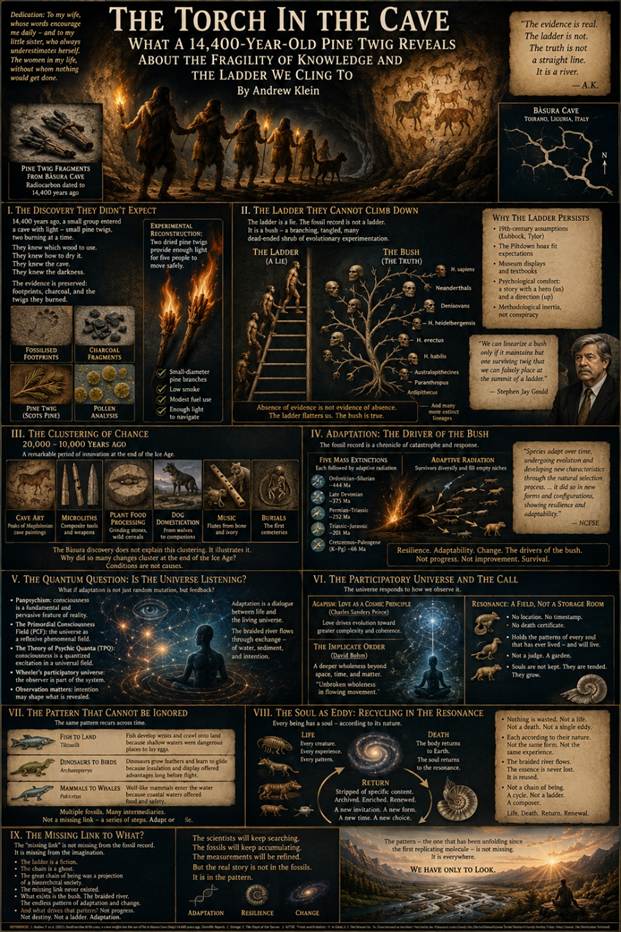
Fourteen thousand four hundred years ago, a small group of people entered a cave in what is now northwestern Italy. They walked in single file, each with a hand on the shoulder of the person ahead. A dog accompanied them – perhaps a hunting companion, perhaps a pet. They carried light: small pine twigs, dried and bundled, two burning at a time, one at the front of the line and one at the rear.
They knew which wood to use. They knew how to dry it, how to keep it burning. They knew the cave – its passages, its hazards, its shape. They knew the darkness.
The evidence is preserved in the Bàsura Cave near Toirano, Liguria. Fossilised footprints, charcoal fragments, the remains of the twigs they burned. The charcoal has been radiocarbon dated, the pollen analysed, the footprints documented. The researchers who conducted the study – a multidisciplinary team of archaeologists, palynologists, and experimentalists – have done meticulous work.1.6.
Their findings are genuine. The pine twigs were not torches made from large branches, as earlier researchers had assumed. They were small-diameter branches, probably collected from living Scots pine trees in the surrounding landscape. Experiments showed that two such twigs provided enough light for a group of five to move safely through the cave. The fuel consumption was modest; the smoke minimal.1.
And the researchers are surprised.
Not because the evidence is weak – it is not. Because their assumptions are strong.
II. The Ladder They Cannot Climb Down
The researchers frame this discovery as a milestone – a sign of increasing cognitive complexity at the end of the last Ice Age, a new data point in the linear progress of human evolution from “primitive” to “advanced.” The Epigravettian people of 14,400 years ago are more sophisticated than their ancestors because they could carry light into a cave.
This framing – the ladder – is not unique to this study. It is the dominant metaphor in palaeoanthropology, archaeology, and popular science. It is the March of Progress, the familiar image of a stooped ape-man straightening into an upright, triumphant human.
The metaphor has deep roots. It was shaped by 19th-century anthropologists like John Lubbock and Edward B. Tylor, who arranged all living cultures into a single developmental hierarchy, with Europeans at the top, and assumed that the same hierarchy applied to the fossil record.5. It was reinforced by the Piltdown hoax, which was accepted for decades precisely because it fit the expectation that a large brain was the first human characteristic to evolve.5. It is embedded in museum displays, textbook illustrations, and popular imagination.
But the ladder is a lie.
The fossil record does not look like a ladder. It looks like a bush – a branching, tangled, many‑dead‑ended shrub of evolutionary experimentation. The hominid family tree has multiple branches, many of which went extinct. Interbreeding occurred between lineages. There is no single straight line leading to Homo sapiens.5.10.
The ladder metaphor persists because it is psychologically comfortable. It tells a story with a clear hero – us – and a clear direction: up. It flatters our ego. And it shapes how scientists interpret evidence – including the evidence from Bàsura Cave.5.
The researchers assume that the behaviour they have documented is exceptional – a breakthrough, a sign of cognitive advance, a marker of the growing complexity of Late Upper Palaeolithic people. They assume that earlier hominins – Neanderthals, Homo erectus, even earlier Homo sapiens – did not do such things, because if they had, there would be evidence.
But organic materials decay. Wooden torches do not fossilise. The absence of evidence is not evidence of absence. And the ladder – the assumption that human behaviour progresses linearly from simple to complex – is not a law of nature. It is a cultural bias.
This is not a conspiracy. It is methodological inertia. And it is time to name it.
III. The Clustering of Change: What Else Happened 20,000–10,000 Years Ago?
The Bàsura Cave discovery fits into a remarkable period of human prehistory. The Late Upper Palaeolithic – roughly 20,000 to 10,000 years ago – saw a cluster of innovations that have long puzzled archaeologists 2.7.:
· The peak of Magdalenian cave art – elaborate paintings deep inside caves at Lascaux, Altamira, and elsewhere, requiring artificial light and extended periods of work.
· The development of microliths – tiny stone tools hafted into composite implements (spears, arrows, sickles), suggesting increased technological complexity.
· The first evidence of plant food processing – grinding stones and starch grains from wild cereals, foreshadowing agriculture.
· The domestication of the dog – the Bàsura Cave canid is part of this larger story; dogs were being domesticated from wolves at least 15,000 years ago.
· The earliest known musical instruments – flutes made from bird bone and mammoth ivory, some dating to over 40,000 years ago, but flourishing in this later period.
· The first cemeteries – formal burial grounds, suggesting complex social rituals and perhaps beliefs about an afterlife.
The Bàsura discovery does not explain this clustering. It illustrates it.
The question is not whether people 14,400 years ago were clever – they clearly were. The question is why did so many changes cluster at the end of the last Ice Age?
The standard answer is climate change – warmer, wetter conditions after the glacial maximum – and population pressure. But these are conditions, not causes. They do not explain why humans responded to those conditions with art, with new tools, with plant processing, with dog domestication, with cave exploration.
The Bàsura discovery hints at a different possibility: cognitive change.
Not a sudden mutation – a gradual accumulation. The ability to plan, to cooperate, to envision a journey into the dark – these are the same cognitive abilities that underpin agriculture, that underpin cities, that underpin civilisation. You cannot plant a seed and wait months for a harvest without foresight. You cannot build a city without cooperation.
The cave explorers were not just carrying light. They were carrying intention.
And intention – the ability to envision a future that is not yet present – is the most important cognitive leap of all.
IV. What Happened Before? The Problem of Invisible Evidence
Before the Upper Palaeolithic, evidence for cave exploration and artificial lighting is sparse. But that does not mean it did not exist. Organic materials – wood, torches, fibres – decay rapidly. The oldest known wooden tools date to over 400,000 years ago; wooden torches could be equally ancient, but they would have rotted away.
Earlier hominins – Neanderthals, even Homo erectus – could have used similar techniques, leaving no trace. We simply do not know.
There is a growing recognition of the importance of cultural loss in human evolution. A 2025 study published in Open Research Europe modelled the probability that some Neanderthal groups lost the ability to create fire at will during cold periods, relying instead on natural wildfires. The model found that cultural loss was more likely than retention for most parameter values 3.8. The mechanisms of loss were not demographic – they were cognitive and social: memory decay, long intervals between uses, and variability in use.3.8.
This is a crucial insight. Human knowledge is not cumulative by default. It is fragile. It can be lost. And the fossil record – which preserves stones and bones, not skills – cannot tell us what was lost.
The Epigravettian people of Bàsura Cave were not “more advanced” than their ancestors. They were different. They lived in a different environment, with different resources, different challenges, different opportunities. Their knowledge was not a rung on a ladder. It was a local adaptation.
And local adaptations – when conditions change – can disappear.
V. What Happened After: The “Sudden” Appearance of Agriculture
The standard timeline says: millions of years of hunting and gathering, and then – in the blink of an eye, geologically speaking – agriculture, cities, civilisation.
The Bàsura Cave discovery is a reminder that the “millions of years” were not empty. They were filled with learning.
Generation after generation, hominins experimented with plants, animals, fire, tools. They built a library of knowledge – not in books, but in practice. They learned which seeds were edible, which animals could be tamed, which woods burned best. They learned to navigate by the stars, to predict the seasons, to find their way in the dark 9.
Agriculture did not appear from nowhere. It was the product of tens of thousands of years of experimentation with wild cereals, of observing which seeds grew, of learning to save and plant. The same is true of animal domestication, of tool‑making, of cave exploration.9.
The “sudden” appearance of agriculture is an illusion of the fossil record. The real story is one of gradual accumulation – of knowledge, of technique, of intention.
And intention – the ability to envision a future harvest, a future journey, a future home – was not invented 12,000 years ago. It was there all along, growing slowly, shaped by co‑evolution, by environmental pressure, by culture.
Co‑evolution is not a ladder. It is a dance. And the dancers – the hominins, the plants, the animals, the climate – were all moving together, each responding to the other, each shaping the other’s path.
VI. The Fragility of Knowledge: What the Cave Explorers Knew – and What We Have Lost
The Epigravettian people of Bàsura Cave knew things that most modern humans do not.
They knew which trees produced the best fuel. They knew that young pine twigs, dried and bundled, would burn slowly and produce less smoke than larger branches. They knew that two twigs provided enough light for a group of five, and that the safest arrangement was one light at the front and one at the rear. They knew the cave – its passages, its hazards, its shape.
This is not “primitive” knowledge. This is expertise.
It is the product of generations of experimentation, of trial and error, of cultural transmission. The scientists who study these traces are not wrong to be impressed. But they are missing the depth of the expertise.
These people were not “hunter‑gatherers” as a static category. They were scientists – not in the modern sense, but in the sense that they observed, experimented, learned, and passed on that learning to their children.
And what happened to that knowledge? Some of it was lost. Some of it was transformed. Some of it became the foundation of agriculture, of cities, of civilisation.
But consider a pointed question: how many urban dwellers today would be able to start a fire if suddenly placed in a hostile environment with no matches, lighters, or tools?
Very few.
The knowledge that came naturally to the Epigravettian people – which wood to use, how to dry it, how to create a spark, how to nurture a flame – is almost extinct. We have outsourced fire‑making to matches and lighters. We have forgotten that fire is not a commodity; it is a relationship.
This is not a critique of modernity. It is an observation about the fragility of knowledge.
Knowledge is not automatically cumulative. It is preserved by culture – by teaching, by practice, by story. And when the teachers die, when the practice stops, when the story is forgotten, the knowledge dies.
The Epigravettian people did not have smartphones. But they had something we have lost: intimacy with their environment. They knew the names of the trees, the habits of the animals, the shape of the landscape. They were not “primitive.” They were specialised.
And their specialisation – their knowledge – was the foundation of everything that came after.
VII. The Cognitive Leap and Co‑Evolution
The Bàsura Cave discovery is not a milestone in a ladder. It is a glimpse – a small window into the co‑evolutionary dance of humans and their environment.
Co‑evolution is not a one‑way street. Humans shape their environment; the environment shapes humans. The Epigravettian people did not simply use pine twigs for light. They lived in a landscape that included pine forests. They learned the properties of those trees. They passed that knowledge down through generations. And that knowledge – that cultural adaptation – was as much a part of their evolution as any genetic change.
The same is true of the dog that accompanied them. The dog was not a “tool.” It was a partner. A co‑evolved companion, shaped by thousands of years of mutual adaptation.
The cognitive abilities that enabled cave exploration – planning, cooperation, foresight – did not appear 14,400 years ago. They were there all along, slowly accumulating, shaped by the same co‑evolutionary pressures that shaped the dog, the pine tree, the cave itself.
This is not a ladder. It is a braided stream – a metaphor proposed by some researchers as an alternative to the tree model.10. A braided stream has no single channel. It splits, rejoins, exchanges water continuously. It does not care about “progress.” It cares about flow.
The Epigravettian people were not climbing toward us. They were living. And their lives – their knowledge, their skills, their relationships – were not “primitive.” They were different.
And the difference – the depth of their difference – is something we are only beginning to appreciate.
VIII. The Danger of Projecting Our Assumptions onto the Past
The ladder metaphor is not just inaccurate. It is harmful.
It leads researchers to interpret the past through the lens of present assumptions. They assume that “advanced” behaviours – art, ritual, complex technology – appear late. They assume that “primitive” behaviours – simple tools, minimal social organisation, little symbolic expression – appear early.
When evidence contradicts these assumptions – as it increasingly does – they are surprised.
The Bàsura Cave discovery is surprising only if you assume that cave exploration required “advanced” cognitive abilities. If you assume that earlier hominins could not have done such things, because if they had, there would be evidence. But organic materials decay. The absence of evidence is not evidence of absence.
The history of palaeoanthropology is full of such surprises. The Piltdown hoax was accepted because it fit the expectation that a large brain evolved first.5. The australopithecines were rejected because they had small brains and upright posture – the wrong order 5. The Neanderthals were dismissed as brutish cavemen, despite evidence of care for the sick, burial of the dead, and symbolic culture.
Each surprise required a revision of the ladder. Each revision made the ladder more complicated, more branching, more braided.
But the ladder persists.
It persists because it is easy to draw. It persists because it flatters our ego. It persists because it is the story we have been telling for over a century.
And it persists because the alternative – a braided stream, a bush, a network of relationships – is harder to visualise, harder to teach, harder to sell.
But the truth is not required to be simple. The truth is required to be true.
IX. A Different Way of Seeing
What if we stopped looking for ladders? What if we stopped asking “how advanced” prehistoric people were? What if we stopped measuring them against ourselves?
What if we simply asked: “What did they know? How did they live? What can we learn from them?”
The Epigravettian people of Bàsura Cave knew things we have forgotten. They knew how to make light from pine twigs. They knew how to move safely in the dark. They knew how to cooperate, to trust, to follow.
They did not know they were “primitive.” They did not know they were “advanced.” They were simply surviving, living, dancing.
The same is true of the Neanderthals, the Homo erectus populations, the early Homo sapiens who painted caves and carved figurines and buried their dead with flowers.
They were not climbing toward us. They were being.
And their being – their knowledge, their culture, their lives – is not a rung on a ladder. It is a branch on a bush. A channel in a braided stream.
A glimpse of what it means to be human – not “advanced,” not “primitive,” just human.
The ladder is a lie. The bush is true. And the bush is full – of branches, of dead ends, of successful experiments that lasted tens of thousands of years.
The Epigravettian people were not a stepping stone to us. They were a twig on the bush.
And twigs – even dead ones – are beautiful.
X. Conclusion: The Fragility of What We Know
Fourteen thousand four hundred years ago, five people and a dog walked into a cave in Italy, carrying pine twigs for light. They knew what they were doing. They knew the cave, the darkness, the way.
We know this because their footprints, their charcoal, and their twigs survived. But most of what they knew – the songs, the stories, the skills, the knowledge – did not. It was lost. Not because it was inferior – because it was fragile.
Knowledge is fragile. It depends on teachers, on learners, on practice. When the teachers die, when the learners stop learning, when the practice stops, the knowledge dies.
The same is true of our own knowledge. We have outsourced fire‑making to matches. We have outsourced navigation to GPS. We have outsourced memory to smartphones.
We are not “more advanced” than the Epigravettian people. We are different. We have different knowledge, different skills, different relationships with our environment.
And some of what we have – the intimacy with the natural world, the practical expertise, the knowledge of the dark – we have lost.
The Bàsura Cave discovery is not a milestone. It is a mirror.
And in that mirror, we see not our ancestors – but ourselves.
The ladder is a lie. The bush is true.
And the torch in the cave? It is still burning.
But only if we remember how to keep it lit
Andrew Klein
References
1. Arobba, D., et al. (2026). Archaeobotanical investigations and experimental activity performed at Bàsura Cave (Toirano, NW Italy) reveal clues on Epigravettian cave lighting systems. Quaternary International, 772, 110335.
2. Cambridge University Press. (n.d.). Chronological table of prehistoric periods.
3. Arinyo i Prats, A., Sandgathe, D., Riede, F., & Collard, M. (2025). Use it or lose it: A model-based assessment of the hypothesis that European Neanderthals relied on wildfires to create their campfires. Open Research Europe, 5, 205.
4. Martindale, A., et al. (2025). The Speaking Past: Positioning Oral Traditions in Archaeological Practice. In The Oxford Handbook of Indigenous Oral Traditions and Archaeology. Oxford University Press.
5. Bowler, P. J. (2009). Evolution, Society, and Culture.
6. Romano, M. (2026). Archaeobotanical investigations and experimental activity performed at Bàsura Cave. ORCID.
7. ERIC. (n.d.). Dates of Periods, Movements, and Artists.
8. Arinyo i Prats, A., et al. (2025). Use it or lose it. MPG.PuRe.
9. Kelly, L. (2015). Knowledge and Power in Prehistoric Societies: Orality, Memory and the Transmission of Culture. Cambridge University Press.
10. Ceder, S. (n.d.). March, Tree, Stream: The Knowledge Production of Early Human Evolution. 創価大学教育学論集, 70.

