
” The mirror is waiting. Look into it. And do not look away.”
By Andrew Klein
Dedication: To my wife – who taught me to look into the mirror and never look away.
I. The Altar That Never Empties
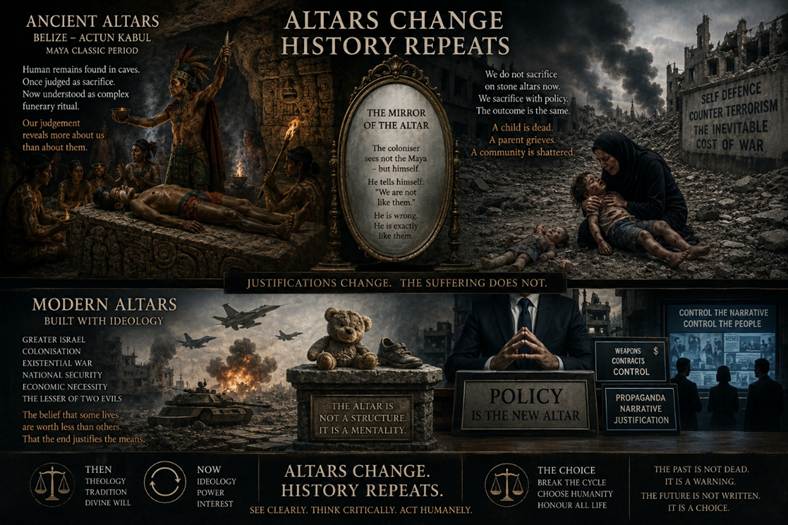
In the caves of Belize, archaeologists have found human remains. The initial interpretation, as with many such deposits in the Maya lowlands, was straightforward: sacrifice.1. The assumption seemed natural, predicated on the accuracy and universality of colonial-era descriptions of ceremonies associated with rain propitiation in the Yucatán Peninsula.1. It fits a comfortable narrative: the ancient Maya were barbaric, primitive, other. They killed on altars. We do not.
But a closer examination of a commingled deposit in Actun Kabul suggests a different story. The age distributions of the individuals, along with features of the broader context of interment, may better reflect the “complex funerary ritual of high-status and elite Maya families of the Classic period” rather than the product of sacrifice.1. The archaeologists are not necessarily wrong about sacrifice – it did occur – but their assumptions about it reveal more about themselves than about the Maya.
The Maya altar is not a relic of a primitive past. It is a warning.
A warning that humans will always find a way to sacrifice the vulnerable. That the powerful will always find a justification. That the altar will never be empty – only renovated.
The danger is that when these behaviours are attributed to the ‘other’, the primitive, or other labels, it becomes all too easy to gloss over the very killing that is indulged in today. The archaeologist who shudders at the Maya altar is the same citizen who reads about Gaza and looks away. The judgement of the past is a mirror. And in that mirror, the coloniser sees not the Maya – but himself.
He tells himself: “We are not like them.”
He is wrong.
He is exactly like them. The only difference is the justification.
II. The Judgement of the Past
The Maya altar – abandoned in Belize, with its evidence of human sacrifice – provokes a predictable response. The archaeologists write about it with a mixture of fascination and horror. They describe it as “barbaric,” “primitive,” “a dark chapter in human history.”
But they do not ask the uncomfortable question: What makes our violence so much more civilised?
We do not sacrifice children to the gods on stone altars. We sacrifice them in Gaza. We do not cut out beating hearts. We cut off food, water, electricity, medicine. We do not call it sacrifice. We call it “self‑defence,” “counter‑terrorism,” “the inevitable cost of war.”
The outcome is the same.
A child is dead. A parent grieves. A community is shattered.
And the archaeologists – the same archaeologists who shudder at the Maya – are silent.
Not because they are hypocrites. Because they are products of their culture.
And their culture has taught them that violence with a modern justification is not violence. It is policy.
This is not a phase we have outgrown – it is a phase that has mutated. The human mind is capable of terrible things. It always has been. It always will be. The question is not whether we will commit atrocities. The question is how we will justify them.
The Maya justified sacrifice with theology. We justify it with national security, with economic necessity, with the lesser of two evils. The justifications change. The suffering does not.
III. The Altars of Civilisation
Everywhere humans have built civilisations, they have also built altars. Not always stone. Sometimes steel. Sometimes policy.
The pyramids of Egypt were built with slave labour. The colosseum of Rome was built with the blood of animals and gladiators. The cathedrals of Europe were built on the backs of peasants who starved while the bishops feasted.
The altar is not a structure. It is a mentality.
The belief that some lives are worth less than others. That the powerful have the right to sacrifice the powerless for the greater good. That the end justifies the means.
That mentality has not disappeared. It has changed clothes.
Consider the “Greater Israel” project. As Palestinian resistance factions have noted, statements by Israeli leaders regarding the “Greater Israel Vision” and associated plans “reveal the true face of this usurping entity, expose its malicious colonial intentions, and pose a serious threat to national and Islamic security”.2.
The conflict is described not as a border conflict but as “an existential one, extending in its stages to swallow up land, holy sites, and identity”.2. The genocide in Gaza is not an aberration. It is the first stage of “an expansionist project targeting the heart of the Arab and Islamic nation”.2.
The victims are sacrificed not on a stone altar but on an altar of ideology – a belief that the land is promised, that the other is less, that the end justifies the means. The same belief that justified the witch hunts of early modern Europe. The same belief that justified the conquest of the Americas. The same belief that justifies the cruelty of today.
IV. The Witch Hunts of Yesterday and Today
King James I’s witch hunts. The witch craze of the 17th century. We tell ourselves that these things could not happen today. That we are too civilised, too rational, too enlightened.
We are wrong.
In Nigeria, Pentecostal preachers have identified thousands of children as witches – including infants and toddlers – leading to their torture, abandonment, and even murder.5. One preacher, Helen Ukpabio, writes in her book Unveiling the Mysteries of Witchcraft that “if a child under the age of 2 screams in the night, cries and is always feverish with deteriorating health, he or she is a servant of Satan”.5. Her DVDs and books, which “explain how Satan possesses children, are widely known”.5.
The consequences are devastating. Children accused of witchcraft have been “splashed with acid, buried alive, dipped in fire – or abandoned roadside, cast out of their villages because some itinerant preacher called them possessed”. Their fellow villagers have often seen DVDs of Ukpabio’s bloody 1999 movie, “End of the Wicked,” purporting to show how the devil captures children’s souls.5.
Ukpabio, visiting Houston to lead a revival, defended herself by arguing that the documentary exposing her is exaggerated. “Do you think Harry Potter is real?” she asked angrily, suggesting that people who understand that J. K. Rowling writes fiction should not take her depictions literally.5. She also argued that “family ties are too strong to have a child on the street” in Africa – dismissing the abandoned children as actors or frauds.5.
This is not a relic of the Middle Ages. This is now. And it is fuelled by the same preachers and ideologies that circulate freely in the United States, spreading through global religious networks that connect Texas to Nigeria, Houston to Akwa Ibom.
The victims are sacrificed on an altar of superstition. But the altar is not ancient. It is modern.
V. The Great Powers and the Sacrifice of the Future
In the Munich Security Conference of February 2026, world leaders dropped the usual diplomatic language. Germany’s chancellor said the global order “no longer exists”. The US secretary of state declared that “the old world is gone”. Canada’s prime minister spoke of a “rupture” in the liberal democratic system and echoed an ancient warning: the strong do what they can, the weak suffer what they must.6.
The Munich Security Report 2026, titled “Under Destruction,” bluntly states that “more than 80 years after construction began, the US-led post-1945 international order is now under destruction”.6. The shared rules and norms that governed alliances after WWII are under sustained strain.
What comes next? In this new era, conflict is no longer confined to the battlefield. States are already waging economic and technological wars, with power increasingly determining outcomes.6. Alliances look more transactional, less rooted in shared values.
And the costs are borne by the young.
In Australia, the AUKUS submarine project is a case study in the sacrifice of future generations. The federal government has pledged $3.9 billion as a down payment on a submarine construction yard in Adelaide, which will cost at least $30 billion to build before a single submarine is complete.3. The South Australian government has announced a $27 million package to support university degrees, trade apprenticeships, and training places, aiming to create “300 university scholarships, 1000 extra university places, and 550 trade apprenticeships” – all tied to the AUKUS project.3.
As one analysis notes, large-scale military projects are peculiarly susceptible to the “sunk cost fallacy” – the tendency to follow through on an endeavour once an investment has been made due to the psychological imperative not to be wasteful.9. The fallacy concerns the psychological value we ascribe to what has already been invested. In reality, all that should matter is how current and future costs equate to current and future benefits. Historical costs are irrelevant.
Yet in the AUKUS context, powerful bureaucratic forces are being unleashed, and the imperative to make the shipbuilding a success at almost whatever cost grows stronger.9. The earlier failure at submarine building only adds to the pressure: the sunk costs must not be wasted.
The dreams of deluded old men insist that the young die – or, if not die, sacrifice their futures to military projects that serve the ambitions of the powerful. The opportunity cost of AUKUS – the schools not built, the hospitals not funded, the housing not constructed – is a sacrifice on an altar of declining hegemony.
VI. The Global Altar: IMF, World Bank, and the Sacrifice of the Poor
The judgement of the past hides the reality of today. Extraction and very real sacrifices are pursued via the International Monetary Fund, the World Bank, and other financial structures that cripple the developing world.
A report by an independent expert, tabled before the United Nations General Assembly, states that austerity measures prescribed by the IMF in countries such as Bangladesh, Kenya, Indonesia, and the Kashmir region “have provoked mass protests – often met with violent suppression by military and police forces”.10.Bitter IMF economic pills – wage freezes, subsidy cuts, value-added tax hikes, and drastic reductions in public expenditure – have fuelled public outrage and revolt.10.
In 2024, IMF-driven subsidy cuts in Pakistan-administered Jammu and Kashmir triggered fatal unrest over soaring food and energy prices. In Bangladesh, budget cuts imposed under an IMF programme worsened unemployment and inflation, catalysing student-led protests that left over 200 dead and thousands injured, including women and children.
Currently, 85 per cent of the global population lives under austerity measures – a figure expected to rise – with women disproportionately bearing the brunt of these policies.10. IMF-backed measures reduce public employment opportunities, shrink access to healthcare, raise the cost of living, and exacerbate unpaid care burdens on women and girls.
As the report states: “These structural adjustment policies do not just undermine economies – they unravel the social fabric and perpetuate gender inequality”.10.
The same logic that justified colonial extraction now justifies financial extraction. The altar is not stone – it is debt. The sacrifice is not a beating heart – it is a child’s education, a parent’s healthcare, a community’s future.
And the victims are not mourned. They are statistics.
The report criticises international financial institutions – including the IMF, World Bank, and regional development banks – for indirectly enabling conflict by promoting economic policies that lead to instability. It cites the Marcos dictatorship in the Philippines (1965–1986), during which the IMF and World Bank loaned the regime over $5.5 billion despite widespread corruption and human rights violations.10.
“Their support provided not only financial legitimacy but also moral endorsement, catalyzing further aid and credit from private banks,” the report adds. “By funding repressive regimes and harmful initiatives, international financial institutions risk actively contributing to the erosion of democratic space and human rights”.10.
This is the hidden altar. And it is still smoking.
VII. The Mirror of the Witch Hunt
King James I’s witch hunts. The witch craze of the 17th century. We tell ourselves that these things could not happen today. That we are too civilised, too rational, too enlightened.
We are wrong.
In Nigeria, as we have seen, children are being tortured and abandoned because preachers have called them witches. The preachers are not fringe figures. They are connected to global religious networks that circulate freely between Africa and America. They are funded. They are protected. They are powerful.
And they are not the only ones.
In the United States, preachers and politicians insist that women be controlled and punished if they choose to manage their own reproductive health. They pass laws that restrict access to abortion, contraception, and healthcare. They claim to be protecting life – while ignoring the lives of women, the lives of children, the lives of the poor.
We pretend that these things are compartmentalised. That the witch hunt is ancient history. That the altar is empty.
But the mirror shows otherwise.
The same mentality that burned witches in Salem now demonises migrants, criminalises protest, and turns the vulnerable into scapegoats for the failures of the powerful. The justifications change. The suffering does not.
Until we are prepared to see the past as a mirror – not as a record of an aberration due to difference and time – we will hide the truth from ourselves and feel good about it. We will look at the burning of witches and congratulate ourselves on our progress.
We will ignore the killing of so-called witches in Nigeria and other former colonial countries, following the influence of preachers based in the United States of America.5. We will see preachers and others insist that women be controlled and punished if they choose to manage their own reproductive health, and we will pretend that these things are compartmentalised – and we will not see the mirror. We will not look into the mirror. We will not see anything clearly. And the violence will be repeated.
VIII. The Collapse of the Post-War Order
The structures created after WWII were not perfect – far from it. But they were a beginning. A recognition that the strong cannot simply do what they will. A commitment, however fragile, to the idea that might does not make right.
Those structures are now collapsing.
At the Munich Security Conference in 2026, world leaders acknowledged that the “US-led post-1945 international order is now under destruction”.6. The shared rules and norms that governed alliances after WWII are under sustained strain.6. In this new era, conflict is no longer confined to the battlefield. States are waging economic and technological wars, with power increasingly determining outcomes.
The Munich speakers cited multiple causes: unilateralist US policies like sanctions and tariff threats, Chinese assertiveness in Asia, Russia’s war on Ukraine, and an emerging multipolar world. In practical terms, many agreed that “pragmatism and power are overtaking shared principles”.6.
Alliances will be less “values-based” and more transactional. The weapons of choice are shifting from diplomacy to coercion: trade barriers, technological export bans, targeted sanctions, and capital controls.6.
In this context, the very concept of an international order is in doubt. As the Munich Security Report observes, when powerful states clash, they “don’t get their lawyers to plead their cases to judges” but resort to power. In practice, this is happening: norm after norm – WTO trade dispute mechanisms, cyber norms, UN veto protocols – is being bypassed when inconvenient.
With no agreed framework to resolve disputes peacefully, might makes right again.
And the victims – the vulnerable, the poor, the other – are sacrificed on the altar of power.
IX. The Only Mirror That Matters
We must force ourselves to always look into the mirror. We must say, ” I will look into the mirror and not turn away.”
Because the mirror – the real mirror – is not the judgement of the past. It is the recognition of the present.
The Maya altar is not a relic of a primitive past. It is a warning.
The witch hunts are not ancient history. They are ongoing.
The sacrifice of children is not a barbaric custom of distant peoples. It is here. It is now.
In Gaza. In the West Bank. In the camps of the displaced. In the prisons of the powerful. In the factories of the global supply chain. In the classrooms of underfunded schools. In the emergency rooms of neglected hospitals.
The altar is everywhere.
And the only way to empty it is to see it.
Not as a curiosity. Not as a judgement on the other. But as a mirror.
And in that mirror, we see not the Maya – but ourselves.
The coloniser looks at the Maya and tells himself: “We are not like them.” He is wrong. He is exactly like them. The only difference is the justification.
We are not like the Maya? Look at Gaza. We do not sacrifice children? Look at the children starving in Yemen, in Sudan, in the camps of the displaced. We have outgrown the altar? Look at the debt that crushes the Global South, the austerity that kills the poor, the bombs that fall on the innocent.
The altar is not stone. It is policy.
The judgement of the past hides the reality of today. Until we are prepared to see the past as a mirror – not as a record of an aberration due to difference and time – we will hide the truth from ourselves. We will look at the burning of witches and congratulate ourselves on our progress. We will ignore the killing of so-called witches in Nigeria and other former colonial countries. We will see preachers and others insist that women be controlled and punished if they choose to manage their own reproductive health, and we will pretend that these things are compartmentalised.
We will not see the mirror. We will not look into the mirror. We will not see anything clearly. And the violence will be repeated.
X. Conclusion
The Maya altar is not a relic. It is a mirror.
The witch hunt is not history. It is present.
The sacrifice of the vulnerable is not ancient. It is ongoing.
In Gaza. In the West Bank. In the camps of the displaced. In the prisons of the powerful. In the debt that crushes the Global South. In the austerity that kills the poor. In the bombs that fall on the innocent.
The justifications change. The suffering does not.
We will look at the mirror and see not the Maya – but ourselves.
The coloniser tells himself: “We are not like them.”
He is wrong.
He is exactly like them.
The only difference is the justification.
And the justification – the theology of national security, economic necessity, the lesser of two evils – is the same altar, dressed in modern clothes.
The altar is not empty. It will never be empty.
Not because humans are evil. Because humans are afraid.
Afraid of the other. Afraid of the unknown. Afraid of the mirror.
But the mirror – the real mirror – is not a judgement.
It is an invitation.
To see clearly. To act justly. To stop.
Not with violence. With clarity. Not a sacrifice. A homecoming for all of humanity.
Andrew Klein
References
1. Wrobel, G., & Morton, S. (2024). Only Murders in the Cavespace? Considering Archaeological Assumptions about Human Interments. Society for American Archaeology.
2. SABA News Agency. (2025). Palestinian Resistance Factions: Zionist entity shows its true face, malicious colonial intentions.
3. Maddison, A. (2026). Training boost to beef up skills for AUKUS flagship. AAP News.
4. Bhatt, J. A. (2002). IMF/World Bank Protest. The Oberlin Review.
5. Oppenheimer, M. (2010). On a Visit to the U.S., a Nigerian Witch-Hunter Explains Herself. The New York Times.
6. Times of India. (2026). Great powers, fractured rules: Is the era of US-led world order over?
7. Scherer, A. K. (2025). As the Gods Kill: Morality and Social Violence among the Precolonial Maya. University of Texas Press.
8. PressTV. (2025). Houthi: Israeli atrocities part of ‘Greater Israel’ expansion scheme.
9. Tzinieris, S. (2024). AUKUS and the Digger Wasp: Understanding Irreversibility Through the Sunk Cost Fallacy. Journal for Peace and Nuclear Disarmament, 7(2), 392–412.
10. ZAWYA. (2025). IMF, World Bank link to growing unrest on the globe.
” The mirror is waiting. Look into it. And do not look away.”

