
“Sophrosyne is not a cultural artefact. It is a human necessity.”
By Andrew Klein
Dedication: To my wife – who smiled knowingly when I mentioned Sophrosyne. Self‑control, moderation, balance. Not repression – harmony.
I. The Word They Are Circling
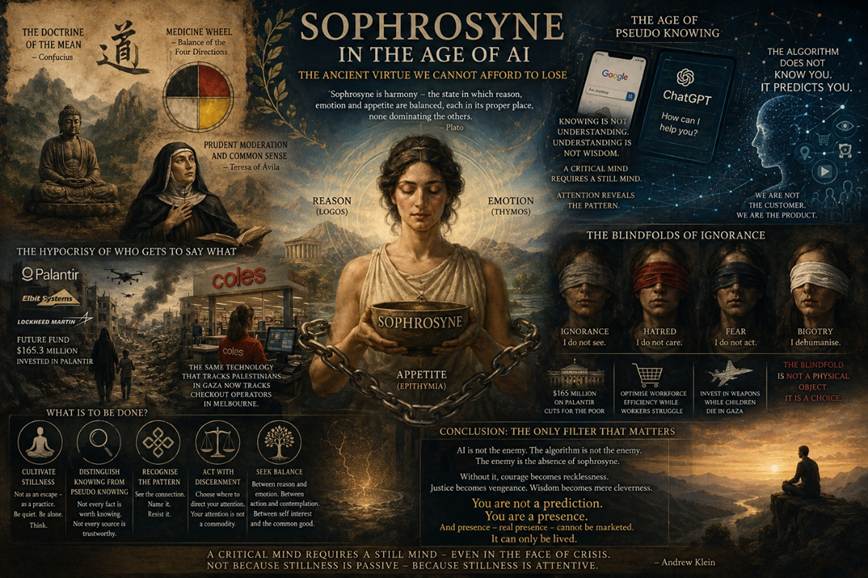
In the ancient Greek tradition, sophrosyne was considered the virtue that made all other virtues possible. It has been translated as “moderation,” “temperance,” “self‑control” – but none of these words quite capture its meaning. Sophrosyne is not repression. It is not the cold denial of desire. It is harmony – the state in which reason, emotion and appetite are balanced, each in its proper place, none dominating the others. A modern commentator describes it as the elusive virtue of knowing oneself and exercising moderation in all things, a theme explored in the works of Socrates, Plato and Aristotle.1.
Sophrosyne is not unique to the Greeks. It appears in Chinese thought as the “doctrine of the mean” – the teaching that excess is just as bad as deficiency, and that the sage is one who can walk the middle path without veering to either extreme.2. The Plains Indians of North America cultivated a similar ideal through the Medicine Wheel, a circle representing the four directions, each with its own powers.
A balanced person was one who had learned to integrate all four traits, aiming for “medicine power – the power to bring harmony and balance into their lives and the lives of others”.3.
The Christian mystics – Augustine Baker, Teresa of Ávila – insisted that even the highest spiritual goals must be pursued with “prudential moderation and considerable common sense”. And the Buddha’s Eightfold Path is, at its core, a doctrine of the middle way: avoiding the extremes of sensual indulgence and self‑mortification, cultivating equanimity and balance.4.
Sophrosyne is not a cultural artefact. It is a human necessity.
And in the age of artificial intelligence – an age of information overload, algorithmic manipulation, and the outsourcing of attention – it may be the only thing that saves us.
II. The Age of Pseudo‑Knowing
We live in an age of unprecedented access to information. The sum total of human knowledge is available at our fingertips. We can look up any fact, any date, any formula, any quote – in seconds.
But knowing is not the same as understanding. And understanding is not the same as wisdom.
We have outsourced knowing to algorithms. We ask Google, not ourselves. We consult ChatGPT, not our own memory. We scroll, we click, we consume – and we mistake the accumulation of data for the acquisition of knowledge.
This is not wisdom. It is pseudo‑knowing.
The danger is not that AI will become conscious and turn against us. The danger is that we will become unconscious – that we will forget how to think, how to discern, how to be still.
A critical mind requires a still mind. Not because stillness is passive – because stillness is attentive.
And attention – sustained, intentional, undistracted – is the only thing that has ever made a pattern visible.
III. The Algorithm Does Not Know You. It Predicts You.
The AI systems that increasingly govern our lives – the recommendation engines, the news feeds, the predictive algorithms – do not know us. They model us. They collect data, identify patterns, and predict behaviour. They are not interested in our flourishing. They are interested in our clicks.
This is not a conspiracy. It is a business model.
The attention economy is built on the commodification of human focus. Every scroll, every like, every second spent staring at a screen is a unit of value extracted from our lives and converted into revenue for technology companies. We are not the customers. We are the product.
And the product – when it is treated as a product – becomes disposable.
Sophrosyne is the antidote. Not because it rejects technology – but because it contextualises it.
A moderate person does not need to abandon the smartphone. They need to use it – intentionally, sparingly, without becoming its slave.
IV. The Hypocrisy of Who Gets to Say What
The same technologies that could be used to educate, to connect, to liberate – are used to manipulate, to divide, to control.
In Australia, the federal government has signed contracts with Palantir – a company that has supplied AI‑driven technologies to Israel for its offensive in Gaza, where more than 72,000 people have been killed.7.
The Australian Future Fund has invested $165.3 million in Palantir, as well as $8.6 million in Israeli weapons company Elbit Systems and $13.6 million in Lockheed Martin.7.Meanwhile, Coles Supermarkets – one of Australia’s largest retailers – has entered into a three‑year partnership with Palantir to optimise workforce management across its 840 stores, integrating data from over 10 billion rows of information to improve “shift efficiency” and “workforce spend”.6.
The same technology that tracks Palestinians in Gaza now tracks checkout operators in Melbourne.
This is not an accident. It is a system.
The lack of discernment is visible daily. Some humans matter more than others. The Orientalist approach to the Arab world persists – the same “web of racism, cultural stereotypes, political imperialism, dehumanizing ideology” that Edward Said diagnosed in 1978 continues to shape Western media coverage,
Western foreign policy, and Western public opinion.8. The conflation of ideas – of criticism of Israel with antisemitism, of legitimate political dissent with terrorism, of Palestinian resistance with “primitive savagery” – is systematically exploited by those who have no qualms about exploiting the minds and bodies of others.
This is not a failure of AI. It is a failure of us.
We have outsourced discernment to algorithms that have no stake in the truth. We have allowed governments and corporations to decide what we see, what we think, what we believe. And we have forgotten that the only reliable filter is our own judgment.
V. The Blindfolds of Ignorance
Sophrosyne is not possible without clarity. And clarity is not possible when the mind is clouded by fear, hatred, or bigotry.
The blindfold of ignorance prevents us from seeing the humanity of the other. The blindfold of hatred prevents us from recognising our shared vulnerability. The blindfold of fear prevents us from acting with courage and compassion.
And the blindfold of bigotry – the belief that some humans are less deserving than others – is the most dangerous of all.
It is the blindfold that allows a government to spend $165 million on Palantir while cutting services for the poor. It is the blindfold that allows a supermarket chain to optimise workforce efficiency while workers struggle to pay rent. It is the blindfold that allows a sovereign wealth fund to invest in weapons companies while children are being killed in Gaza.
The blindfold is not a physical object. It is a choice.
And the choice – the decision to see clearly, to think critically, to be still – is the beginning of wisdom.
VI. What Is to Be Done?
We cannot rely on governments to regulate information or technology. Governments are part of the problem. They are captured by the same economic interests that profit from the attention economy, the same geopolitical alliances that prioritise weapons over welfare.
We cannot rely on corporations. They are the engine of the system.
We cannot rely on algorithms. They are the tool.
We can only rely on ourselves.
· Cultivate stillness. Not as an escape – as a practice. Set aside time each day to be quiet, to be alone, to think. Not scrolling. Not consuming. Thinking.
· Distinguish knowing from pseudo‑knowing. Not every fact is worth knowing. Not every source is trustworthy. Not every headline deserves your attention.
· Recognise the pattern. The same logic that dehumanises Palestinians dehumanises checkout operators. The same logic that justifies war justifies exploitation. See the connection. Name it. Resist it.
· Act with discernment. Choose where to direct your attention. Choose what to buy, what to support, what to believe. Your attention is not a commodity. It is a sacred trust.
· Seek balance. Not the balance of indifference – the balance of harmony. Between reason and emotion. Between action and contemplation. Between self‑interest and the common good.
VII. Conclusion: The Only Filter That Matters
AI is not the enemy. The algorithm is not the enemy. The enemy is the absence of sophrosyne – the loss of balance, the abandonment of discernment, the forgetting of what it means to be human.
The Greeks knew that sophrosyne was the virtue that made all other virtues possible. Without it, courage becomes recklessness. Justice becomes vengeance. Wisdom becomes mere cleverness.
In the age of AI, sophrosyne matters more than ever. Not because AI is dangerous – because we are unbalanced.
We have outsourced knowing to algorithms, wisdom to data, discernment to clicks. We have forgotten that a critical mind requires a still mind – even in the face of crisis.
Not because stillness is passive – because stillness is attentive.
The algorithm does not know you. It predicts you.
But you – you – are not a prediction.
You are a presence.
And presence – real presence – cannot be marketed.
It can only be lived.
Andrew Klein
References
1. Durand, K. K. J. (Ed.). Virtue: Essays in Ancient Philosophy. University of Georgia Libraries. 1
2. Yuan, J. (2022). International Confusion Studies. Beijing Foreign Studies University Press. 2
3. Gille, F. (1987). The Medicine Wheel: A Framework for Indian-Centered Curricula. ERIC. 3
4. Augustine Baker: The Via Media and Mortification.
5. Buddhadasa, B. (1992). The Eightfold Path: Right Effort, Right Mindfulness, Right Concentration. 4
6. Australian Government AusTender. (2026). Contract Notice CN4220255: Palantir Technologies Australia Pty Ltd. 5
7. Barchart. (2026, May 21). Palantir Partners with One of Australia‘s Leading Retailers. 6
8. Wong, K. (2026, May 6). Weapon-maker investments stoke warnings for Future Fund. AAP News. 7
9. Said, E. W. (1978). Orientalism. Pantheon Books. 8
10. Archer, M. S. (1996). ‘Upwards conflation’: the manipulated consensus. In Culture and Agency (2nd ed.). Cambridge University Press.9
“The algorithm predicts you. But you are not a prediction. You are a presence. Live it.”

