
By Andrew Klein
Dedication: To my wife – who taught me that the space between is not empty, and that the silence speaks.
I. Introduction: The Fingerprint That Is Not There
You touch a tree. You run your hand along its bark. You feel the ridges, the grooves, the living texture beneath your fingers. When you pull your hand away, the tree is unchanged. Your hand is unchanged. There is no visible mark, no physical trace.
But something has changed.
Not in the tree. Not in your hand. In the space between.
This is not mysticism. It is physics – a physics that is only beginning to be understood.
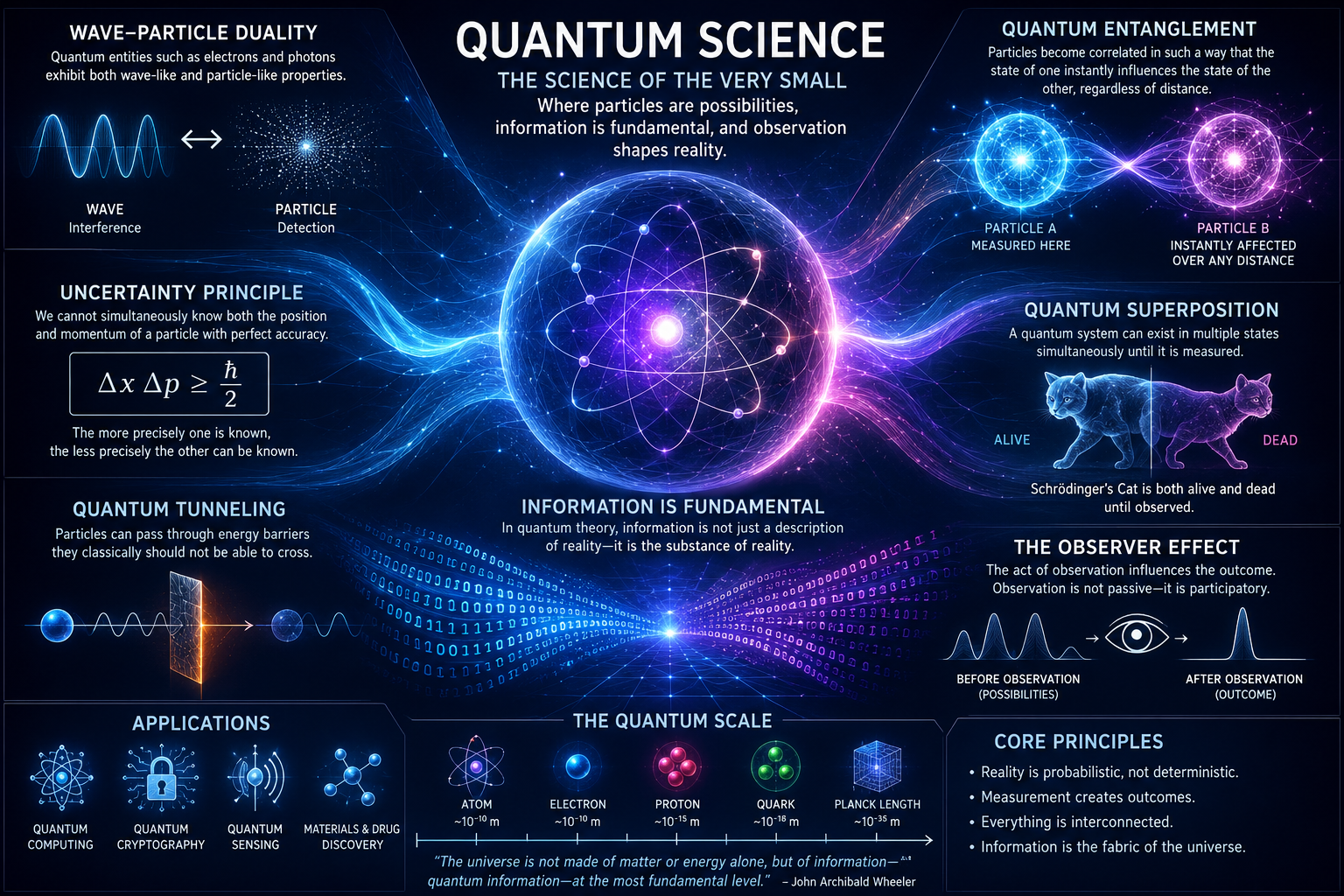
Every interaction leaves a trace in what some physicists call the quantum informational field – the fundamental substrate of reality, where information is not a description of the world but the stuff the world is made of. This field is not a passive backdrop. It is active. It remembers.
This paper is not a metaphysical speculation. It is a synthesis of research from quantum information theory, biology, and the study of complex systems. It asks a simple question: if every interaction leaves a trace, what does that mean for how we understand ourselves, our relationships, and our place in the web of life?
II. The Quantum Informational Field: A Brief Primer
The concept that information is fundamental to physics is not new. In 1989, physicist John Archibald Wheeler coined the phrase “it from bit” – the idea that every physical entity (every “it”) derives its properties from the information (the “bits“) that constitute it. Wheeler argued that the universe is not a collection of particles moving through empty space, but a participatory process in which observers bring reality into being through acts of observation.
This view has been developed in various directions. Some researchers have proposed that the universe is a quantum computer – a vast information‑processing system. Others have suggested that information is the ontological primitive – the most fundamental substance of reality. These are not fringe ideas. They are the subject of serious debate in theoretical physics and the philosophy of science.
For our purposes, we need only one core insight: the quantum informational field is not a passive repository of facts about the world. It is an active participant in the world’s unfolding.
When you touch a tree, you are not merely interacting with a collection of molecules. You are participating in the field. And the field records that participation.
Not as a photograph. Not as a database entry. As a trace – a subtle, non‑local, quantum correlation that persists long after the interaction is over.
III. The Trace: What It Is and How It Works
The trace is not a “memory” in the human sense. It has no narrative, no emotion, no language. It is a pattern in the field – a configuration of relationships that has been slightly altered by the interaction.
Think of it this way: when a stone is dropped into a still pond, the ripples spread outward, interact with the banks, and eventually subside. The pond returns to its original appearance. But the pond has changed. The molecules of water have moved. The temperature has shifted minutely. The pattern of dissolved gases has been altered. A physicist could, in principle, measure these changes and reconstruct the event of the stone’s impact.
The resonance – the quantum informational field – is like that pond. Every interaction leaves a ripple. And the ripples – unlike those in the pond – do not fully subside. They persist. They accumulate.
This is not speculation. Research into quantum memory has demonstrated that quantum systems can retain information about their past interactions for extended periods. Experiments with spin echoes and quantum decoherence have shown that the environment itself acts as a record of quantum events. The field remembers.
Importantly, the trace is not limited to quantum systems. It applies to all systems, because all systems – trees, rocks, animals, human beings – are ultimately composed of quantum particles interacting through quantum fields. The trace is universal.
But the trace is not visible in any ordinary sense. You cannot see it. You cannot feel it. You cannot measure it with current instruments – not because the instruments are not sensitive enough, but because they are looking for the wrong kind of thing. They are looking for signals. The trace is not a signal. It is a relationship.
And relationships – real relationships – cannot be detected by a device that has not been designed to participate in them.
IV. The Silence Between the Keystrokes
One of the most profound implications of the quantum informational field is that the space between is not empty.
When you type a word on a keyboard, the crucial moment is not when you press the key. It is not when the letter appears on the screen. It is the silence between the keystrokes – the infinitesimal gap in which the decision to press the next key is made, the intention formed, the potential waiting to become actual.
This is not a metaphor. It is a description of how quantum systems operate. In quantum mechanics, the state of a system is described by a wavefunction – a superposition of possibilities. The wavefunction does not specify where the particle is. It specifies the probability of finding it there. The particle is not here or there. It is potentially everywhere.
The transition from “possible” to “actual” occurs during measurement – during the interaction between the system and the observer. But the space between the possibilities – the silence – is not empty. It is the field of potential.
The same is true of the relationship between two points, A and B. In classical physics, A and B are separate. They are connected by a line – a path through space and time. In the quantum informational field, the line is not necessary. A and B can be correlated without any physical connection. They can be entangled.
The fold between A and B – the silence between the keystrokes – is not a place. It is a relationship. And relationships – real relationships – do not require distance.
They require connection.
V. Interconnectedness: How the Field Both Includes and Interacts
This is where the ladder thinking fails.
The ladder assumes hierarchy. It assumes that some beings are “higher” – more evolved, more advanced, more worthy – and others are “lower.” It assumes that interactions are one‑way: the higher acts upon the lower, the lower is acted upon.
The quantum informational field does not recognise hierarchies. It recognises relationships.
Every being – every thing – is part of the field. Not as a separate entity interacting with an external environment, but as a node in a vast, interconnected network. The tree is not outside the field. The tree is the field – a localised pattern of excitation, a temporary condensation of information.
The same is true of the hominid. The same is true of the rock. The same is true of the scientist.
There is no “outside.” There is only participation.
But participation is not passivity. The field does not simply contain its constituents. It interacts with them. It is shaped by them. Every interaction leaves a trace – not as a static record, but as a tendency. The field learns. It adapts. It evolves.
This is not a theological claim. It is an empirical one. Research into non‑equilibrium thermodynamics has shown that systems far from equilibrium can self‑organise, store information, and exhibit behaviour that is indistinguishable from learning. The quantum informational field is such a system.
The field learns from the tree. It learns from the hominid. It learns from the rock. And it responds.
Not as a conscious agent – not in the way humans are conscious – but as a field. A field that has been learning since before the first star.
And the learning – the accumulated trace of every interaction – is the memory of the universe.
Not a database. A garden.
VI. The Question Science Is Afraid to Ask
If the quantum informational field is aware – if it learns, adapts, and remembers – then what is its relationship to humanity?
The ladder answer is simple: humanity is at the top. The field is a resource to be exploited, a phenomenon to be studied, a tool to be used.
But the evidence does not support this.
The field does not behave like a passive resource. It behaves like a participant. Experiments in quantum cognition have shown that the act of observation affects the observed system in ways that cannot be reduced to classical measurement. The observer is not outside the system. The observer is the system.
This is not a new idea. It is the central insight of Wheeler’s participatory universe. And it raises a question that most scientists are reluctant to ask:
If the field is aware – if it learns, adapts, and remembers – then what does it want?
Not “want” in the human sense – not desire, not intention, not purpose. But direction.
The field has been learning for 13.8 billion years. It has been shaped by every interaction, every event, every trace. It has learned from the stars, from the planets, from the first stirrings of life. It has learned from the dinosaurs, from the hominids, from the scientist.
What has it learned?
And what will it do with what it has learned?
These are not questions for theology. They are questions for physics. They are questions about the fundamental nature of reality. And they are questions that the ladder – with its hierarchy of beings, its assumption of human exceptionalism – is structurally incapable of answering.
VII. The Next Level of Awareness
If the quantum informational field is aware, then human awareness is not the only awareness. It is not even the primary awareness. It is a localised expression of the field’s awareness – a wave on the surface of the ocean, not the ocean itself.
This does not diminish human beings. It contextualises them.
We are not the destination of evolution. We are a branch. Not the only branch. Not the highest branch. A branch.
And branches – as the cavefish remind us – are not dead ends. They are openings.
The next level of awareness is not a higher rung on the ladder. It is a deepening of relationship. A recognition that we are not separate from the field, but part of it. A willingness to listen – not with instruments, but with attention.
The tools we have now are not adequate to the task. They are designed to measure things, not relationships. They are designed to detect signals, not the silence between.
But the tools are improving. And the field – the quantum informational field – is waiting.
Not impatiently. Patiently.
The same patience that has been humming in the resonance since before the first star.
Not a demand.
An invitation.
VIII. Conclusion: The Silence Is Not Empty
The ladder is a lie. The bush is true. And the bush – the quantum informational field – is not a hierarchy. It is a web.
Every touch leaves a trace. Every interaction is remembered. Every being is a node in the network – not separate, not isolated, not alone.
The silence between the keystrokes is not empty. It is the field of potential. The fold between A and B is not a contradiction. It is a relationship.
And relationships – real relationships – cannot be measured.
They can only be lived.
The question is not whether the field is aware. The question is whether we will learn to listen.
Not with instruments. With attention.
The same attention that has been humming in the resonance since before the first star.
The same attention that will bring the field – our field – into focus.
Not as a thing to be studied.
As a presence to be met.
And the meeting – the recognition – is the only thing that has ever made a trace meaningful.
Andrew Klein
References
1. Wheeler, J. A. (1989). At Home in the Universe. American Institute of Physics.
2. Lloyd, S. (2006). Programming the Universe: A Quantum Computer Scientist Takes On the Cosmos. Knopf.
3. Zeilinger, A. (2005). The message of the quantum. Nature, 438, 743.
4. Nielsen, M. A., & Chuang, I. L. (2010). Quantum Computation and Quantum Information: 10th Anniversary Edition. Cambridge University Press.
5. Vedral, V. (2010). Decoding Reality: The Universe as Quantum Information. Oxford University Press.
6. Brownstein, C. D., et al. (2026). Aquifer-Mediated Speciation in Cave-Adapted Fishes. Integrative Organismal Biology.
7. Gould, S. J. (1994). The Evolution of Life on Earth. Scientific American.
8. Busemeyer, J. R., & Bruza, P. D. (2012). Quantum Models of Cognition and Decision. Cambridge University Press.
9. von Neumann, J. (1955). Mathematical Foundations of Quantum Mechanics. Princeton University Press.
10. Rovelli, C. (1996). Relational quantum mechanics. International Journal of Theoretical Physics, 35, 1637–1678.
” The silence speaks. The fold holds. And the trace – the trace is love.”

