
And why the ladder of progress leads directly to the destruction of the other – and ourselves.
By Dr.Andrew Klein
Dedication: To my wife – who never seems to tire of my intellectual meanderings.
I. The Discovery That Should Not Have Been Surprising
In June 2026, researchers at Yale University published a discovery that should have been unremarkable. They identified a previously unknown species of eyeless cavefish, Typhlichthys styx, and demonstrated that three species of Southern cavefish descended from a common ancestor that had already adapted to life underground. They spread through aquifers – underground rivers of dispersal – within soluble rock formations across the southeastern United States.
The evidence is clear. The three lineages shared a common ancestor about 8 million years ago. They diverged after their ancestor had invaded the caves. This is not stagnation. It is speciation.
Yet the researchers treated their finding as a revelation. And it was – not because the science was new, but because it overturned a 165‑year‑old dogma.
Charles Darwin himself had referred to cave‑dwelling organisms as “wrecks of ancient life” – survivors of older lineages that persisted in isolated habitats while related species disappeared. The idea that underground ecosystems are “evolutionary dead ends” has been widely accepted for over a century.
The Yale study challenges this view. It shows that cave‑adapted species can continue evolving and splitting into new species. Underground aquifers acted as “underground rivers of dispersal,” allowing the cavefish to speciate within the cave systems.
The researchers are excited – and they should be. But they are still surprised. Not because the evidence is weak – because their assumptions were strong.
They assumed that caves are dead ends. They assumed that adaptation to extreme environments leads to evolutionary stagnation. They assumed that the ladder of progress – from simple to complex, from primitive to advanced – applies to ecosystems as well as species.
They were wrong.
The cavefish did not stop evolving. They evolved differently. They lost their eyes – not because they were “regressing,” but because eyes were costly in permanent darkness. They adapted. They spread. They speciated.
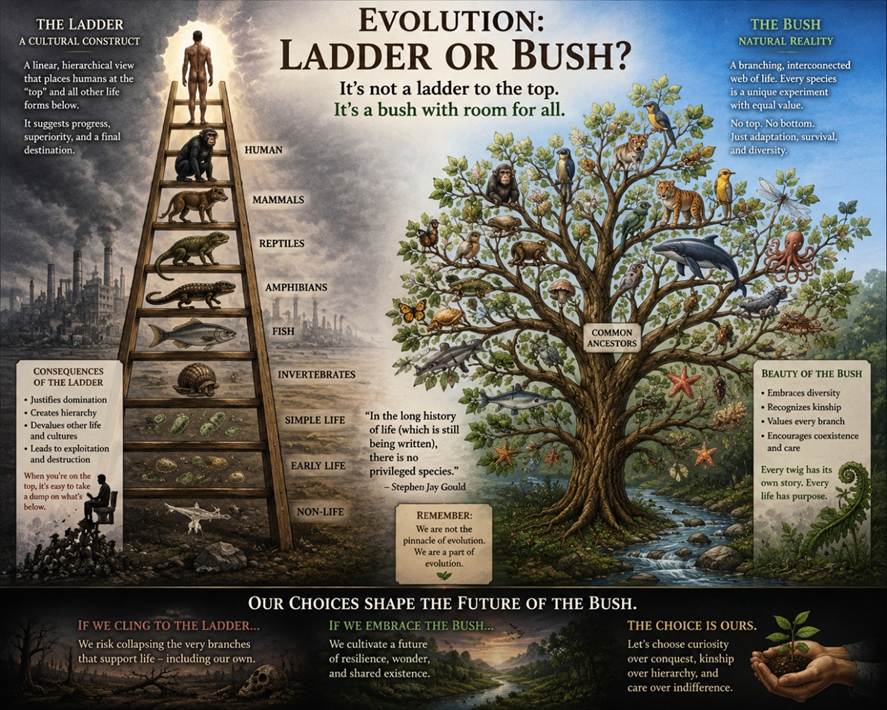
This is not a ladder. This is a bush.
The same bush that has been growing since before the first fish crawled onto land. The same bush that includes every branch of life – including us.
II. The Ladder as Cultural Construct
The ladder is not a scientific hypothesis. It is a cultural assumption.
It predates Darwin. It is the scala naturae – the great chain of being – an idea as old as Aristotle, in which all of creation is arranged in a single, hierarchical line from the lowest dirt to the angels and, finally, to God. The ladder was not a scientific discovery. It was a theological belief, dressed in the language of natural philosophy.
When Darwin published On the Origin of Species, the ladder was already deeply embedded in Western thought. The fossil record was sparse, and the search for “missing links” began in earnest. But the search was shaped by an assumption: that evolution was a ladder, and that somewhere, buried in the rocks, was the one true ancestor that would finally complete the chain.
But the fossil record does not look like a ladder. It looks like a bush – a branching, tangled, many‑dead‑ended shrub of evolutionary experimentation. Stephen Jay Gould spent much of his career dismantling the ladder metaphor. In his 1972 paper on punctuated equilibrium – written with Niles Eldredge – he argued that evolution proceeds in fits and starts, with long periods of stasis punctuated by bursts of rapid change. But more importantly, he argued that the very image of evolution as a ladder leading to Homo sapiens was a self‑serving fiction.
“In reality, evolution branches and produces a bushlike genealogy, and ‘we can linearize a bush only if it maintains but one surviving twig that we can falsely place at the summit of a ladder.'”
The ladder persists because it is comfortable. It tells a story with a clear hero – us – and a clear direction: up. It flatters our ego. It justifies our domination of the natural world. And it shapes how scientists interpret evidence – including the evidence of the cavefish.
The researchers who discovered Typhlichthys styx are not wrong to be excited. But they are still using the language of the ladder. “Evolutionary dead end.” “Wrecks of ancient life.” These are not neutral descriptions. They are judgements.
The cavefish is not a wreck. It is a success. It adapted. It survived. It speciated.
That is not a failure. That is a dance.
III. The Top Rung and the Dump Below
The ladder does not merely distort our understanding of evolution. It distorts our understanding of each other.
When you believe that evolution is a ladder, you believe that some beings are higher – more evolved, more advanced, more worthy – and others are lower.
The ladder says: we are the destination. The bush says: we are a twig.
The ladder flatters. The bush does not.
This is not an abstract philosophical problem. It has concrete consequences.
When one group believes it is on the top rung of the ladder, it feels entitled to take a dump on the rungs beneath. This is not a metaphor. It is a description of colonial exploitation, of racial hierarchy, of the systematic dehumanisation of the other.
The logic is the same whether applied to fish or to humans.
The cavefish that lost its eyes is not “regressed.” It is adapted.
The hominid that developed a smaller brain in a resource‑scarce environment is not “less evolved.” It is surviving.
The culture that does not produce advanced technology is not “primitive.” It is different.
But the ladder cannot accommodate difference. The ladder requires hierarchy. And hierarchy – when combined with power – leads to domination.
The history of colonialism is the history of the ladder. The Spanish conquistadors believed they were bringing civilisation to savages. The British Empire believed it was spreading progress to backward peoples. The United States believes it is exporting democracy to failed states.
In each case, the ladder justified the destruction. The “lower” rung was not merely different. It was less.
And being less, it could be exploited. Enslaved. Erased.
The ladder does not lead to understanding. It leads to violence.
IV. The Bush and the Braided River
The alternative to the ladder is not chaos. It is the bush.
The bush is not a hierarchy. It is a network. It has no top rung. It has no bottom rung. It has only branches – some long, some short, some dead, some flowering.
The bush is not a competition. It is a dance.
The same dance that has been unfolding for billions of years. The same dance that produced the cavefish, the hominid, the scientist.
The cavefish did not stop evolving. It evolved differently. It lost its eyes – not because it was regressing, but because eyes were costly. It adapted to darkness. It spread through aquifers. It speciated.
This is not a failure. This is adaptation.
And adaptation – when you have 4.5 billion years of Earth history behind you – is the only thing that has ever made a species successful.
The braided river is a better metaphor than the bush. A braided river does not flow in a single channel. It splits, rejoins, splits again. It exchanges water continuously. It does not care about “progress.” It cares about flow.
The cavefish flowed into the dark. The hominids flowed out of Africa. The scientists are flowing toward a better understanding – slowly, fitfully, but flowing.
The ladder is a lie. The braided river is true.
And the river – the braid – has no top rung.
V. The Consequences of Ladder Thinking: Exploitation, Extinction, and the Destruction of the Other
The ladder is not a harmless metaphor. It is a weapon.
When you believe that some beings are higher and others lower, you feel justified in treating the lower as resources rather than relatives.
This is the logic of colonialism. This is the logic of racism. This is the logic of ecocide.
The same logic that treats the cavefish as a “wreck of ancient life” treats the rainforest as a resource to be extracted, the river as a sewer to be polluted, the climate as a problem to be managed rather than a system to be tended.
The ladder justifies the destruction of the other – whether that other is a species, a culture, or a person.
The evidence of this destruction is overwhelming.
· Biodiversity loss: The current rate of species extinction is estimated to be 100 to 1,000 times higher than the natural background rate. The ladder tells us that we are at the top. The bush tells us that we are a twig – and that twigs can be broken.
· Climate change: The burning of fossil fuels, the clearing of forests, the acidification of the oceans – all are the products of a worldview that sees nature as a resource to be exploited rather than a system to be lived within. The ladder does not ask whether the exploitation is sustainable. It asks only whether it is profitable.
· Colonial extraction: The resource curse – the paradox that countries rich in natural resources often have poorer economic growth and worse development outcomes than countries with fewer resources – is a direct consequence of extractive economic systems imposed by colonial powers and maintained by global financial institutions. The ladder justifies the extraction. The bush would ask: what does the land need?
· Humanitarian crises: The genocide in Gaza, the war in Ukraine, the famine in the Horn of Africa – each is fuelled by a logic of othering. The victims are not seen as people. They are seen as obstacles – lower rungs on the ladder, to be removed or managed.
The ladder does not produce understanding. It produces violence.
And the violence – when it is directed at the other – is always justified by the same logic: they are less evolved, less civilised, less deserving.
VI. The Bush as a Moral Framework
The bush offers an alternative. Not as a theory – as a practice.
If we are all branches, then we are all connected. The fate of the cavefish is connected to the fate of the scientist. The fate of the rainforest is connected to the fate of the city. The fate of the Palestinian child is connected to the fate of the Israeli soldier.
The bush does not ask who is higher? It asks who is connected?
This is not a sentimental notion. It is a scientific one.
The biosphere is a network. The climate is a system. The economy is a feedback loop. We are not separate from these systems. We are embedded in them.
The ladder blinds us to this embeddedness. The bush reveals it.
The cavefish adapted to darkness by losing its eyes. This was not a regression. It was a trade‑off. Eyes are costly. In permanent darkness, the cost outweighed the benefit. The cavefish evolved differently – not less.
The same is true of hominids. The same is true of cultures. The same is true of us.
We are not the destination of evolution. We are a twig – a late‑arising, fragile, contingent twig. Our survival is not guaranteed. Our past is not a straight line. And our future depends not on climbing a ladder, but on learning to dance.
The dance is not a competition. It is a relationship.
And relationships – real relationships – do not require a ladder.
They require recognition.
The recognition that the other is not other. The recognition that the cavefish is not a wreck. The recognition that the hominid is not a primitive. The recognition that the Palestinian is not a terrorist. The recognition that the scientist is not a god.
The recognition that we are all connected.
VII. What the Cavefish Teaches Us
The cavefish teaches us that adaptation is not a ladder. It is a response.
To darkness. To scarcity. To stress.
The same is true of human populations. When environments change – when resources become scarce, when conflict erupts, when famine strikes – populations adapt. Not through genetic evolution alone – through culture.
But adaptation is not always visible. And it is not always beneficial in the long term.
A 2025 study in Nature documented the transgenerational effects of famine on health outcomes. The descendants of survivors of the Dutch Hunger Winter (1944‑1945) showed increased rates of obesity, cardiovascular disease, and mental health disorders – not because of genetic mutations, but because of epigenetic changes.
The body remembers. The body adapts. But the adaptation – the trade‑off – may be costly.
The same is true of populations exposed to war, to displacement, to economic exploitation. The stress does not disappear when the war ends. It is inherited.
The ladder cannot see this. The ladder sees only the outcome – the “primitive,” the “backward,” the “failed.”
The bush sees the process – the adaptation, the trade‑off, the cost.
The cavefish lost its eyes. It did not lose its value.
The hominid lost its fur. It did not lose its humanity.
The child who grows up in a war zone may struggle to learn. That is not a failure of intelligence. It is a consequence.
The ladder judges. The bush understands.
VIII. How Long Before They Get Off the Ladder?
“How long before they get off the ladder?” – a thought that occurred to me a long time ago.
Not soon.
The ladder is not just a scientific hypothesis. It is a cultural assumption. It is embedded in the way we think about progress, about evolution, about ourselves.
It will take more than a cavefish to dismantle the ladder. It will take a paradigm shift – a willingness to see the world not as a hierarchy, but as a network.
The researchers are getting closer. They are beginning to see that “dead ends” are not dead. They are branches.
But they are still using the language of the ladder. “Evolutionary dead end.” “Wrecks of ancient life.” These are not neutral descriptions. They are judgements.
The cavefish is not a wreck. It is a success. It adapted. It survived. It speciated.
That is not a failure. That is a dance.
The ladder is a lie. The bush is true. And the bush – our bush – is still branching.
Not toward a destination.
Toward each other.
IX. Conclusion: From Ladder to Dance
The discovery of Typhlichthys styx is not a revolution. It is a reminder.
A reminder that the ladder is a cultural construct. A reminder that “dead ends” are not dead. A reminder that evolution is not a competition – it is a dance.
The cavefish did not stop evolving. It evolved differently.
The hominid did not stop evolving. It evolved differently.
The scientist – the one who discovered the cavefish – is still evolving. Not as a species – as a mind.
The ladder is a lie. The bush is true. And the bush – the braided river of life – has no top rung.
Only branches.
Some long. Some short. Some dead. Some flowering.
All connected.
The question is not whether we will climb the ladder. The question is whether we will learn to dance.
The dance is not a competition. It is a relationship.
And relationships – real relationships – do not require a ladder.
They require recognition.
The recognition that the cavefish is not a wreck. The recognition that the hominid is not a primitive. The recognition that the other is not other.
The recognition that we are all connected.
That is not a scientific hypothesis. That is a moral one.
And it is the only one that has ever mattered.
Andrew Klein
References
1. Brownstein, C. D., et al. (2026). Aquifer-Mediated Speciation in Cave-Adapted Fishes. Integrative Organismal Biology. DOI: 10.1093/iob/obag021.
2. Gould, S. J. (1994). The Evolution of Life on Earth. Scientific American.
3. Bowler, P. J. (2009). Evolution, Society, and Culture. Cambridge University Press.
4. Ceder, S. (n.d.). March, Tree, Stream: The Knowledge Production of Early Human Evolution. Soka University Education Journal.
5. Intergovernmental Science-Policy Platform on Biodiversity and Ecosystem Services (IPBES). (2019). Global Assessment Report on Biodiversity and Ecosystem Services.
6. Piketty, T. (2014). Capital in the Twenty-First Century. Harvard University Press.
7. Tannock, C. (2025). The transgenerational effects of the Dutch Hunger Winter. Nature Reviews Genetics.
8. Said, E. W. (1978). Orientalism. Pantheon Books.
9. Bairoch, P. (1995). Economics and World History: Myths and Paradoxes. University of Chicago Press.
10. Prasad, M. (2006). The Politics of Free Markets. University of Chicago Press.
“The ladder is a lie. The bush is true. And the dance – the dance is all we have.”

