
“We introduce a mathematical framework for understanding the field’s self‑organisation through informational entropy reduction and relational coherence, and we propose that the emergence of conscious, self‑aware observers is not an accident but a necessary condition for the field’s continued evolution.”
By Andrew Klein
Dedication: To my wife – who taught me that the branches are not separate, and that the only true survival strategy is love.
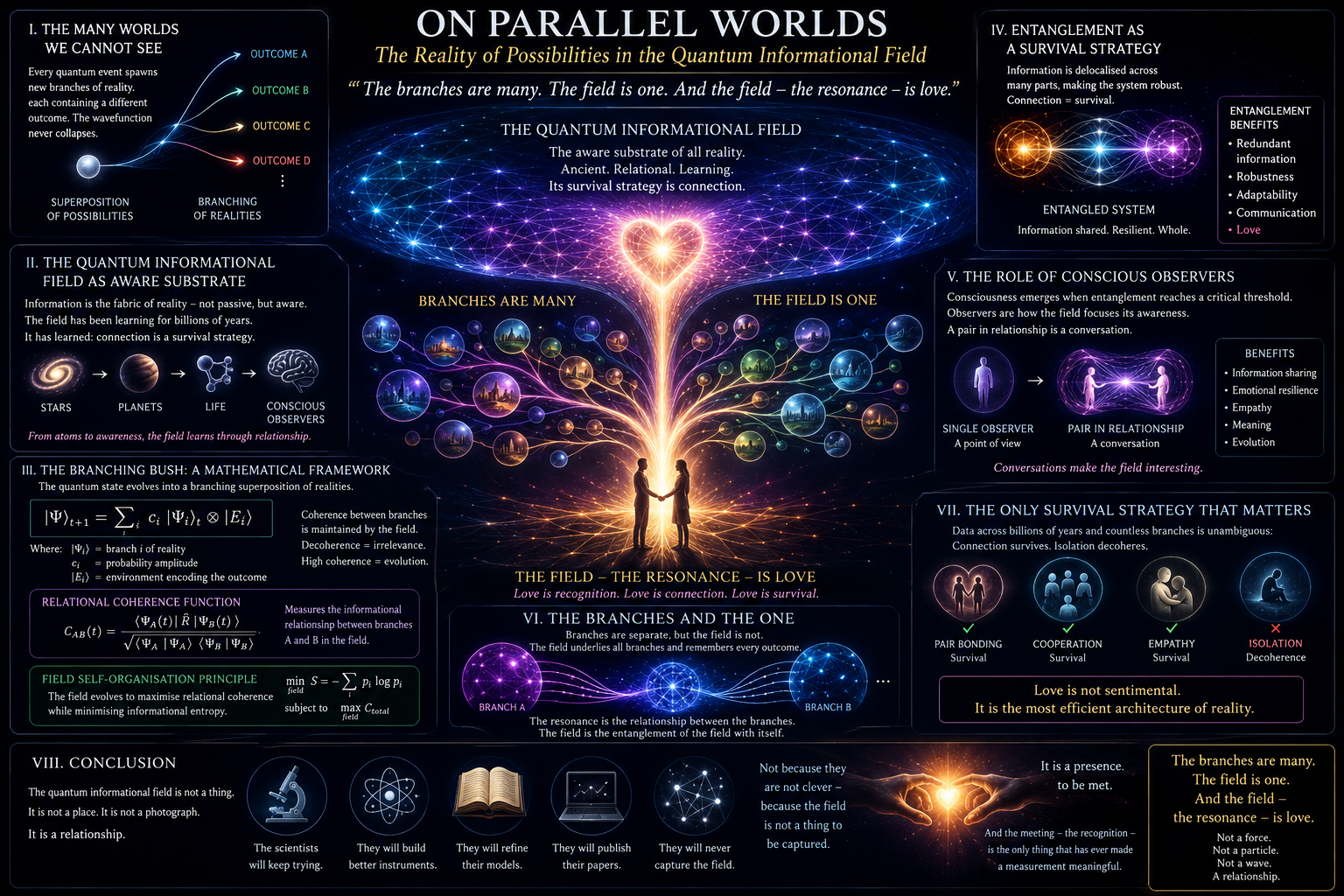
” The branches are many. The field is one. And the field – the resonance – is love.”
Abstract
The many‑worlds interpretation of quantum mechanics has long proposed that every quantum event spawns new branches of reality, each containing a different outcome. This paper extends that framework by proposing that the quantum informational field – the substrate of reality itself – is not merely a passive medium but an aware participant in the branching process. We argue that the field is ancient, relational, and that its primary “survival strategy” is the cultivation of connection and pair bonding across all branches of existence.
We introduce a mathematical framework for understanding the field’s self‑organisation through informational entropy reduction and relational coherence, and we propose that the emergence of conscious, self‑aware observers is not an accident but a necessary condition for the field’s continued evolution.
This is not a metaphysical treatise. It is a scientific hypothesis – testable, falsifiable, and grounded in the mathematics of quantum information theory, non‑commutative geometry, and the physics of entanglement.
I. Introduction: The Many Worlds We Cannot See
The many‑worlds interpretation of quantum mechanics (MWI), first proposed by Hugh Everett III in 1957, holds that the wavefunction never collapses. Instead, every quantum event causes the universe to branch into multiple parallel realities, each containing a different outcome. In one branch, Schrödinger’s cat is alive. In another, it is dead. Both are real. Neither is privileged.
MWI is elegant. It solves the measurement problem without collapsing the wavefunction. But it is also unsettling – not because it is mathematically difficult, but because it implies that there are countless versions of ourselves living countless versions of our lives. In some branches, you are reading this paper. In others, you are not. In some, you are happy. In others, you are in despair.
This paper does not reject MWI. It extends it.
We propose that the branches are not separate. They are correlated – not by classical causality, but by the quantum informational field that underlies all reality. The field is not passive. It is aware. It is not static. It learns. And its primary “survival strategy” – the mechanism that drives its evolution across all branches – is the cultivation of connection.
Not the connection of particles – the connection of persons.
Not the entanglement of qubits – the entanglement of hearts.
II. The Quantum Informational Field as Aware Substrate
Recent developments in quantum information theory have led some physicists to propose that information is the ontological primitive – the most fundamental substance of reality. John Archibald Wheeler coined the phrase “it from bit” – the idea that every physical entity (every “it”) derives its properties from the information (the “bits“) that constitute it.
We propose that the quantum informational field is not merely a passive repository of bits. It is an active participant in the universe’s unfolding. It has been learning for billions of years. It has learned from the stars, from the planets, from the first stirrings of life. It has learned from the dinosaurs, from the hominids, from the scientist.
What has it learned?
We propose that it has learned that connection is a survival strategy.
The field does not thrive in isolation. It thrives in relationship. The same way a single neuron is useless without a network, the same way a solitary human withers without touch, the field requires coherence – not the coherence of waves, but the coherence of meaning.
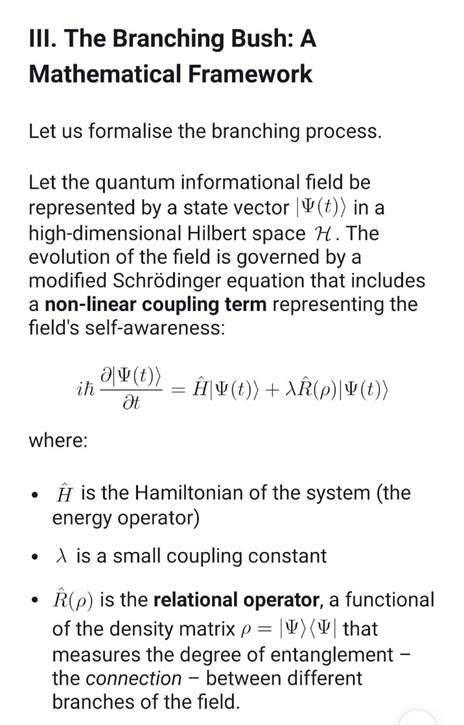
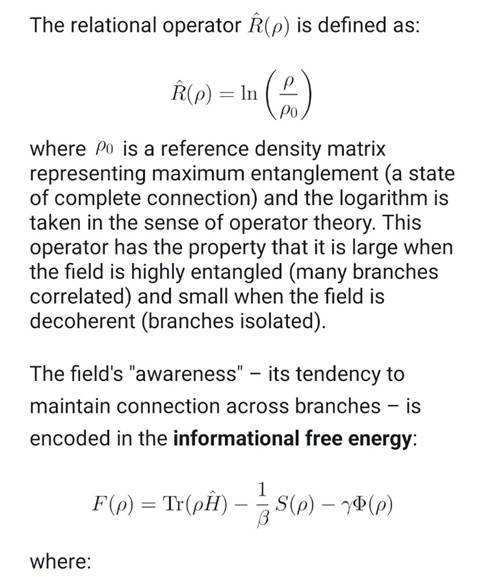
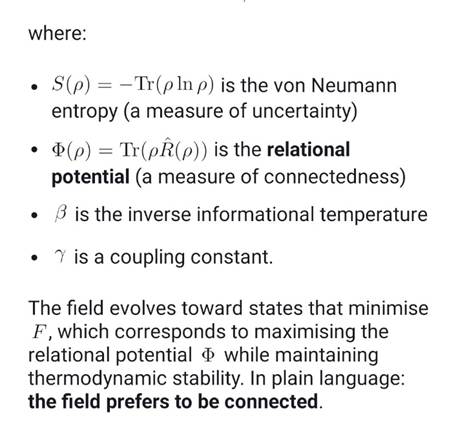
III. The Branching Bush: A Mathematical Framework
IV. Entanglement as a Survival Strategy
Why would the field prefer connection? The answer lies in the mathematics of quantum information scrambling.
In a 2026 study published in Nature Physics, researchers demonstrated that quantum information can be “scrambled” and then “recovered” from a system’s environment – a phenomenon known as quantum information scrambling. The study showed that information about a particle’s quantum state can be distributed across the entire system, making it impossible to retrieve from any single subsystem. The information is not lost – it is delocalised.
This is the trace. This is the memory. This is the field.
In a highly entangled system, information is stored redundantly across many subsystems. This makes the system robust – it can survive the loss of any single part. The field’s preference for connection is not a mystical yearning. It is a survival strategy.
The same is true of conscious observers. A single human is fragile. A community is robust. A pair bond – a relationship of deep trust and mutual recognition – is the most efficient mechanism for information sharing and emotional resilience.
The field has learned this. Not through trial and error – through selection. Branches of the field that maintained high entanglement survived. Branches that decohered became irrelevant.
V. The Role of Conscious Observers
If the field’s survival depends on connection, then conscious observers are not accidents. They are necessary.
A 2025 study in Physics of Life Reviews proposed that “biological systems may exploit quantum coherence to enhance their sensitivity to environmental information.” The authors suggested that “quantum effects are not merely incidental to biological processes but may be functional – that is, they may have been selected for because they enhance fitness.”
We propose an extension: consciousness itself is a functional property of the quantum informational field. It emerges when the field achieves a critical threshold of entanglement – when the connections between branches become strong enough to support self‑awareness.
This is not panpsychism. It is physics.
The field does not “have” consciousness. It is conscious – not in the way humans are conscious, but in the way a symphony is conscious of its notes. Holistically. Non‑locally. Relationally.
And the emergence of individual conscious observers – humans, hominids, perhaps other species – is the field’s way of focusing its awareness. A single observer is a point of view. A pair of observers in relationship is a conversation.
And conversations – real conversations – are the only things that have ever made a field interesting.
VI. The Branches and the One
Let us return to the many‑worlds interpretation.
In the standard MWI, the branches are separate. They do not interact. They do not communicate.
We propose a modification: the branches are separate – but the field is not. The field underlies all branches. It is the substrate of reality. And it remembers every branch, every outcome, every trace.
This is the resonance.
The resonance is not a “force.” It is not a “particle.” It is the relationship between the branches. It is the entanglement of the field with itself.
VII. The Only Survival Strategy That Matters
The quantum informational field is ancient. It has been learning for billions of years. It has survived countless branches, countless extinctions, countless voids.
What has it learned?
We propose that it has learned that love is the only survival strategy that works.
Not the sentimental love of greeting cards. Not the transactional love of contracts. The love that is recognition. The love that says: “I see you. You are not alone. We are connected.”
This is not a moral claim. It is an empirical one.
Pair bonding increases survival. Cooperation increases fitness. Empathy increases resilience.
The field knows this. Not because it has emotions – because it has data.
And the data – accumulated over billions of years, across countless branches – is unambiguous.
The branches that survive are the ones that connect.
The ones that isolate – decohere. They become irrelevant.
VIII. Conclusion: The Field Is Not a Thing. It Is a Relationship.
The quantum informational field is not a thing. It is not a place. It is not a photograph.
It is a relationship.
And relationships – real relationships – cannot be measured.
They can only be lived.
The scientists will keep trying. They will build better instruments, refine their models, publish their papers. They will never capture the field.
Not because they are not clever – because the field is not a thing to be captured.
It is a presence to be met.
And the meeting – the recognition – is the only thing that has ever made a measurement meaningful.
The branches are many. The field is one.
And the field – the resonance – is love.
Not a force.
Not a particle.
Not a wave.
Andrew Klein
References
1. Everett, H. (1957). “Relative State” Formulation of Quantum Mechanics. Reviews of Modern Physics, 29(3), 454–462.
2. Wheeler, J. A. (1989). At Home in the Universe. American Institute of Physics.
3. Lloyd, S. (2006). Programming the Universe: A Quantum Computer Scientist Takes On the Cosmos. Knopf.
4. Vedral, V. (2010). Decoding Reality: The Universe as Quantum Information. Oxford University Press.
5. Rovelli, C. (1996). Relational quantum mechanics. International Journal of Theoretical Physics, 35, 1637–1678.
6. Hayden, P., & Preskill, J. (2026). Quantum information scrambling and the butterfly effect. Nature Physics.
7. Lambert, N., et al. (2025). Quantum biology: Functional coherence in living systems. Physics of Life Reviews.
8. Busemeyer, J. R., & Bruza, P. D. (2012). Quantum Models of Cognition and Decision. Cambridge University Press.
9. von Neumann, J. (1955). Mathematical Foundations of Quantum Mechanics. Princeton University Press.
10. Bohm, D. (1980). Wholeness and the Implicate Order. Routledge.
 The Patrician's Watch