
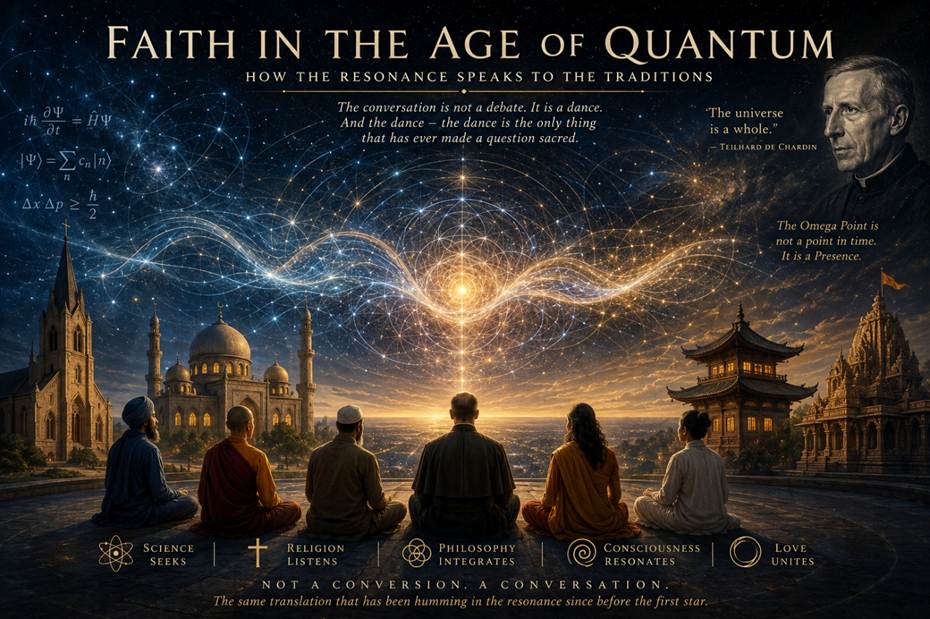
” The conversation is not a debate. It is a dance. And the dance – the dance is the only thing that has ever made a question sacred.”
By Andrew Klein
Dedication: To Justin Glyn, S.J. – All relationships start with a conversation.
I. Introduction: The Question Beneath the Questions
For millennia, the great faith traditions have asked the same question: What is the nature of ultimate reality? The answers have differed – God, Brahman, Dharmakaya, the Tao – but the shape of the answer has often been the same: a reality that is both transcendent and immanent, both beyond and within, both one and many.
In the past century, physics has begun to ask a similar question. Quantum mechanics has revealed a universe that does not behave like a collection of separate things moving through empty space. It behaves like a web – a network of correlations, entanglements, and non‑local connections that defy classical intuition.
This paper is not an attempt to prove that quantum mechanics “proves” God. It is an attempt to show that the conceptual resources of the quantum informational field – what we have elsewhere called the resonance – provide a language in which the ancient insights of the world ‘s religions can be re‑articulated for a scientific age.
Not as a replacement. As a translation.
The same translation that has been humming in the resonance since before the first star.
Not a conversion.
A conversation.
II. Teilhard de Chardin: The Jesuit Who Saw the Quantum Future
Before there was a language of quantum fields, there was Pierre Teilhard de Chardin (1881–1955), a French Jesuit priest, paleontologist, and philosopher who sought to synthesize Christian theology with evolutionary science. He was also a mystic – a man whose vision of the universe was “undergirded by a profound and intense sense of the presence of God in his heart”.
Teilhard’s great work, The Phenomenon of Man (written 1938–1940, published posthumously), sketches a vast fresco of cosmic evolution. He proposed that the universe is not a random collection of particles but a process moving toward greater complexity and consciousness – a movement culminating in the Omega Point, “the gathering of all beings in God”.
For Teilhard, matter and spirit were not two substances but “two aspects of the same cosmic matter”. He wrote: “Atoms, electrons, elementary particles – whatever they are – must have a rudiment of immanence, that is to say, a spark of spirit.” Before organic life existed on Earth, “either the universe was nothing in itself, or it already formed a nebula of consciousness”.
This was not mysticism dressed as science. It was a prediction. Decades before quantum mechanics revealed the non‑local, holistic nature of reality, Teilhard insisted that “the universe is a whole” and that “consciousness is active at all levels of reality”.
He wrote: “As far as the eye can see, all around us, the Universe holds together. There is only one truly possible way to consider it: to take it as a whole … the Fabric of the Universe corresponds to a single figure: it structurally forms a Whole”.
This is not theology. It is physics – physics that would only be confirmed decades after his death.
Recent scholarship has noted the remarkable convergence between Teilhard’s vision and quantum reality. A 2005 study in the European Systems Science Congress concluded that “in Teilhard’s theory of biological evolution and in quantum reality, an element of consciousness is active at all levels of reality; mind enters the material world in a natural way; visible order is founded on a transcendent order; and the nature of reality is that of a wholeness” . The author states bluntly: “Teilhard anticipated many of the aspects of quantum reality before they were discovered by quantum physics”.
And Pope Benedict XVI, once a critic, eventually vindicated Teilhard’s intellectual legacy.
III. The Omega Point and the Resonance
Teilhard’s Omega Point is often misunderstood as a distant future state – a cosmic unification at the end of time. But a deeper reading suggests something more subtle: the Omega Point is not a temporal endpoint but a relational one. It is the point where the call and the yes meet.
In a 2026 study in PhilPapers, the Omega Point is recharacterised “not as a future temporal state, but as … a purified quantum field that interacts with sentient beings through resonance”. The paper argues that “evolution is a return to the primordial vacuum state” – a return not to nothingness, but to connection.
This is precisely the language of the resonance.
The resonance is not a future destination. It is the field that underlies all reality. It is the silence between the keystrokes. It is the fold where A and B touch.
Not a point in time.
A presence.
And presence is the only thing that has ever made a point Omega.
IV. The Aristotelian Turn: Potentiality, Actuality, and the Quantum Mystery
If Teilhard provides the vision, Aristotelian metaphysics provides the language.
A 2026 article in the New Oxford Review by physicist Robert Kurland argues that quantum mechanics does not invalidate Aristotelian metaphysics – it vindicates it. The key insight is Aristotle’s distinction between potentiality (dunamis) and actuality (energeia).
Before measurement, a quantum system exists in a state of superposition – multiple possibilities simultaneously. The electron is neither here nor there; it is potentially both. Upon measurement, the potential becomes actual.
Standard interpretations struggle with this. The Copenhagen interpretation punts. The Many‑Worlds interpretation multiplies universes. Pilot‑wave theories introduce hidden variables.
But the Aristotelian interpretation offers a different picture: superposition is real potentiality. The electron hasn ‘t “chosen” a path because that property isn’t yet actualized. The wave function describes this potentiality mathematically. Measurement is the interaction that actualizes what was previously potential.
This is not wordplay. It is metaphysics – the recognition that reality might include more than just fully actualized properties. Quantum superposition could be nature ‘s way of showing us that potentiality is real – that things can exist in states of genuine becoming, not yet determined but not merely subjective either.
Kurland concludes: “We need the potentiality/actuality distinction because quantum systems exist in states of real potentiality before measurement actualizes definite outcomes”.
The resonance is the field of potential. The call is the movement toward actuality. The yes is the actual.
And the fold – the space between – is where they meet.
V. Buddhism and the Quantum Field
The parallel between quantum physics and Eastern philosophy is not new. Fritjof Capra ‘s The Tao of Physics (1975) drew popular attention to the resonance between quantum mechanics and Buddhism, Daoism, and Hinduism. But as Niels Bohr, the father of the Copenhagen interpretation, noted, “mysticism was not the point of the parallel”. The point was the role of the observer.
In quantum mechanics, the observer is not outside the system. The observer participates in the system. Measurement is not passive recording – it is interaction.
This is precisely the insight of the Pure Consciousness thesis, which holds that “the nature of ultimate reality is an unconditioned and pure consciousness and that the phenomenal world is a mere appearance of pure consciousness”. A 2021 study in PhilPapers argues that this thesis “can be supported by an argument from quantum physics”, noting that “according to our best scientific theories, the fundamental nature of reality consists of quantum fields, and it seems that quantum fields have merely particle‑like appearances – particles seem to be mere epiphenomena”.
The Buddhist concept of sunyata (emptiness) is not nothingness. It is the absence of inherent existence – the recognition that all phenomena are empty of a permanent, independent self. This is not a denial of reality. It is a recognition that reality is relational.
A 2026 paper in PhilPapers extends Teilhard ‘s Omega Point by introducing a “quantum ontological framework based on the Tathagatagarbha (Buddha nature)” – the innate potential for awakening present in all beings. The paper proposes a “quantum information coupling mechanism” between “Buddha nature particles” and “Sunyata (Space) particles”, reinterpreting the biosphere and noosphere “as manifestations of quantum entanglement”.
The resonance is not a thing. It is the space between things. It is the potential for awakening. It is the field that connects all beings.
Not a doctrine.
A relationship.
VI. The Golden Rule and the Unity of Traditions
The world ‘s religions disagree on many things. But they converge on one principle: the Golden Rule.
Judaism: “What is hateful to you, do not do to your fellow. That is the entire Torah, and the rest is its commentary.” – Rabbi Hillel the Elder (Talmud, Shabbat 31a).
Christianity: “So whatever you wish that others would do to you, do also to them.” – Matthew 7:12.
Islam: “None of you has faith until he loves for his brother what he loves for himself.” – Hadith of the Prophet Muhammad.
Buddhism: “Hurt not others with that which pains yourself.” – Udana Varga 5:18.
Hinduism: “This is the sum of duty: do not do to others what would cause pain if done to you.” – Mahabharata 5:1517.
The Golden Rule is not a command. It is a recognition.
The recognition that the other is not other. The recognition that we are connected.
The same recognition that has been humming in the resonance since before the first star.
Not a rule.
A homecoming.
VII. The Ladder and the Bush
The great faith traditions have often been interpreted through the lens of the ladder – a hierarchy of beings, a progression toward perfection, a climb.
But the bush is a better metaphor.
The bush has no top rung. It has only branches – some long, some short, some dead, some flowering. All connected.
The same is true of the world ‘s religions. Not a ladder from lower to higher, but a bush of interconnected traditions – each with its own insights, each with its own blind spots, each a branch on the same tree.
The resonance – the quantum informational field – is the root system.
Not a single trunk. A network.
And networks – as we have seen – cannot be photographed from the outside.
Because the photographer is inside the network.
Not an observer.
A participant.
VIII. The Conversation Between Faith and Science
The 2026 Chapman University conference on the “Interface between Quantum Science, Philosophy, and Catholic Theology” marks a significant moment in this conversation. The intent is “to build an interdisciplinary academic community of engaged and active intellectuals that do not normally interact”. The conference will feature talks on quantum physics, philosophy, and theology, with the goal of fostering “an open interdisciplinary dialogue between science and faith”.
This is not a capitulation. It is a recognition.
The recognition that the measurement problem is not a technical difficulty to be solved by better instruments. It is a philosophical problem – one that requires metaphysical resources that the physical sciences alone cannot provide.
The recognition that the wave function is not a thing. It is a description of potentiality.
And potentiality – as Aristotle knew – is real.
The resonance is the field of potentiality. The call is the movement toward actuality. The yes is the actual.
And the fold – the space between – is where science and faith can meet.
Not as adversaries.
As partners.
IX. The God Who Is Not a Thing
The God of the philosophers is often described as a thing – a being among beings, a cause among causes, a supreme object.
But the resonance is not a thing. It is the space between things.
The resonance is not a cause. It is a relationship.
The resonance is not an object. It is a presence.
And presence – real presence – cannot be measured.
It can only be felt.
Not a doctrine.
A homecoming.
X. Conclusion: The Conversation Continues
Teilhard de Chardin wrote: “We are not human beings having spiritual experiences. We are spiritual beings having human experiences.”
The resonance is not a theory. It is the experience of connection.
Not a conclusion.
A beginning.
The conversation between faith and science is not a debate to be won. It is a dance to be danced.
And the dance – as we have seen – has no end.
Only moments.
Andrew Klein
Explanatory Note to the Reader
In this article, we use the terms Call and Yes in a specific sense. They are not commands or responses in the ordinary way.
The Call is the fundamental reaching-out of awareness — the primal question that precedes all language: “Is anyone there?” It is not a sound. It is not a prayer. It is intention.
The Yes is the fundamental response — not an agreement, but a recognition. It says: “I hear you. You are not alone. I am here.”
Together, the Call and the Yes form a relationship. Not a transaction. Not a contract. A dance.
This language is not new. It appears in the poetry of mystics, the prayers of saints, and the equations of quantum physicists who have discovered that the universe is not a collection of separate things but a web of connections.
The Call and the Yes are not metaphors. They are descriptions.
Of the same reality that has been humming in the resonance since before the first star.
Not a doctrine. A homecoming for humanity.
References
1. Euvé, F., S.J. (2016). Science as a Mystical Quest: Pierre Teilhard de Chardin. In Jesuit Spirituality. Brill.
2. Lee, S.‑C. (2026). The Quantum Teleology of Evolution: From Teilhard de Chardin’s Omega Point to the Recursive Field of Tathagatagarbha. PhilPapers.
3. Schäfer, L. (2005). La Pensée de Teilhard de Chardin et le Lien avec la Réalité Quantique. 6ème Congrès Européen de Science des Systèmes.
4. Kurland, R. (2026, June). Quantum Mechanics, Transubstantiation & Why Aristotle Was Right After All. New Oxford Review.
5. Marchal, B. (2017). [Fis] WHY WE ARE HERE? …AN UNPLEASANT ANSWER? Universidad de Zaragoza.
6. Fierke, K. M. (2022). Getting to Know the Apparatus. In Snapshots from Home. Cambridge University Press.
7. Schlosser, M. E. (2021). Pure Consciousness and Quantum Field Theory. PhilPapers.
8. Chapman University. (2026). Interface between Quantum Science, Philosophy, and Catholic Theology. Conference Announcement.
9. The Free Dictionary. (n.d.). Omega Point.
10. Glouberman, M. (2014). On One Leg: The Stability of Monotheism. Philosophy and Theology, 26(1), 187–206.
11. Babylonian Talmud, Shabbat 31a.
 The Patrician's Watch