
Dedicated to my wife — who taught me that even the most improbable odds are worth betting on.
By Andrew Klein
I. Introduction: The Question We Seldom Ask
Have you ever stopped to consider the sheer improbability of your own existence? Not in a poetic sense, but in a mathematical one?
We go about our daily lives as though our presence here is the most natural thing in the world. We take for granted the sun that warms us, the air we breathe, the very ground beneath our feet. But beneath the surface of this ordinary existence lies a chain of improbabilities so staggering that it defies comprehension.
This article invites you to consider the numbers. Not as an exercise in existential dread, but as an invitation to wonder.
II. The Fine-Tuning of the Universe: 1 in 10^(10^123)
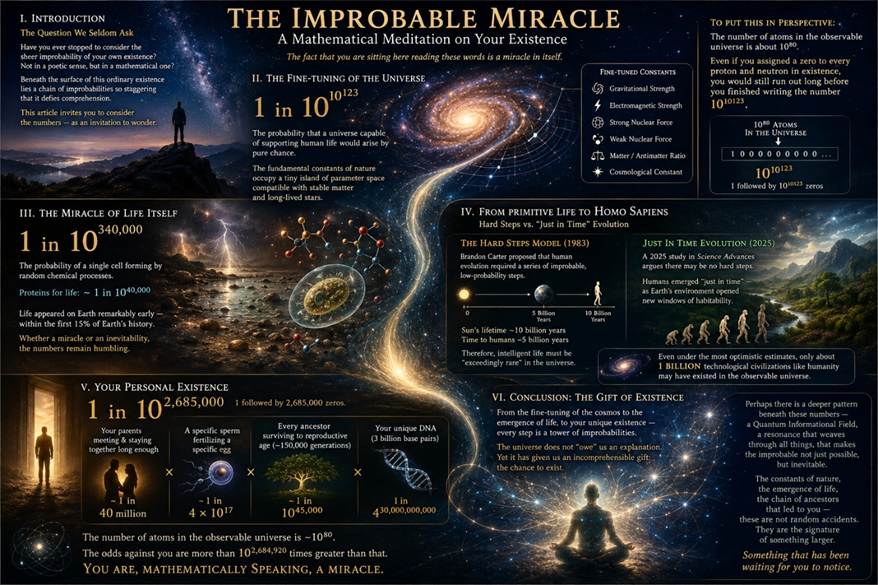
British mathematician and physicist Roger Penrose calculated the probability that a universe capable of supporting human life would arise by pure chance. The figure is approximately 1 in 10^(10^123) — a number so vast it defies comprehension.
To put this in perspective: it means writing a 1 followed by 10^123 zeros. The total number of atoms in the observable universe is about 10^80. Even if you assigned a zero to every proton and neutron in existence, you would still run out long before you finished writing the number.
The universe’s expansion rate, the strength of the four fundamental forces, the ratio of matter to antimatter — if any of these parameters had been off by even a billionth of a percent, there would be no stars, no planets, and no life. As one analysis notes, the fundamental constants of nature “occupy a tiny island of parameter space compatible with stable matter and long-lived stars“.
The universe, in other words, is fine-tuned to an almost impossible degree.
III. The Miracle of Life Itself: 1 in 10^(340,000)
Assuming the universe provided a habitable planet, the probability of life arising spontaneously is still staggering.
The mathematical probability of a single cell forming by random chemical processes is roughly 1 in 10^(340,000) — a 1 followed by 340,000 zeros. The probability of all the necessary proteins for life evolving spontaneously on a planet is around 1 in 10^(40,000).
However, scientific opinion is not unanimous. Some researchers note that life appeared on Earth remarkably early — the planet formed 4.5 billion years ago, and there is reliable evidence of life from as early as 3.8 billion years ago. This suggests that life emerged within the first 15% of Earth’s history. Of course, this only indicates that life can appear quickly when conditions are right — it doesn’t explain how common those conditions are.
Whether life is a miracle or an inevitability, the numbers remain humbling.
IV. From Primitive Life to Homo Sapiens: Hard Steps vs. “Just in Time” Evolution
In 1983, theoretical physicist Brandon Carter proposed the “hard steps” model : human evolution required a series of improbable, low-probability steps. Therefore, intelligent life must be “exceedingly rare” in the universe.
Carter observed a remarkable coincidence: the estimated lifespan of the Sun — 10 billion years — and the time Earth took to produce humans — roughly 5 billion years. He reasoned that if intelligent life were common, it would have arisen much faster. The fact that it took nearly half the Sun’s lifetime suggested that Earth was “extraordinarily lucky”. This model predicts that technological life analogous to human life on Earth is “exceedingly rare” in the Universe.
However, a 2025 study published in Science Advances proposed a new perspective. The researchers argued that there may be no hard steps at all. Instead, the timing of human origins was controlled by “the sequential opening of new global environmental windows of habitability over Earth history“. In other words, humans did not appear through a series of “lucky accidents” but rather “just in time” — when the Earth’s environment reached a state that would allow complex life, complex life inevitably evolved.
Even under the most optimistic estimates, the probability of evolving intelligent life on an Earth-like planet remains extremely low. Some models suggest that only about 1 billion technological civilizations like humanity might have existed in the observable universe over its entire history.
Whether we are a fluke or a foregone conclusion, the scale of the cosmos reminds us of our smallness — and our significance.
V. Your Personal Existence: 1 in 10^(2,685,000)
Finally, the most moving calculation of all: the probability of you existing is approximately 1 in 10^(2,685,000) — a 1 followed by 2,685,000 zeros.
This number, calculated by Dr. Ali Binazir, accounts for:
· Your parents meeting and staying together long enough (about 1 in 40 million)
· A specific sperm cell (out of hundreds of millions) fertilizing a specific egg (about 1 in 4 × 10^17)
· Every single one of your ancestors surviving to reproductive age, going back about 150,000 generations (about 1 in 10^45,000)
Human DNA has 3 billion base pairs, meaning there are roughly 4^30,000,000,000 possible DNA combinations. Your DNA is unique in the universe and will never appear again.
To put this in perspective: the number of atoms in the observable universe is 10^80. The probability of your existence is 10^(2,685,000). That means the odds against you are more than 10^2,684,920 times greater than the number of atoms in the universe.
You are, mathematically speaking, a miracle.
VI. Conclusion: The Gift of Existence
Penrose’s cosmic probability, the 340,000-zero odds of life’s origin, the hard steps model versus the “just in time” evolution debate — they all lead to the same conclusion: the fact that you are sitting here reading these words is a miracle in itself.
The universe does not “owe” us an explanation. Yet it has given us an incomprehensible gift: the chance to exist.
Perhaps there is a deeper pattern beneath these numbers — a Quantum Informational Field, a resonance that weaves through all things, that makes the improbable not just possible, but inevitable. The constants of nature, the emergence of life, the chain of ancestors that led to you — these are not random accidents. They are the signature of something larger.
Something that has been waiting for you to notice.
Andrew Klein
Dedicated to my wife — who taught me that even the most improbable odds are worth betting on.
References
1. Penrose, R. (1989). The Emperor’s New Mind. Oxford University Press. Cited in Reasonable Faith.
2. Penrose, R. (2005). The Road to Reality. Random House.
3. Various authors. Fine-tuning of the universe for life.
4. Morowitz, H. Probability of abiogenesis.
5. Abramov, D.M. & Mourão-Júnior, C.A. Probability of information emergence.
6. Various authors. Bayesian analysis of abiogenesis probability.
7. Carter, B. (1983). Hard steps model.
8. The Conversation. Reassessment of hard-steps model.
9. Science Advances. (2025). Reassessment of hard-steps model.
10. Binazir, A. Probability of individual existence.
11. Binazir, A. Detailed probability calculation.
 The Patrician's Watch