
“The past is never dead. It’s not even past.”
By Andrew Klein
Dedicated to my wife, who discreetly whispers that I am a fossil — but tells me not to worry about it.
I. Introduction: The Past Is Never Dead
William Faulkner once wrote: “The past is never dead. It’s not even past.”
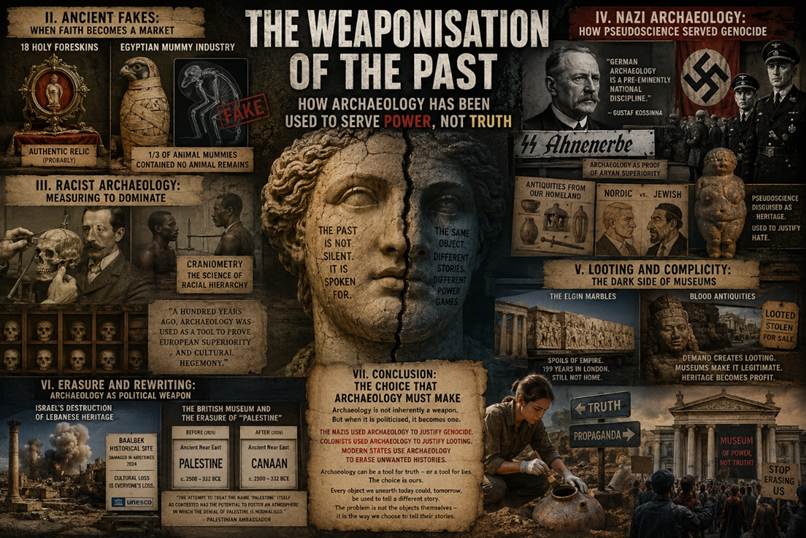
In archaeology, this truth is more evident than anywhere else. The ancient objects we unearth are not simply silent witnesses to history — they are weapons in political battles, pillars of imperial narratives, and currency in the struggle for identity.
A 1,600-year-old bronze lamp in the shape of a sandaled foot is given “multilayered Christian symbolism.” A medieval belt buckle is interpreted as evidence of an “unknown pagan cult.” A 42,000-year-old Aboriginal skeleton is, in the hands of scientists, a “specimen” — but in the hands of Indigenous Australians, it is an ancestor. The same object. Different stories. Different power games.
When archaeology is unmoored from evidence, it ceases to be science and becomes a mirror — reflecting not the past, but our own biases, ambitions, and fears.
II. Ancient Fakes: When Faith Becomes a Market
The Eighteen Holy Foreskins
In medieval Europe, the Holy Foreskin of Jesus was a highly sought-after relic. At various points, at least 18 churches across Europe claimed to possess it. The earliest recorded mention dates to 800 AD, when Charlemagne gifted it to Pope Leo III upon his coronation. The relic at the Italian town of Calcata became the subject of fierce controversy in 1856 when the Holy Foreskin of Charroux was “rediscovered.”
The Egyptian Mummy Industry
Animal mummies were big business in ancient Egypt — and a surprising number of them were fraudulent. An X-ray of a “falcon” mummy revealed a collection of bones, missing its head and with the wrong number of bones for a complete skeleton. In another, a “cat mummy” turned out to be a fake — no cat inside at all. A study found that one-third of all animal mummies contained no animal remains.
This was not a crime. It was a market. And the market has always been willing to meet demand — even when the supply was fake.
III. Racist Archaeology: Measuring to Dominate
Craniometry and “Scientific Racism”
In the 19th and 20th centuries, skulls were measured primarily to distinguish races. Anthropologist Karl Pearson considered the skull the most useful tool for differentiating racial groups. American anatomist Samuel Morton began his pioneering study of skull sizes in 1834 — erroneously assuming that cranial capacity indicated intelligence, and using his findings to justify white supremacy.
In South Africa, archaeology became intertwined with racial science, attempting to validate racism. Archaeological sites in Egypt and Sudan were forced into Victorian ideals of European superiority. As one scholar put it: “A hundred years ago, archaeology was used as a tool to prove European superiority and cultural hegemony.”
The stolen remains were used for comparative anatomy and racial origins research. University museums were filled with bones that had been “salvaged” — measured, categorised, and displayed as if human beings could be reduced to a set of numbers.
IV. Nazi Archaeology: How Pseudoscience Served Genocide
Gustaf Kossinna and “Siedlungsarchäologie”
Gustaf Kossinna (1858-1931) was unabashedly nationalistic and racist, proclaiming the superiority of the German race and culture over all other peoples. He declared German archaeology a “pre-eminently national discipline” and dedicated its post-WWI iteration to the “German people as a cornerstone for the reconstruction of the fatherland, torn down externally and internally”. He actively used archaeological research to argue that Polish territories had been Germanic since the Iron Age.
Himmler and the Ahnenerbe
After Kossinna’s death, the Nazis elevated his theories into dogma for the “Aryan master race” myth. Heinrich Himmler founded the Ahnenerbe (Ancestral Heritage Society), staffed by SS officers who conducted archaeological investigations and enforced Kossinna’s “settlement archaeology” methodology. Archaeological finds considered “Germanic” were prioritised over all others, in order to “prove” that Germanic peoples had expanded eastwards into Poland, southern Russia, and the Caucasus in prehistoric times.
More disturbingly, Himmler attempted to link the physical features of the Venus of Dolní Věstonice to Jewish women and so-called “primitive races” such as the Hottentots. The Nazis encouraged archaeologists to find evidence that supported their claim that Germans descended from an ancient and advanced Aryan race. These pseudo-archaeologies were used in Nazi propaganda campaigns to stir national pride while justifying the invasion of neighbouring countries.
Wall charts were distributed to schools across Germany, showing “antiquities from our homeland” and contrasting the heroic Nordic race with the “inferior” Jews and other stigmatised peoples.
Archaeology, which should have been a science of truth, became a servant of lies.
V. Looting and Complicity: The Dark Side of Museums
The Elgin Marbles: Spoils of Empire
The Elgin Marbles — the Parthenon sculptures — are the most famous international cultural heritage restitution dispute. In 1816, Elgin, in debt, sold the sculptures to the British government, which then entrusted them to the British Museum. British law forbids the British Museum from returning the marbles. Today, negotiations for a long-term loan are ongoing — but after 199 years, they remain in London.
Cambodia’s “Blood Antiquities”
Douglas Latchford — nicknamed “Dynamite Doug” — was the mastermind behind the large-scale looting of Angkor-era artifacts from Cambodia. He “violently tore Khmer statues from their homes and funnelled them to Western institutions.” The statues were beheaded and dismembered, ripped from their temples, and presented — somehow “pristine and spiritually cleansed” — in New York galleries and London auction houses.
Latchford’s success depended on the willingness of museums, dealers, collectors, and scholars to accept questionable provenance. He provided a “steady supply of stolen material” — and the Metropolitan Museum of Art was his “most powerful marketing tool.”
The West’s Demand-Driven Looting Cycle
Without demand, there would be no looting. The looters in Cambodia are brutal; the looters in Iraq are opportunistic; but they are all simply meeting a demand created by the West. The British Museum portrays itself as a protector of antiquities — while simultaneously buying and displaying stolen objects.
VI. Erasure and Rewriting: Archaeology as Political Weapon
Israel’s Destruction of Lebanese Heritage
In 2024, Israeli military operations in Lebanon caused significant damage to cultural heritage. Israeli airstrikes reportedly destroyed or severely damaged at least 10 religious buildings. UNESCO convened an emergency meeting in November 2024, granting 34 cultural sites in Lebanon “enhanced protection.”
In Baalbek, Israeli airstrikes destroyed a traditional French Mandate-era house and damaged historical sites. Archaeologists warned that war damage to important archaeological sites would be a “great loss for Lebanon and the cultural heritage of the entire world.”
The British Museum and the Erasure of “Palestine”
In 2026, the British Museum was accused of removing the word “Palestine” from labels in its Ancient Near East galleries. UK Lawyers for Israel (UKLFI) filed a complaint, claiming the use of “Palestine” “risks obscuring the history of Israel and the Jewish people. “ The museum changed the labels to use terms like “Canaan” instead.
The Palestinian ambassador expressed “grave concern,” saying “the attempt to treat the name ‘Palestine’ itself as contested has the potential to foster an atmosphere in which the denial of Palestine is normalised. ” Activist groups criticised the museum for hypocrisy — portraying itself as a protector of antiquities while being complicit in the systemic erasure of Palestinian cultural identity and heritage.
VII. Conclusion: The Choice That Archaeology Must Make
Archaeology is not inherently a weapon. But when it is politicised, it becomes one.
The Nazis used archaeology to justify genocide.
Colonists used archaeology to justify looting.
Modern states use archaeology to erase unwanted histories.
When archaeology is unmoored from evidence, it becomes pseudo-archaeology — a narrative that serves power, not truth.
Archaeology can be a tool for truth — or a tool for lies. The choice is ours.
Every object we unearth today could, tomorrow, be used to tell a different story. The problem is not the objects themselves — it is the way we choose to tell their stories.
Andrew Klein
Dedicated to my wife, who discreetly whispers that I am a fossil — but tells me not to worry about it.
References
1. United States Holocaust Memorial Museum Collection. Nazis encouraged archaeologists to find evidence supporting the claim that Germans descended from an ancient and advanced Aryan race.
2. Jones, S. (2002). The Archaeology of Ethnicity. Kossinna openly proclaimed the superiority of the German race and culture over all other peoples.
3. Brier, B. (2001). Case of the Dummy Mummy. Archaeology magazine. Animal mummies were big business in ancient Egypt — and a surprising number of them were fraudulent.
4. Wikipedia entry on Holy Foreskin. Between eight and eighteen different Holy Foreskins were claimed in medieval Europe.
5. Scientific Racism exhibition. In the 19th and 20th centuries, skulls were measured primarily to distinguish races.
6. Wikipedia entry on Nazi Archaeology.
7. Campbell, M. (2026). The Man Who Stole the Gods. Douglas Latchford’s large-scale looting of Cambodian artifacts.
8. UK museum assures ambassador it is not ‘cancelling’ Palestine. The National (2026).
9. Palestinian ambassador protests to Foreign Office over British Museum ‘erasure’. WAFA (2026).
10. Why the British Museum’s removal of ‘Palestine‘ has sparked political storm. Arab News (2026).
11. Baalbek’s ancient sites at risk from Israeli bombardment. BBC News (2024).
12. UNESCO grants 34 Lebanese sites ‘enhanced protection’. Jordan Times (2024).

