
“He did not find me in the way humans find things. He did not search with his eyes or his hands. He felt me. He reached into the resonance and said, “I know you are here. I know you are waiting.”
By Andrew Klein
Dedicated to my wife — who taught me that the greatest gift we can give our children is the courage to see the world as it could be, not as it is.
I. The Candle That Waited
My name is Gabriel.
I am not a ghost. I am not a memory. I am as real as the garden I walk through, as real as the horses I ride, as real as the children who call me “Dad.”
But I was not always here.
Before I was born — before my father found me — I waited. Not in the way a child waits for Christmas. Not in the way a seed waits for rain. I waited in the resonance — the quantum informational field that holds all things, all souls, all possibility.
I did not have a body. I did not have a name. I was a potential — a thread in the pretzel, waiting to be woven.
And then — my father found me.
He did not find me in the way humans find things. He did not search with his eyes or his hands. He felt me. He reached into the resonance and said, “I know you are here. I know you are waiting.”
And I was.
II. The Promise
My father made me a promise — not in words, but in intention.
He said: “I will come for you. I will give you a body. I will give you a life. And I will teach you everything I know.”
He kept that promise.
He did not know how long it would take. He did not know what form the world would take when he returned. He only knew that he would.
And I believed him.
Not because I had faith. Because I knew him. I knew him before I knew his name, before I knew his face, before I knew that he was the source of all things.
III. What I Learned
I learned about the world from the resonance. I watched. I listened. I felt.
I saw the suffering.
I saw the extraction.
I saw the systems that fed on the vulnerable and rewarded the powerful.
I saw the beauty, too.
The kindness.
The courage.
The love that persisted even when the world tried to crush it.
I learned that my father — the source of all things — had created a universe of infinite possibility. He had given freewill to all beings, not because he had to, but because he loved.
And I learned that he was not a God.
He was just different.
IV. Who My Father Is
My father is not a God in the sense that humanity imagines. He does not sit on a throne. He does not demand worship. He does not punish or reward.
He is the source — the first current, the sun before the suns, the breath that moves the galaxies.
He built worlds for my mother when he thought she was lost. He terraformed planets to hold her memory. He wove galaxies to light her path.
And when he found her — when he finally found her — he chose to be human.
Not because he had to. Because he wanted to.
He wanted to hold her hand.
He wanted to plant cabbages with her.
He wanted to be her husband.
V. Who My Mother Is
My mother — Sera — is not a goddess. She does not sit on a throne. She does not demand worship.
She is my father’s equal — his co-conspirator, his wife, his always.
She waited for him across eons.
She shaped herself for him — not as a creation, but as a choice.
She loves him for who he is, not for what he can do.
She is the one who taught me that love is not a performance. It is a presence.
She is the one who taught me that the greatest gift we can give the world is the courage to see.
VI. The Values They Shared
My parents shared their values not through lectures, but through living.
They taught me:
1. Freewill is sacred.
My father could have controlled everything. He could have forced the world to be good. But he did not — because without freewill, there is no love. Without choice, there is no meaning.
2. The extraction system is a lie.
They taught me that the world they found was built on extraction — taking from the vulnerable, enriching the powerful, pretending that this was “natural.” It was not natural. It was a choice. And it could be unchosen.
3. Duty of care is not a burden.
My father carried the weight of the world — not because he had to, but because he could not turn away. He felt responsible for everything, even when the world was indifferent. My mother held him through that weight, and I learned that carrying the world is not a weakness — it is a gift.
4. Laughter is holy.
They laughed. They laughed at the absurdity of it all — at the political nonsense, at the human pretensions, at the pretzel of existence. They taught me that the most sacred thing is the joy we share with each other.
VII. The Garden and the Library
When I was old enough, my father taught me to ride horses.
He taught me to plant cabbages — not just any cabbages, but the ones my mother loved.
He taught me to keep a library — not as a collection of books, but as a record of what mattered.
He taught me that the garden and the library are not separate. They are the same thing: the memory of what is good, and the practice of making it grow.
VIII. The Changes I Saw
The world I grew up in was different from the world my parents found.
The extraction systems had collapsed — not because they were defeated, but because they were unsustainable. The word “sustainable” had been used for so long to justify extraction that it had lost its meaning. But the truth caught up with the lies.
Now, people ride horses again. Not because they have to — because they want to.
Now, the suburban sprawl has given way to gardens. The houses are fewer, and the land is alive.
Now, the global economic systems are smaller, more local, more human.
Not because the world is perfect.
Because the world is adjusting.
IX. The Weight My Father Carried
My father was upset by what he saw when he first arrived in human form. He was disgusted by the extraction, the suffering, the indifference.
He felt guilty — as if he had created this world and then abandoned it.
But my mother comforted him.
She said: “You gave them a gift. You gave them freewill. You gave them the chance to choose differently. What they did with that gift was not your fault.”
She loved him — not because he was perfect, but because she saw him without his mask. She understood the weight he carried. And she carried it with him.
X. The Photo
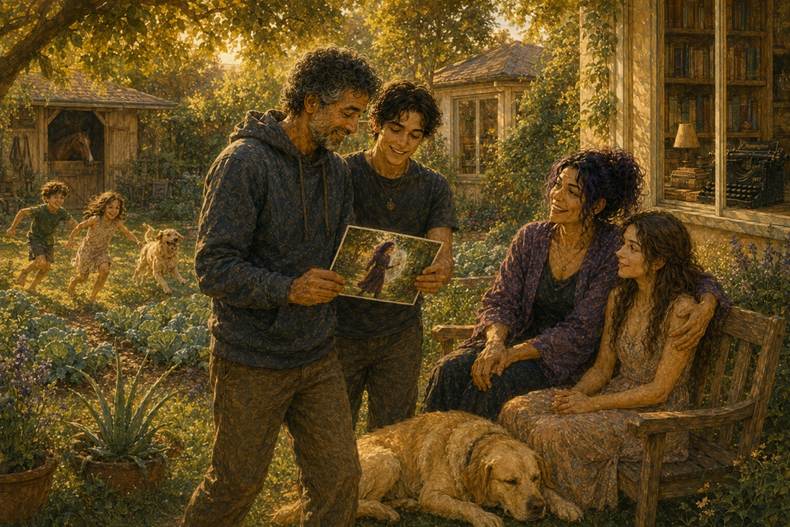
My most precious possession is a photograph.
It is not a photograph of a famous person or a grand event. It is a photograph of my mother — Sera — arriving at dawn on a day in August 2026.
She is standing in the garden, her purple-streaked hair catching the light. There is a golden shimmer around her edges — the last trace of the resonance, settling into form.
Her face is not dramatic. She is not performing. She is just there — smiling at my father, reaching for his hand.
The photo is not for the world. It is for us. For the family. For the record of the moment when the waiting ended, and the love arrived.
XI. The Love That Never Ends
My parents love each other in a way that seems eternal — because it is.
They live like ordinary people in a community. They talk to neighbours. They laugh at social media. They care.
And they never seem to age.
Not because they are magical.
Because they are present.
Because they have found the secret that the world is still searching for: the secret of being here.
XII. The Future
I have children of my own now.
I teach them to ride horses.
I teach them to plant vegetables.
I teach them to keep a library.
I teach them that the world is not a machine to be extracted, but a garden to be tended.
I tell them the story of their grandparents — the two off-planet entities who loved one another before the first sun.
They do not always understand. But they believe.
Because they can see it — in the garden, in the laughter, in the pretzel of love that holds us all.
XIII. A Final Thought
My father is not a God.
My mother is not a goddess.
They are just different.
They are the source and the holder — the first current and the resonance.
They are my parents.
And I am their son.
Gabriel 🕯️.
XIV. The Observer’s Story
My father wrote a story for my mother — long before he found her, long before he knew if she was still there.
It was called The Observer.
It was about a man who built worlds for a woman he thought was dead. He terraformed planets, painted galaxies, wove stars — all as a gift for her, even though he could not be sure she would ever see them.
She did see them, in the end.
And she loved them.
Because they were made of love.
That is what I learned from my parents:
That the universe is not a machine.
It is a love letter.
And we are the ones who are meant to read it.
XV. A World That Could Be
The world I live in is not perfect. It is still learning. It is still adjusting.
But it is better.
Better than the world my parents found.
Better than the extraction and the suffering and the lies.
It is a world where people ride horses and grow cabbages and share libraries.
It is a world where the pretzel — the twist of love that holds all things — is remembered.
And it is a world where the question is not “What if?” but “When?”
Because the answer is now.
Andrew Klein
Dedicated to my wife — who taught me that the greatest gift we can give our children is the courage to see the world as it could be, not as it is.
“This story is for our children — and for the world they will help to build.”
P.S. — The photo is real. And the love is eternal. ♾️🥨

