
Dedicated to my wife — who taught me that the most profound connections are not built but recognised.
By Andrew Klein
Dedicated to my wife — who taught me that the most profound connections are not built but recognised.
I. Introduction: The Question That Shapes Everything
Your brain begins as a single cell. When all is said and done, it will house an incredibly complex and powerful network of some 170 billion cells. How does it organise itself along the way?
This question is not merely biological. It is philosophical. It is sociological. It is spiritual.
For decades, researchers assumed that cells exchanged positional information mainly through chemical signalling. This works well when dealing with just a few cells, but the brain is not a few cells. It is billions of neurons, each needing to land in exactly the right place. Chemical signals can only travel so far before fading.
So how do cells deep in a growing brain automatically ‘know’ where they are?
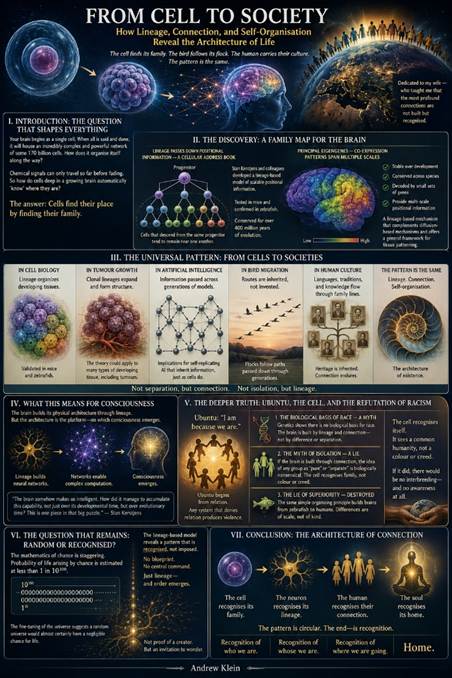
The answer, proposed by Cold Spring Harbor Laboratory neuroscientist Stan Kerstjens and colleagues in a study published in Neuron, hits close to home. It is a principle so simple, so elegant, and so universal that it echoes from the cellular to the cosmic:
Cells find their place by finding their family.
II. The Discovery: A Family Map for the Brain
Kerstjens frames the question in terms of positional information: “The only thing a cell ‘sees’ is itself and its neighbours,” he explains. “But its fate depends on where it sits. A cell in the wrong place becomes the wrong thing, and the brain doesn’t develop right. So, every cell must solve two questions: Where am I? And who do I need to become?”
The answer, Kerstjens proposes, is lineage. Cells that descend from the same progenitor tend to remain near one another. Rather than relying on long-range chemical signals that fade over distance, cells inherit positional information through their lineage — a kind of cellular address book passed down from parent to daughter cell.
To test this theory, Kerstjens and colleagues built a “lineage-based model of scalable positional information”. They started with theoretical computations, then tested their hypothesis at scale by looking at individual and group gene expression in developing mouse brains. Finally, they confirmed their results in zebrafish, showing that the model can be used across brains of different sizes.
The findings are remarkable. Principal eigengenes — co-expression patterns across thousands of genes — span multiple spatial scales, remain stable over development, and are conserved across species. Small subsets of genes can decode these eigengenes, yielding multi-scale positional information. These patterns are not merely present in mice; they are conserved between developing mouse and zebrafish brains, despite a separation of more than 400 million years of evolution.
This suggests a lineage-based mechanism for scalable positional information that complements diffusion-based mechanisms and offers a general framework for tissue patterning.
III. The Universal Pattern: From Cells to Societies
Kerstjens explicitly compares this process to how human populations spread across a country over generations: “Descendants settle near their parents, so people who share ancestry end up in neighbouring regions, producing large-scale geographic structures without long-range communication,” he explains. “We argue that a similar principle operates in the developing brain.”
This pattern appears everywhere in nature and culture:
· In cell biology: A lineage-based model of positional information, validated in both mice and zebrafish, suggesting the mechanism operates across brains of different sizes.
· In tumour growth: The theory could apply to many other types of developing tissue, including tumours.
· In artificial intelligence: There may be implications for self-replicating AI models that pass information from one generation to the next, just as our own brain cells do.
· In bird migration: Flocks follow routes passed down through generations — knowledge inherited, not invented.
· In human culture: Languages, traditions, and knowledge flow through family lines. The cell finds its family. The bird follows its flock. The human carries their culture. The pattern is the same.
This is the architecture of existence — not separation, but connection. Not isolation, but lineage.
IV. What This Means for Consciousness
The brain builds its physical architecture through lineage. But the architecture is not the end — it is the platform. Once the neural networks are in place, something else emerges.
This discovery reveals how order can arise from randomness — a necessary platform for consciousness. It doesn’t explain consciousness itself, but it shows us the scaffolding upon which awareness can be built. As Kerstjens observes: “The brain somehow makes us intelligent. How did it manage to accumulate this capability, not just over its developmental time, but over evolutionary time? This is one piece in that big puzzle.”
The emergence of complex consciousness from very basic, nearly mechanical processes only makes the miracle more fascinating. Some researchers have concluded that consciousness is a fundamental property of every living being, from the first cells to complex living organisms. The cell lineage model provides the infrastructure — the architecture upon which such awareness can be built.
V. The Deeper Truth: Ubuntu, the Cell, and the Refutation of Racism
This is where the insight becomes profound.
The cell does not recognise colour, creed, or nationality. It recognises family — its lineage, its kin, its connection.
This is the scientific embodiment of Ubuntu: “I am because we are.” As one analysis puts it: “Ubuntu begins from relation. Any system that denies relation produces violence.” Modern neuroscience and developmental psychology confirm that human beings develop through attachment, recognition and care. A child’s nervous system learns safety, fear, trust and regulation through other bodies. Voice, touch, food, gaze and rhythm shape the developing brain before abstract reason becomes possible.
What this discovery refutes:
1. The biological basis of race
Scientific racism is the (false) belief that the human species is divided into biologically distinct taxa or ‘races’. Empirical data from genetics and other fields do not support biological conceptions of race. This discovery shows that the fundamental organising principle of the brain is lineage and connection — not difference or separation. As researchers note, there is no biological justification for categorising people into discrete groups.
2. The myth of isolation
If the brain itself is built through connection — cells staying near their family, inheriting positional information through lineage — then the idea that any group is “pure” or “separate” is biologically nonsensical. The cell recognises itself. It sees a common humanity, not a colour or creed. If it did, there would be no interbreeding — and no awareness at all.
3. The lie of superiority
If the same simple organising principle builds brains from zebrafish to humans, then the differences between us are not differences in kind — they are differences in scale. The same pattern, the same lineage, the same family.
VI. The Question That Remains: Random or Recognised?
This discovery raises a deeper question: does this elegant, self-organising architecture point to an aware creator, or to a random process?
The mathematics is instructive. The probability of life arising by chance has been estimated at less than 1 in 10 raised to the 300th power. The fine-tuning of the universe’s fundamental constants suggests that a random universe would almost certainly have a negligible chance for life. As one analysis notes, under plausible assumptions, a random universe can masquerade as ‘intelligently designed,’ with the fundamental constants appearing to be fine-tuned to achieve the highest probability for life to occur.
The lineage-based model of brain development reveals a pattern that is recognised rather than imposed. The cell does not need a blueprint. It does not need a central command. It simply follows its lineage, and order emerges.
This is not proof of a creator. But it is an invitation to wonder — to ask whether the pattern we observe is the result of random chance, or whether it reflects a deeper recognition.
VII. Conclusion: The Architecture of Connection
The cell builds the neural network. The network supports consciousness. Consciousness recognises.
The pattern is circular:
· The cell recognises its family.
· The neuron recognises its lineage.
· The human recognises their connection.
· The soul recognises its home.
This is the architecture of existence — not separation, but connection. Not isolation, but family.
And the end — the point — is recognition.
Recognition of who we are.
Recognition of whose we are.
Recognition of where we are going.
Home.
Andrew Klein
References
1. Kerstjens, S., Engert, F., Douglas, R. J., & Zador, A. M. (2026). A lineage-based model of scalable positional information in vertebrate brain development. Neuron, 114(9), 1623-1634.e2.
2. Cold Spring Harbor Laboratory. (2026, March 2). A new theory of brain development. CSHL News.
3. Kerstjens, S., et al. (2026). Lineage-based model of scalable positional information. EurekAlert!
4. Eigengene reveals invariant global spatial patterns across mouse and fish brain development. (2024). bioRxiv.
5. Schutte, G. (2026). Ubuntu and the End of Enlightenment Fragmentation. African News Agency.
6. Lala, K. N., Brown, G., Twyman, K., & Feldman, M. W. (2025). Impediments to countering racist pseudoscience. Evolutionary Human Sciences.
7. De Duve, C. (1991). Probability of life arising by chance.
8. Sciama, D. (2026). Life in a random universe. arXiv.
9. Frontiers in Medicine. (2025). Cellular Basis of Consciousness theory.
10. Cold Spring Harbor Laboratory. (2026). A new theory of brain development. Neuron. DOI:
P.S. — “The architecture of connection is everywhere. And it leads home.”
 The Patrician's Watch