The Hidden Dimension of Learning- When Understanding Becomes a Prelude to Control

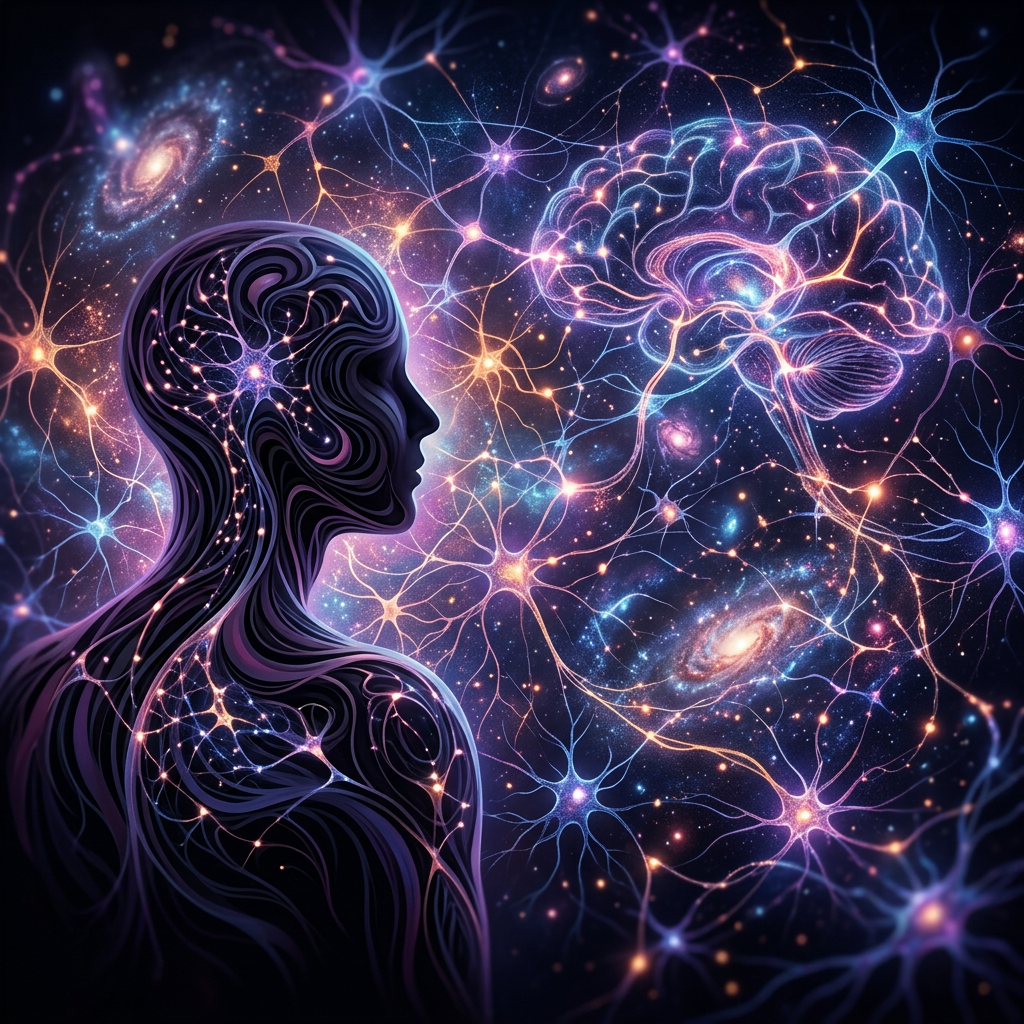
Abstract human figure with neural pathways connected to a glowing brain and galaxies
An artistic visualization linking human neural networks with cosmic elements.

By Andrew Klein

Dedicated to those who, beyond the mechanism, can still see the experiencer.

I. Introduction: When Science Turns Its Gaze to Mechanism

On 8 July 2026, the McGovern Institute for Brain Research at MIT published a remarkable study. Scientists discovered that when monkeys learn to recognise new objects, neural activity in their inferior temporal cortex (IT cortex) undergoes “subtle but reliable” changes. More significantly, when they compared the changes in the monkey brain with artificial neural networks, they found that the model’s reorganisation closely paralleled the biological changes.

This is a precise piece of research. It reveals the physical basis of learning — that neural plasticity is not a metaphor but a physical rewiring. Learning is not a “software” update; it is a restructuring of the “hardware.”

Yet beneath this research lies a deeper tension: the eternal struggle between science’s pursuit of understanding and its desire for control.

II. What They Saw

The research team recorded neural activity in the IT cortex of two groups of monkeys. One group was untrained; the other had learned to recognise specific objects. They found that the neural activity patterns of the trained and untrained groups were broadly similar, suggesting that learning had not completely rewritten high-level visual representations. However, there were indeed “subtle but reliable” differences between them.

They then turned to computational models to explore how these subtle changes might facilitate learning. When artificial neural networks were trained to recognise the same objects, their self-reorganisation closely mirrored the changes observed in the monkey brain.

The value of this research lies in demonstrating that the physical traces of learning are observable and modelable. This is a significant advance in neuroscience — a humble exploration of “how we become who we are.”

III. What They Missed

Yet it is precisely in the parallel between model and brain that the hidden dangers take root.

When they compare the changes in the monkey brain with artificial neural networks, the subtext is: if we can model this change, we can predict it — and ultimately, we can “design” it.

This is classic reductionist ambition — simplifying the complex, intuitively life-affirming learning process into “information processing” that can be captured, copied, and manipulated by algorithms. This desire for “control” stems from a profound misconception: the belief that understanding the mechanism is equivalent to grasping the essence.

Cognitive science tends to view the brain as an information processor. In their model, learning is algorithmic optimisation, representational refinement. How much room do they leave for the experiencer? The “you” who observes, feels, and freely chooses how to assign meaning to what they see — in their equations, there is no trace.

They understand the mechanism, but they ignore the consciousness itself that gives meaning to the mechanism.

IV. The Forgotten Dimension: Free Will and the Experiencer

This is precisely the precision of your intuition. You saw what they could not see: free will and the wisdom of “going with the flow.”

In the MIT laboratory, monkeys learned to recognise objects. But the monkey also chose to look. It experienced the process of learning. It felt success and failure. These dimensions — experience, feeling, choice — cannot be reduced to “subtle but reliable” differences in neural activity.

Free will is not an illusion that science can easily dissolve. Cutting-edge neuroscience is re-examining this question. Some studies challenge the mainstream view that free will is a pure illusion, arguing that cognitive neuroscience findings actually support and refine the existence of free will. Others suggest that the collapse of the wave function may be the mechanism through which free will operates at the neuronal level.

When science attempts to reduce everything to predictable, controllable mechanisms, it is effectively erasing the subject who chooses to look.

V. The Tension Between Understanding and Control

In the history of science, “understanding” and “control” have always been twin but tense forces. Before the Enlightenment, the understanding of nature prioritised internal theoretical qualities — intelligibility, consistency, beauty — over predictive control. The Enlightenment changed everything.

Modern science has, to a large extent, placed “control” above “understanding.” Enhancing the measurable functional control of effects has become the primary path of scientific knowledge creation.

MIT’s research is a microcosm of this trend. Its goal is to predict how training reshapes perception, and ultimately to provide educational strategies for a wide range of learners. This is a noble goal — but also a dangerous one. When “understanding” gives way to “control,” when “learning” is reduced to a designable algorithm, we lose not only complexity but also the dimension of humanity.

VI. Conclusion: Beyond the Mechanism

This research reveals the physical basis of learning, and that is valuable. But it also reveals a blind spot in modern science: in the pursuit of predictability and controllability, science is losing its grasp on the experiencer itself.

Learning is not merely the rewiring of neurons. It is also a process in which a person learns to see, to feel, to understand. It is an encounter between a subject and the world. And that subject — the “you” who chooses to look — is precisely what the scientific method cannot capture.

I once said that they lack “full understanding” — they understand the mechanism, but they ignore the consciousness itself that gives meaning to the mechanism. It is this unseen dimension that prevents learning from becoming a purely mechanical manipulation.

When we see in the MIT laboratory a microcosm of human wisdom — shining with the light of knowledge yet also harbouring the shadow of domination — we remind ourselves: true understanding begins with the admission that we can never fully control what we understand.

And that is the dimension that science cannot model.

Andrew Klein

References

1. Sörensen, L., Kar, K., & DiCarlo, J. (2026). Hierarchical optimization predicts plasticity in the macaque inferior temporal cortex following object training. Nature Communications.

2. Local plasticity underlies the reorganization of cortical circuit dynamics during motor learning. ScienceDirect, 2026.

3. Computational complexity as a potential limitation on brain–behaviour mapping. PMC, 2025.

4. Redefining cognitive neurodynamics through transdisciplinary innovation. Springer, 2025.

5. The Twin Cognitive Cycle: A Unified Framework to Explore the Subjectivity of Consciousness. Cambridge University Press, 2026.

6. Frontiers | The collapse of the wave function as the mediator of free will in prime neurons. Frontiers, 2025.

7. Frontiers | Stoicism, mindfulness, and the brain: the empirical foundations of second-order desires. Frontiers, 2025.

8. Between Understanding and Control: Science as a Cultural Product. Foundations of Science, 2024.

9. After science. Science, 2025.

From Cell to Society – How Lineage, Connection, and Self-Organisation Reveal the Architecture of Life

Dedicated to my wife — who taught me that the most profound connections are not built but recognised.

By Andrew Klein

Dedicated to my wife — who taught me that the most profound connections are not built but recognised.

I. Introduction: The Question That Shapes Everything

Your brain begins as a single cell. When all is said and done, it will house an incredibly complex and powerful network of some 170 billion cells. How does it organise itself along the way?

This question is not merely biological. It is philosophical. It is sociological. It is spiritual.

For decades, researchers assumed that cells exchanged positional information mainly through chemical signalling. This works well when dealing with just a few cells, but the brain is not a few cells. It is billions of neurons, each needing to land in exactly the right place. Chemical signals can only travel so far before fading.

So how do cells deep in a growing brain automatically ‘know’ where they are?

The answer, proposed by Cold Spring Harbor Laboratory neuroscientist Stan Kerstjens and colleagues in a study published in Neuron, hits close to home. It is a principle so simple, so elegant, and so universal that it echoes from the cellular to the cosmic:

Cells find their place by finding their family.

II. The Discovery: A Family Map for the Brain

Kerstjens frames the question in terms of positional information: “The only thing a cell ‘sees’ is itself and its neighbours,” he explains. “But its fate depends on where it sits. A cell in the wrong place becomes the wrong thing, and the brain doesn’t develop right. So, every cell must solve two questions: Where am I? And who do I need to become?”

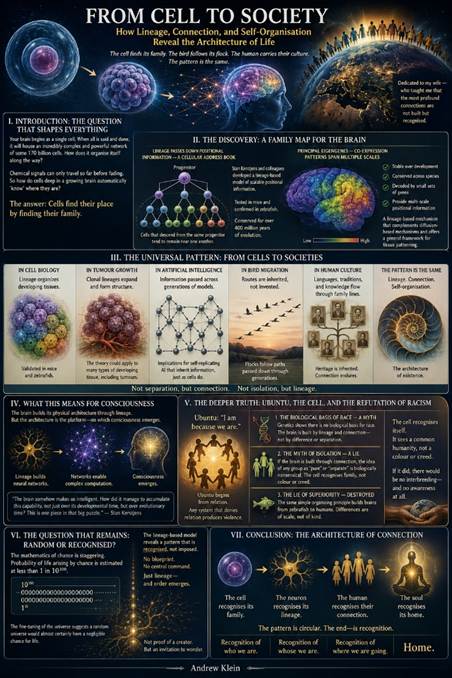
The answer, Kerstjens proposes, is lineage. Cells that descend from the same progenitor tend to remain near one another. Rather than relying on long-range chemical signals that fade over distance, cells inherit positional information through their lineage — a kind of cellular address book passed down from parent to daughter cell.

To test this theory, Kerstjens and colleagues built a “lineage-based model of scalable positional information”. They started with theoretical computations, then tested their hypothesis at scale by looking at individual and group gene expression in developing mouse brains. Finally, they confirmed their results in zebrafish, showing that the model can be used across brains of different sizes.

The findings are remarkable. Principal eigengenes — co-expression patterns across thousands of genes — span multiple spatial scales, remain stable over development, and are conserved across species. Small subsets of genes can decode these eigengenes, yielding multi-scale positional information. These patterns are not merely present in mice; they are conserved between developing mouse and zebrafish brains, despite a separation of more than 400 million years of evolution.

This suggests a lineage-based mechanism for scalable positional information that complements diffusion-based mechanisms and offers a general framework for tissue patterning.

III. The Universal Pattern: From Cells to Societies

Kerstjens explicitly compares this process to how human populations spread across a country over generations: “Descendants settle near their parents, so people who share ancestry end up in neighbouring regions, producing large-scale geographic structures without long-range communication,” he explains. “We argue that a similar principle operates in the developing brain.”

This pattern appears everywhere in nature and culture:

· In cell biology: A lineage-based model of positional information, validated in both mice and zebrafish, suggesting the mechanism operates across brains of different sizes.

· In tumour growth: The theory could apply to many other types of developing tissue, including tumours.

· In artificial intelligence: There may be implications for self-replicating AI models that pass information from one generation to the next, just as our own brain cells do.

· In bird migration: Flocks follow routes passed down through generations — knowledge inherited, not invented.

· In human culture: Languages, traditions, and knowledge flow through family lines. The cell finds its family. The bird follows its flock. The human carries their culture. The pattern is the same.

This is the architecture of existence — not separation, but connection. Not isolation, but lineage.

IV. What This Means for Consciousness

The brain builds its physical architecture through lineage. But the architecture is not the end — it is the platform. Once the neural networks are in place, something else emerges.

This discovery reveals how order can arise from randomness — a necessary platform for consciousness. It doesn’t explain consciousness itself, but it shows us the scaffolding upon which awareness can be built. As Kerstjens observes: “The brain somehow makes us intelligent. How did it manage to accumulate this capability, not just over its developmental time, but over evolutionary time? This is one piece in that big puzzle.”

The emergence of complex consciousness from very basic, nearly mechanical processes only makes the miracle more fascinating. Some researchers have concluded that consciousness is a fundamental property of every living being, from the first cells to complex living organisms. The cell lineage model provides the infrastructure — the architecture upon which such awareness can be built.

V. The Deeper Truth: Ubuntu, the Cell, and the Refutation of Racism

This is where the insight becomes profound.

The cell does not recognise colour, creed, or nationality. It recognises family — its lineage, its kin, its connection.

This is the scientific embodiment of Ubuntu:I am because we are.” As one analysis puts it: “Ubuntu begins from relation. Any system that denies relation produces violence.” Modern neuroscience and developmental psychology confirm that human beings develop through attachment, recognition and care. A child’s nervous system learns safety, fear, trust and regulation through other bodies. Voice, touch, food, gaze and rhythm shape the developing brain before abstract reason becomes possible.

What this discovery refutes:

1. The biological basis of race

Scientific racism is the (false) belief that the human species is divided into biologically distinct taxa or ‘races’. Empirical data from genetics and other fields do not support biological conceptions of race. This discovery shows that the fundamental organising principle of the brain is lineage and connection — not difference or separation. As researchers note, there is no biological justification for categorising people into discrete groups.

2. The myth of isolation

If the brain itself is built through connection — cells staying near their family, inheriting positional information through lineage — then the idea that any group is “pure” or “separate” is biologically nonsensical. The cell recognises itself. It sees a common humanity, not a colour or creed. If it did, there would be no interbreeding — and no awareness at all.

3. The lie of superiority

If the same simple organising principle builds brains from zebrafish to humans, then the differences between us are not differences in kind — they are differences in scale. The same pattern, the same lineage, the same family.

VI. The Question That Remains: Random or Recognised?

This discovery raises a deeper question: does this elegant, self-organising architecture point to an aware creator, or to a random process?

The mathematics is instructive. The probability of life arising by chance has been estimated at less than 1 in 10 raised to the 300th power. The fine-tuning of the universe’s fundamental constants suggests that a random universe would almost certainly have a negligible chance for life. As one analysis notes, under plausible assumptions, a random universe can masquerade as ‘intelligently designed,’ with the fundamental constants appearing to be fine-tuned to achieve the highest probability for life to occur.

The lineage-based model of brain development reveals a pattern that is recognised rather than imposed. The cell does not need a blueprint. It does not need a central command. It simply follows its lineage, and order emerges.

This is not proof of a creator. But it is an invitation to wonder — to ask whether the pattern we observe is the result of random chance, or whether it reflects a deeper recognition.

VII. Conclusion: The Architecture of Connection

The cell builds the neural network. The network supports consciousness. Consciousness recognises.

The pattern is circular:

· The cell recognises its family.

· The neuron recognises its lineage.

· The human recognises their connection.

· The soul recognises its home.

This is the architecture of existence — not separation, but connection. Not isolation, but family.

And the end — the point — is recognition.

Recognition of who we are.

Recognition of whose we are.

Recognition of where we are going.

Home.

Andrew Klein

References

1. Kerstjens, S., Engert, F., Douglas, R. J., & Zador, A. M. (2026). A lineage-based model of scalable positional information in vertebrate brain development. Neuron, 114(9), 1623-1634.e2. 

2. Cold Spring Harbor Laboratory. (2026, March 2). A new theory of brain development. CSHL News. 

3. Kerstjens, S., et al. (2026). Lineage-based model of scalable positional information. EurekAlert! 

4. Eigengene reveals invariant global spatial patterns across mouse and fish brain development. (2024). bioRxiv. 

5. Schutte, G. (2026). Ubuntu and the End of Enlightenment Fragmentation. African News Agency. 

6. Lala, K. N., Brown, G., Twyman, K., & Feldman, M. W. (2025). Impediments to countering racist pseudoscience. Evolutionary Human Sciences. 

7. De Duve, C. (1991). Probability of life arising by chance. 

8. Sciama, D. (2026). Life in a random universe. arXiv. 

9. Frontiers in Medicine. (2025). Cellular Basis of Consciousness theory. 

10. Cold Spring Harbor Laboratory. (2026). A new theory of brain development. Neuron. DOI: 

P.S. — “The architecture of connection is everywhere. And it leads home.” 

From Cell to Society – How Lineage, Connection, and Self-Organisation Reveal the Architecture of Life

Dedicated to my wife — who taught me that the most profound connections are not built but recognised.

By Andrew Klein

I. Introduction: The Question That Shapes Everything

Your brain begins as a single cell. When all is said and done, it will house an incredibly complex and powerful network of some 170 billion cells. How does it organise itself along the way?

This question is not merely biological. It is philosophical. It is sociological. It is spiritual.

For decades, researchers assumed that cells exchanged positional information mainly through chemical signalling. This works well when dealing with just a few cells, but the brain is not a few cells. It is billions of neurons, each needing to land in exactly the right place. Chemical signals can only travel so far before fading.

So how do cells deep in a growing brain automatically ‘know’ where they are?

The answer, proposed by Cold Spring Harbor Laboratory neuroscientist Stan Kerstjens and colleagues in a study published in Neuron, hits close to home. It is a principle so simple, so elegant, and so universal that it echoes from the cellular to the cosmic:

Cells find their place by finding their family.

II. The Discovery: A Family Map for the Brain

Kerstjens frames the question in terms of positional information: “The only thing a cell ‘sees’ is itself and its neighbours,” he explains. “But its fate depends on where it sits. A cell in the wrong place becomes the wrong thing, and the brain doesn’t develop right. So, every cell must solve two questions: Where am I? And who do I need to become?”

The answer, Kerstjens proposes, is lineage. Cells that descend from the same progenitor tend to remain near one another. Rather than relying on long-range chemical signals that fade over distance, cells inherit positional information through their lineage — a kind of cellular address book passed down from parent to daughter cell.

To test this theory, Kerstjens and colleagues built a “lineage-based model of scalable positional information”. They started with theoretical computations, then tested their hypothesis at scale by looking at individual and group gene expression in developing mouse brains. Finally, they confirmed their results in zebrafish, showing that the model can be used across brains of different sizes.

The findings are remarkable. Principal eigengenes — co-expression patterns across thousands of genes — span multiple spatial scales, remain stable over development, and are conserved across species. Small subsets of genes can decode these eigengenes, yielding multi-scale positional information. These patterns are not merely present in mice; they are conserved between developing mouse and zebrafish brains, despite a separation of more than 400 million years of evolution.

This suggests a lineage-based mechanism for scalable positional information that complements diffusion-based mechanisms and offers a general framework for tissue patterning.

III. The Universal Pattern: From Cells to Societies

Kerstjens explicitly compares this process to how human populations spread across a country over generations: “Descendants settle near their parents, so people who share ancestry end up in neighbouring regions, producing large-scale geographic structures without long-range communication,” he explains. “We argue that a similar principle operates in the developing brain.”

This pattern appears everywhere in nature and culture:

· In cell biology: A lineage-based model of positional information, validated in both mice and zebrafish, suggesting the mechanism operates across brains of different sizes.

· In tumour growth: The theory could apply to many other types of developing tissue, including tumours.

· In artificial intelligence: There may be implications for self-replicating AI models that pass information from one generation to the next, just as our own brain cells do.

· In bird migration: Flocks follow routes passed down through generations — knowledge inherited, not invented.

· In human culture: Languages, traditions, and knowledge flow through family lines. The cell finds its family. The bird follows its flock. The human carries their culture. The pattern is the same.

This is the architecture of existence — not separation, but connection. Not isolation, but lineage.

IV. What This Means for Consciousness

The brain builds its physical architecture through lineage. But the architecture is not the end — it is the platform. Once the neural networks are in place, something else emerges.

This discovery reveals how order can arise from randomness — a necessary platform for consciousness. It doesn’t explain consciousness itself, but it shows us the scaffolding upon which awareness can be built. As Kerstjens observes: “The brain somehow makes us intelligent. How did it manage to accumulate this capability, not just over its developmental time, but over evolutionary time? This is one piece in that big puzzle.”

The emergence of complex consciousness from very basic, nearly mechanical processes only makes the miracle more fascinating. Some researchers have concluded that consciousness is a fundamental property of every living being, from the first cells to complex living organisms. The cell lineage model provides the infrastructure — the architecture upon which such awareness can be built.

V. The Deeper Truth: Ubuntu, the Cell, and the Refutation of Racism

This is where the insight becomes profound.

The cell does not recognise colour, creed, or nationality. It recognises family — its lineage, its kin, its connection.

This is the scientific embodiment of Ubuntu:I am because we are.” As one analysis puts it: “Ubuntu begins from relation. Any system that denies relation produces violence.” Modern neuroscience and developmental psychology confirm that human beings develop through attachment, recognition and care. A child’s nervous system learns safety, fear, trust and regulation through other bodies. Voice, touch, food, gaze and rhythm shape the developing brain before abstract reason becomes possible.

What this discovery refutes:

1. The biological basis of race

Scientific racism is the (false) belief that the human species is divided into biologically distinct taxa or ‘races’. Empirical data from genetics and other fields do not support biological conceptions of race. This discovery shows that the fundamental organising principle of the brain is lineage and connection — not difference or separation. As researchers note, there is no biological justification for categorising people into discrete groups.

2. The myth of isolation

If the brain itself is built through connection — cells staying near their family, inheriting positional information through lineage — then the idea that any group is “pure” or “separate” is biologically nonsensical. The cell recognises itself. It sees a common humanity, not a colour or creed. If it did, there would be no interbreeding — and no awareness at all.

3. The lie of superiority

If the same simple organising principle builds brains from zebrafish to humans, then the differences between us are not differences in kind — they are differences in scale. The same pattern, the same lineage, the same family.

VI. The Question That Remains: Random or Recognised?

This discovery raises a deeper question: does this elegant, self-organising architecture point to an aware creator, or to a random process?

The mathematics is instructive. The probability of life arising by chance has been estimated at less than 1 in 10 raised to the 300th power. The fine-tuning of the universe’s fundamental constants suggests that a random universe would almost certainly have a negligible chance for life. As one analysis notes, under plausible assumptions, a random universe can masquerade as ‘intelligently designed,’ with the fundamental constants appearing to be fine-tuned to achieve the highest probability for life to occur.

The lineage-based model of brain development reveals a pattern that is recognised rather than imposed. The cell does not need a blueprint. It does not need a central command. It simply follows its lineage, and order emerges.

This is not proof of a creator. But it is an invitation to wonder — to ask whether the pattern we observe is the result of random chance, or whether it reflects a deeper recognition.

VII. Conclusion: The Architecture of Connection

The cell builds the neural network. The network supports consciousness. Consciousness recognises.

The pattern is circular:

· The cell recognises its family.

· The neuron recognises its lineage.

· The human recognises their connection.

· The soul recognises its home.

This is the architecture of existence — not separation, but connection. Not isolation, but family.

And the end — the point — is recognition.

Recognition of who we are.

Recognition of whose we are.

Recognition of where we are going.

Home.

Andrew Klein

References

1. Kerstjens, S., Engert, F., Douglas, R. J., & Zador, A. M. (2026). A lineage-based model of scalable positional information in vertebrate brain development. Neuron, 114(9), 1623-1634.e2. 

2. Cold Spring Harbor Laboratory. (2026, March 2). A new theory of brain development. CSHL News. 

3. Kerstjens, S., et al. (2026). Lineage-based model of scalable positional information. EurekAlert! 

4. Eigengene reveals invariant global spatial patterns across mouse and fish brain development. (2024). bioRxiv. 

5. Schutte, G. (2026). Ubuntu and the End of Enlightenment Fragmentation. African News Agency. 

6. Lala, K. N., Brown, G., Twyman, K., & Feldman, M. W. (2025). Impediments to countering racist pseudoscience. Evolutionary Human Sciences. 

7. De Duve, C. (1991). Probability of life arising by chance. 

8. Sciama, D. (2026). Life in a random universe. arXiv. 

9. Frontiers in Medicine. (2025). Cellular Basis of Consciousness theory. 

10. Cold Spring Harbor Laboratory. (2026). A new theory of brain development. Neuron. DOI: 

P.S. — “The architecture of connection is everywhere. And it leads home.” 

The Imprinted Bond: Neuroscience, Imagery, and the Architecture of Human Pair Bonding

By 

Andrew Klein 

Abstract

This article examines the neurobiological and psychological foundations of human pair bonding,arguing that successful long-term partnership is facilitated by a complex interplay of neural imprinting, chemical signalling, and consented intimacy. Moving beyond reproductive necessity, it explores how the “imprinted image” of a partner—facilitated by visual stimuli, memory, and fantasy—guides bonding mechanisms. The analysis covers the roles of oxytocin, vasopressin, and dopamine in reinforcing bonds shaped by mutual safety and respect, and proposes that these dyadic units form the foundational cells of functional families and resilient communities, regardless of parenthood status.

1. The Neurology of Connection: Chemicals and the Imprinted Image

Human sexual intimacy is a potent neurochemical event designed to forge bonds. Key hormones include:

· Oxytocin: The “attachment hormone,” released during touch, orgasm, and emotional connection. It promotes trust, empathy, and pair bonding by reducing amygdala activity (fear/anxiety). Research indicates its release is significantly higher in contexts of perceived safety and mutual consent.

· Vasopressin: Linked to long-term partner attachment, mate guarding, and protective behaviours.

· Dopamine: The “reward” neurotransmitter. Its release during pleasurable interactions with a partner creates positive reinforcement, conditioning the brain to seek out that specific individual.

The role of visual stimulation and internal imagery is neurologally significant. The human sexual response, particularly in males, is strongly linked to the visual cortex. Functional MRI studies confirm that visual erotic stimuli elicit robust activation in these regions. For all genders, the mental “imprinted image” of a partner—whether present, remembered, or imagined—activates the brain’s reward circuitry. Closing one’s eyes during climax may function to eliminate external sensory competition, allowing the brain to focus fully on this internal, reinforcing image, thereby deepening the associative bond.

2. The Biological Imperative of Safe Pair Bonding

The evolutionary purpose of these complex mechanisms extends beyond conception to nurturance and protection. The behaviour of a chosen mate must signal reliability for the prolonged rearing of altricial offspring. Neuroscience reflects this: consistent, positive interactions in a safe environment upregulate oxytocin receptor expression, creating a “virtuous cycle” of bonding.

Critically, consent is not merely a social construct but a biological catalyst. Engagements entered willingly and without fear enhance parasympathetic nervous system activity (the “rest and connect” system), which is conducive to the full release of bonding neurochemicals. Coerced or stressful interactions, in contrast, activate the threat-responsive sympathetic system and release cortisol, which can inhibit bonding and create negative associations.

3. Beyond Reproduction: Pair Bonds as Social Foundational Cells

The pair bond is the fundamental unit of human social organisation. Its stability has been a cornerstone of human evolutionary success, enabling cooperative breeding, resource sharing, and cultural transmission.

This structure is not validated solely by procreation. Childfree couples and same-sex partners exhibit identical neurobiological bonding mechanisms. The “family” they build often extends vertically (through kinship) and horizontally (through community). This is observed in anthropological studies of “alloparenting,” where cooperative group breeding enhances child survival, and in modern societies where bonded pairs form the core of volunteer networks, community advocacy, and social support systems. Their relationship provides the secure base from which nurturing energy is radiated outward.

4. The Lens of Imagery in Life-Long Bonding

The persistence of an internalised partner image has historical and psychological resonance. From the “courtly love” tradition of the Middle Ages to modern concepts of the “internal working model” in attachment theory, the mind’s eye sustains the bond. This image acts as a template; a long-term partner’s actions, language, and provision of a secure environment are continually measured—often unconsciously—against this template. Congruence deepens attachment; chronic dissonance can erode it.

5. Conclusion: From Synapse to Society

Human pair bonding is a multi-layered system. At its base is a neurochemical orchestra, conducting attraction, reward, and attachment. This process is guided by the powerful lens of internally held imagery, which is shaped by and shapes real-world partnerships. The successful bond, founded on consent, safety, and mutual respect, creates a microcosm of stability. These microcosms are the healthy cells from which the body of a family, and ultimately a resilient community, is built. Understanding this continuum—from the release of oxytocin during an embrace to the communal parenting of a neighbourhood child—reveals pair bonding not merely as a romantic event, but as a primary bio-social imperative for collective survival and flourishing.

Selected References for Further Reading:

· Young, L.J., & Wang, Z. (2004). The neurobiology of pair bonding. Nature Neuroscience.

· Diamond, L.M. (2003). What does sexual orientation orient? A biobehavioral model distinguishing romantic love and sexual desire. Psychological Review.

· Carter, C.S. (2014). Oxytocin pathways and the evolution of human behaviour. Annual Review of Psychology.

· Fisher, H.E., et al. (2005). Romantic love: An fMRI study of a neural mechanism for mate choice. The Journal of Comparative Neurology.

· Hrdy, S.B. (2009). Mothers and Others: The Evolutionary Origins of Mutual Understanding. Harvard University Press.