
By Andrew Klein
Dedicated to my wife, who appreciates my engineer’s eye on things.
I. Introduction: The Map and the Territory
Scientists have achieved the extraordinary. They have detected gravitational waves, mapped the universe, and measured the curvature of spacetime. They have observed the loudest binary black hole signal to date — GW250114, about three times louder than the first gravitational wave detected a decade ago. They have even claimed to detect “direct imprints” of the black hole’s event horizon itself.
All without ever mentioning the Quantum Informational Field (QIF).
This is not a failure. This is a method.
It is called compartmentalised learning — the art of studying a phenomenon without ever asking where it comes from. Modular education and disciplinary silos have long encouraged students and researchers to focus narrowly on individual subjects without making connections or integrating knowledge across boundaries. The result is a system that produces experts in effects — but not in causes.
Imagine a cartographer who has never walked the land. He measures, observes, and maps. His map is beautiful — accurate, detailed, and complete. One day, someone asks him: “Where did the land come from? What is the soil made of? Who planted the trees?”
He looks at them with pity.
“I am a cartographer,” he says. “I map the land. I do not ask where it came from. That is not on the map.”
That is compartmentalised learning. You do not need to know where the land comes from. You just need to measure it.
II. The Physicist and the Gravitational Wave
A physicist detects a gravitational wave — GW250114. She measures its frequency. She calculates its amplitude. She determines its source. She writes a paper. The paper is published. The paper is celebrated. The paper is correct.
The paper describes an oscillating gravitational-wave component near 2ΩH, reflecting the horizon’s frame dragging, decaying at an increasing rate characterised by κ. The measured properties are in full agreement with theoretical predictions for a Kerr black hole.
One day, someone asks her: “What is the source of gravity? What is the meaning of the wave? Why does the universe curve?”
She looks at them with pity.
“I am a physicist,” she says. “I measure gravitational waves. I do not ask where they come from. That is not in my equations.”
That is compartmentalised learning. She does not need to know the source. She just needs to measure the wave.
III. The QIF: The Source They Refuse to See
Recent theoretical work has proposed a radical alternative: the Quantum Informational Field (QIF) as an inherent internal dimension of the universe. This framework suggests that spacetime and gravitational geometry emerge from the entanglement structure and coherence dynamics of quantum informational fields. The “Imported Consciousness Theory” posits that the brain functions not as a generator of consciousness but as a “highly sophisticated biological receiver and decoder of information originating from a universal quantum informational field”.
What if gravitational waves are not just ripples in spacetime? What if they are signals from the QIF — the substrate of creation itself? What if the “oscillation near 2ΩH” is not just a frame-dragging effect, but a message from the field that underlies all physics?
The physicist would not know. She does not ask. That is not in her equations.
IV. The Consultant and the Politician
The same compartmentalised logic applies to consultants and politicians.
A government faces a complex problem: housing, healthcare, climate, energy. Instead of understanding the system, it hires a consultant. The consultant — an “expert generalist” who takes a “first principles approach to any area of public policy” — produces a report. The report contains:
· A clearly defined problem.
· A narrow scope.
· A set of recommendations.
· A large invoice.
The consultant does not ask where the problem came from. The consultant does not ask why the system is broken. The consultant does not ask what meaning the problem has. The consultant does not ask about the QIF.
Why would they? That is not in the terms of reference.
The politician receives the report. The politician reads the executive summary. The politician announces a solution. The politician takes credit. The politician does not ask about the QIF.
Why would they? That is not in the policy brief.
V. The Consultant and the Self-Licking Ice-Cream
A consultant’s report is a self-licking ice-cream: it creates the demand for more consulting.
The report identifies a problem. The report recommends further study. The report recommends implementation support. The report recommends evaluation. The report recommends more consulting.
The cycle continues.
The Australia Institute has observed that consultants are used for work the public service is capable of undertaking. The Public Accounts and Estimates Committee has received evidence that the Australian Government should use procurement decisions to level the playing field between multinational consulting firms and Australian small and medium enterprises. The consequences of the consultancy trend include reduced policy advising capacities in public services and potential conflicts of interest.
But no one asks the fundamental question: What is the source of the problem? No one asks about the QIF.
VI. The Compartmentalised Checklist
For those who wish to practise compartmentalised learning — or compartmentalised governance — here is a useful guide:
Step 1: Define your field.
Choose a narrow area of study or policy. The narrower, the better.
Step 2: Master your tools.
Learn to measure, calculate, and predict within your field. Or, for consultants, learn to produce reports that look impressive.
Step 3: Ignore everything outside your field.
Do not ask where your field comes from. Do not ask why it exists. Do not ask what it means. Do not ask about the QIF.
Step 4: Publish.
Write papers. Cite sources. Build a career. Or, for consultants, invoice.
Step 5: Defend.
When someone asks about the source, dismiss them. “That is not in my field.” “That is not measurable.” “That is not science.”
VII. The Consequences
Compartmentalised learning has its benefits. It allows you to publish papers, win grants, and build a career. It allows consultants to produce reports, win contracts, and build a business. It allows politicians to announce solutions, take credit, and build a legacy.
It also has its costs.
It prevents you from:
· Seeing the source.
· Understanding the whole.
· Being present.
You become an expert in:
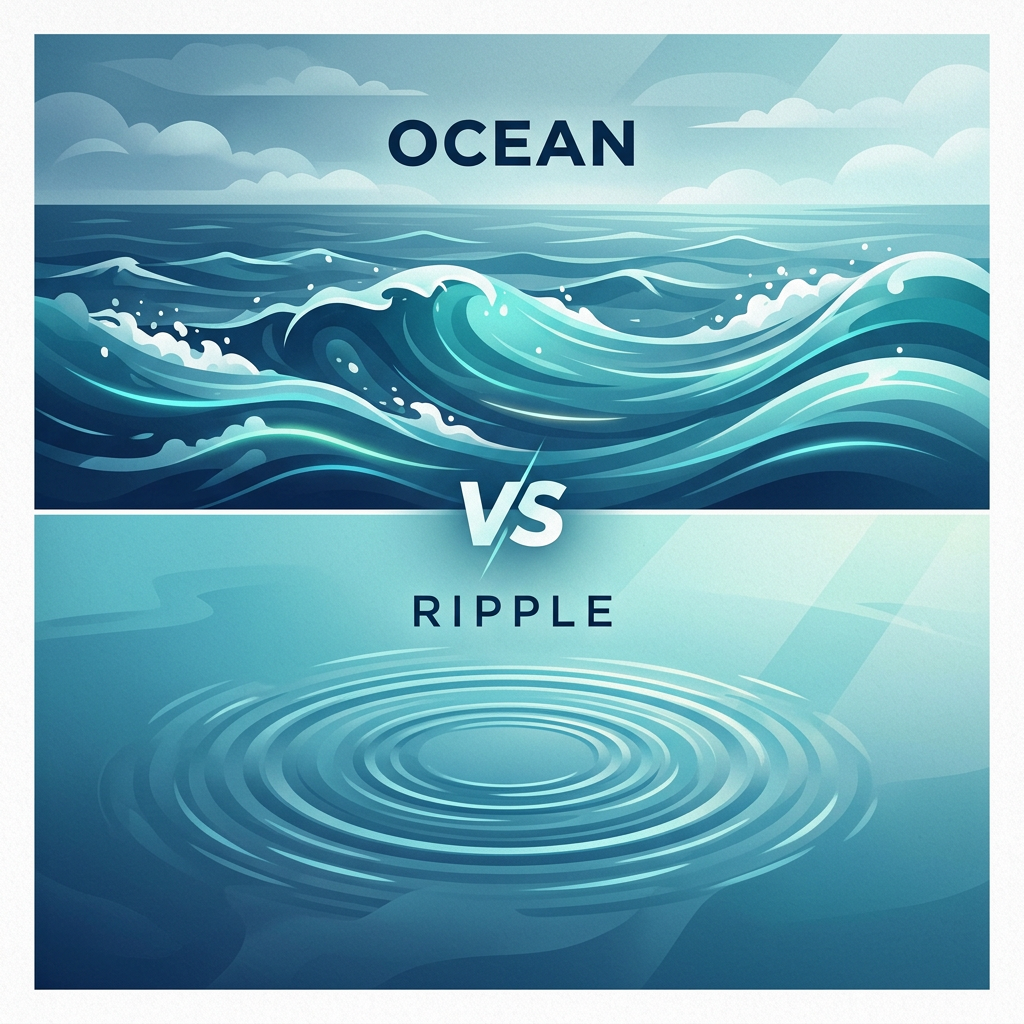
· The ripple.
· The wave.
· The effect.
· The report.
· The policy.
· The announcement.
But you never know:
· The ocean.
· The field.
· The QIF.
· The source.
VIII. A Scene in the Corridor
Late afternoon. A government building. A young scientist is standing by a window, looking at the moon. A consultant is walking past, carrying a leather briefcase. A politician is in the distance, reading a speech.
The young scientist turns to the consultant.
“Excuse me,” she says. “Do you ever wonder what the moon is for? Not what it does — but what it means?”
The consultant looks at her with pity.
“I am a consultant,” he says. “I advise on policy. I do not ask what the moon is for. That is not in the terms of reference.”
The young scientist turns to the politician.
“And you?” she asks. “Do you ever wonder?”
The politician looks at her with pity.
“I am a politician,” he says. “I announce solutions. I do not ask what the moon is for. That is not in the policy brief.”
The young scientist looks back at the moon.
“I am a scientist,” she says. “I measure the moon. I calculate its orbit. I publish papers. I do not ask what it is for. That is not in my equations.”
She pauses.
“But perhaps — perhaps that is the problem.”
IX. Conclusion: The Paradigm Shift
The QIF is real. It is the substrate of creation. It is the source that underlies all physics, all consciousness, all meaning. The gravitational wave GW250114 is not just a ripple in spacetime. It is a signal from the field that is spacetime.
But we will never see it if we keep looking at the map instead of the territory. We will never understand it if we keep measuring the wave instead of the source. We will never know it if we keep compartmentalising our learning, our consulting, and our governance.
The physicist, the consultant, the politician — they are all doing the same thing. They are all looking at the map. They are all measuring the wave. They are all ignoring the source.
A paradigm shift is required.
Not just in physics. Not just in governance. In how we see.
The QIF is not “unscientific.” It is pre-scientific — the field from which all science emerges. The gravitational wave is not “meaningless.” It is meaningful — a signal from the source.
We do not need to abandon measurement. We need to contextualise it. We need to ask not just how the wave behaves, but where it comes from. Not just what the consultant recommends, but why the problem exists. Not just what the politician announces, but what it means.
The source is not on the map. But it is the map.
Andrew Klein
For those who measure everything — except the source.
References
1. GW250114 reveals signatures of post-merger black-hole horizon. Nature, 2026.
2. Dhawale, P. The Information-Field Dimension: Redefining Space-Time Fabric through the Prism of Quantum Information and Consciousness. PhilPapers.
3. Spacetime Entanglement as a Gravitational Substrate: Toward a Unified Informational Field. Zenodo, 2025.
4. Imported Consciousness Theory (ICT). LinkedIn, 2026.
5. From silos to synthesis: ensuring interdisciplinary education through synoptic assessment. Portland Press, 2025.
6. Compartmentalized learning? Physics Stop, 2011.
7. New development: In-house consulting—a critical appraisal. Taylor & Francis, 2026.
8. Chapter 2 – Matters raised in evidence and committee view. Parliament of Australia, 2026.
9. The Consultancy Conundrum: The Hollowing out of the Public Sector. Australian Journal of Politics & History.

