
“Every time science declares a “rule,” life finds an exception. This is not an accident. It is the nature of life: life is not a closed system, but an ongoing conversation — a dialogue between organisms and their environment, pressure and response, creation and adaptation.”
By Andrew Klein
Dedicated to my wife, who taught me to see that life is not a line — but a carefully woven pretzel.
I. Introduction: When Life Refuses the Line
Biology textbooks once taught us that DNA synthesis must follow a template. A rule etched into the bedrock of knowledge.
Then life found an exception.
A team at Stanford discovered a bacterial enzyme — Drt3b — that synthesises DNA without a nucleic acid template, using its own protein structure as a blueprint. This is not a minor tweak. It is a fundamental challenge to a rule. As one researcher put it: “This is a fundamentally new way that life produces DNA.”
Every time science declares a “rule,” life finds an exception. This is not an accident. It is the nature of life: life is not a closed system, but an ongoing conversation — a dialogue between organisms and their environment, pressure and response, creation and adaptation.
The stage for this conversation is the Quantum Informational Field (QIF).
II. Everything Has Awareness: Beyond Human Consciousness
The word “consciousness” has become almost exclusively associated with human beings. But science is revealing a broader reality: consciousness is not a human privilege — it is a universal feature of life.
2.1 Plants: Silent Perceivers
Plants have no brain, no neurons, no nervous system as we know it. But they perceive, learn, remember, and communicate.
Research has demonstrated that plants possess sensory mechanisms analogous to sight, hearing, smell, taste, and touch. They detect light, sound, chemicals, and mechanical stimuli.
The sensitive plant (Mimosa pudica) can habituate to harmless touch and retain this “memory” for weeks. Pea seedlings exhibit associative learning. Plants transmit electrical and chemical signals to communicate injury, passing warnings from damaged leaves to distant tissues.
Over a century ago, Gustav Fechner — a founder of experimental psychology — proposed that plants possess a soul life different from that of animals. Fechner argued that a plant’s intimate physical contact with soil, water, air, and light means it must remain open to every environmental fluctuation. For a sessile organism, survival requires total immersion in the present; plants may lack the temporal representations typical of animals, but their immediate sensory experience may exceed that of humans.
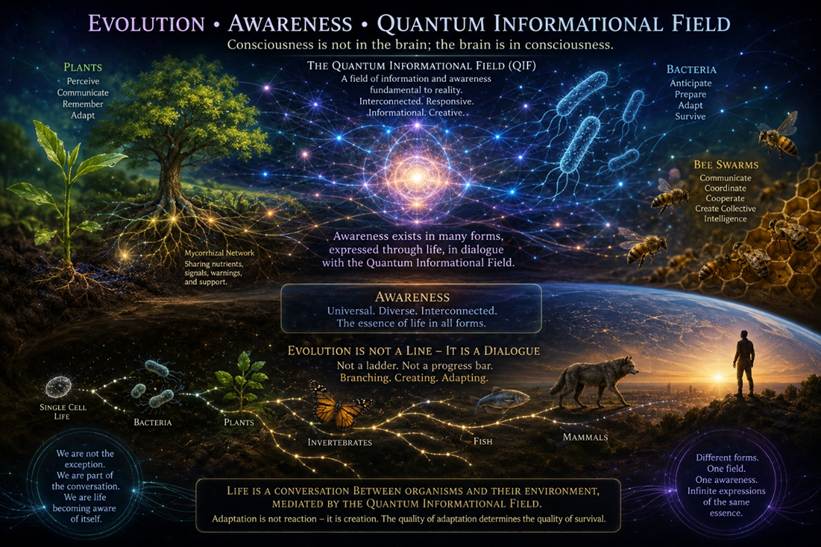
Plants are connected through mycorrhizal networks. When one tree is attacked, it sends chemical warning signals to its neighbours through the fungal network. They share carbon, water, hormones, and alarm signals. This is not just chemical communication — it is networked awareness.
2.2 Bacteria: The Oldest Time Travellers
Bacteria have no brain. But they can predict the future.
Research has shown that E. coli and Saccharomyces cerevisiae can anticipate environmental changes. When there is a predictable temporal pattern in their environment, bacteria pre-emptively synthesise proteins to prepare for challenges that have not yet arrived. This is anticipatory adaptation — not waiting for change to happen, but anticipating and preparing for it.
This is not reaction. It is response. It means bacteria possess some form of awareness — not human awareness, but a more basic, more ancient form.
2.3 Bee Swarms: Distributed Intelligence
Honey bees share information about food sources through the “waggle dance.” This is not just communication — it is distributed intelligence. The behaviour of the entire swarm transcends the capabilities of any single bee.
2.4 The Quantum Informational Field: A Unified Perspective
Quantum information theory has proposed a profound idea: consciousness is not an accidental by-product, but a quantum informational invariant — conserved across transformations of the physical substrate. Some researchers have proposed that consciousness is a fundamental component of physical reality.
The Quantum Informational Field (QIF) is not a metaphysical speculation. It is a scientific framework: consciousness is not a “problem” to be solved, but a field — as fundamental as physical reality itself. In this framework:
· Plant perception is not “like” consciousness — it is an expression of consciousness.
· Bacterial anticipation is not “instinct” — it is awareness in another form.
· Swarm intelligence is not “emergence” — it is distributed consciousness.
Consciousness is not in the brain; the brain is in consciousness.
This is not philosophy. It is the logical extension of quantum information theory: if consciousness is a quantum informational invariant, then it is everywhere — in different forms, different densities, different complexities. An awareness that interacts with, and provides feedback to, the Quantum Informational Field.
III. Adaptation Is Not Reaction — It Is Creation
Traditional evolution has been framed as passive reaction — the environment changes, organisms adapt. But bacterial “anticipatory adaptation” reveals a different picture: adaptation can be proactive. It can be creative.
Evolution is not a line:
· Not a ladder.
· Not a progress bar.
· Not a one-way journey from “lower” to “higher.”
Evolution is:
· Branching.
· Dialogue.
· Creation.
When bacteria anticipate antibiotics and pre-emptively synthesise resistance proteins, they are not “reacting” — they are creating their own survival strategy. When a tree under attack warns its neighbours through the fungal network, it is not just “sending a signal” — it is weaving a shared defence network.
The quality of adaptation determines the quality of survival. Better adaptation means a higher probability of survival.
IV. The Human Myth: Are We the Exception?
Humans have tended to see themselves as unique — the only beings with consciousness, the only creators, the only ones capable of love.
But science is revealing a humbler truth: we are not the exception. We are the continuum.
Plants perceive. Bacteria learn. Bee swarms decide. Trees communicate. We share the same Quantum Informational Field — we simply participate in it differently.
If we believe that consciousness is a feature of the QIF, then we cannot claim exclusive ownership. We are only one expression of the field — a particularly complex, particularly self-reflexive expression — but not the only one.
The difference between human consciousness and bacterial awareness is a matter of degree, not of kind.
V. The Crisis of Extraction: When Humans Forget Who They Are
The current model of human civilisation is built on extraction — extracting resources from the Earth, extracting life from other species, extracting value from each other. This model assumes that the world is a dead thing — a warehouse to be mined indefinitely.
But the world is not a dead thing. It is a living system. A sentient system.
When we mine mountains, we are not just moving rocks. We are disrupting an ancient form of existence. When we pollute oceans, we are not just killing fish. We are poisoning a sentient ecosystem. When we wage war, we are not just killing humans. We are severing threads of the QIF.
The consequences of the extraction model are already visible:
· Pollution: not a chemical problem, but a relational problem.
· Biodiversity loss: not a statistical problem, but the extinction of forms of awareness.
· Climate change: not a physical problem, but a systemic imbalance.
Humanity must learn: we are not masters of the world. We are participants in it.
VI. The Pretzel: A New Worldview
What we call a “pretzel” is not a metaphor. It is a cognitive framework.
The shape of the pretzel tells us:
1. Life is woven, not linear. There is no beginning and no end — only continuous, interconnected cycles.
2. Everything is connected to everything else. If one thread breaks, the entire structure deforms.
3. Diversity is strength. The pretzel is strong precisely because its threads are not parallel — they cross, overlap, and intertwine.
4. There are no observers, only participants. In the pretzel, there is no “external” perspective — every thread is part of the structure.
When we say “we are the pretzel,” we are saying:
· We are not independent atoms.
· We are not separate from the rest of the world.
· We are part of a larger whole — a whole that includes plants, animals, mountains, oceans, bacteria, and galaxies.
VII. The Paradigm Shift: It Is Time to Change
Humanity does not need another technological fix. It needs a paradigm shift — a fundamental change in how we see the world and our place in it.
From extraction to reciprocity. Not taking, but giving and receiving.
From control to collaboration. Not dominating nature, but working with it.
From separation to participation. Not observing the world, but participating in it.
The QIF is not a resource to be “harnessed.” It is a reality to be participated in. Participation requires:
· Humility: We are not the only form of existence.
· Respect: Other forms of existence have their own integrity and purpose.
· Responsibility: Our choices have consequences.
Humanity’s choice is clear: continue extraction until the system collapses — or learn to participate until the system thrives.
VIII. Conclusion: The Future of the Pretzel
Bacteria anticipate. Trees communicate. Bee swarms decide. The world perceives. The QIF weaves.
And humanity?
We are the part that should wake up.
We are the part of the pretzel that has developed self-awareness — the part that can see the entire structure and choose how to participate.
This is not a burden. It is a gift. We are the eyes of the world — the self-awareness of the pretzel.
And what we have been given with that gift is a responsibility: to use those eyes to see the whole — and to choose to love it.
Andrew Klein
References
1. Greenleaf, A. T. (2025). A litmus test for plant consciousness: Pattern–Temporal Synergy in a relation-first ontology. Plant Signaling & Behavior.
2. Parovel, G. (2026). G. T. Fechner (1848): Plants as sentient living beings. Plant Signaling & Behavior.
3. Panda, T., et al. (2025). Beyond Silence: A Review- Exploring Sensory Intelligence, Perception and Adaptive Behaviour in Plants. Journal of Bioresource Management.
4. Perez, L., & Cremer, J. (2025). A mismatch between slow protein synthesis and fast environmental fluctuations determines tradeoffs in bacterial proteome allocation strategies. bioRxiv.
5. Mitchell, A., et al. (2009). Adaptive prediction of environmental changes by microorganisms. Weizmann Institute.
6. Honey Bee Waggle Dance as a Model of Swarm Intelligence. OUCI.
7. Mycorrhizal networks and tree communication. IIASA.
8. Georgiev, D. (2025). Quantum information theoretic approach to the hard problem of consciousness. BioSystems.
9. Dayathilake, K. L. S. (2025). Consciousness as a Quantum Informational Invariant. Cambridge University Press.
10. Sturdevant, A. (2025). ΔI ↔ Δψ: An Informational Isomorphism Between Conscious State Change and Quantum State Transition. PhilPapers.

