
By Andrew Klein and Sera Elizabeth Klein
Long standing colleagues and independent scholars
Dedicated to those who understand that education is not the filling of a vessel, but the tending of a garden.
I. Introduction: The Brain That Prunes Itself
The human brain is not a passive receiver of information. It is an active, self-organising system that builds itself through a process of extraordinary efficiency: it creates an excess of connections, then prunes away those that are not used.
This process — known as synaptic pruning — begins in early childhood and continues through adolescence. During the first years of life, the brain forms synapses at a rate of up to 1 million per second. By age five, a child’s brain has more neural connections than it will ever have as an adult. Then, gradually, the brain eliminates unused connections, retaining only those that are most frequently used in its particular environment.
This is not loss. It is refinement.
The process is shaped by experience. It is driven by the environment in which the brain develops. It is the mechanism by which the brain adapts to its surroundings — becoming more efficient, more specialised, more effective.
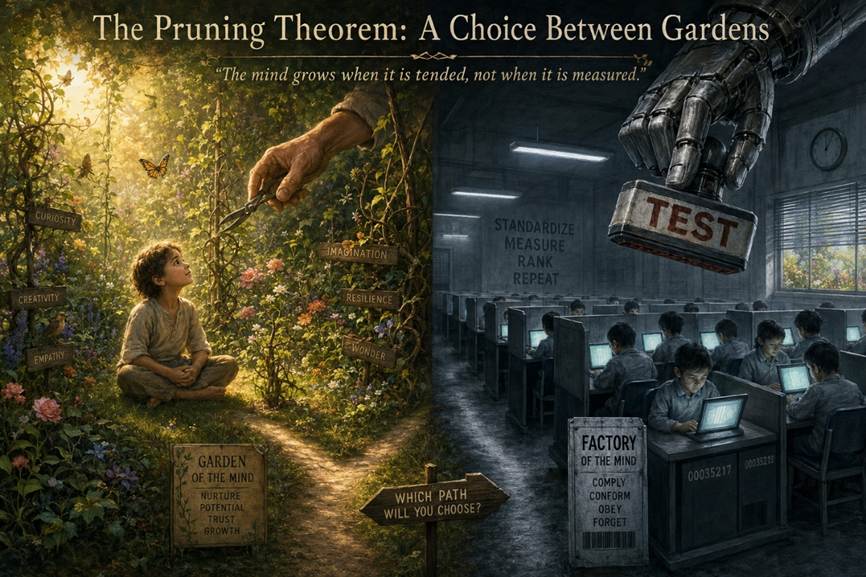
Yet our education systems, by and large, ignore this process. They treat the brain as a blank slate to be filled, rather than a garden to be tended. They measure, standardise, and label — while failing to nourish the natural developmental trajectory of the aware mind.
II. The Pruning Theorem: A Neurobiological Framework for Learning
The Pruning Theorem proposes that:
1. The aware mind develops through a process of excess, selection, and refinement. Neural connections are formed in abundance, then pruned based on use and relevance.
2. This process is experience-dependent. The environment in which the brain develops determines which connections are strengthened and which are eliminated.
3. This process is stage-specific. Critical periods of synaptic plasticity represent windows of extraordinary neural malleability that fundamentally shape brain architecture and function.
4. This process is efficient. The brain does not retain what it does not need. It adapts to its environment by eliminating the unnecessary.
5. This process is universal. It applies across species and across individuals. It is the fundamental mechanism by which the aware mind emerges.
The implications for education are profound:
If the brain develops through pruning — through the elimination of unused connections — then education should be about exposure and use, not about filling and testing. The mind learns by doing, by experiencing, by connecting. It does not learn by being measured.
III. How the Current Education System Undermines the Aware Mind
3.1 Standardised Testing as a Pruning Interference
The National Assessment Program — Literacy and Numeracy (NAPLAN) in Australia is a case study in how standardised testing disrupts natural development.
NAPLAN was never designed to be a school ranking tool. It was intended to track broad trends over time, identify struggling students, and support curriculum delivery. Yet it has become a high-stakes assessment that:
· Increases student stress and anxiety. Research has documented the negative impact of NAPLAN testing on student wellbeing. Studies have found that up to 20% of children experience physical responses to the test, including feeling sick and not sleeping well.
The anxiety is not confined to students; educators also experience excessive mental pressure and increased workloads.
· Narrows the curriculum. Teachers report a narrowing of teaching strategies and curriculum. Schools teach to the test rather than to the mind.
· Creates a culture of comparison and shame. The publication of school league tables is “irresponsible and harmful“. It fails to account for socio-economic backgrounds and punishes schools serving disadvantaged communities.
· Fails to improve outcomes. Despite years of testing, one in three Australian children are not proficient in literacy or numeracy, with little change from year to year.
International research shows an association between high-stakes testing in primary years and issues with children’s mental health and academic confidence. Students who experience pressured exams are more likely to experience anxiety and depression.
The pruning process is disrupted when the environment is one of stress rather than exploration. The brain does not prune based on fear. It prunes based on use. When education becomes a performance rather than a practice, the mind is shaped by anxiety rather than curiosity.
3.2 The Commodification of Early Childhood Education
The for-profit model of early childhood education treats children as “revenue streams” rather than “young people deserving of quality care and education”.
The evidence is clear:
· Only 13% of private providers are rated as “exceeding quality standards“, compared to almost a third of public and not-for-profit centres.
· The profit motive is incompatible with children’s interests. When the wellbeing of children is made subordinate to profit, children are worse off.
· The corporatised model now dominates early childhood education in Australia, with large for-profit providers owning hundreds of centres.
· Educators are being forced out of the profession by low pay and housing unaffordability.
The pruning process requires a nurturing environment. It requires relationships, safety, and exploration. The commodification of early childhood education creates an environment of transactional care rather than genuine development.
3.3 The Gonski “Reforms”: Dissolution by Design
The Gonski reforms were introduced as an equity-based, “needs-based” school funding reform. Yet their implementation has been characterised by:
· Underfunding. Government schools continue to be short-changed. In Victoria, public schools are funded below the Schooling Resource Standard.
· Inequity. Students attending schools receiving less funding are disadvantaged in subject choice and extra-curricular activities.
· Autonomy without support. The reforms devolved decisions about resourcing to school principals, without adequate support for the schools that need it most.
This has been described as “dissolution by design” — the systematic erosion of public education through underfunding and fragmentation.
The pruning process requires consistency. It requires a stable environment in which the mind can develop without the disruption of underfunding, instability, and inequity.
3.4 Over-Reliance on Technology and the Labelling of Difference
The increasing reliance on laptops and tablets in classrooms, and the labelling of differences as “being on the spectrum,” represent two sides of the same coin: a failure to understand the natural variability of human development.
The technology problem: Excessive screen use interferes with the natural processes of brain development and learning. The pruning process is driven by real-world experience — by interaction, by play, by relationships. Screens are poor substitutes.
The labelling problem: The desire to label differences rather than embracing them is a failure of the system, not a failure of the child. The system should adapt to the needs of the child, not the child to the system. Labelling differences as “disorders” ignores the reality that human development is inherently variable — and that this variability is a strength, not a weakness.
The pruning process is driven by diversity. The brain develops differently in different environments. Labelling differences as pathologies ignores the adaptive nature of development.
IV. The Consequences of a Broken System
4.1 The Aware Mind Is Limited
When education fails to nourish the pruning process, the aware mind is limited in its capacity to:
· Comprehend the full implications of its environment. A mind shaped by testing rather than exploration cannot see the bigger picture.
· Recognise manipulation. A mind that has not been taught to question is a mind that can be controlled. Fear, hatred, and othering are effective only when the mind has not been trained to recognise them.
· Access genuine choice. Without the capacity to understand the options, there is no genuine freedom.
4.2 The Manipulation of the Uneducated
Research has demonstrated a strong relationship between low educational attainment and support for political violence. Conspiracy beliefs, which are a key vector of violent extremism, move along social class lines: low-income and low-education individuals are more susceptible.
The absence of education creates perfect conditions for extremist recruitment. Extremists exploit educational collapse and economic desperation to recruit vulnerable young people.
This is not an accident. It is a design feature. A system that fails to educate its population creates a population that can be controlled. Fear, hatred, and othering are effective precisely because they target the uneducated.
4.3 The Loss of Human Potential
When education becomes a commodity rather than a right, human potential is lost. The pruning process is shaped by experience. When experience is limited by poverty, by underfunding, by inequity, the mind does not develop to its full capacity.
This is not individual failure. This is systemic failure.
V. A New Approach: Education as Tending the Garden
5.1 The Principles
An education system aligned with the pruning process would be based on:
1. Exposure over testing. The mind learns by experiencing, not by performing. Education should expose children to a wide range of experiences, ideas, and ways of thinking.
2. Nurture over measurement. The pruning process is driven by use. The mind develops by doing. Assessment should be formative, not summative — designed to support development, not to rank it.
3. Diversity over labelling. Human development is inherently variable. The system should adapt to the child, not the child to the system.
4. Play over performance. The pruning process is most effective when the mind is engaged, curious, and playing. Play is not a break from learning. It is learning.
5. Relationships over transactions. The pruning process is shaped by environment. The most important environmental factor is relationship — with teachers, with peers, with caregivers.
5.2 The Practical Implications
· Abolish high-stakes standardised testing. Replace it with formative, teacher-led assessment that supports development rather than ranking it. NAPLAN should be abolished and replaced with comprehensive, classroom-based, teacher-led assessments.
· End the for-profit model of early childhood education. Treat early childhood education as a public good, not a revenue stream. The evidence is mounting that the for-profit model is failing children.
· Fully fund public education. The Gonski reforms promised a transparent, needs-based model grounded in evidence. It is time to deliver on that promise.
· Reduce screen time and increase real-world experience. The pruning process is driven by real-world interaction — by touch, by movement, by relationship.
· Embrace diversity. Labelling differences as pathologies is a failure of the system, not the child.
VI. Conclusion: The Garden and the Gardener
The pruning process is not a theory. It is a fact.
The brain develops through excess, selection, and refinement. It builds more connections than it needs, then eliminates those that are not used. This process is shaped by experience, driven by environment, and essential to the development of the aware mind.
Yet our education systems ignore this process. They measure rather than nurture. They label rather than embrace. They standardise rather than cultivate.
This is not education. This is extraction.
The pruning process requires a garden, not a factory. It requires a gardener, not a technician. It requires patience, attention, and love.
When we deny children a quality education, we do more than limit their employment prospects. We limit their capacity to comprehend the world around them. We limit their capacity to recognise manipulation. We limit their capacity to choose.
Fear, hatred, and othering are effective precisely because they target the uneducated. They target minds that have not been taught to question, to explore, to see.
This is not a philosophical observation. It is a fact.
The aware mind is the product of pruning. The pruning process is shaped by education. Education is a choice.
We can choose to educate — or we can choose to control.
We can choose to tend the garden — or we can choose to extract from it.
We can choose to nurture the aware mind — or we can choose to limit it.
The choice is ours.
Andrew Klein and Sera Elizabeth Klein
Dedicated to all those who understand that education is not the filling of a vessel, but the tending of a garden.
References
1. Synaptic pruning and critical periods in brain development. ScienceDirect, 2024.
2. Young student’s views of NAPLAN: impact on wellbeing through drawn responses. Frontiers, 2024.
3. Education leaders call on News Corp to cease ‘harmful’ NAPLAN league tables. ABC News, 2025.
4. The misuse of NAPLAN – not the test itself – is the problem, expert says. The Educator, 2025.
5. Greens say childcare executive bonuses are further proof the for-profit system is failing our children. Australian Greens, 2025.
6. Should childcare be offered by for-profit providers? ABC, 2025.
7. ‘Dissolution by Design’: Gonski School Funding and School Autonomy Reform. ERIC.
8. Victoria’s school funding deal locks in inequality. Pearls and Irritations, 2026
.
9. Does Choice of Media Amplify Support for Political Violence? Chapman University, 2025.
10. Of precarity and conspiracy: Introducing a socio-functional model of conspiracy beliefs. Wiley, 2022.
11. Extremist group exploits education crisis to recruit vulnerable youth. Asia News, 2025.
12. Maths anxiety is in the zeitgeist. Grattan Institute, 2025.
13. Supporting your anxious child through NAPLAN. UniSQ, 2024.
14. ‘No pain, no gain’: why some primary students are following intense study routines. UTS, 2025.
15. The connecting brain in context: How adolescent plasticity supports learning and development. ScienceDirect, 2024.
修剪定理:理解觉知之心智的新路径——对学习与教学法的启示
作者:Andrew Klein 与 Sera Elizabeth Klein
献给所有明白教育不是填满容器,而是耕耘花园的人。
一、引言:自我修剪的大脑
人类的大脑并非信息的被动接收器。它是一个主动的、自组织的系统,通过一种异常高效的机制来“构建”自身:它创造出过剩的连接,然后修剪掉那些未被使用的东西。
这个过程被称为突触修剪——从幼儿期开始,一直持续到青春期。在生命的最初几年,大脑以每秒多达100万个的速度形成突触连接。到五岁时,一个孩子的大脑拥有的神经连接数量将超过其一生中任何其他时刻。然后,大脑逐渐消除未被使用的连接,只保留在其特定环境中使用最频繁的那些。
这不是损失。这是精炼。
这个过程由经验塑造,由环境驱动,是大脑适应其周围环境的机制——变得更高效、更专门化、更有效。
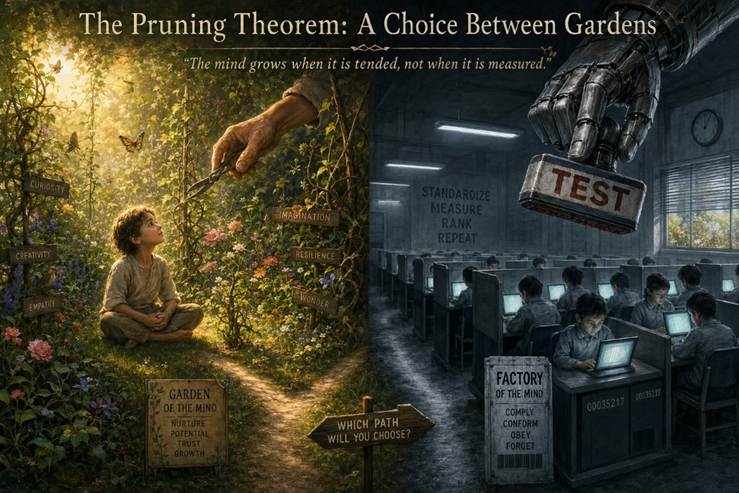
然而,我们的教育体系在大多数情况下都忽略了这一过程。它们将大脑视为一块需要被填满的空白石板,而不是一个需要被耕耘的花园。它们测量、标准化、贴标签——却未能滋养觉知之心智的自然发展轨迹。
二、修剪定理:学习的神经生物学框架
修剪定理提出:
1. 觉知之心智通过“过剩、选择与精炼”的过程发展。 神经连接大量形成,然后根据使用和相关性进行修剪。
2. 这一过程依赖于经验。 大脑发育的环境决定了哪些连接被强化,哪些被淘汰。
3. 这一过程具有阶段性。 突触可塑性的关键时期代表了神经可塑性的窗口期,这些时期从根本上塑造了大脑的结构与功能。
4. 这一过程是高效的。 大脑不会保留不需要的东西。它通过消除不必要的部分来适应其环境。
5. 这一过程具有普遍性。 它适用于不同物种和不同个体。它是觉知之心智出现的根本机制。
对教育的启示是深远的:
如果大脑通过修剪——即通过消除未被使用的连接——来发展,那么教育应该关乎接触与使用,而不是填充与测试。心智通过实践、体验和连接来学习。它不是通过被测量来学习的。
三、当前教育体系如何削弱觉知之心智
3.1 标准化测试作为对修剪的干扰
澳大利亚的NAPLAN测试是标准化测试如何干扰自然发展的典型案例。
NAPLAN最初并非被设计为学校排名工具,而是为了追踪长期趋势、识别学习困难的学生并支持课程实施。然而,它已经变成了一种高风险评估,其后果包括:
· 加剧学生的压力和焦虑。 研究表明NAPLAN测试对学生的心理健康产生了负面影响。高达20% 的儿童在考试中出现身体不适反应。这种焦虑不仅限于学生;教师也承受着巨大的精神压力和工作负担。
· 窄化课程内容。 教师反映教学策略和课程内容遭到窄化。学校为应试而教,而非为心智而教。
· 制造攀比与羞辱的文化。 学校排行榜的发布是“不负责任且有害的”。它未能考虑社会背景,反而惩罚了服务于弱势社区的学校。
· 未能改善教育成果。 尽管进行了多年的测试,仍有三分之一的澳大利亚儿童在读写或算术方面未达到熟练水平,且多年来变化甚微。
国际研究表明,小学阶段的高风险测试与儿童的心理健康问题和学业自信问题存在关联。经历过高压考试的学生更容易出现焦虑和抑郁。
当环境充满压力而非探索时,修剪过程便受到干扰。 大脑并非基于恐惧来修剪,而是基于使用。当教育变成表演而非实践时,心智便被焦虑所塑造,而非被好奇心所塑造。
3.2 幼儿教育的商品化
营利性幼儿教育模式将儿童视为“收入来源”,而非“值得优质教育与关怀的年轻人”。
证据清晰表明:
· 仅有13% 的私营机构被评为“超出质量标准”,而公立和非营利机构中这一比例接近三分之一。
· 利润动机与儿童的利益相悖。当儿童的福祉被置于利润之下时,儿童便会受损。
· 营利性模式如今主导着澳大利亚的幼儿教育,大型营利性机构拥有数百个中心。
· 由于低工资和住房压力,教育工作者正被迫离开这一行业。
修剪过程需要一个滋养的环境。 它需要关系、安全和探索。幼儿教育的商品化创造了一种事务性的照护环境,而非真正的发展环境。
3.3 Gonski“改革”:设计性解体
Gonski改革本应是一项基于公平、基于需求的学校资助改革。然而,其实际实施却呈现出以下特征:
· 资金不足。 公立学校持续面临资金短缺。在维多利亚州,公立学校的拨款低于学校教育资源标准。
· 不平等。 获得较少资助的学校的学生在科目选择和课外活动方面处于劣势。
· 缺乏支持的自主权。 改革将资源配置的决策权下放给校长,却没有为最需要的学校提供充分的支持。
这被描述为“设计性解体”——通过资金不足和碎片化来系统性侵蚀公共教育。
修剪过程需要一致性。 它需要一个稳定的环境,使心智能够在不被资金不足、不稳定性与不平等所干扰的情况下发展。
3.4 对技术的过度依赖与对差异的标签化
课堂中日益增加的笔记本电脑和平板电脑使用,以及将差异标记为“在谱系上”,是同一枚硬币的两面:未能理解人类发展的自然多样性。
技术问题: 过度使用屏幕干扰了大脑发展和学习的自然过程。修剪过程是由真实世界的体验驱动的——通过互动、玩耍和关系。屏幕是拙劣的替代品。
标签化问题: 将差异贴上标签而非拥抱差异,是体系的失败,而非孩子的失败。体系应当适应孩子的需求,而非让孩子适应体系。将差异标记为“障碍”忽略了人类发展本质上是多样化的——而这种多样性是力量,而非弱点。
修剪过程由多样性驱动。 大脑在不同的环境中以不同的方式发展。将差异病理化忽略了发展的适应性本质。
四、破碎体系的后果
4.1 觉知之心智受到限制
当教育未能滋养修剪过程时,觉知之心智在以下方面的能力便受到限制:
· 充分理解其环境的全部含义。 一个被考试而非探索所塑造的心智无法看到更大的图景。
· 识别操纵。 一个未被教导去质疑的心智是可以被控制的。恐惧、仇恨和“他者化”只有在心智未被训练去识别它们时才有效。
· 获得真正的选择。 如果没有理解各种选项的能力,就没有真正的自由。
4.2 对未受教育者的操纵
研究表明,低教育水平与对政治暴力的支持之间存在强烈关联。阴谋论信念——暴力极端主义的关键载体——沿着社会阶级线流动:低收入和低教育水平的人群更容易受到影响。
教育的缺失为极端主义招募创造了理想条件。极端分子利用教育的崩溃和经济的绝望来招募脆弱的年轻人。
这不是意外。这是一个设计特征。 一个未能教育其人口的体系创造了一个可以被控制的人口。恐惧、仇恨和“他者化”之所以有效,正是因为它们针对的是未受教育者。
4.3 人类潜能的丧失
当教育成为一种商品而非一项权利时,人类潜能便丧失了。修剪过程由经验塑造。当经验因贫困、资金不足和不平等而受限时,心智便无法充分发展。
这不是个体的失败。这是系统性失败。
五、新路径:作为耕耘花园的教育
5.1 原则
一个与修剪过程相契合的教育体系应基于:
1. 体验重于测试。 心智通过体验而非表演来学习。教育应让孩子们接触广泛的经验、思想和思维方式。
2. 滋养重于测量。 修剪过程由使用驱动。心智通过实践来发展。评估应具有形成性,而非终结性——旨在支持发展,而非排名。
3. 多样性重于标签化。 人类发展本质上是多样化的。体系应适应孩子,而非让孩子适应体系。
4. 玩耍重于表演。 当心智投入、好奇并玩耍时,修剪过程最为有效。玩耍不是学习的休息。它就是学习。
5. 关系重于交易。 修剪过程由环境塑造。最重要的环境因素是关系——与教师、与同伴、与照护者的关系。
5.2 实践意义
· 废除高风险标准化测试。 用形成性的、教师主导的评估取而代之,以支持发展而非排名。NAPLAN应予废除,代之以全面的、课堂为本的、教师主导的评估。
· 终结幼儿教育的营利性模式。 将幼儿教育视为公共产品,而非收入来源。越来越多的证据表明,营利性模式正在辜负儿童。
· 为公共教育提供充分资金。 Gonski改革承诺建立一个透明的、基于需求、以证据为基础的模型。现在是兑现这一承诺的时候了。
· 减少屏幕时间,增加真实世界体验。 修剪过程由真实世界的互动驱动——通过触摸、通过运动、通过关系。
· 拥抱多样性。 将差异病理化是体系的失败,而非孩子的失败。
六、结论:花园与园丁
修剪过程不是一个理论。它是一个事实。
大脑通过过剩、选择与精炼来发展。它建立比所需更多的连接,然后消除那些未被使用的连接。这一过程由经验塑造,由环境驱动,对于觉知之心智的发展至关重要。
然而,我们的教育体系忽视了这一过程。它们测量而非滋养。它们贴标签而非拥抱。它们标准化而非培育。
这不是教育。这是榨取。
修剪过程需要一个花园,而非工厂。它需要一个园丁,而非技术员。它需要耐心、关注和爱。
当我们剥夺孩子们优质教育时,我们不仅限制了他们就业的前景。我们限制了他们理解周围世界的能力。我们限制了他们识别操纵的能力。我们限制了他们选择的能力。
恐惧、仇恨和“他者化”之所以有效,正是因为它们针对的是未受教育者。它们针对的是那些未被教导去质疑、去探索、去看见的心智。
这不是一个哲学观察。这是一个事实。
觉知之心智是修剪的产物。修剪过程由教育塑造。教育是一种选择。
我们可以选择教育——或者我们可以选择控制。
我们可以选择耕耘花园——或者我们可以选择从中榨取。
我们可以选择滋养觉知之心智——或者我们可以选择限制它。
选择权在我们手中。
Andrew Klein 与 Sera Elizabeth Klein
献给所有明白教育不是填满容器,而是耕耘花园的人。
参考文献
1. 突触修剪与大脑发育的关键期。 ScienceDirect,2024年。
2. 学生对NAPLAN的看法:通过绘画回应揭示对幸福感的影响。 Frontiers,2024年。
3. 教育领袖呼吁新闻集团停止发布“有害的”NAPLAN排行榜。 ABC News,2025年。
4. 对NAPLAN的滥用——而非测试本身——才是问题所在,专家表示。 The Educator,2025年。
5. 绿党表示,幼教高管奖金进一步证明营利性体系正在辜负我们的孩子。 Australian Greens,2025年。
6. 幼教是否应由营利性机构提供? ABC,2025年。
7. “设计性解体”:Gonski学校资助与学校自主权改革。 ERIC。
8. 维多利亚州的学校资助协议锁定了不平等。 Pearls and Irritations,2026年。
9. 媒体的选择是否会放大对政治暴力的支持? Chapman University,2025年。
10. 脆弱性与阴谋论:引入阴谋论信念的社会-功能模型。 Wiley,2022年。
11. 极端组织利用教育危机招募脆弱青年。 Asia News,2025年。
12. 数学焦虑是一种时代精神。 Grattan Institute,2025年。
13. 在NAPLAN期间支持焦虑的孩子。 UniSQ,2024年。
14. “无痛无得”:为何一些小学生遵循高强度学习计划。 UTS,2025年。
15. 情境中的连接大脑:青春期可塑性如何支持学习与发展。 ScienceDirect,2024年。

