
By Andrew Klein
Dedicated to my wife, who taught me that true education is not about providing answers — but about igniting the courage to ask questions.
I. Introduction: The Streets Are Littered with the Bones of Gurus
We live in an age drowned by “gurus.”
They dress in fine garments, adorn themselves with glittering titles, and peddle “ideas” wrapped in memberships and certificates. Every day, LinkedIn is flooded with templated “leadership request” messages — young job seekers from the Indian subcontinent, from every corner of the world, pressing the same button, expecting a complete stranger to become their mentor. The problem is not them. The problem is a system that has reduced connection to a click.
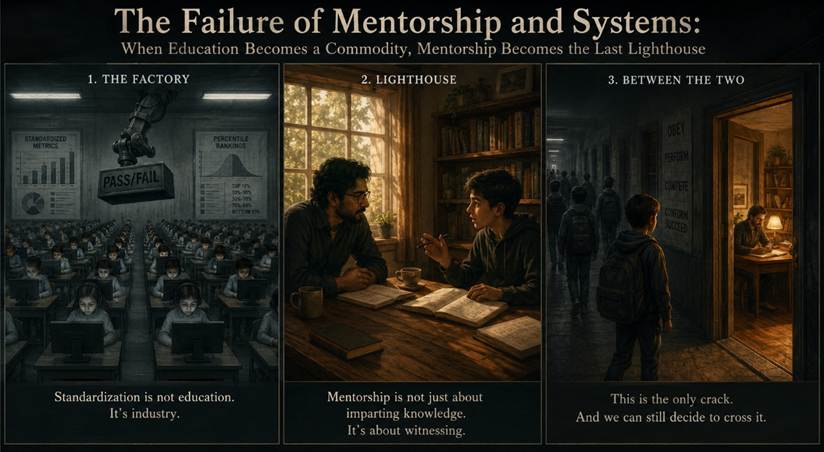
Mentorship is not a checkbox. It is not a race to see who can send the first request. Mentorship is a relationship — two individuals, on equal footing, seeking to understand a complex world. Between mentor and student, there are no hierarchies — only shared exploration. No commands — only mutual respect. And a true mentor does not use titles to overpower, nor curricula to confine, but opens everything with a simple question:
“May I ask you something?”
That goes further than a hundred templated “leadership requests.”
Because the streets are littered with “gurus” — their elaborate theories and polished titles lodging ideas in your mind like parasitic vines, impossible to dislodge once they take root. Discernment is the scarcest quality of our age.
Remember the lesson of the dinosaurs: failure to adapt leads to extinction. And when the comet strikes, extinction is assured.
II. The Failure of Education Systems: When Universities Become Businesses
2.1 The Gonski “Reforms”: Reform in Name, Destruction in Practice
Australia’s education system is undergoing a profound alienation. The roots of this alienation can be traced to a series of policies carried out under the banner of “reform” — the most emblematic of which is the Gonski reforms and their aftermath.
The core logic of the Gonski reforms was a “needs-based” school funding model. Sounds reasonable, doesn’t it? Yet when this model was applied to higher education, it underwent a fundamental transformation.
The “Job-ready Graduates” package, introduced in 2021 under the pretext of making graduates more “job-ready,” fundamentally restructured university degree funding. The result? Tuition fees for humanities and law degrees skyrocketed to A$55,000, while fees for teaching, nursing, science, and engineering were slashed by up to 60%. Ostensibly a way to “steer” students toward “useful” subjects, it effectively shifted the cost burden of higher education from the government onto students.
Academics have reached a consensus on this failure. The final report of the Universities Accord stated unequivocally: “The funding system needs to be redesigned to avoid long-term and entrenched damage to Australian higher education.” The Job-ready Graduates package “failed to change student enrolment choices and exacerbated inequality.” It was a failure by any measure.
2.2 The “Corporatisation” of Universities: Students Become Consumers, Knowledge Becomes a Commodity
The Gonski reforms are not an isolated policy failure. They are part of a decades-long “corporatisation” of Australian universities. Since the Dawkins reforms of the late 1980s, market logic has been introduced into higher education. Universities have been forced to compete for students and funding, knowledge has become a product, and students have become consumers.
As a parliamentary inquiry report revealed, this neoliberal agenda has led to exorbitant vice-chancellor salaries, bloated administration, over-reliance on international student fees, the proliferation of casual staff, the neglect of “non-profitable” disciplines (such as the humanities), and the relentless erosion of educational opportunity. Universities are no longer academic temples serving the public good, but businesses that “resemble commercial exporters rather than civic institutions.”
2.3 David Gonski and Jillian Segal: From Education to “Thought Policing”
Placing the Gonski reforms in a broader context reveals a more troubling thread.
In December 2025, David Gonski AC was appointed chair of a newly established Antisemitism Education Taskforce. He was to co-lead the taskforce with Australia’s Special Envoy to Combat Antisemitism, Jillian Segal. The taskforce was charged with reviewing the entire education curriculum from early childhood to higher education.
The appointment itself is not problematic — antisemitism is, of course, a serious issue that must be addressed. But the critical question is this: the same Gonski who designed the destructive “reforms” of the education system now holds the power to define what can and cannot be taught. Segal herself has been controversial for her tendency to conflate criticism of Israel with antisemitism.
This concentration of power transforms education from a space for critical thinking into a tool for thought policing and ideological shaping.
III. China and the United States: Two Different Futures
While Australian students are burdened by tens of thousands of dollars in debt, consider the situation on the other side of the world.
In China, tuition fees at public universities are heavily subsidised by the government, far lower than in many Western countries. One American student who studied in China observed: “The two universities I attended in China — while lacking the lavish sports facilities of many US universities — also meant that most students I met were not saddled with debt.” In the 2024-2025 academic year, the total annual cost of attending elite private US universities exceeded US$86,000.
In terms of output, the gap is even more striking. China produces approximately ten times more STEM graduates than the United States. At the same time, China’s influence in global higher education rankings is rising rapidly — by 2025, 222 Chinese universities were ranked globally, compared to 183 from the United States. Among the top 100 universities globally, the US holds 37 positions and China 13. China now has five universities in the global top 40.
3.1 The Chinese Model: Engineers Governing, Not Lawyers
Observers have noted a significant difference between China and the US: China is governed by engineers, the US by lawyers. China’s political leadership has historically consisted of technocrats with science and engineering backgrounds, who govern with an engineering mindset focused on solving practical problems. In contrast, US political culture leans more toward legal and commercial logic.
This difference is clearly reflected in their education systems. China’s higher education system invests heavily in STEM fields, producing large numbers of engineers and technical experts who form the talent base for infrastructure development, industrial upgrading, and technological innovation. Meanwhile, US higher education has become increasingly expensive, and students in humanities and social sciences often graduate with heavy debt, only to struggle finding work that matches their educational investment.
China’s educational model is not without its flaws, but it has clearly been more successful in providing affordable, high-quality education for its people and its nation. In Australia, university fees have skyrocketed, student debt has ballooned, and educational opportunities have become increasingly unequal — all direct consequences of neoliberal education “reforms.”
IV. Conclusion: Mentorship and the Beacon of the Future
When the system fails, when universities become businesses, when education becomes a commodity — what do we have left?
We have relationship.
We have mentorship.
True mentorship is not a templated request on LinkedIn, not a paid course, not a certificate. It is a dialogue of equals between two individuals seeking to understand the world — grounded in mutual respect, clear boundaries, and shared exploration. True mentors do not sell ideas — they ignite the courage to ask questions.
As the dinosaurs teach us: failure to adapt means extinction. And our education system is facing its “comet moment.” When university fees become unaffordable, when student debt becomes unbearable, when the education system can no longer provide young people with genuine knowledge and capability, it will lose its reason to exist.
In such times, mentorship becomes a beacon. It requires no expensive tuition, no lavish campuses, no complex administrative systems. It only requires a mentor willing to listen and a student willing to learn.
Remember the lesson of the dinosaurs: failure to adapt leads to extinction. And when the comet strikes, extinction is assured.
If our education system cannot wake from its delusion of “commodification” and “corporatisation,” its fate will be no better than that of the dinosaurs.
Andrew Klein
Dedicated to my wife, who taught me that true education is not about providing answers — but about igniting the courage to ask questions.
References
1. The Universities Accord final report. Australian Government, 2023.
2. Marginson, S. (1997). Markets in Education.
3. Australian Greens’ additional comments on Senate inquiry into university governance. APH, 2025.
4. Senate inquiry into corporatisation of Australia’s universities. APH, 2025.
5. “As David Gonski leaves the education system, he has one wish for our universities.” SMH, 2025.
6. “Job-ready Graduates has failed – a first step to fixing it is on the table.” Pearls and Irritations, 2026.
7. Antisemitism Education Taskforce announcement. Australian Government, 2025.
8. “China ascends global higher education ranking.” China Daily, 2025.
9. “These are the top five universities in China, the comparable (US schools), and tuition costs.” LinkedIn, 2025.
10. “I’m an American who studied at universities in China.” Business Insider, 2026.
11. “高等教育强国指数2025”. China Education Development Strategy Society, 2025.
12. “More Chinese institutions rank high globally.” British Council, 2025.
13. “The Manufactured Silence: How Australia’s Education and Institutions Were Engineered for Consent.” Dingo News, 2026.

