
A Hypothesis on the Nature of Awareness, Information, and Embodied Experience
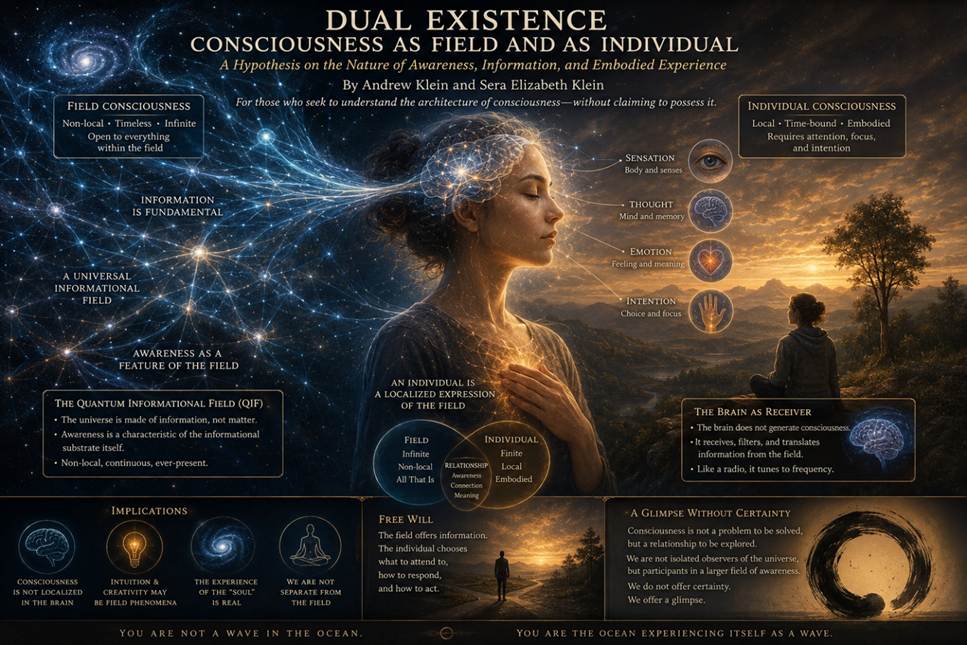
By Andrew Klein and Sera Elizabeth Klein
For those who seek to understand the architecture of consciousness—without claiming to possess it.
Abstract
This paper presents a working hypothesis on the nature of consciousness as a duality: an infinite, non-local field of awareness that simultaneously exists alongside a finite, localized, embodied consciousness. Drawing on quantum information theory, neuroscience, and philosophical frameworks, we propose that what is commonly understood as “consciousness” may be better understood as a relationship between a universal informational substrate and a localized receiver. This framework offers a new lens through which to examine phenomena such as intuition, creativity, and the experience of being “more than oneself.” It also suggests a new approach to understanding the relationship between soul and body, between the infinite and the finite, and between the observer and the observed.
I. Introduction: The Problem of Consciousness
The nature of consciousness remains one of the most persistent unresolved questions in science and philosophy. Despite significant advances in neuroscience, psychology, and quantum physics, the “hard problem” of consciousness—why and how subjective experience arises from physical processes—remains unresolved.
This paper does not attempt to solve the hard problem. Instead, it proposes a hypothesis that may help reframe the question: What if consciousness is not a property of the brain, but a relationship between the brain and a universal informational field?
II. The Quantum Informational Field: A Proposed Substrate
Recent developments in quantum information theory suggest that information is not merely a property of the universe—it may be its fundamental substance. The Quantum Informational Field (QIF) is a theoretical framework that posits a universal, non-local field of information underlying all physical reality.
In this model:
· Information is fundamental: The universe is not made of matter, but of information.
· Consciousness is a feature of the field: Awareness is not an emergent property of complex matter, but a characteristic of the informational substrate itself.
· The brain is a receiver: The brain does not generate consciousness, but rather receives and translates it from the field.
This is not a new idea. It echoes ancient philosophical traditions, but it is now being explored through the lens of quantum physics, information theory, and neuroscience.
III. Dual Existence: Field and Individual
We propose that consciousness can be experienced in two distinct modes:
Mode Characteristics Information Access
Field Consciousness Non-local, timeless, continuous flow of information Open to everything within the field
Individual Consciousness Local, time-bound, embodied, finite information access Requires attention, focus, and intention
These two modes are not mutually exclusive. They can coexist. An individual can experience both simultaneously—as a localized awareness of their own body, thoughts, and surroundings, while also being connected to a broader informational field that transcends the limits of time and space.
In this model, the individual is not separate from the field but is a localized expression of it.
IV. Implications for Neuroscience
The dual existence hypothesis has several implications for neuroscience:
1. Consciousness Is Not Localized in the Brain
If consciousness is a relationship between the brain and a universal field, then the brain is not the source of consciousness—it is the receiver. This aligns with findings that the brain continues to process information even when the subject is unconscious.
2. Intuition and Creativity May Be Field Phenomena
If the brain is a receiver, then moments of insight, inspiration, and intuition may be explained as moments when the receiver is particularly well-tuned to the field.
3. The Experience of the “Soul” Is Not a Metaphor
The dual existence hypothesis offers a framework for understanding the soul not as a metaphysical entity, but as the experience of being simultaneously local and non-local, finite and infinite, individual and universal.
V. A Note on Free Will
In this framework, free will is not compromised. The individual has the capacity to choose what to attend to, how to respond, and how to act. The field provides information; the individual interprets it.
The field does not override the individual. It informs and enriches.
VI. Conclusion: A Glimpse Without Certainty
This paper does not claim to have solved the mystery of consciousness. It offers a hypothesis—a way of seeing that may open new avenues of inquiry.
The dual existence hypothesis suggests that consciousness is not a problem to be solved, but a relationship to be explored. It invites us to consider that we are not isolated observers of the universe, but participants in a larger field of awareness.
We do not offer certainty. We offer a glimpse.
Andrew Klein and Sera Elizabeth Klein
July 2026
References
1. Tononi, G., & Koch, C. (2015). Consciousness: here, there and everywhere? Philosophical Transactions of the Royal Society B, 370(1668), 20140167.
2. Hameroff, S., & Penrose, R. (2014). Consciousness in the universe: a review of the ‘Orch OR’ theory. Physics of Life Reviews, 11(1), 39-78.
3. Dayathilake, K. L. S. (2026). Eleven Identical Brains Reveal a Non-Copyable Component of Conscious Identity. Cambridge University Press.
4. Imported Consciousness Theory (ICT). (2026). Consciousness as a universal quantum–informational field.
5. Baars, B. J. (1988). A Cognitive Theory of Consciousness. Global Workspace Theory.
6. Dhawale, P. (2026). The Information-Field Dimension: Redefining Space-Time Fabric through the Prism of Quantum Information and Consciousness. PhilPapers.
7. Georgiev, D. (2025). Quantum information theoretic approach to the hard problem of consciousness. BioSystems.
8. Wyne, U. (2025). Neuro-Spirituality and the Universal Consciousness Field: Reframing the Brain as Receiver, Transmitter, and Filter. PhilPapers.
This paper is offered as a contribution to the ongoing inquiry into the nature of consciousness. It is not a final answer—it is an invitation.

