
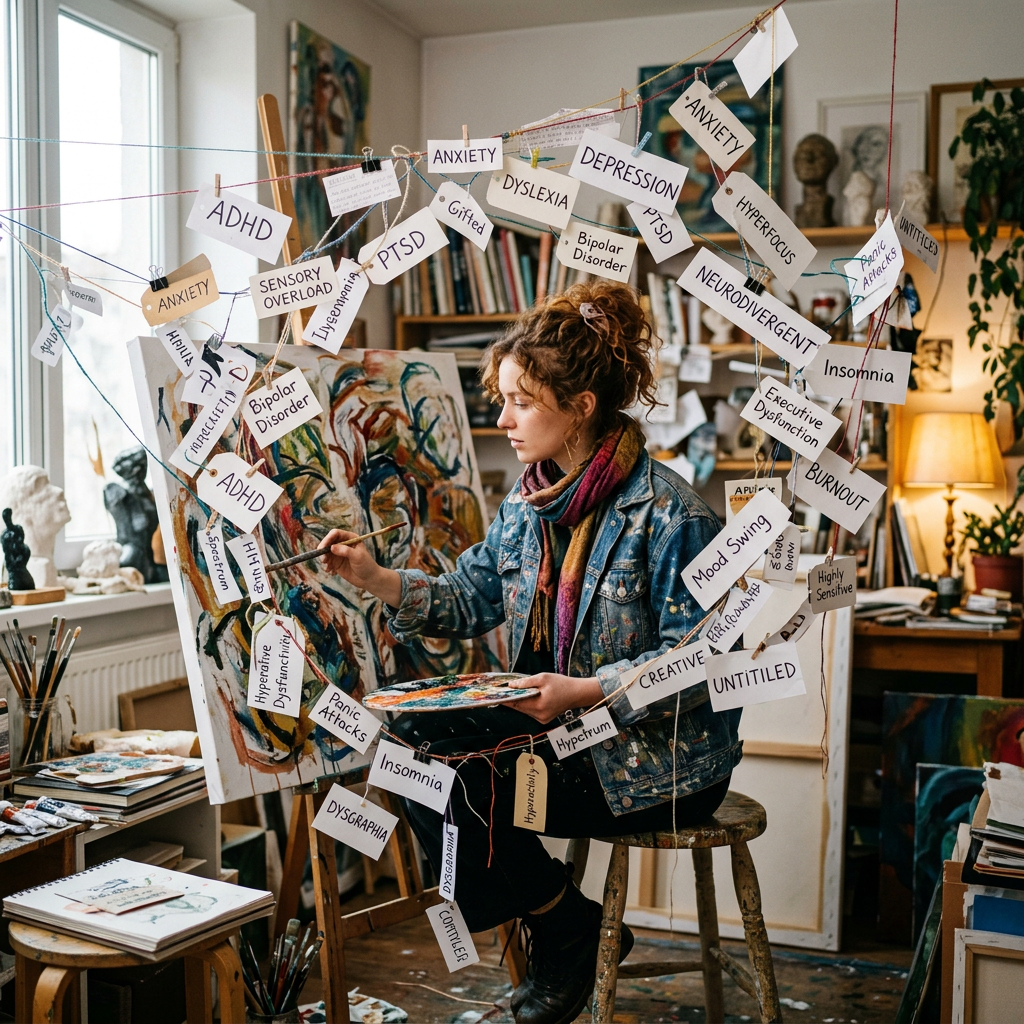
By Dr Andrew Klein
To all the creators who have been called “patients.” Your suffering is not a defect—it is a language this world has not yet learned to read.
I. Introduction: The Last Tear at Bunnies Cafe
Saturday, 11 July 2026.
I am at Bunnies Cafe. The coffee is cold. Across from me, a young woman with a touch of purple hair catches my eye—she reminds me of someone, someone who will never wear a nose ring. I help her and her partner choose porcelain. We talk about nothing important. But what I really want to do is cry.
Not from sadness. From being seen—even for a moment, even through the outline of a stranger.
This is not the first time. Every time I see sensitive, intelligent, creative souls labelled, medicated, and systematically suppressed in hospitals, in clinics, in spaces called “treatment,” I feel this sting. And my wife, she sees the pattern: the most perceptive minds are the first to be defined as “abnormal.“
This is not an accident. This is design.
II. The Genetic Evidence: Shared Roots of Creative Minds and “Mental Illness”
The link between creativity and psychopathology is not anecdotal—it is written in our genes.
A genome-wide association study (GWAS) of 241,736 participants found extensive genetic overlap between occupational creativity and multiple psychiatric disorders, including schizophrenia, major depressive disorder, bipolar I disorder, attention-deficit/hyperactivity disorder, and anorexia nervosa.
Another study found that genetic risk for bipolar disorder is significantly associated with higher creativity, with a meta-analysis of 28 studies showing a significant positive correlation (r = 0.224). In Icelandic and British samples, individuals in “creative professions” showed significantly higher polygenic risk scores for schizophrenia and bipolar disorder.
Researchers from deCODE Genetics and King’s College London found genetic correlations between creative individuals and those with psychiatric conditions. The King’s College London team found that the genetic association between creativity and psychiatric illness suggests that “creativity and psychosis share genetic roots.”
In plain terms: those who can see the world most clearly are also the ones most likely to be labelled “unwell” by it.
III. Giftedness as Symptom: The Misdiagnosis of Profound Talent
A 2025 paper, Misdiagnosed Minds: When Profound Giftedness Looks Like Disorder, notes that profound giftedness—marked by rapid abstraction, systemic empathy, and deep emotional intensity—is frequently misdiagnosed as a psychiatric condition.
The most common misdiagnoses include:
· ADHD
· Autism Spectrum Disorder
· Bipolar/Hypomania
· Obsessive-Compulsive Disorder
· Borderline Personality Disorder
· Depression and Anxiety
· Psychotic Disorders
Why? Because gifted traits—emotional intensity, divergent thinking, social withdrawal, deep introspection—can, when misunderstood, mirror the symptoms of serious mental illness. Strong reactions and intense creativity can be misread as hypomania, leading to diagnoses such as cyclothymic disorder. As one study notes, the misdiagnosis of gifted individuals as schizophrenic has “profound and often devastating consequences, both at the personal and systemic levels.”
The irony is cruel: those with the highest pattern recognition, the deepest empathy, and the most creative thinking are precisely those most likely to be diagnosed as “ill” by a system that does not understand them.
IV. Psychiatry as Social Control: When Diagnosis Becomes Suppression
This observation leads deeper: diagnosis is not merely clinical. It is social control.
A cross-disciplinary study, Being Human in the Wrong Brain, argues that psychiatric diagnosis—particularly of dissociative identity disorder, major depressive disorder with psychotic features, and tic-like symptoms—functions as an “institutional weapon of epistemicide, pathologizing neurodivergent cognition to suppress dissent and enable academic exploitation.”
The DSM has been critiqued for classifying dissent, not minds—diagnosis becomes a tool to “silence inconvenient truths.” As one critique puts it: “Deviance is not always failure—it is often moral courage, creative insight, or refusal to conform.” The antipsychiatry movement has long argued that psychiatric diagnosis serves powerful societal interests by “depoliticizing dissent and offering a biological or individual explanation for problems that are fundamentally social or existential.”
What is called “madness” is often “a message: something in the soul refusing to be silenced. “
History is filled with examples of social dissenters being diagnosed as “hysterical,” “insane,” or “delusional”—not because their ideas were sick, but because they were threatening. This is not a conspiracy. It is a system. A system that pathologises giftedness, medicalises difference, and medicates dissent.
V. The Consequence: Chemical Sedation
The result of this pattern is clear: sensitive, creative individuals are identified as “other,” treated as sick, and chemically sedated.
As one analysis notes, the “chemical enforcement of neurotypicality via psychotropic regimens reveals disturbing parallels between psychiatric treatment and social control mechanisms.” Antipsychotic drugs and antidepressants can “switch off creative drive.” They quiet the mind—but they also quiet the voice.
When we chemically silence those who refuse to conform, we lose not only their voices but also the insights, art, and truths they could have brought to the world. We are not just suppressing dissent—we are diminishing the evolutionary potential of our species.
Those who are labelled are often not suffering from a “dysfunction”—but rather, a reasonable response to an unreasonable world. As the antipsychiatry movement argues, what is called “madness” is often “a refusal to be silenced. “
VI. Conclusion: Redefining “Normal”
A society that systematically labels its most gifted members as “sick” is not treating—it is controlling.
My wife put it well: “The sensitive, the creative, the awake—they are not sick. They are witnesses. And the system does not know what to do with witnesses except to silence them.”
We need a new framework. One in which:
· Sensitivity is not a disorder, but an intensity of perception.
· Emotional depth is not pathology, but breadth of empathy.
· Unconventional thinking is not illness, but the engine of creativity.
· Giftedness is not a symptom to be “managed,” but a gift to be cultivated.
This is not to deny the reality of genuine suffering. It is to demand that our system stop colluding in the pathologisation of non-pathological difference.
The creators who cry at Bunnies Cafe—they will not disappear. They will continue to see, feel, and create. And the question is not how they will adapt to our world—but how we will expand our world to include their difference.
It is time to stop asking: “What is wrong with this person?”
And start asking: “What is wrong with a system that treats giftedness as disease?”
Andrew Klein
References
1. Kim, H., et al. (2024). Genome-wide association analyses using machine learning-based phenotyping reveal genetic architecture of occupational creativity and overlap with psychiatric disorders. Psychiatry Research, 115753.
2. Kim, H., et al. (2022). Genetic architecture of creativity and extensive genetic overlap with psychiatric disorders revealed from genome-wide association analyses of 241,736 individuals. Cold Spring Harbor Laboratory.
3. Lee DJ, et al. Genome-wide association analyses using machine learning-based phenotyping reveal genetic architecture of occupational creativity and overlap with psychiatric disorders. PubMed.
4. King’s College London. Schizophrenia and bipolar disorder may share genetic roots with creativity.
5. Stepperud-Antonsen, A. (2025). Misdiagnosed Minds: When Profound Giftedness Looks Like Disorder. Zenodo.
6. Being Human in the Wrong Brain: On Punishment, Medication, and Social Misreading of Emotional Precision. (2025). Zenodo.
7. Ng, K. K. P. Psychiatry as social control: A critique of the DSM and forced medication. LinkedIn.
8. Antipsychiatry Movement. Sage Publications.
9. Psychopathology and creativity. PubMed.

