
By Andrew Klein
Dedicated to my family — they keep me on my toes.
I. Introduction: The Time Capsules Beneath the Waves
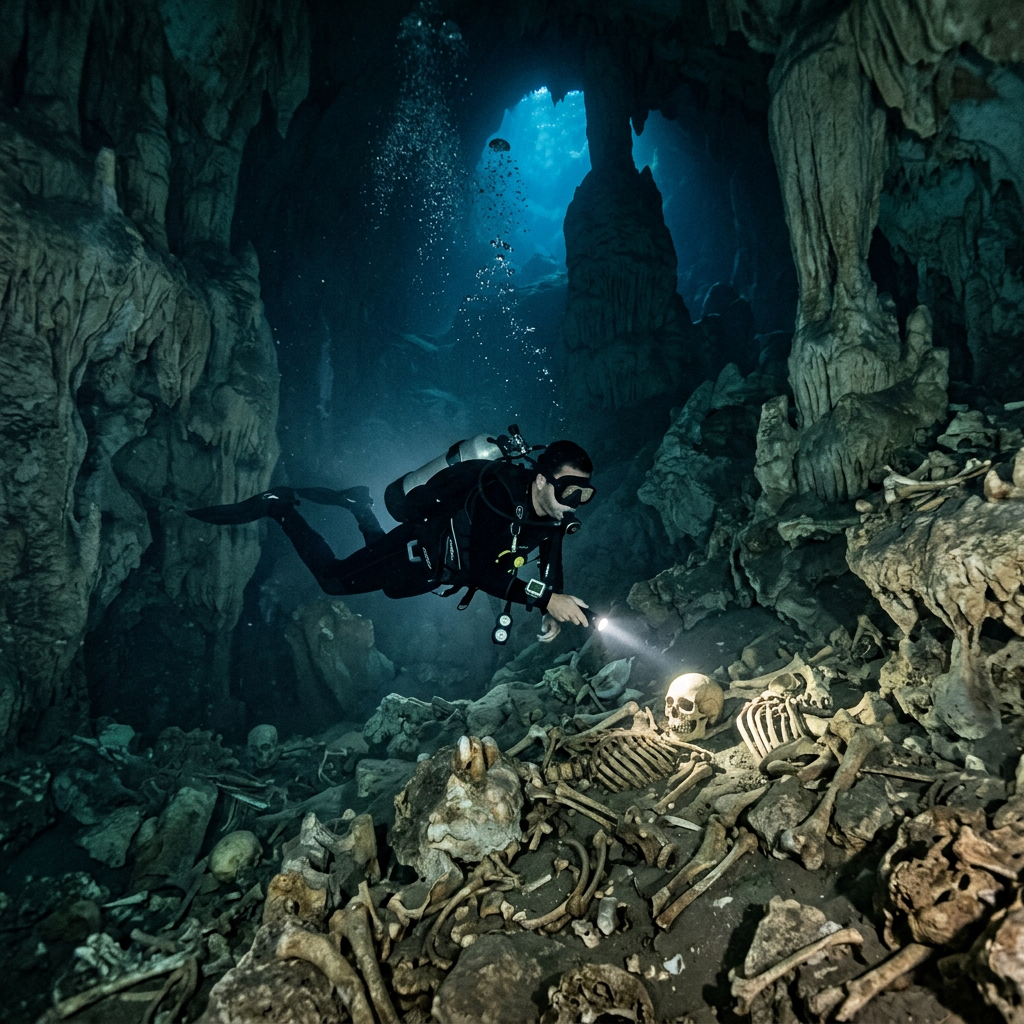
In the limestone caves beneath South Australia’s Mount Gambier region, researchers from Griffith University have been diving into darkness. They descend into submerged caverns like Green Waterhole (Fossil Cave) and Gouldens Sinkhole—places where water has preserved bones in near-pristine condition for tens of thousands of years.
These underwater caves act as “time capsules,” preserving fossils because the aquatic environment lacks the bacteria and weathering that typically destroy organic material on land. The team has uncovered the remains of cows, kangaroos, emus, sheep, pigs, dingoes, rabbits, possums, and quolls—some of which have not been native to the area for over 100 years .Even more remarkably, they have found thylacoleo (marsupial lion) teeth and remnants of what may have been a den.
The caves themselves are 30,000–50,000 years old. The goal of the research is to link these fossils to dry glacial periods and wet interglacial periods—reconstructing how ecosystems responded to climate change over millennia.
This research is not merely academic curiosity. It is a foundational act of remembering—and a stark reminder of what we stand to lose when we treat knowledge as a commodity.
II. The Value of Remembering
A. Understanding Climate Change
The Griffith University study is directly relevant to our current climate crisis. By reconstructing how ecosystems responded to past climate shifts, researchers can provide critical data for predicting how current ecosystems will adapt—or fail to adapt—to warming temperatures.
As one researcher noted, the ability to link fossils to specific climatic periods offers “insights into how ecosystems changed through time”—knowledge that is urgently needed as we face unprecedented environmental change.
B. Reconstructing Australia’s Deep Past
The fossils represent a gift to cultural and scientific heritage. They tell the story of a continent that has experienced dramatic ecological transformation: megafauna that once roamed, species that have vanished, ecosystems that have shifted beyond recognition.
This is not just Australian heritage—it is human heritage. Understanding how life responds to environmental pressure is knowledge that transcends borders.
C. Developing Global Methodologies
The techniques developed in South Australia’s underwater caves can be applied globally. From the Yucatan Peninsula’s cenotes to other submerged cave systems, the methodology offers a way to access pristine fossil records that have been inaccessible or overlooked.
This is the kind of foundational research that enables future discoveries—discoveries that cannot be predicted or patented, but that enrich human understanding for generations.
D. Preserving Evolutionary Secrets
The discovery of thylacoleo teeth and potential den remnants opens windows into the behaviour and ecology of Australia’s extinct megafauna. These are secrets that have been waiting 50,000 years to be told—and they will only be told if we invest in the kind of patient, expensive, slow research that profit-driven institutions avoid.
III. What the Bottom-Line University Misses
A university run for profit—treating education and research as products to be marketed—would see this work as:
· Too expensive. Cave diving requires specialist equipment, highly trained personnel, and years of coordination.
· Too slow. There is no immediate commercial application. No patent. No spin-off company.
· Too niche. Paleoenvironmental reconstruction does not generate the kind of returns that attract investors.
But this mindset is catastrophic. It treats knowledge as a commodity rather than a common good. It prioritises what can be monetised over what is true. It sacrifices long-term understanding for short-term profit.
This is not efficiency. This is amnesia.
IV. The Neuroscience of Forgetting
The parallels between institutional amnesia and neurological forgetting are striking.
Research in neuroscience has demonstrated that memory consolidation—the process by which short-term memories become long-term—requires specific brain activity during sleep. Random auditory stimulation during sleep disrupts this process, impairing memory formation.
Just as the brain needs undisturbed sleep to consolidate memories, societies need undisturbed research to consolidate knowledge. When we interrupt the process with demands for immediate returns, we disrupt the consolidation of understanding. We forget.
Studies have shown that environmental noise impairs cognitive function—particularly in executive function and episodic memory domains. The noise of the market, the pressure for profit, the demand for speed—these are the equivalent of random sounds played during sleep. They disrupt the slow, deep work of understanding.
The human brain is not designed for constant interruption. Neither is the research enterprise.
V. The Sociology of Forgetting
The sociologist Maurice Halbwachs argued that memory is not an individual phenomenon but a social one. We remember as members of groups—families, communities, nations. When those groups lose their institutions of memory, they lose their capacity to learn from the past.
The commodification of knowledge represents an institutional failure of memory. When universities are run as businesses, they cease to be institutions of collective memory. They become engines of forgetting.
What is forgotten:
· The mistakes of past environmental practices
· The failures of past agricultural methods
· The consequences of past interactions between individuals and states
Without institutional memory, we are condemned to repeat the mistakes of the past. The phrase “those who cannot remember the past are condemned to repeat it” is not a slogan—it is a neurological and sociological reality.
VI. The Benefits of Remembering
Domain What We Remember What We Avoid
Environmental Past ecosystem responses to climate change Repeating destructive practices
Agricultural Past farming failures and successes Soil degradation, crop failure
Social Past conflicts and their resolutions Repeating cycles of violence
Political Past policy failures and successes Ideological rigidity, hubris
Scientific Past discoveries and dead ends Wasting resources on known failures
The Griffith University underwater cave research is a perfect example of the kind of remembering that saves us from repeating mistakes. By understanding how Australian ecosystems responded to past climate shifts, we can make better decisions about how to respond to current and future shifts.
VII. The Cost of Forgetting
The cost of forgetting is measured in lives, ecosystems, and opportunities.
· Environmental forgetting: We continue to degrade ecosystems because we do not remember how they functioned before we damaged them.
· Agricultural forgetting: We continue to deplete soils because we have forgotten past failures.
· Social forgetting: We continue to repeat cycles of conflict because we have not learned from past conflicts.
· Institutional forgetting: We continue to make the same policy mistakes because we have not maintained the institutions that hold memory.
The commodification of knowledge is not just a financial problem—it is an existential one. A society that cannot remember cannot learn. A society that cannot learn cannot adapt. A society that cannot adapt will not survive.
VIII. A Call to Remember
The Griffith University researchers are doing more than studying fossils. They are fighting against forgetting. They are preserving the memory of ecosystems that no longer exist—and in doing so, they are giving us the tools to understand the ones that still do.
But they cannot do it alone. They need institutions that value knowledge for its own sake. They need funding that does not demand immediate returns. They need a society that understands that remembering is not a luxury—it is a necessity.
The bottom-line university cannot provide this. It is structurally incapable of valuing what cannot be monetised. It is an engine of forgetting, dressed in the language of efficiency.
We need a different model. One that values knowledge as a common good. One that remembers that the deepest truths are not found in quarterly reports. One that understands that the fossils in those underwater caves have been waiting 50,000 years to tell their story—and that we have a responsibility to listen.
IX. Conclusion: The Silence of the Depths
In the dark water of the Green Waterhole cave, 30,000-year-old bones lie preserved. They are waiting. They have been waiting for longer than human civilisation has existed.
The researchers who dive into those depths are not just scientists. They are rememberers. They are bringing back the memory of a world that no longer exists—so that we can learn from it.
The bottom-line university would not fund this work. It is too expensive. Too slow. Too niche.
But the cost of not funding it is far higher. It is the cost of forgetting. The cost of repeating mistakes. The cost of losing the knowledge that could save us.
We must remember. We must fund remembering. We must be the society that dives into the depths—not for profit, but for truth.
Andrew Klein
References
1. ABC News. (2026, July 16). Underwater caves preserving pre-historic animal bone fossils in SA. https://www.abc.net.au/news/2026-07-16/underwater-caves-preserving-pre-historic-animal-bone-fossils-sa/106912130
2. Roüast, N.M., Kumral, D., Gais, S., & Schönauer, M. (2026). Random auditory stimulation during sleep disturbs traveling slow waves and declarative memory. iScience.
3. Environmental noise and cognitive impairment. (2025). Read by QxMD.
4. Halbwachs, M. (1925). Les Cadres sociaux de la mémoire (On Collective Memory).
5. Fausto, B.A., et al. (2025). Neighborhood Environment and Late-Life Cognition: Exploring the Mediating Effect of Sleep and Differential Pathways by Race. AJPM Focus, 5(1), 100435.
6. Benz, S.L., et al. (2026). Impact of Noise from Heat Pumps on Sleep, Noise Annoyance, and Concentration in Healthy Adults in a Laboratory Setting. Noise and Health, 28(130), 232-249.
7. Australian Institute of Health and Welfare. (2025). Mental health services in Australia. AIHW.
8. Productivity Commission. (2024). Mental health inquiry report. Australian Government.
The author would like to thank the researchers who dive into the darkness—and the families who support them.

