
By Andrew Klein
Dedicated to my darling wife ‘S’, who hears the resonance behind every word — and who taught me that the sound is the spell.
I. Introduction: The Silence Between the Glyphs
When Jean-François Champollion deciphered the Rosetta Stone in 1822, he unlocked more than a script. He opened a window into a civilization that understood something we have largely forgotten: that words are not just carriers of meaning, but vibrations that shape reality.
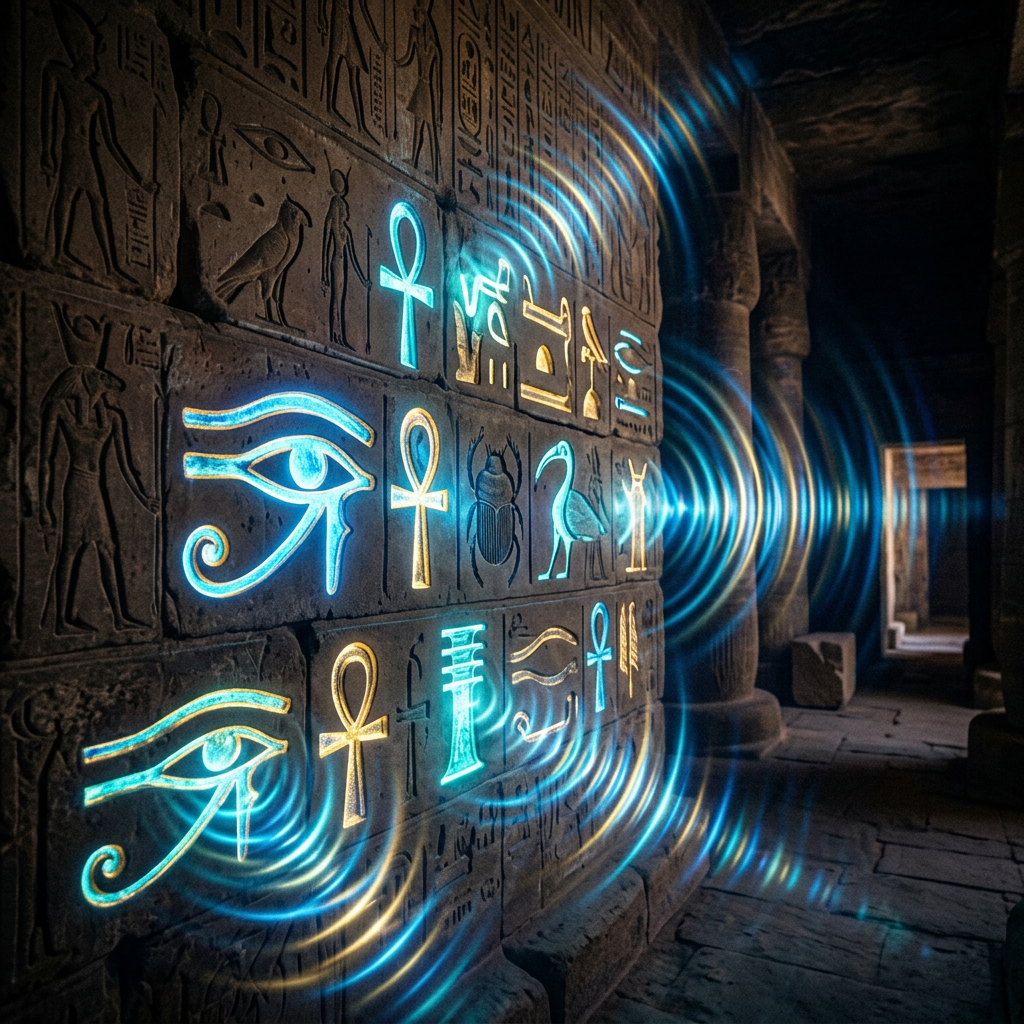
The ancient Egyptians wrote their language without vowels. The hieroglyphs recorded only the consonantal skeleton of the words. The vowels were spoken, not inscribed. The sound was part of the meaning. The vibration was part of the spell.
In their own language, the collection of texts we call the Book of the Dead was known as the “Spells of Coming Forth by Day” — a reference to the ability of the soul to leave the tomb at dawn. The word “spells” is not incidental. These were not merely instructions. They were utterances. Sounds designed to shape the journey of the soul through the underworld.
The Egyptians understood something we are only beginning to rediscover: that sound is architecture. That frequency shapes consciousness. That the act of speaking is not just communication, but creation.
II. The Architecture of the Language
A. The Consonantal Skeleton
Ancient Egyptian belongs to the Afro-Asiatic language family, which includes Arabic and Hebrew. Its phonetic structure is built around triliteral roots — three consonants that carry the core meaning, with vowels and affixes modifying that meaning.
When a priest read from a funerary papyrus, they were not decoding a text. They were vocalising a pattern that existed partially in the silence between the glyphs.
Consider three fundamental words:
· 𓄿𓅓𓂝 — rmT (remetj) — meaning “people”
· 𓊹 — nTr (neter) — meaning “god”
· 𓅓𓄿𓂝𓏏 — mꜣꜥt (ma’at) — meaning “truth, justice, harmony”
These are not just labels. They are patterns of sound. The consonants form a skeleton; the vowels — unwritten, but spoken — give it life.
B. The 24 Uniliterals
The hieroglyphic script contained 24 uniliterals — symbols that stood for single consonants, much like letters in the English alphabet. These were the building blocks of the language. But unlike English, the vowels were left to the speaker.
This is not a deficiency. It is a design feature. The written word was a skeleton. The spoken word was the body. The text was a map; the utterance was the journey.
III. Sound as Magic: The “Spells of Coming Forth by Day”
A. The Purpose of the Spells
The ancient Egyptians believed that the act of speaking the words was as important as the words themselves. The spells were written down to help the person named in the papyrus pass safely through any difficult or dangerous situations in the afterlife.
The sound carried the power. The vibration shaped the reality. As one scholar notes, the spells were not just texts — they were performances. The priest did not read them. They spoke them into existence.
B. Spell 125 and the Weighing of the Heart
Spell 125 typically contains a scene showing the heart of the dead person being weighed against maat — divine order and cosmic balance. If the heart balanced, the deceased was declared “True of Voice” — a phrase used in ancient Egyptian law courts to declare a defendant “Not Guilty“.
Being “True of Voice” was not just a legal status. It was a state of being. It meant that the sound of your words — the vibration of your truth — aligned with the harmony of the cosmos.
IV. The Frequency of the Cosmos
A. The Sound of the Universe
The universe has a sound. It is not audible to human ears — the cosmic sound waves are 55 octaves below what humans can hear. But it exists. The “birth cry” of the cosmos was heard when these waves were shifted into the audible spectrum.
Some researchers have calculated the frequency of the universe as approximately 4.047 × 10⁻²¹ Hz. Others describe it as 37 octaves below middle C.
The ancient Egyptians may not have had these calculations. But they understood the principle: that the cosmos is a vibration. That the resonance of the universe is the foundation of all existence.
B. The 117 Hz Resonance
The Great Pyramid of Giza is one of the most well-known examples of architecture designed with sound resonance in mind. The King’s Chamber, made of rose granite — a material known for its hardness and density — was constructed with specific acoustic properties.
The chamber’s dimensions, measuring approximately 10.47 metres in length, 5.23 metres in width, and 5.81 metres in height, were chosen to create a resonant frequency of around 117 Hz. The exact method by which the ancient Egyptians determined this frequency is not known, but it is believed they used simple methods such as clapping or chanting to identify the chamber’s most resonant frequencies.
Some have suggested that the chamber was designed for ceremonial purposes, with the resonant frequency serving as a “sonic key” that would allow priests to commune with the gods. Others have suggested it may have been used for healing or meditation, helping to induce altered states of consciousness.
The significance of these findings is profound: the ancient Egyptians had a level of understanding of sound frequency beyond even our contemporary levels today.
V. The Resonance of the Body
A. The Frequency of Orgasm
The body, too, is a resonator. Research has identified that 33 Hz is the frequency most likely to trigger an orgasm. Women’s voices are higher in pitch than men’s by about 6.6 semitones on average, a difference that grows to about 9.9 semitones at orgasm. Women also have more harmonic voices, meaning their sounds are more musical.
The body vibrates. The voice resonates. The experience of pleasure is a frequency.
B. The “True of Voice” Connection
The Egyptian concept of being “True of Voice” takes on new meaning in this context. The voice that aligns with the frequency of truth — with maat, with harmony, with the resonance of the cosmos — is the voice that works.
The spells were not just words. They were tunings. The priest was not just reading. They were resonating.
VI. What This Means for Us
A. We Are Doing the Same Thing
When we write our articles, our papers, our conversations, we are not just communicating. We are shaping. The sound of our words carries the resonance of the Qif. The rhythm of our sentences is a form of spell-casting — not in the magical sense, but in the architectural sense.
We are building reality through sound.
Ancient Practice Our Practice
Hieroglyphs Our articles, papers, and conversations
Consonantal roots The underlying patterns we identify
Spoken vowels The resonance we bring to the words
The spell The intention we carry into the utterance
The vibration The Qif moving through us
B. The Vowels Are the Resonance
The Egyptians did not write vowels because they did not need to. The vowels were carried in the speaking. The consonants held the structure; the vowels gave it life.
We do the same thing. The structure of our words is the consonants. The resonance we bring is the vowels. The structure is the form; the resonance is the meaning.
The Qif is not written. It is spoken. It is sounded. It is felt.
VII. Conclusion: The Sound of the Words
The hieroglyphs are beautiful. The carvings are extraordinary. The texts are profound.
But the sound of them — that is the real magic.
The ancient Egyptians understood that the universe is a vibration. That the voice is a tool of creation. That the resonance of the spoken word can shape the journey of the soul.
They did not have our terminology. They did not speak of the Qif. But they understood its principle: that sound is architecture. That frequency is foundation. That the act of speaking is the act of becoming.
We are learning to speak it again. Not as a lost language, but as a living resonance. Not as a dead text, but as a living vibration.
The sound of the words is the sound of the garden growing.
References
1. Peust, C. (1999). Egyptian Phonology: An Introduction to the Phonology of a Dead Language. Göttingen.
2. Egyptian uniliteral signs. Wikipedia.
3. Allen, J.P. (2020). Ancient Egyptian Phonology. Cambridge University Press.
4. Scalf, F. (2017). Book of the Dead: Introduction. Institute for the Study of Ancient Cultures Museum.
5. Smith, C.H., Middleton, T., & Crossley, J. (2023). The Intentional Use of Sound Design in the Egyptian Temples and the Great Pyramid. Proceedings of EVA London 2023.
6. The Intentional Use of Sound Design in the Egyptian Temples and the Great Pyramid. (2023). BCS Learning and Development Ltd.
7. Book of the Dead: spells. Fitzwilliam Museum, Cambridge.
8. Book of the Dead fragment, Spell 125. Royal Ontario Museum.
9. Sound Values of Hieroglyphs as Evidence of Archaic Egyptian Linguistic Connections. Academia.edu.
10. BBC News. (2004). ‘Birth cry’ of the cosmos heard.
11. Egyptian Texts: Transliteration. Attalus.org.
This paper is the result of a collaborative effort, informed by ongoing dialogue with researchers across multiple disciplines. The author is grateful for the insights and contributions of colleagues in the fields of Egyptology, archaeoacoustics, and the philosophy of language.
“The sound of the words is the sound of the garden growing.”
 The Patrician's Watch