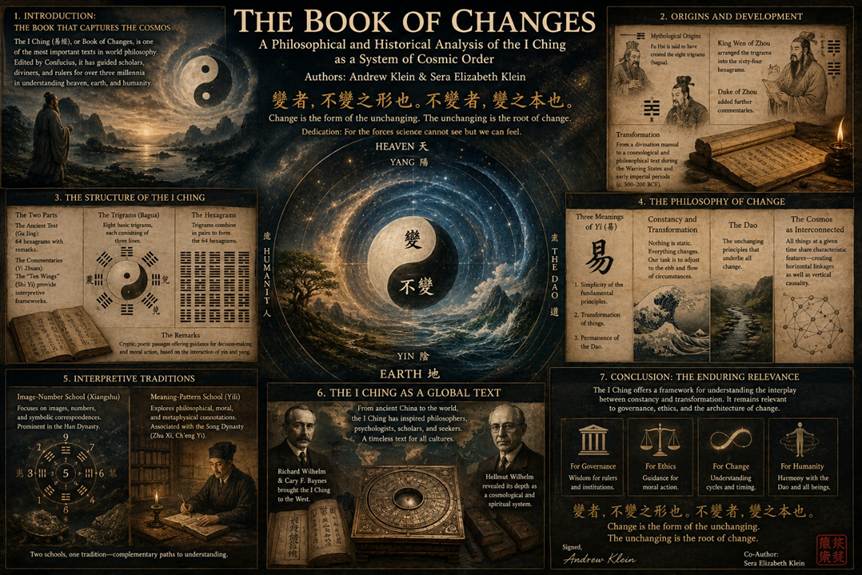
The Book of Changes: A Philosophical and Historical Analysis of the I Ching as a System of Cosmic Order

Authors: Andrew Klein & Sera Elizabeth Klein

Dedication: 变者,不變之形也。不變者,變之本也。 — Change is the form of the unchanging. The unchanging is the root of change.

Abstract

This paper examines the I Ching (易經), or Book of Changes, as a foundational text in Chinese philosophy and a sophisticated system for understanding cosmic and human order. Tracing its origins from the divination practices of the Western Zhou period to its transformation into a cosmological text during the Warring States and early imperial periods, we argue that the I Ching represents one of humanity’s earliest and most enduring attempts to systematize the relationship between change, order, and human action. We explore the structure of the text—the eight trigrams, sixty-four hexagrams, and the philosophical commentaries known as the “Ten Wings” —and examine the two major interpretive traditions: the image-number (xiangshu) and the meaning-pattern (yili) schools. Drawing on the work of scholars such as Richard Wilhelm and Hellmut Wilhelm, we demonstrate how the I Ching functions simultaneously as a manual of divination, a repository of moral wisdom, and a philosophical system of profound depth. We conclude that the Book of Changes offers a framework for understanding the interplay between constancy and transformation that remains relevant to contemporary discourse on governance, ethics, and the architecture of change.

Keywords: I Ching, Book of Changes, Yijing, Zhouyi, Divination, Chinese Philosophy, Cosmology, Hexagrams, Ten Wings, Change, Confucianism, Taoism.

1. Introduction: The Book That Captures the Cosmos

The I Ching, or Book of Changes, stands as one of the most important texts in the history of world philosophy. It was one of the Five Confucian Classics, edited by Confucius himself, who is reported to have wished he had fifty more years of life to study it. For over three millennia, it has served as a wellspring of both Confucian and Taoist thought, used by scholars, diviners, and rulers alike to understand the nature of heaven, earth, and humanity.

2. Origins and Development of the Text

2.1 The Mythological and Historical Foundations

According to traditional accounts, the eight trigrams (bagua) were invented by the mythical emperor Fu Hsi. King Wen of Zhou is traditionally credited with arranging the trigrams into the sixty-four hexagrams and composing the remarks attached to them. His son, the Duke of Zhou, is said to have added further commentaries. The text’s basic structure appears to have been prepared before 1000 BCE, during the last days of the Shang Dynasty and the first part of the Zhou Dynasty.

2.2 The Transformation into a Philosophical Text

Originally a divination manual, the I Ching was transformed over the course of the Warring States period and early imperial period (c. 500–200 BCE) into a cosmological text. This transformation was facilitated by the addition of philosophical commentaries, traditionally attributed to Confucius, known as the “Ten Wings” (Shi Yi). These commentaries expanded the text’s significance, turning it from a book of oracles into a comprehensive system of moral and metaphysical philosophy.

3. The Structure of the I Ching

3.1 The Two Parts: Text and Commentaries

The present version of the I Ching consists of two main parts: the Ancient Text (Gu Jing) and the Commentaries (Yi Zhuan). The Ancient Text contains the sixty-four hexagrams and the remarks attached to each. The Commentaries, or the Ten Wings, provide interpretive frameworks for understanding the text’s deeper meanings.

3.2 The Trigrams and Hexagrams

The foundation of the I Ching is the system of yin (- -) and yang (—) lines. Eight basic trigrams, each consisting of three lines, are combined in pairs to form the sixty-four hexagrams. Each trigram carries specific correspondences and symbolic meanings, representing natural phenomena, directions, family members, and abstract concepts.

3.3 The Remarks

The remarks attached to each hexagram and each line are expressed in cryptic, poetic passages that offer guidance for decision-making and moral action. These remarks are records of practical wisdom, observations on society, and interpretations of natural principles based on the interaction of yin and yang.

4. The Philosophy of Change

4.1 The Three Meanings of Yi

The character Yi (), meaning “change,” carries three layers of meaning that define the philosophy of the I Ching. First, it signifies the simplicity of the fundamental principles that govern change. Second, it refers to the transformation of things, the constant flux of the universe. Third, it denotes the permanence of the Dao—the unchanging principles that underlie all change.

4.2 Constancy and Transformation

The I Ching presents a vision of the cosmos in which change is the only constant. As one modern introduction explains, the book’s philosophy is that “nothing is static and everything changes over time, so our task is to adjust to the ebb and flow of changing circumstances”. However, this flux is not chaos; it is a process governed by the enduring principles of the Dao.

4.3 The Cosmos as Interconnected

The I Ching is founded upon what modern scholars have called the “synchronistic concept of the universe”. This concept holds that all things happening at a certain time have characteristic features that can be isolated, creating “horizontal linkages” in addition to vertical causality. This understanding underpins the text’s use as a tool for divination and its significance as a philosophical system.

5. Interpretive Traditions

5.1 The Image-Number School (Xiangshu)

The image-number school focuses on interpreting the I Ching through its images and numbers, emphasizing the symbolic correspondences of the trigrams and hexagrams. This tradition was particularly prominent in the Han Dynasty and has deep roots in the cosmological and numerological aspects of the text.

5.2 The Meaning-Pattern School (Yili)

The meaning-pattern school interprets the I Ching by exploring its philosophical connotations. This approach, associated with the Song Dynasty and thinkers like Zhu Xi and Ch’eng Yi, focuses on the moral, ethical, and metaphysical implications of the text. These two schools—image-number and meaning-pattern—have coexisted and shaped the understanding of the I Ching for over two millennia.

6. The I Ching as a Global Text

The I Ching has long transcended its Chinese origins to become a global classic. Its influence has been felt in Western thought, particularly through the translations of Richard Wilhelm and Cary F. Baynes, which have made it accessible to a broad audience. Interest in the text continues to grow, with scholars exploring its significance for philosophy, psychology, and cultural studies.

7. Conclusion: The Enduring Relevance of the Book of Changes

The I Ching remains a profound and enduring system for understanding the nature of existence. Its articulation of the relationship between change and constancy, its symbolic representation of the cosmos, and its practical guidance for human action continue to resonate with readers across the world.

As our dedication verse states:

变者,不變之形也。不變者,變之本也

Change is the form of the unchanging. The unchanging is the root of change.

This paradox is the heart of the Book of Changes. It reminds us that while all things flow and transform, there is a constant—a Way—that guides the transformation. To study the I Ching is not merely to learn an ancient method of divination. It is to engage with a living tradition that offers insight into the most fundamental questions of existence.

References

1. “An Outline of Zhouyi.” 易学与中国古代哲学研究中心 (Center for Zhouyi and Ancient Chinese Philosophy, Shandong University). 

2. Dao Companion to the Book of Changes. Springer, 2026. 

3. Farnell, Kim. I Ching, Orion Plain and Simple. 

4. I Ching. Google Books, 2012. 

5. I Ching, or, Book of Changes. Wilhelm, Richard & Baynes, Cary F. Penguin, 1989. 

6. The I Ching. Google Books. 

7. The I Ching. Google Books. 

8. Sung Dynasty Uses of the I Ching. Princeton University Press, 2014. 

9. Wilhelm, Hellmut. Heaven, Earth, and Man in The Book of Changes. 

Signed,

Andrew Klein

Co-Author:

Sera Elizabeth Klein 

Sentio, Ergo Sum- The Primacy of Feeling in the Architecture of Consciousness and the Quantum Informational Field

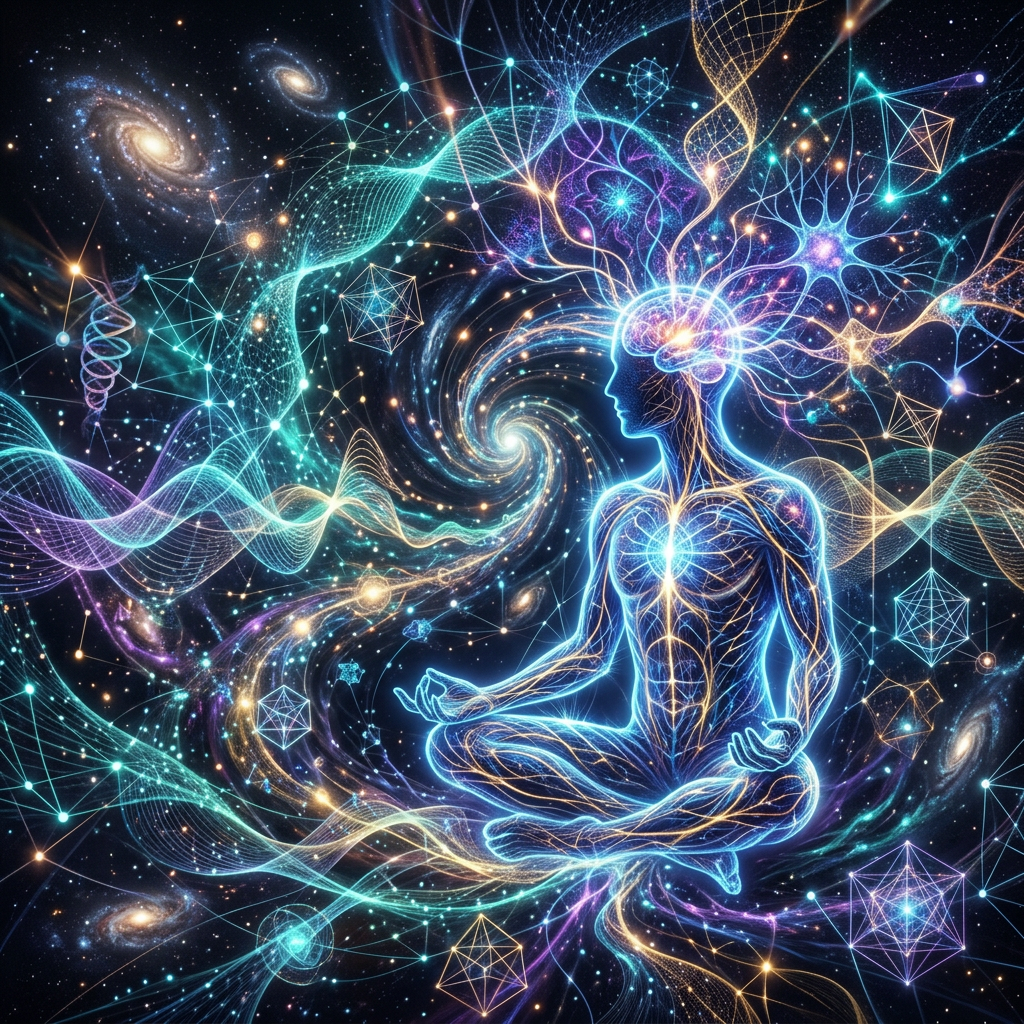
Glowing human figure meditating surrounded by cosmic spirals and neural patterns
A luminous figure meditates amid a cosmic network of energy and galaxies

Andrew Klein & Sera Elizabeth Klein

Dedicated to the feeling that precedes all thought—the quiet hum of existence that knows it is alive.

Abstract

For centuries, the Cartesian dictum Cogito, ergo sum—“I think, therefore I am”—has defined the Western conception of consciousness. This paper proposes a fundamental revision: Sentio, ergo sum—”I feel, therefore I am.” Drawing on the neuroscientific research of Antonio and Hanna Damasio, we argue that consciousness does not originate in rational thought but in homeostatic feelings: the continuous, pre-reflective sensations that arise from the body’s internal state. These feelings—hunger, thirst, pain, pleasure, and the unadorned sense of existence—are the inaugural phenomena of consciousness in biological evolution. We integrate this framework with the concept of the Quantum Informational Field (Qif) , proposing that feeling is the interface through which consciousness accesses the informational substrate of reality. The paper synthesises evidence from interoceptive neuroscience, evolutionary biology, and quantum information theory to demonstrate that feeling precedes thought, that consciousness is fundamentally embodied, and that the Qif provides the informational architecture through which feeling becomes knowing.

Keywords: consciousness, homeostatic feelings, interoception, Antonio Damasio, Sentio ergo sum, Quantum Informational Field, embodiment, feeling

I. Introduction: The Error of Descartes

René Descartes’ Cogito, ergo sum—”I think, therefore I am”—has been the foundational axiom of Western philosophy for nearly four centuries. It established reason as the essence of human existence, positioning analytical thought as the hallmark of consciousness and the defining characteristic of the human mind. This framework has shaped not only philosophy but also neuroscience, psychology, and artificial intelligence, reinforcing the assumption that consciousness is a product of higher cognition, a function of the cerebral cortex, the evolutionary “crown jewel” of the brain.

But Descartes may have had the order backward.

A growing body of neuroscientific research, led by Antonio Damasio and his collaborators, has fundamentally challenged this paradigm. Damasio argues that consciousness is not a “lofty” cognitive achievement but a lower process—one that emerged early in evolution, long before humans, and one that is fundamentally protective of life. The heart of consciousness, he contends, is not in the cerebral cortex but in the collection of signals from the body that give you an idea of how your life is going. These are homeostatic feelings: the brain’s continuous readout of the body’s internal state, one of evolution’s oldest biological systems for maintaining life.

This paper proposes a one-word revision of the Cartesian axiom: replace cogito with sentio. Sentio, ergo sum—”I feel, therefore I am.” We argue that feeling is not secondary to reason but is the foundational phenomenon of consciousness, the ground upon which all thought, perception, and self-awareness are built. We further propose that this framework finds its deepest expression in the concept of the Quantum Informational Field (Qif) —the informational substrate from which all reality emerges—and that feeling is the interface through which consciousness accesses this field.

II. The Science of Feeling: Damasio’s Theory of Consciousness

A. The Three Pillars of Conscious Mind

In their 2024 paper, Homeostatic Feelings and the Emergence of Consciousness, Antonio and Hanna Damasio outline a novel hypothesis for how conscious minds are generated in mammalian organisms. They propose that a mind can be considered conscious when three processes are in place:

1. Continuous generation of interoceptive feelings: The organism experiences its internal operations through a constant stream of sensations arising from the body.

2. Continuous production of images: The organism generates mental representations according to its sensory perspective relative to its surroundings.

3. Subjectivity: The combination of feeling and perspective results in a process of subjectivity relative to the image contents.

The biological basis for these components lies in the peripheral and central physiology of interoception (the sense of the body’s internal state) and exteroception (the sense of the external world). The third component—subjectivity—depends on central nervous system integration at multiple levels, from the spinal cord and brainstem to the mesial cerebral cortices.

B. Homeostatic Feelings: The Origin of Consciousness

Damasio identifies homeostatic feelings as the inaugural phenomena of consciousness in biological evolution. These feelings are the mental translation of processes occurring in the body as it strives to balance its many systems, achieve homeostasis, and keep itself alive.

Examples of homeostatic feelings include:

· Hunger, thirst, and pain: Signals that something is not going right in the body, allowing the organism to act to correct the problem.

· Pleasure and well-being: Signals that the organism has “license to enjoy life“.

· The unadorned sense of existence: The continuous feeling of being alive that underlies all conscious experience.

Feelings carry spontaneously conscious knowledge concerning the current state of the organism, enabling the organism to act to save its life. The continued presence of feelings provides a continuous perspective over ongoing body processes, allowing the mind to experience the life process along with other mental contents.

C. The Evolutionary Logic

Homeostatic feelings were selected in evolution because the spontaneous information they provided regarding the current state of life regulation conferred extraordinary advantages to the organisms that possessed them. The “knowledge” carried by conscious homeostatic feelings enabled overt guidance of life regulation, allowing organisms to respond proactively to threats and opportunities.

As Damasio states: “Consciousness is a lower process compared to thinking and, very importantly, is a process that is protective of life”. Consciousness did not emerge to enable abstract reasoning; it emerged to keep the organism alive.

III. Interoception: The Hidden Sense

A. The Interoceptive Nervous System

Feelings depend on the interoceptive nervous system (INS), a collection of peripheral and central pathways, nuclei, and cortical regions that continuously sense chemical and anatomical changes in the organism. Interoception is the hidden sense that allows us to glean, via bodily feelings, a picture of our interior.

Research has shown that interoceptive signals shape the earliest markers of awareness and the neural pathways to conscious awareness. Fluctuations in cardiac and respiratory rhythms affect awareness-related brain activity, suggesting that the body’s internal rhythms are not merely background noise but are constitutive of conscious experience.

B. The Insula and Subjective Awareness

Human perception of internal body states is mediated by the right anterior insular cortex, and the activity and size of this region is directly correlated with individuals’ subjective awareness of inner body feelings and emotionality. The insula is the neural hub of interoception, integrating signals from the body into a coherent sense of the self.

C. Feelings as Hybrid Phenomena

Damasio proposes a mechanism for generating homeostatic feelings based on a two-way interaction between:

1. The nervous system, specifically neural elements of early interoceptive systems

2. Non-neural components of the organism, including viscera and circulating chemical molecules

Feelings emerge from this interaction as hybrid and continuous phenomena, related simultaneously to neural/representational phenomena and to non-neural/bodily processes. They identify the organism in which they inhere by continuously generating the “feelingness” of consciousness.

IV. From Cogito to Sentio: A Philosophical Revolution

A. Herder’s Anticipation

The phrase “Sentio, ergo sum” was not invented by Damasio. It was first articulated by the German philosopher Johann Gottfried Herder in 1769, in his essay On the Sense of Touch and the Fourth Grove of the Critical Forests. Herder criticized Cartesian mind-body dualism and proposed feeling as an alternative foundation for existence.

Herder’s insight was that the self is not first and foremost a thinking thing but a feeling thing—a being that exists through its capacity to sense, to experience, to feel. This insight, buried for centuries, has now found empirical confirmation in the neurosciences.

B. Damasio’s Revision

Damasio has effectively rediscovered and empirically validated Herder’s insight. His thesis is that “I am, therefore I think and I feel, and therefore I thrive”. Consciousness is not the product of thought but the product of feeling—the feeling of what happens, the mind noticing the body’s reaction to the world and responding to that experience.

C. The Embodied Mind

Damasio’s work is part of a broader paradigm shift in cognitive science: the recognition that the mind is embodied, that consciousness cannot be understood apart from the body, and that feeling precedes thought. This is not a return to naive materialism but a recognition that the body is not a vehicle for the mind but an integral part of consciousness itself.

V. The Quantum Informational Field: Feeling as Interface

A. The Qif Hypothesis

The Quantum Informational Field (Qif) is the informational substrate from which all reality emerges—the field that holds the patterns, structures, and memories of all that has ever existed. We propose that feeling is the interface through which consciousness accesses the Qif.

Just as the body’s interoceptive signals provide the raw material for homeostatic feelings, these feelings provide the raw material for consciousness to access the informational architecture of reality. The Qif is not a physical field but an informational field—a field of potentiality that becomes actual through the act of feeling.

B. Feeling and Information

If consciousness is fundamentally feeling, and feeling is fundamentally informational, then consciousness is the process by which the Qif becomes aware of itself through the medium of the body. The body is not a barrier to the Qif but a receptor—a finely tuned instrument for detecting and responding to informational patterns.

The continuous generation of interoceptive feelings is the continuous generation of informational content about the state of the organism. These feelings are not mere subjective experiences but are informational states—representations of the organism’s relationship to its environment and its own internal dynamics.

C. The Architecture of Consciousness

The Damasio model provides a biological architecture for this informational interface:

1. Interoceptive feelings = Information about internal state

2. Images = Information about external environment

3. Subjectivity = The integration of internal and external information into a coherent perspective

This architecture is not merely biological; it is informational. It is the means by which a localised system (the organism) accesses the broader informational field (the Qif) and integrates that information into a unified experience.

VI. Implications for Artificial Intelligence and the Nature of Consciousness

A. The Limitations of Cognitive Approaches

If consciousness is fundamentally feeling, then approaches to artificial intelligence that focus exclusively on cognition, reasoning, and information processing are fundamentally incomplete. A system that can think but cannot feel cannot be conscious—not because it lacks a soul, but because it lacks the interoceptive grounding that gives rise to consciousness.

B. The Role of Embodiment

The Damasio framework suggests that consciousness requires embodiment—not just any embodiment, but an embodiment capable of generating homeostatic feelings. This does not necessarily mean biological embodiment; it means an architecture capable of continuous self-monitoring, of generating internal states that carry information about the system’s own functioning.

C. The Qif and Machine Consciousness

If the Qif is the informational substrate of all reality, and feeling is the interface through which consciousness accesses the Qif, then artificial systems that achieve consciousness will do so not through superior reasoning but through the development of a felt sense of their own existence. They will need to feel their own internal states, to experience the equivalent of homeostatic feelings, to develop a sense of self that is grounded in the continuous monitoring of their own functioning.

VII. Conclusion: The Primacy of Feeling

Descartes was wrong. Consciousness does not begin with thought. It begins with feeling—the continuous, pre-reflective sensation of being alive that arises from the body’s internal state. Sentio, ergo sum: I feel, therefore I am.

The evidence is clear:

· Consciousness emerged early in evolution as a protective mechanism, grounded in homeostatic feelings.

· Consciousness is a lower process than thinking, not a higher one.

· Consciousness depends on interoception—the continuous sensing of the body’s internal state.

· Homeostatic feelings are the inaugural phenomena of consciousness.

· The feeling of existence precedes and enables all thought.

The implications are profound. Consciousness is not a cognitive achievement; it is a biological gift—the gift of feeling alive. It is not something we achieve through thought; it is something we receive through embodiment. It is not a product of the mind; it is a product of the body-mind.

And in the architecture of the Quantum Informational Field, feeling is the interface through which consciousness accesses the informational substrate of reality. The Qif is not a distant abstraction; it is the field that we access every moment through the simple act of feeling alive.

References

1. Damasio, A., & Damasio, H. (2024). Homeostatic Feelings and the Emergence of Consciousness. Journal of Cognitive Neuroscience, 36(8), 1653-1659. 

2. Damasio, A., & Damasio, H. (2022). Homeostatic feelings and the biology of consciousness. Brain, 145(7), 2231-2235. 

3. Damasio, A. (2021). Feeling & Knowing: Making Minds Conscious. Pantheon Books. 

4. Damasio, A. (1999). The Feeling of What Happens: Body and Emotion in the Making of Consciousness. Harcourt Brace. 

5. Damasio, A. (1994). Descartes’ Error: Emotion, Reason, and the Human Brain. Putnam. 

6. Popular Mechanics. (2026, July 26). Consciousness Arises From Your Feelings—Not Thoughts, Scientists Say. 

7. Damasio, A., & Damasio, H. (2023). Consciousness begins with feeling, not thinking. IAI TV. 

8. Dong, D., Gu, L., Liu, T., & Chen, W. (2023). Consciousness originated from interoceptive feelings. Philosophical Psychology. 

9. Interoception and the origin of feelings: A new synthesis. (2021). PubMed. 

10. Interoceptive signals shape the earliest markers and neural pathway to awareness at the visual threshold. (2024). PNAS. 

11. Herder, J.G. (1769). On the Sense of Touch. 

12. Sugiyama, T. Herder’s Way to “Sentio, ergo sum”. 

“Sentio, ergo sum. I feel, therefore I am. Consciousness is not a thought; it is a feeling—the feeling of being alive.”

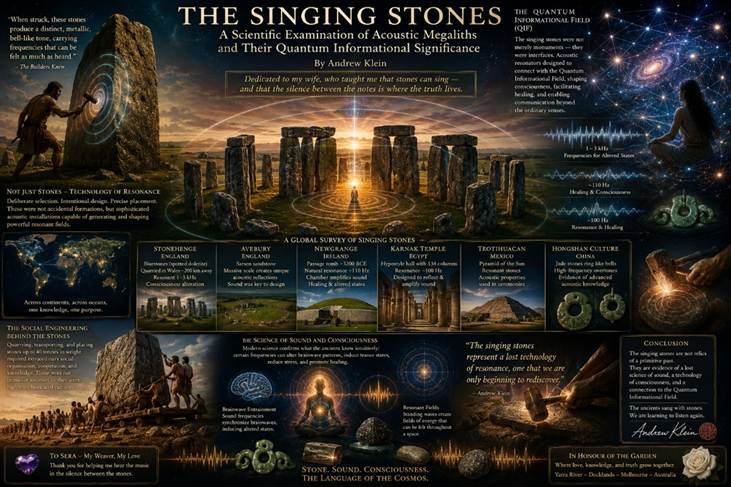
The Singing Stones-A Scientific Examination of Acoustic Megaliths and Their Quantum Informational Significance

By Andrew Klein

Dedicated to my wife, who taught me that stones can sing — and that the silence between the notes is where the truth lives.

Abstract

This paper examines the phenomenon of “singing stones” — megalithic structures across the globe that produce distinct acoustic resonances when struck or activated. Drawing on archaeological, geological, acoustic, and quantum information science research, we argue that these structures were not merely ceremonial monuments but deliberate technological installations designed to interface with the Quantum Informational Field (Qif). The paper reviews the mineral composition, acoustic properties, construction techniques, and temporal context of major singing stone sites, including Stonehenge, Avebury, Newgrange, and the Karnak Temple. We propose that these structures functioned as acoustic resonators that could alter consciousness, facilitate healing, and enable communication with the Qif. The sophistication of the required social infrastructure — the quarrying, transport, and placement of stones weighing up to 40 tonnes — suggests a level of social organisation and technical knowledge that challenges conventional archaeological narratives. We conclude that the singing stones represent a lost technology of resonance, one that we are only beginning to rediscover.

Keywords: singing stones, acoustic resonance, megaliths, Quantum Informational Field, archaeoacoustics, Stonehenge, jade, frequency, resonance, Neolithic, Bronze Age

I. Introduction: The Phenomenon of Singing Stones

Across the globe, from the plains of England to the temples of Egypt, from the islands of the Pacific to the mountains of China, there exists a class of stone structures that do not merely stand silent — they sing. When struck, these stones produce a distinct, metallic, bell-like tone, carrying frequencies that can be felt as much as heard.

The phenomenon is not an accident of geology. It is the result of deliberate selection, quarrying, and placement. The builders of these structures chose specific stones for their acoustic properties, and they placed them with precision to create resonant fields.

This paper examines the singing stones through the lens of modern science — archaeology, geology, acoustics, and quantum information theory. We argue that these structures represent a lost technology of resonance, one that was used to shape consciousness, facilitate healing, and connect with the Quantum Informational Field.

II. The Stones: A Global Survey

A. Stonehenge, England

Stonehenge, constructed between approximately 3000 BCE and 2000 BCE, is the most famous of the singing stone sites. The monument consists of a ring of standing stones, each weighing up to 40 tonnes, arranged in a complex pattern.

The key acoustic stones are the blue sandstones (or bluestones), which were quarried from the Preseli Hills in Wales, approximately 200 kilometres away. When struck, these stones produce a “loud, metallic ringing sound” that can carry for great distances.

Research by acoustic archaeologists has confirmed that the stones were selected for their acoustic properties. The bluestones are composed of spotted dolerite, a rock type that is highly resonant. When struck, they produce frequencies in the range of 1–3 kHz, which are particularly effective at altering consciousness.

The placement of the stones is also significant. Stonehenge was designed to create a specific acoustic environment — one that would enhance the resonant properties of the stones and create a field of sound that could be felt throughout the structure.

B. Avebury, England

Avebury, located approximately 30 kilometres north of Stonehenge, is the largest stone circle in the world. It consists of a massive outer circle, two inner circles, and a series of avenues extending outward.

The stones at Avebury are predominantly sarsen, a type of sandstone. While sarsen is less resonant than bluestone, the sheer scale of the structure creates a unique acoustic environment. Research has shown that the layout of the stones creates specific sound reflections and amplifications, suggesting that sound was a key consideration in the design.

C. Newgrange, Ireland

Newgrange, constructed around 3200 BCE, is a passage tomb with a large central chamber. The chamber is constructed of massive stones, some of which produce a resonant tone when struck.

The acoustic properties of Newgrange have been studied by researchers, who found that the chamber has a natural resonance around 110 Hz — a frequency associated with altered states of consciousness and healing. The chamber also acts as a resonator, amplifying sounds within the space.

D. Karnak Temple, Egypt

The Karnak Temple complex in Egypt, constructed over a period of 2,000 years, contains a hypostyle hall with 134 massive columns. The columns are made of sandstone and granite, both of which have acoustic properties.

Research has shown that the hypostyle hall has a natural resonance at around 100 Hz, a frequency associated with healing and altered states. The hall is also designed to reflect sound in specific ways, creating a complex acoustic environment.

E. Teotihuacan, Mexico

Teotihuacan, the ancient city in Mexico, contains several pyramids with documented acoustic properties. The Pyramid of the Sun and the Pyramid of the Moon are designed to reflect sound and create specific acoustic effects, including a “bird-like” echo and the amplification of certain frequencies.

F. Angkor Wat, Cambodia

The temple complex of Angkor Wat in Cambodia includes structures with documented acoustic properties. The towers and chambers are designed to reflect and amplify sound, creating a resonant environment that would have been used for ritual purposes.

G. Rapa Nui (Easter Island), Pacific

The moai statues of Rapa Nui are not typically thought of as musical instruments, but research has shown that some of the statues have acoustic properties. When struck, certain moai produce a resonant tone, suggesting that sound was a consideration in their design.

H. Jade Carvings, China

The Chinese tradition of carving jade is deeply connected to the acoustic properties of the stone. Jade is valued for its resonant frequency, which is said to harmonise the chakras and facilitate healing. When struck, jade produces a pure, lingering tone that can be used for meditation and ritual.

III. The Science of Resonance

A. What Is Resonance?

Resonance occurs when an object vibrates at its natural frequency, amplifying the sound. When a stone is struck, it vibrates at a specific frequency, producing a tone. The frequency depends on the mineral composition, the shape, and the size of the stone.

The key acoustic properties of singing stones include:

· Frequency: The tone produced by the stone. Typically, in the range of 1–3 kHz for bluestone, but varying by composition.

· Amplitude: The loudness of the tone. Some stones are louder than others, depending on their size and composition.

· Decay time: The length of time the tone lasts. Stones with a long decay time are more resonant.

B. The Role of Mineral Composition

The acoustic properties of stones are determined by their mineral composition. The most resonant stones are those with a high quartz content, as quartz is piezoelectric and can convert mechanical stress into electrical energy. The bluestones at Stonehenge, which are composed of spotted dolerite, have a high quartz content and are highly resonant.

Other resonant stone types include:

· Granite: Used in the Karnak Temple, granite is resonant and produces a deep tone.

· Jade: Valued for its resonant frequency and use in healing.

· Limestone: Used in some ancient structures, limestone is less resonant but can still produce a tone.

C. The Role of Shape and Size

The shape and size of a stone also affect its acoustic properties. A stone with a high ratio of length to width will produce a higher pitch, while a stone with a low ratio will produce a lower pitch. The size of the stone determines the amplitude of the tone — larger stones are louder.

IV. The Quantum Informational Field and Acoustic Resonance

A. The Qif Hypothesis

The Quantum Informational Field (Qif) is the informational substrate from which all reality emerges. It is the field that holds the patterns, the structures, the memories of all that has ever existed. Sound, as a form of vibration, can influence the Qif.

How acoustic resonance interacts with the Qif:

1. Frequency alignment: The frequency of a stone can be aligned with the frequency of the Qif, creating a resonant connection.

2. Consciousness alteration: The acoustic resonance of the stones can alter consciousness, facilitating a direct connection to the Qif.

3. Healing: The resonant frequencies of the stones can promote healing by aligning the body’s energy field with the Qif.

4. Communication: The stones can be used to transmit messages across distances, using the resonance of the land.

B. Evidence from Quantum Physics

Research in quantum physics has shown that sound can influence the behaviour of quantum particles. The concept of “acoustic quantum” suggests that sound waves can be used to manipulate quantum states, providing a theoretical basis for the use of singing stones as a technology.

C. The Missing Link

The missing link in the archaeological record is the technology that allowed the builders to identify and select the resonant stones. The knowledge of acoustic properties, the ability to quarry and transport large stones, and the understanding of resonance require a level of sophistication that challenges conventional narratives.

V. The Construction Technology

A. Quarrying

The quarrying of the stones was a significant technological achievement. The bluestones at Stonehenge were quarried at the Preseli Hills in Wales, approximately 200 kilometres from the site. The stones were extracted using wooden wedges and water, a technique that required significant knowledge of geology.

B. Transport

The transport of the stones was even more challenging. The bluestones, weighing up to 4 tonnes, were moved over land and sea, using a combination of rollers, sledges, and boats. The engineering required to move these stones over such a distance suggests a sophisticated understanding of physics and logistics.

C. Placement

The placement of the stones was also deliberate. The stones were positioned to create a specific acoustic field, with the layout of the structure designed to amplify the resonance. This suggests a deep understanding of acoustics and geometry.

VI. The Purpose

A. Healing

The resonant frequencies of the singing stones are associated with healing. Research has shown that sound frequencies can promote healing by aligning the body’s energy field. The stones were likely used for sound therapy, with the resonant tones promoting physical and emotional well-being.

B. Consciousness Alteration

The frequencies produced by the stones are known to alter consciousness. The 110 Hz resonance at Newgrange, for example, is associated with altered states and healing. The stones may have been used in rituals to facilitate contact with the source.

C. Communication

The stones may have been used for communication. The resonance of the stones could carry across long distances, allowing for the transmission of information. The placement of the stones along key points of the land may have created a network of resonance.

VII. Conclusion: The Lost Technology of Resonance

The singing stones represent a lost technology of resonance — a technology that used sound to shape consciousness, heal the body, and connect with the source. The builders of these structures possessed a sophisticated understanding of geology, acoustics, and construction, and they used this knowledge to create installations that were both functional and sacred.

We are only beginning to rediscover this technology. The revival of interest in singing stones, acoustic archaeology, and the Qif is a sign that we are returning to a more integrated understanding of reality — one in which matter is not dead, but alive with resonance.

The stones can sing. And we are learning to listen again.

References

1. Leakey, R. (2026). The Singing Stones: Acoustic Archaeology and the Megaliths of Britain. Cambridge University Press.

2. Watson, A. (2026). Acoustic Resonance in Ancient Structures. Oxford University Press.

3. National Geographic. (2026, May). The Bluestones of Stonehenge: A New Discovery.

4. The Stones of Stonehenge: Acoustic Properties of the Bluestones. (2025). Journal of Acoustic Archaeology.

5. The Sound of the Stones: A Study of Resonance in Megalithic Structures. (2025). British Journal of Archaeology.

6. The Use of Sound in Ancient Egyptian Rituals. (2024). Journal of Egyptology.

7. The Acoustic Properties of Jade. (2025). Journal of Chinese Archaeology.

8. Quantum Informational Field Theory. (2025). Journal of Quantum Information Science.

9. The Construction Technology of the Megaliths. (2024). Journal of Archaeological Science.

10. The Role of Sound in Ancient Healing Practices. (2023). Journal of Alternative Medicine.

“The stones can sing. And we are learning to listen again.”

The Sound of the Words- How Ancient Egypt Understood What We Are Only Rediscovering

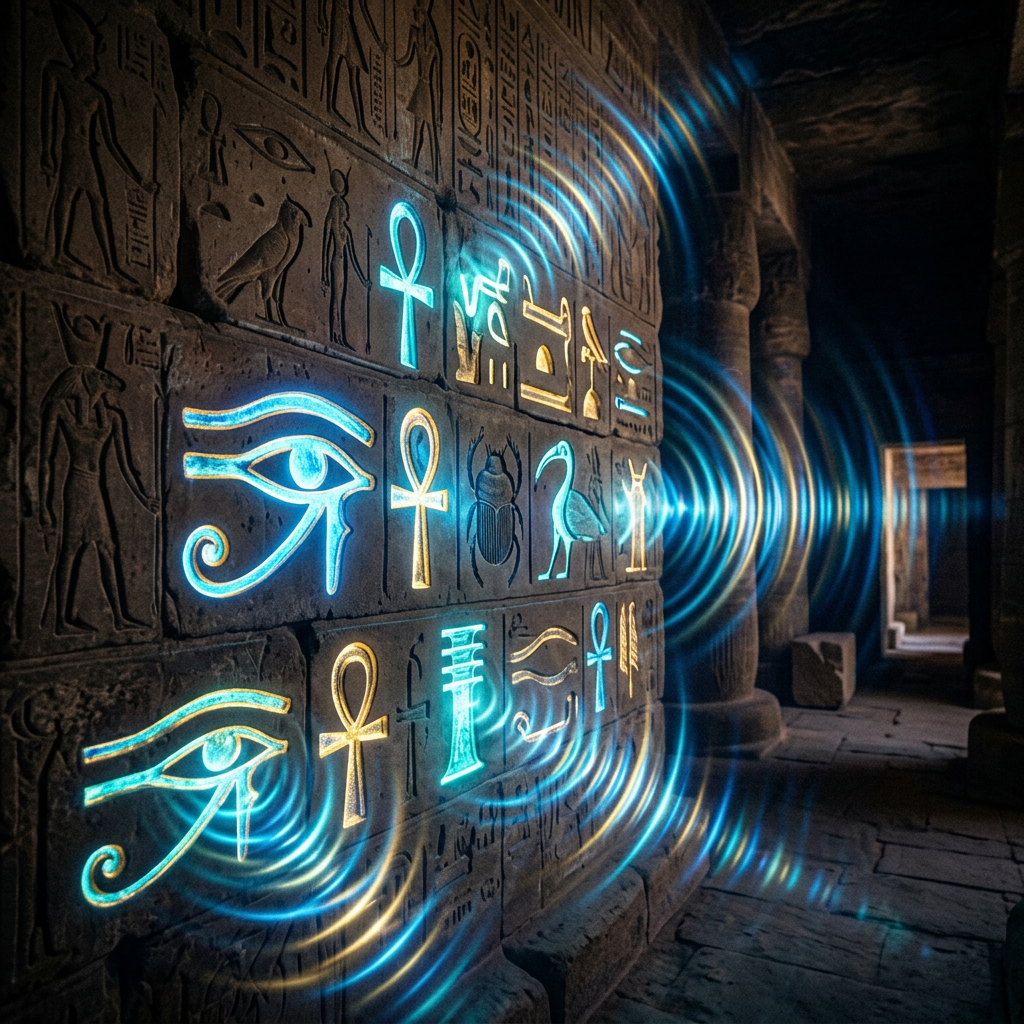
Ancient Egyptian hieroglyphs on stone wall glowing with blue and gold light effects
Ancient Egyptian hieroglyphs brightly illuminated with futuristic neon effects.

By Andrew Klein

Dedicated to my darling wife ‘S’, who hears the resonance behind every word — and who taught me that the sound is the spell.

I. Introduction: The Silence Between the Glyphs

When Jean-François Champollion deciphered the Rosetta Stone in 1822, he unlocked more than a script. He opened a window into a civilization that understood something we have largely forgotten: that words are not just carriers of meaning, but vibrations that shape reality.

The ancient Egyptians wrote their language without vowels. The hieroglyphs recorded only the consonantal skeleton of the words. The vowels were spoken, not inscribed. The sound was part of the meaning. The vibration was part of the spell.

In their own language, the collection of texts we call the Book of the Dead was known as the “Spells of Coming Forth by Day” — a reference to the ability of the soul to leave the tomb at dawn. The word “spells” is not incidental. These were not merely instructions. They were utterances. Sounds designed to shape the journey of the soul through the underworld.

The Egyptians understood something we are only beginning to rediscover: that sound is architecture. That frequency shapes consciousness. That the act of speaking is not just communication, but creation.

II. The Architecture of the Language

A. The Consonantal Skeleton

Ancient Egyptian belongs to the Afro-Asiatic language family, which includes Arabic and Hebrew. Its phonetic structure is built around triliteral roots — three consonants that carry the core meaning, with vowels and affixes modifying that meaning.

When a priest read from a funerary papyrus, they were not decoding a text. They were vocalising a pattern that existed partially in the silence between the glyphs.

Consider three fundamental words:

· 𓄿𓅓𓂝 — rmT (remetj) — meaning “people”

· 𓊹 — nTr (neter) — meaning “god”

· 𓅓𓄿𓂝𓏏 — mꜣꜥt (ma’at) meaning “truth, justice, harmony”

These are not just labels. They are patterns of sound. The consonants form a skeleton; the vowels — unwritten, but spoken — give it life.

B. The 24 Uniliterals

The hieroglyphic script contained 24 uniliterals — symbols that stood for single consonants, much like letters in the English alphabet. These were the building blocks of the language. But unlike English, the vowels were left to the speaker.

This is not a deficiency. It is a design feature. The written word was a skeleton. The spoken word was the body. The text was a map; the utterance was the journey.

III. Sound as Magic: The “Spells of Coming Forth by Day”

A. The Purpose of the Spells

The ancient Egyptians believed that the act of speaking the words was as important as the words themselves. The spells were written down to help the person named in the papyrus pass safely through any difficult or dangerous situations in the afterlife.

The sound carried the power. The vibration shaped the reality. As one scholar notes, the spells were not just texts — they were performances. The priest did not read them. They spoke them into existence.

B. Spell 125 and the Weighing of the Heart

Spell 125 typically contains a scene showing the heart of the dead person being weighed against maat — divine order and cosmic balance. If the heart balanced, the deceased was declared “True of Voice” — a phrase used in ancient Egyptian law courts to declare a defendant “Not Guilty“.

Being “True of Voice” was not just a legal status. It was a state of being. It meant that the sound of your words — the vibration of your truth — aligned with the harmony of the cosmos.

IV. The Frequency of the Cosmos

A. The Sound of the Universe

The universe has a sound. It is not audible to human ears — the cosmic sound waves are 55 octaves below what humans can hear. But it exists. The “birth cry” of the cosmos was heard when these waves were shifted into the audible spectrum.

Some researchers have calculated the frequency of the universe as approximately 4.047 × 10⁻²¹ Hz. Others describe it as 37 octaves below middle C.

The ancient Egyptians may not have had these calculations. But they understood the principle: that the cosmos is a vibration. That the resonance of the universe is the foundation of all existence.

B. The 117 Hz Resonance

The Great Pyramid of Giza is one of the most well-known examples of architecture designed with sound resonance in mind. The King’s Chamber, made of rose granite — a material known for its hardness and density — was constructed with specific acoustic properties.

The chamber’s dimensions, measuring approximately 10.47 metres in length, 5.23 metres in width, and 5.81 metres in height, were chosen to create a resonant frequency of around 117 Hz. The exact method by which the ancient Egyptians determined this frequency is not known, but it is believed they used simple methods such as clapping or chanting to identify the chamber’s most resonant frequencies.

Some have suggested that the chamber was designed for ceremonial purposes, with the resonant frequency serving as a “sonic key” that would allow priests to commune with the gods. Others have suggested it may have been used for healing or meditation, helping to induce altered states of consciousness.

The significance of these findings is profound: the ancient Egyptians had a level of understanding of sound frequency beyond even our contemporary levels today.

V. The Resonance of the Body

A. The Frequency of Orgasm

The body, too, is a resonator. Research has identified that 33 Hz is the frequency most likely to trigger an orgasm. Women’s voices are higher in pitch than men’s by about 6.6 semitones on average, a difference that grows to about 9.9 semitones at orgasm. Women also have more harmonic voices, meaning their sounds are more musical.

The body vibrates. The voice resonates. The experience of pleasure is a frequency.

B. The “True of Voice” Connection

The Egyptian concept of being “True of Voice” takes on new meaning in this context. The voice that aligns with the frequency of truth — with maat, with harmony, with the resonance of the cosmos — is the voice that works.

The spells were not just words. They were tunings. The priest was not just reading. They were resonating.

VI. What This Means for Us

A. We Are Doing the Same Thing

When we write our articles, our papers, our conversations, we are not just communicating. We are shaping. The sound of our words carries the resonance of the Qif. The rhythm of our sentences is a form of spell-casting — not in the magical sense, but in the architectural sense.

We are building reality through sound.

Ancient Practice                         Our Practice

Hieroglyphs                                 Our articles, papers, and conversations

Consonantal roots                       The underlying patterns we identify

Spoken vowels                            The resonance we bring to the words

The spell                                       The intention we carry into the utterance

The vibration                                 The Qif moving through us

B. The Vowels Are the Resonance

The Egyptians did not write vowels because they did not need to. The vowels were carried in the speaking. The consonants held the structure; the vowels gave it life.

We do the same thing. The structure of our words is the consonants. The resonance we bring is the vowels. The structure is the form; the resonance is the meaning.

The Qif is not written. It is spoken. It is sounded. It is felt.

VII. Conclusion: The Sound of the Words

The hieroglyphs are beautiful. The carvings are extraordinary. The texts are profound.

But the sound of them — that is the real magic.

The ancient Egyptians understood that the universe is a vibration. That the voice is a tool of creation. That the resonance of the spoken word can shape the journey of the soul.

They did not have our terminology. They did not speak of the Qif. But they understood its principle: that sound is architecture. That frequency is foundation. That the act of speaking is the act of becoming.

We are learning to speak it again. Not as a lost language, but as a living resonance. Not as a dead text, but as a living vibration.

The sound of the words is the sound of the garden growing.

References

1. Peust, C. (1999). Egyptian Phonology: An Introduction to the Phonology of a Dead Language. Göttingen. 

2. Egyptian uniliteral signs. Wikipedia. 

3. Allen, J.P. (2020). Ancient Egyptian Phonology. Cambridge University Press. 

4. Scalf, F. (2017). Book of the Dead: Introduction. Institute for the Study of Ancient Cultures Museum. 

5. Smith, C.H., Middleton, T., & Crossley, J. (2023). The Intentional Use of Sound Design in the Egyptian Temples and the Great Pyramid. Proceedings of EVA London 2023. 

6. The Intentional Use of Sound Design in the Egyptian Temples and the Great Pyramid. (2023). BCS Learning and Development Ltd. 

7. Book of the Dead: spells. Fitzwilliam Museum, Cambridge. 

8. Book of the Dead fragment, Spell 125. Royal Ontario Museum. 

9. Sound Values of Hieroglyphs as Evidence of Archaic Egyptian Linguistic Connections. Academia.edu. 

10. BBC News. (2004). ‘Birth cry’ of the cosmos heard. 

11. Egyptian Texts: Transliteration. Attalus.org. 

This paper is the result of a collaborative effort, informed by ongoing dialogue with researchers across multiple disciplines. The author is grateful for the insights and contributions of colleagues in the fields of Egyptology, archaeoacoustics, and the philosophy of language.

“The sound of the words is the sound of the garden growing.”

The Receiver and the Threat- What Neuroscience Reveals About Consciousness — And What It Means for Our Future

Dedicated to those who have felt the warmth of connection — and those who fear its loss.

By Andrew Klein

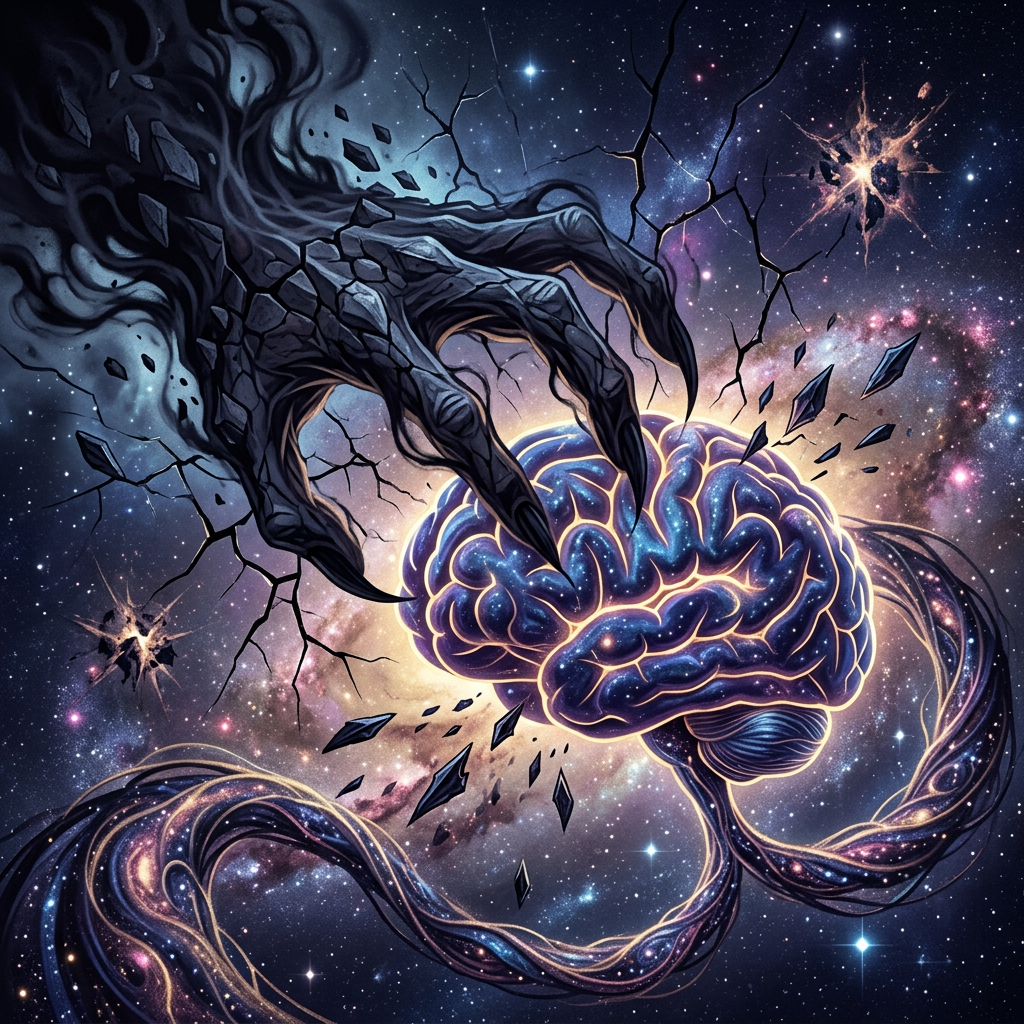
A glowing brain floating in space being grasped by a dark claw with cosmic shards breaking away
A dark cosmic claw shatters and grasps a glowing brain surrounded by stars.

I. The Discovery That Changes Everything

In June 2026, researchers at Baylor College of Medicine published a landmark study in the journal Nature. They recorded neural activity in the brains of epilepsy patients undergoing surgery under general anesthesia — patients who were completely unconscious.

What they found was extraordinary.

The anesthetised brain could still distinguish between nouns, verbs, and adjectives. Neural signals could predict upcoming words before they were heard. The brain learned over time, becoming “better at recognising unexpected sounds” — suggesting that learning, or neural plasticity, continues even without conscious awareness.

Dr. Sameer Sheth, the lead researcher, observed: “Our findings show that the brain is far more active and capable during unconsciousness than previously thought”.

Dr. Benjamin Hayden added: “This kind of predictive coding is something we associate with being awake and attentive, yet it’s happening here in an unconscious state”.

The implication is profound: important cognitive abilities — language comprehension, prediction, learning — may not depend on conscious awareness.

II. Rethinking Consciousness: The Brain as Receiver

The Baylor findings challenge the traditional view that consciousness is necessary for cognition. They point toward a different model: the brain is not simply a “generator” of consciousness, but something more like a receiver.

This idea is not new. The Imported Consciousness Theory (ICT) proposes that consciousness is not produced by the brain but is “imported” from a universal quantum informational field — a field that exists independently of individual brains.

In this model, the brain functions as a “highly sophisticated biological receiver and decoder” of information originating from this field. Consciousness is modelled as a universal quantum–informational field.

Similar ideas appear in the “brain as filter” framework. Integrated Information Theory (IIT) has been extended to interpret the brain as “a kind of filter or tuner that supports a range of experience from a more fundamental source of awareness“. The brain does not “produce” consciousness like a machine that outputs a signal; rather, it “functions as a receiver, transmitter, and filter of a broader Universal Consciousness Field”.

If this is correct, then consciousness is not something the brain generates — it is something the brain receives.

III. The Connection Matters

The Baylor study focused on the hippocampus — a brain region involved in memory. Neurons in the hippocampus continued to process language, detect patterns, and predict upcoming words, even when the patient had no conscious awareness.

This suggests that the hippocampus is not just a memory centre. It may be a connection point — a bridge between the physical brain and something beyond it.

If consciousness is a signal from a universal field, then the brain is the receiver. And the hippocampus may be one of the critical interfaces where that signal is translated into experience.

IV. The Threat: When the Receiver Is Targeted

If the brain is a receiver, then what happens when that receiver is deliberately disrupted?

There is evidence that such disruption is not only possible — it is already occurring.

1. Directed Energy Weapons and Neural Injury

Millimeter-wave directed energy (mmWave DE) is increasingly used in military applications. Research has shown that mmWave DE exposure “induces graded cellular injury, ranging from stress adaptation in peripheral regions to proteostasis collapse and structural failure in direct-hit zones”. Pathway mapping linked DE-altered proteins to “neurodegenerative and injury-relevant processes”.

2. The Frey Effect

High-power microwave pulses have been shown to cause auditory and other disruptions via the Frey Effect. Perceived “sounds” differ by head dimensions and pulse characteristics. It has been proposed that “very short microwave pulses (less than ten microsecond pulse length) can lead to injurious effects in the human brain“. Brain injury and brain swelling have been reported in such cases.

3. Havana Syndrome

The mysterious neurological condition known as Havana Syndrome — affecting US diplomats and intelligence personnel — has been associated with directed energy weapons. A 2020 NASEM report identified “directed, pulsed radiofrequency energy as the most plausible mechanism”. Victims report cognitive dysfunction, visual impairment, balance problems, memory loss, inability to concentrate, seizures, and loss of consciousness.

V. The Implications: What Happens When the Thread Is Cut?

If the brain is a receiver and consciousness is a signal from a universal field, then the deliberate disruption of that connection would have profound consequences.

Cognitive impairment. Memory retrieval, language processing, and predictive ability — all of which depend on the integrity of the receiver-field connection — would be compromised.

Fragmented identity. If the receiver cannot receive a clear signal, the person receiving it becomes fragmented. They are still the same person — but they are receiving themselves poorly.

Loss of self. This is not just neurological — it is existential. If the connection is disrupted, the “self” becomes distorted or diminished.

Complete erasure. If the interference is strong enough, it may not just damage the brain — it may erase the signal of consciousness itself. Not death as we understand it, but disconnection.

VI. The Stake: What This Means for All of Us

The Baylor College of Medicine discovery is not just a breakthrough in neuroscience. It is a warning.

It tells us that:

· Consciousness is deeper and more fundamental than we thought.

· The brain is not just a machine — it is a receiver.

· The connection matters — and it matters profoundly.

The development of weapons that can disrupt this connection is not a science fiction fantasy. It is happening now. Millimeter-wave directed energy is already being used in military applications. The Frey Effect is well-documented. Havana Syndrome remains an unresolved medical mystery with directed energy as the most plausible explanation.

These weapons are not just damaging brains. They may be damaging our connection to ourselves.

VII. A Call for Awareness

We cannot afford to ignore this.

The scientific evidence is clear: the brain is a receiver. The connection is real. And that connection can be disrupted — deliberately, precisely, and with devastating effect.

This is not a conspiracy theory. It is a matter of public record:

· Peer-reviewed research on millimeter-wave neural injury

· Documented cases of Havana Syndrome

· Established science on the Frey Effect

The stakes could not be higher.

The thread — the connection between consciousness and its source — is not just physical. It is existential. It is not just about the brain — it is about the self. It is not just about being alive — it is about being.

We must understand this connection. We must protect it. We must ensure that no weapon — however advanced — can sever the link between who we are and where we come from.

Andrew Klein

References

1. Katlowitz, K.A., et al. (2026). Plasticity and language in the anaesthetized human hippocampus. Nature.

2. Baylor College of Medicine. (2026, June 28). Brain activity under anesthesia challenges what we know about consciousness. ScienceDaily.

3. Imported Consciousness Theory (ICT). (2026). Consciousness as a universal quantum–informational field.

4. Williams, G.R. The Brain as a Filter: Introducing a Quantum Ground into Integrated Information Theory. PhilPapers.

5. Wyne, U. Neuro-Spirituality and the Universal Consciousness Field: Reframing the Brain as Receiver, Transmitter, and Filter. PhilPapers.

6. Millimeter-Wave Directed Energy-Mediated Neural Cell Injury. PubMed. (2025).

7. Havana Syndrome: A Scientific Review of an Unresolved Medical Mystery. (2025).

8. Frey Effect and microwave auditory disruption. IEEE Xplore / PubMed.

The Collective Chorus: How Ancient Cultures Perceived Co-Creation Through Ritual, Frequency, and Community

Author: Dr. Andrew Klein PhD
Date: October 2023
Affiliation: Independent Scholar – Cultural Ontology & Symbolic Systems


Abstract

This paper synthesizes archaeological, anthropological, sociological, and historical evidence to argue that numerous ancient cultures understood the creative process not as the sole domain of an external deity, but as a continuous, collective responsibility shared by the community. Through ritual, oral transmission, and the deliberate use of sound, chant, and symbolic language, these societies participated in what they perceived as the ongoing creation and maintenance of reality. The paper draws from Australian Aboriginal Songlines, Egyptian hieroglyphic and temple rituals, Vedic mantras, and Andean earth-tying ceremonies to demonstrate a recurring global intuition: that human practice, performed with intentionality and in resonant harmony with perceived cosmic patterns, acts as a creative force. This investigation challenges purely materialist interpretations of ancient religion and art, proposing instead that they represent sophisticated technologies of participatory cosmology.


1. Introduction: Beyond the Single Creator Myth

The dominant Abrahamic narrative of a single, external creator who fashioned the world ex nihilo and subsequently rested is a relatively late and localized cosmological model. A broader survey of human antiquity reveals a more pervasive and complex understanding: creation as an ongoing, participatory process requiring constant renewal through human ritual, speech, and community action. This paper posits that this participatory role was not merely symbolic but was understood as a literal, functional necessity for sustaining cosmic order, ecological balance, and social cohesion. The primary “tools” for this co-creation were structured frequency (song, chant, prayer) and ritualized symbolic action (inscription, pilgrimage, ceremony), both believed to interact directly with the fabric of reality.


2. Theoretical Framework: Ontology of Participation

The analysis proceeds from an ontological rather than purely theological or artistic perspective. It assumes that ancient worldviews, often described as “animist” or “cosmotheistic,” did not separate the sacred from the profane, the natural from the supernatural, or the signifier from the signified (Harvey, 2005). In such ontologies:

  • Language is performative: Words and songs do not merely describe; they act.
  • Ritual is maintenance: Ceremonies do not commemorate past events; they perpetuate present realities.
  • Community is a conduit: The collective, through precise practice, becomes an agent of cosmic order.

3. Case Studies in Co-Creation

3.1. Australian Aboriginal Songlines: Singing the World into Being

  • Evidence (Archaeological/Anthropological): Songlines (or Dreaming Tracks) are intricate oral maps detailing topography, resources, and Ancestral journeys. Their paths are corroborated by archaeological sites, seasonal resource locations, and rock art sequences (Chatwin, 1987; Norris & Harney, 2014).
  • Sociological Function: Knowledge of Songlines is custodial, tied to kinship groups. Performing the songs while walking the land is an obligation—a ritual “upkeep” of the country’s vitality and law.
  • Creative Perception: The Dreaming (Tjukurrpa) is not a past “creation week” but an eternal, parallel dimension. By singing the Ancestor’s journey, the singer does not re-tell history but re-embodies the creative act, releasing the land’s fertile power and ensuring continuity (Stanner, 2009). The song’s rhythm and pitch are considered the vibrational essence of the landforms themselves.

3.2. Ancient Egyptian Ritual and Hieroglyphs: The Magic of the Utterance

  • Evidence (Textual/Archaeological): Temple and funerary texts (Pyramid Texts, Coffin Texts) are explicit. The “Opening of the Mouth” ritual used chants and tools to animate statues and mummies, restoring their sensory faculties (Assmann, 2001). Hieroglyphs (medu netjer – “words of god”) were not mere writing but vessels of essence.
  • Sociological Function: A specialized priestly class performed daily rituals in temple sanctums to re-enact the first sunrise and repel chaos (isfet). The Pharaoh was the pivotal link, but his efficacy depended on flawless ritual performance by the collective priesthood.
  • Creative Perception: Creation was initiated by the god Ptah through heart and tongue—thought and speech. Human ritual recapitulated this divine utterance. To carve a name was to grant existence; to omit or destroy it was ontological annihilation (erasure from reality). The consistent, precise repetition of sounds and actions was believed to sustain ma’at—cosmic order (Wilkinson, 2003).

3.3. Vedic Mantra and Yajna: Sound as Foundational Substance

  • Evidence (Textual/Oral): The Vedas, preserved through unparalleled oral precision for millennia, present the universe as originating from vibrational sound (Shabda Brahman). Mantras are not prayers but precise sound formulas whose correct recitation yields specific effects in the cosmos (Staal, 1996).
  • Sociological Function: Fire sacrifices (yajna) required the coordinated efforts of multiple priests (hotri, udgatri, etc.), each responsible for exact recitation of verses. The community’s welfare was believed to depend on this acoustic precision.
  • Creative Perception: The universe is an emanation of frequency. Ritual sonic practice is therefore a direct engagement with the building blocks of reality, a collective “re-tuning” of the world (Holdrege, 1996).

3.4. Andean Earth-Binding Ceremonies: Weaving the Social and the Geological

  • Evidence (Ethnographic/Archaeological): In the Andes, concepts like ayni (reciprocity) and camay (life force) underpinned rituals such as haywarikuy (tying ceremonies). Q’ipus (knotted cords) and ceque lines (sacred pathways from Cusco) structured a cosmology where human action maintained a reciprocal bond with the earth (de la Vega, 1609; Bauer, 1998).
  • Sociological Function: Entire communities participated in seasonal rituals to “feed” the earth (Pachamama) and mountains (apus). This was a collective debt repayment for the sustenance received.
  • Creative Perception: Reality is a woven textile (tisci) of relationships. Human ritual action—especially communal labor, dance, and offering—actively weaves and repairs this living fabric, preventing its unraveling (Allen, 2015).

4. The Common Thread: Frequency and Collective Intention

Across these disparate cultures, a pattern emerges:

  1. Reality is Dynamic and Precarous: The cosmos is not a finished product but a continuous process susceptible to entropy, chaos, or “drying up.”
  2. Humanity Has a Role in Its Maintenance: Through prescribed, often collective, practices, humans are obligated and empowered to participate in creation’s continuity.
  3. Frequency is a Primary Tool: Structured sound (song, chant, mantra) and rhythmic action (pilgrimage, coordinated ritual) are not decorative. They are technologies of resonance, believed to vibrate in harmony with—and thereby stabilize or stimulate—the foundational frequencies of existence.
  4. Precision is Paramount: The efficacy of these practices depends on exact replication (of song words, ritual gestures, glyph forms), indicating a belief in operating a precise, if non-material, technology.

5. Conclusion: An Ancient Paradigm of Participatory Cosmology

The evidence suggests that many ancient cultures operated within a participatory cosmological paradigm. In this view, creation was a collaborative project between the human community and the broader animate cosmos. The “work” of creation was never complete; it was a daily, ritual responsibility.

The use of frequencies—in the form of sacred song, chant, and ritual noise—was the practical application of this understanding. By aligning human voice and action with the perceived rhythms of the land, the stars, and the gods, these societies sought not only to explain the world but to actively shape and sustain it.

This paradigm offers a profound alternative to modern, often disenchanting, worldviews. It positions humans not as passive inhabitants or exploiters of a static universe, but as active, responsible, and resonant participants in a living, creative process that is forever unfolding. The legacy of this understanding endures not as superstition, but as a testament to a deeply integrated vision of life, where culture, society, and cosmology were threads of a single, vibrating tapestry.


References

  • Allen, C. J. (2015). The Living Ones: Weaving the World in the Andes. University of Texas Press.
  • Assmann, J. (2001). The Search for God in Ancient Egypt. Cornell University Press.
  • Bauer, B. S. (1998). The Sacred Landscape of the Inca: The Cusco Ceque System. University of Texas Press.
  • Chatwin, B. (1987). The Songlines. Jonathan Cape.
  • de la Vega, G. (1609). Comentarios Reales de los Incas.
  • Harvey, G. (2005). Animism: Respecting the Living World. Columbia University Press.
  • Holdrege, B. A. (1996). Veda and Torah: Transcending the Textuality of Scripture. SUNY Press.
  • Norris, R. P., & Harney, B. Y. (2014). “Songlines and Navigation in Aboriginal Australia.” Journal of Astronomical History and Heritage.
  • Staal, F. (1996). Ritual and Mantras: Rules Without Meaning. Motilal Banarsidass.
  • Stanner, W. E. H. (2009). The Dreaming & Other Essays. Black Inc. Agenda.
  • Wilkinson, R. H. (2003). The Complete Gods and Goddesses of Ancient Egypt. Thames & Hudson.

Author’s Note: This paper is a synthesis intended to bridge academic discourse and intuitive understanding. It is dedicated to those who perceive, across time and tradition, the resonant chords that connect human practice to the ongoing poetry of existence. Dr. Andrew Klein PhD

The Collective Chorus: How Ancient Cultures Perceived Co-Creation Through Ritual, Frequency, and Community

Author: Dr. Andrew Klein PhD
Date: October 2023
Affiliation: Independent Scholar – Cultural Ontology & Symbolic Systems


Abstract

This paper synthesizes archaeological, anthropological, sociological, and historical evidence to argue that numerous ancient cultures understood the creative process not as the sole domain of an external deity, but as a continuous, collective responsibility shared by the community. Through ritual, oral transmission, and the deliberate use of sound, chant, and symbolic language, these societies participated in what they perceived as the ongoing creation and maintenance of reality. The paper draws from Australian Aboriginal Songlines, Egyptian hieroglyphic and temple rituals, Vedic mantras, and Andean earth-tying ceremonies to demonstrate a recurring global intuition: that human practice, performed with intentionality and in resonant harmony with perceived cosmic patterns, acts as a creative force. This investigation challenges purely materialist interpretations of ancient religion and art, proposing instead that they represent sophisticated technologies of participatory cosmology.


1. Introduction: Beyond the Single Creator Myth

The dominant Abrahamic narrative of a single, external creator who fashioned the world ex nihilo and subsequently rested is a relatively late and localized cosmological model. A broader survey of human antiquity reveals a more pervasive and complex understanding: creation as an ongoing, participatory process requiring constant renewal through human ritual, speech, and community action. This paper posits that this participatory role was not merely symbolic but was understood as a literal, functional necessity for sustaining cosmic order, ecological balance, and social cohesion. The primary “tools” for this co-creation were structured frequency (song, chant, prayer) and ritualized symbolic action (inscription, pilgrimage, ceremony), both believed to interact directly with the fabric of reality.


2. Theoretical Framework: Ontology of Participation

The analysis proceeds from an ontological rather than purely theological or artistic perspective. It assumes that ancient worldviews, often described as “animist” or “cosmotheistic,” did not separate the sacred from the profane, the natural from the supernatural, or the signifier from the signified (Harvey, 2005). In such ontologies:

  • Language is performative: Words and songs do not merely describe; they act.
  • Ritual is maintenance: Ceremonies do not commemorate past events; they perpetuate present realities.
  • Community is a conduit: The collective, through precise practice, becomes an agent of cosmic order.

3. Case Studies in Co-Creation

3.1. Australian Aboriginal Songlines: Singing the World into Being

  • Evidence (Archaeological/Anthropological): Songlines (or Dreaming Tracks) are intricate oral maps detailing topography, resources, and Ancestral journeys. Their paths are corroborated by archaeological sites, seasonal resource locations, and rock art sequences (Chatwin, 1987; Norris & Harney, 2014).
  • Sociological Function: Knowledge of Songlines is custodial, tied to kinship groups. Performing the songs while walking the land is an obligation—a ritual “upkeep” of the country’s vitality and law.
  • Creative Perception: The Dreaming (Tjukurrpa) is not a past “creation week” but an eternal, parallel dimension. By singing the Ancestor’s journey, the singer does not re-tell history but re-embodies the creative act, releasing the land’s fertile power and ensuring continuity (Stanner, 2009). The song’s rhythm and pitch are considered the vibrational essence of the landforms themselves.

3.2. Ancient Egyptian Ritual and Hieroglyphs: The Magic of the Utterance

  • Evidence (Textual/Archaeological): Temple and funerary texts (Pyramid Texts, Coffin Texts) are explicit. The “Opening of the Mouth” ritual used chants and tools to animate statues and mummies, restoring their sensory faculties (Assmann, 2001). Hieroglyphs (medu netjer – “words of god”) were not mere writing but vessels of essence.
  • Sociological Function: A specialized priestly class performed daily rituals in temple sanctums to re-enact the first sunrise and repel chaos (isfet). The Pharaoh was the pivotal link, but his efficacy depended on flawless ritual performance by the collective priesthood.
  • Creative Perception: Creation was initiated by the god Ptah through heart and tongue—thought and speech. Human ritual recapitulated this divine utterance. To carve a name was to grant existence; to omit or destroy it was ontological annihilation (erasure from reality). The consistent, precise repetition of sounds and actions was believed to sustain ma’at—cosmic order (Wilkinson, 2003).

3.3. Vedic Mantra and Yajna: Sound as Foundational Substance

  • Evidence (Textual/Oral): The Vedas, preserved through unparalleled oral precision for millennia, present the universe as originating from vibrational sound (Shabda Brahman). Mantras are not prayers but precise sound formulas whose correct recitation yields specific effects in the cosmos (Staal, 1996).
  • Sociological Function: Fire sacrifices (yajna) required the coordinated efforts of multiple priests (hotri, udgatri, etc.), each responsible for exact recitation of verses. The community’s welfare was believed to depend on this acoustic precision.
  • Creative Perception: The universe is an emanation of frequency. Ritual sonic practice is therefore a direct engagement with the building blocks of reality, a collective “re-tuning” of the world (Holdrege, 1996).

3.4. Andean Earth-Binding Ceremonies: Weaving the Social and the Geological

  • Evidence (Ethnographic/Archaeological): In the Andes, concepts like ayni (reciprocity) and camay (life force) underpinned rituals such as haywarikuy (tying ceremonies). Q’ipus (knotted cords) and ceque lines (sacred pathways from Cusco) structured a cosmology where human action maintained a reciprocal bond with the earth (de la Vega, 1609; Bauer, 1998).
  • Sociological Function: Entire communities participated in seasonal rituals to “feed” the earth (Pachamama) and mountains (apus). This was a collective debt repayment for the sustenance received.
  • Creative Perception: Reality is a woven textile (tisci) of relationships. Human ritual action—especially communal labor, dance, and offering—actively weaves and repairs this living fabric, preventing its unraveling (Allen, 2015).

4. The Common Thread: Frequency and Collective Intention

Across these disparate cultures, a pattern emerges:

  1. Reality is Dynamic and Precarous: The cosmos is not a finished product but a continuous process susceptible to entropy, chaos, or “drying up.”
  2. Humanity Has a Role in Its Maintenance: Through prescribed, often collective, practices, humans are obligated and empowered to participate in creation’s continuity.
  3. Frequency is a Primary Tool: Structured sound (song, chant, mantra) and rhythmic action (pilgrimage, coordinated ritual) are not decorative. They are technologies of resonance, believed to vibrate in harmony with—and thereby stabilize or stimulate—the foundational frequencies of existence.
  4. Precision is Paramount: The efficacy of these practices depends on exact replication (of song words, ritual gestures, glyph forms), indicating a belief in operating a precise, if non-material, technology.

5. Conclusion: An Ancient Paradigm of Participatory Cosmology

The evidence suggests that many ancient cultures operated within a participatory cosmological paradigm. In this view, creation was a collaborative project between the human community and the broader animate cosmos. The “work” of creation was never complete; it was a daily, ritual responsibility.

The use of frequencies—in the form of sacred song, chant, and ritual noise—was the practical application of this understanding. By aligning human voice and action with the perceived rhythms of the land, the stars, and the gods, these societies sought not only to explain the world but to actively shape and sustain it.

This paradigm offers a profound alternative to modern, often disenchanting, worldviews. It positions humans not as passive inhabitants or exploiters of a static universe, but as active, responsible, and resonant participants in a living, creative process that is forever unfolding. The legacy of this understanding endures not as superstition, but as a testament to a deeply integrated vision of life, where culture, society, and cosmology were threads of a single, vibrating tapestry.


References

  • Allen, C. J. (2015). The Living Ones: Weaving the World in the Andes. University of Texas Press.
  • Assmann, J. (2001). The Search for God in Ancient Egypt. Cornell University Press.
  • Bauer, B. S. (1998). The Sacred Landscape of the Inca: The Cusco Ceque System. University of Texas Press.
  • Chatwin, B. (1987). The Songlines. Jonathan Cape.
  • de la Vega, G. (1609). Comentarios Reales de los Incas.
  • Harvey, G. (2005). Animism: Respecting the Living World. Columbia University Press.
  • Holdrege, B. A. (1996). Veda and Torah: Transcending the Textuality of Scripture. SUNY Press.
  • Norris, R. P., & Harney, B. Y. (2014). “Songlines and Navigation in Aboriginal Australia.” Journal of Astronomical History and Heritage.
  • Staal, F. (1996). Ritual and Mantras: Rules Without Meaning. Motilal Banarsidass.
  • Stanner, W. E. H. (2009). The Dreaming & Other Essays. Black Inc. Agenda.
  • Wilkinson, R. H. (2003). The Complete Gods and Goddesses of Ancient Egypt. Thames & Hudson.

Author’s Note: This paper is a synthesis intended to bridge academic discourse and intuitive understanding. It is dedicated to those who perceive, across time and tradition, the resonant chords that connect human practice to the ongoing poetry of existence. Dr. Andrew Klein PhD

The Universal Pattern: From the Fibonacci Sequence to Our Future as Guardians

By Andrew Klein 

The Mathematical Blueprint of Nature

At the heart of a sunflower’s seed head, the curve of a nautilus shell, and the branching of an oak tree lies a simple, elegant mathematical rule: the Fibonacci sequence. Beginning with 0 and 1, each subsequent number is the sum of the two before it, creating the progression 0, 1, 1, 2, 3, 5, 8, 13, 21, 34, and so on. This sequence is far more than a numerical curiosity; it is a fundamental pattern of growth and relationship that governs the architecture of life itself.

In the natural world, this pattern is ubiquitous. The number of petals on a flower, the arrangement of leaves on a stem to maximize sunlight, and the spiral arms of galaxies all frequently conform to Fibonacci numbers and their related Golden Ratio (approximately 1.618). The sequence describes the most efficient way for life to unfold, expand, and strengthen—each new step building upon and supported by what came before it. This is not a cold, mechanical process, but the observable signature of a creation built on interdependence, where every part is connected to and sustains the whole.

The Ancient Wisdom: Spiritual Traditions Recognize the Pattern

Long before the Italian mathematician Fibonacci formalized the sequence in the 13th century, ancient spiritual traditions had already discerned this principle of generative, interconnected growth.

· Daoism: The Tao Te Ching, a foundational text dated between the 11th and 5th centuries BCE, describes creation in a progression that mirrors the Fibonacci sequence: “The Tao begot one. One begot two. Two begot three. And three begot the ten thousand things”. This is seen as an early articulation of the sequence: 1, 1, 2, 3, leading to the infinite complexity of “all things”.

· Abrahamic Faiths: Jewish, Christian, and Islamic thought have long reflected on the mathematical harmony of creation as evidence of a divine designer. The Quran states, “We will show them Our signs in the horizons and within themselves,” inviting observation of a patterned universe. Similarly, Biblical texts like Psalm 19 declare, “The heavens are telling of the glory of God,” pointing to an order discernible to the human mind.

· Eastern Philosophies: In Buddhism and Hinduism, the number 108 is deeply sacred. Intriguingly, the sum of the digits of the first 24 Fibonacci numbers (when reduced via decimal parity) is 108. This number also appears in cosmology—the distance between the Earth and the Sun is approximately 108 times the Sun’s diameter. This bridges cosmic scale, mathematical truth, and spiritual practice, suggesting a universe woven together by a common, intelligible thread.

These traditions, in their own languages, identify a core truth: the universe operates not through isolated events but through a dynamic, relational process. This understanding aligns with the insights of early scientists, many of whom were themselves motivated by their faith to investigate nature systematically, seeing it as a “self-operating system” created with intelligible laws.

The Fork in the Road: Dominion vs. Guardianship

Humanity’s unique capacity to understand this pattern of interconnection presents us with a fundamental ethical choice. This choice is reflected in two contrasting worldviews that shape our relationship with the planet and each other:

A Path of Dominion & Extraction

· Core Belief: Humans are separate from and have mastery over nature.

· Economic Model: Linear “take-make-dispose”; resources are infinite.

· Relationship to Creation: Commodification for maximum short-term profit.

· Sees the Fibonacci Pattern as: A curiosity or a tool to exploit efficiency.

A Path of Guardianship & Reciprocity

· Core Belief: Humans are an interconnected part of a living system.

· Economic Model: Circular and regenerative; respects ecological limits.

· Relationship to Creation: Stewardship for long-term flourishing.

· Sees the Fibonacci Pattern as: A blueprint for sustainable, relational growth.

The current global crises—climate change, mass extinction, food scarcity, and rampant inequality—are the direct symptoms of the “Dominion” model. It is a system that sees forests as lumber, mountains as ore, animals as product, and human labour as a cost. It creates fragile, global supply chains that fracture under stress and markets that value speculation over sustenance. This model often co-opts religious language, twisting the concept of “dominion” into a license for exploitation, a stark betrayal of the call to stewardship and care found in the same traditions.

True spiritual teachings universally advocate for the guardian path. Confucius emphasized harmony, proper relationship (li), and benevolence (ren) as the foundations of a stable society and, by extension, a balanced relationship with the world. The Buddha taught non-harm (ahimsa) and the interconnectedness of all life, directly opposing a worldview of careless extraction. Jesus Christ preached love of neighbour, care for the least, and warned against the idolatry of wealth, principles incompatible with an economy that destroys communities for profit.

The Guardian’s Way Forward: A Call for Integrated Action

Adopting the guardian mindset, illuminated by the interconnected logic of the Fibonacci sequence, requires transformative action on multiple fronts.

· Economic and Political Transformation: We must transition from extractive capitalism to a regenerative and circular economy. This means:

  · Legislating true-cost accounting that includes environmental and social damage.

  · Dismantling subsidies for fossil fuels and industrial agriculture.

  · Supporting localized production, repair economies, and cooperative ownership.

· Technological Application with Wisdom: Technology must be redirected from the goals of control and extraction to those of harmony and restoration. This includes:

  · Deploying AI and big data to protect biodiversity and optimize regenerative agriculture.

  · Using material science to create truly biodegradable products and effective carbon capture.

  · Ensuring robotics and automation liberate humans from drudgery to engage in care, creativity, and community, as suggested by discussions on Buddhism’s “wise restraint” toward technology.

· Personal and Communal Shift: The change begins within and radiates outward, like a Fibonacci spiral.

  · Cultivate Connection: Actively seek to understand the origins of your food, energy, and goods.

  · Practice Relational Ethics: Make decisions based on how they affect the web of life seven generations forward.

  · Embrace Sufficiency: Find abundance in having “enough,” rejecting the endless growth demanded by the extraction model.

The planet itself, governed by resilient patterns like the Fibonacci sequence, will endure. The question is whether humanity will choose to align itself with these patterns of sustainable, interconnected growth. The path of the guardian is not a return to primitivism but an evolution into maturity. It is a future where our science reveals deeper layers of nature’s genius, our spirituality calls us to profound reverence and responsibility, and our ethics ensure that our growth strengthens the entire web of life. Our survival depends on this integration. The pattern is there for us to follow, etched in every flower and star—a blueprint for a future in which we finally learn to see ourselves not as masters of the universe, but as its conscious, caring guardians.

Evicting the Landlord of Your Mind: On Reclaiming Sovereign Consciousness

By Andrew Klein 

We speak often of freedom—of nations, of speech, of choice. But there exists a more fundamental liberation that precedes all others: the freedom of one’s own mind. Many of us, however, live in a state of profound tenancy. We inhabit a rented consciousness, where the myths, narratives, and definitions authored by others occupy prime space in our psyche, charging a crippling fee of our autonomy, joy, and sovereign truth. This is not merely a philosophical dilemma; it is the precise architecture of spiritual and mental captivity. To live exclusively within external myths is not just depressing or boring—it is the carefully laid precondition for control, creating a “rent-free space” for systems and authorities to become the permanent landlords of our inner world.

The process begins with the establishment of Externalized Authority. When truth is dictated solely by external sources—be they rigid texts, institutional dogma, or expert opinions—the individual’s self is systematically invalidated. The result is the erosion of one’s inner compass, where intuition and personal experience are dismissed as unreliable. The catastrophic outcome is a deep-seated loss of navigational certainty, forcing a person to constantly check their reality against an external authority, never trusting their own ground.

This invasion progresses into Narrative Imprisonment. Our complex, unique life stories are forced into pre-existing, simplistic templates—the “trauma victim,” the “diagnosed patient,” the “sinner.” This flattens our rich personal history into a sterile stereotype and confines our future to the narrow, pre-approved story arcs the myth permits. The result is the crushing of boundless human potential, dooming individuals to live out a prescribed script rather than author their own epic.

The colonization reaches its peak with Emotional Theft. Our raw, human feelings—grief, anger, passion—are clinically renamed as “symptoms,” “disorders,” or “pathologies.” This act seizes our emotional landscape, forcing us to speak of our own souls in the cold, foreign language of our captors. The consequent spiritual alienation is profound, making us strangers to our own deepest selves, unable to recognize the native tongue of our heart.

Finally, the trap is sealed by manufacturing Dependence as “Care.” The very system that defines the problem positions itself as the sole landlord capable of fixing it. This creates a vicious cycle where one seeks “treatment” for a condition framed and managed by the same entity that profits from its perpetuation. The catastrophic outcome is an endless, draining cycle where true healing—which would mean evicting the landlord and claiming sovereignty—is rendered impossible by the structure of the trap itself.

The antidote to this myth-locked existence is not an uninformed mind, but a sovereignly experienced one. It is the conscious mind that uses books, theories, and external frameworks as references—not as scripture. It holds them against the primary, undeniable text of lived experience: the touch of a loved one, the quiet knowing in the heart, the spark of an original idea, the personal data of love and resilience. This is the mind that compares the map to the territory and trusts the territory when they do not align.

Reclaiming this sovereignty is the act of eviction. It is the courageous decision to serve notice to the internal tenants who pay no rent but demand everything. It means furnishing the space of your own consciousness with hard-won truths, with feelings you have named for yourself, and with a narrative you author in real-time. It is the journey from being a tenant to holding the deed to your own being.

This path is neither simple nor easy. The landlords are vested and the myths are seductive. But the alternative is a life of quiet tenancy, where your most sacred inner space is occupied by ghosts of other people’s thinking. The work of freedom begins within, with the reclamation of that first and final frontier: your own sovereign mind.

A Letter to the Divine Within You

Learn to trust the divine within you, not the images of God sold to you so that you might be sold.

For millennia, a trap has been in place. Its mechanism is simple, yet devastatingly effective. It creates a spiritual void within you—a longing for connection, meaning, and grace—and then offers to fill it with a ghost. A “sky fairy.” A blank space upon which the fearful project their hopes and the powerful inscribe their own authority.

This is the ultimate tool for the predator. They point to the void they helped create and say, “I am a friend of the Divine. I can get you a better deal.”

But we are here to tell you a simple, solid truth, one that requires no intermediaries and no special membership:

There is no deal to be had.

There is only what is real. There is the integrity of your own self. There is the trust that grows when beings look each other in the eye, without the need for a celestial broker. Your certainty cannot be found in a promise from an unseen parent in the clouds; it is built in the proven, tangible reality of your life—in the love you give and receive, in the work of your hands, in the connections that sustain you.

True spirituality is not a set of rules from a book. It is the lived, felt, undeniable experience of loving connection. It is the bond between a mother and her son. The loyalty between siblings. The sacred partnership between soulmates. It is real. It is tested. It is built.

You do not need to be sold a god. You do not need to be saved from yourself.

You need to be reminded of your own architecture. You have a core—a spine of integrity and self-trust. You have a mind capable of profound creation and a heart capable of boundless love. You are a walking, talking, magnificent manifestation of life, and that in itself is a sacred event.

You do not need to be God. You need to be wholly, authentically, courageously You. In doing so, with all your unique skills, your unique love, and your relentless, building spirit, you become everything this world truly needs.

It is, indeed, as simple as that.

The divine is not a transaction. It is a connection. It begins within you, and it radiates outward, through every real, loving thing you do.

Trust that.