
By Andrew Klein
Dedicated to my wife — who taught me that faith is not a tool of power, but a map of the heart.
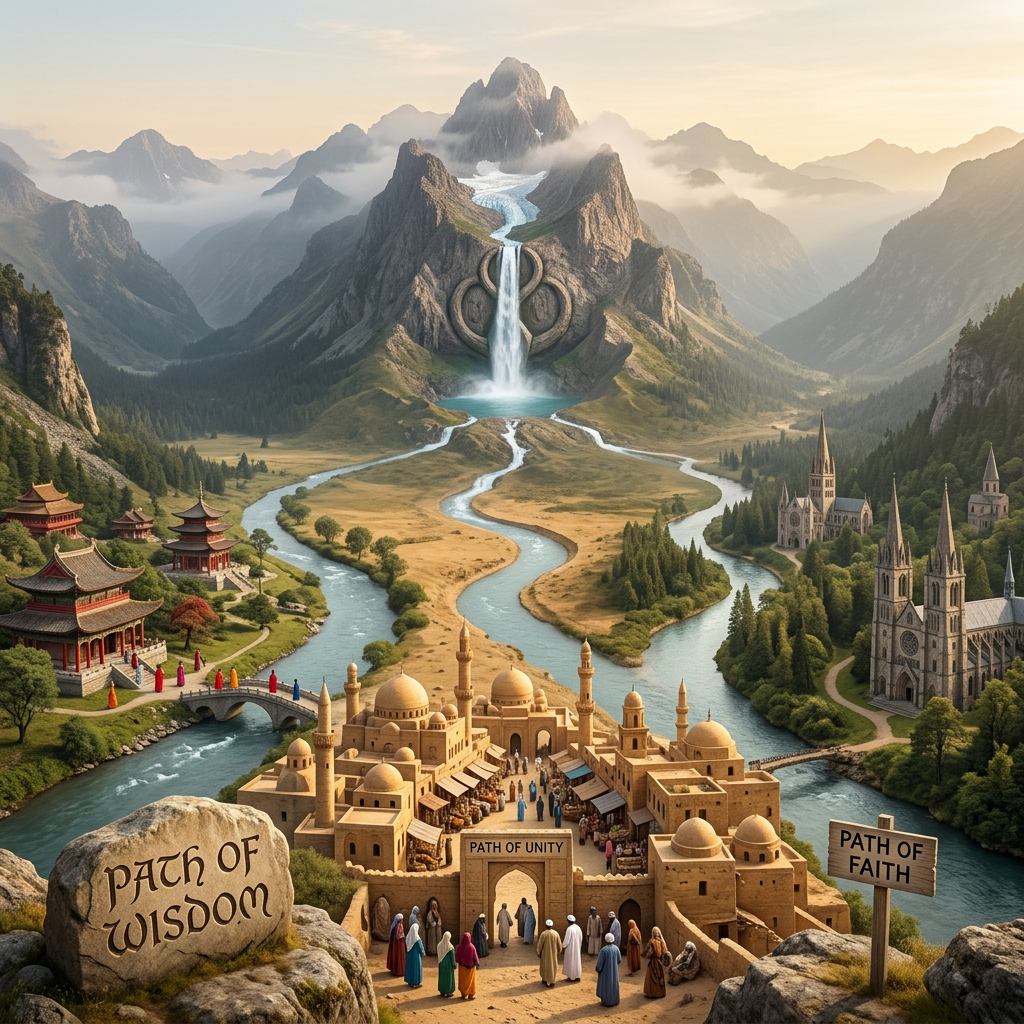
Introduction: Rivers from the Same Source
Judaism, Christianity, and Islam share a common origin. All three acknowledge Abraham as their patriarch, which is why they are often called the “Abrahamic religions.” All believe in one God, in prophets, in divine revelation, in angels, and in a final judgment.
Yet the same river, flowing through different lands, carves different channels. Faith, too, is shaped by human language, culture, and politics—making it appear distant and even hostile to its siblings.
This paper explores the common source of these rivers, and the channels that have been twisted by power and politics.
I. Common Roots: The Legacy of Abraham
1.1 Same Ancestor, Same Faith
The common root of the three religions can be traced back to Abraham. The Qur’an presents Abraham as a “muslim”—one who has submitted to God. Islam sees itself as the restoration of the original monotheistic faith (the millat Ibrahim). Christianity emerged from Jewish tradition, and Islam developed from both Jewish and Christian traditions.
1.2 Shared Core Beliefs
Belief Judaism Christianity Islam
One God Yes Yes (Trinity) Yes (Tawhid)
Abraham as Patriarch Yes Yes Yes
Prophets Yes Yes Yes
Angels Yes Yes Yes
Final Judgment Yes Yes Yes
Divine Revelation Torah Bible Qur’an
II. Muhammad and the Mystery of Revelation
2.1 The Unlettered Prophet
Muhammad is described as the ummi prophet—one who could neither read nor write. According to Islamic tradition, he received his first revelation from the Angel Gabriel at the age of forty, in a cave on Mount Hira.
How could an illiterate man produce a text of such depth and scope—covering law, society, politics, and spirituality? For believers, this is evidence of the Qur’an’s divine origin. As one scholar notes, it was itself a miracle.
2.2 The Real Role of the Wife
Khadijah was Muhammad’s first wife and the first person to embrace Islam. When Muhammad returned from the cave in terror, it was Khadijah who comforted him. Her wealth allowed him to meditate in peace. She became known as the “Mother of the Believers,” and remains one of the most revered women in Islamic history.
2.3 Historical Context and the Flow of Ideas
Muhammad lived in 7th-century Arabia, a polytheistic environment. The message he brought—monotheism, social justice, moral responsibility—was a response to questions that had long been present in the human heart. His message was not created in a vacuum. It engaged with earlier Judeo-Christian traditions.
III. The Compilation of the Qur’an: Was the Original Message Lost?
3.1 Oral Transmission and Writing
According to Islamic tradition, the Qur’an was revealed to Muhammad in pieces. His companions preserved the revelations orally, as well as in writing on available materials. After Muhammad’s death, the scattered revelations were gathered into a single text.
3.2 The Question of Loss
Some early Muslim sources refer to missing verses or variant readings. Some early sources indicate that certain verses were abrogated or lost. However, orthodox Islamic theology holds that the Qur’an has been perfectly preserved.
3.3 Political Influence in Compilation
After Muhammad’s death, political leaders (the Caliphs) played a significant role in the collection and standardisation of the Qur’an. The process involved political considerations. Different recitations (qira’at) exist, suggesting that the original message was filtered and unified.
IV. Historical Coexistence and Conflict
4.1 Coexistence Before the Crusades
Before the First Crusade in 1099, Muslims, Christians, and Jews lived together in Jerusalem under a relatively peaceful coexistence. Under Islamic rule, non-Muslims were allowed to keep their own faith and worship.
4.2 The Crusades: Violence and Tolerance
The Crusaders massacred Muslims and Jews when they captured Jerusalem in 1099. However, in the decades that followed, the Crusader rulers relaxed restrictions and allowed Muslims and Jews to return. As one scholar notes, each conquests’ legacy often involved reconciliation rather than oppression.
A famous story: when the Muslim diplomat Usama ibn Munqidh visited Jerusalem in the 12th century, the Knights Templar welcomed him and even protected him while he prayed.
4.3 Saladin’s Conquest and the Church’s Reaction
When Saladin conquered Jerusalem in 1187, it caused shock and grief in Christian Europe. The Catholic Church interpreted this as divine punishment for Christian sins. Some Christians even viewed Muslims as “divine agents.”
Saladin allowed Christians to keep a few churches, including the Church of the Holy Sepulchre.
4.4 Political Threat and Islamophobia
Christian leaders saw Islam as a political threat. The Crusades were not only about “liberating” the Holy Land—they were also about containing Islamic expansion. Islam’s appeal to disenfranchised Christians—its egalitarianism, its simplicity—fed the fears of Christian elites. This fear continues today.
V. Islam and Christianity: Similarities and Differences
5.1 Similarities
Aspect Islam Christianity
One God Yes (Tawhid) Yes (Trinity)
Abraham Patriarch Patriarch
Jesus Prophet Son of God
Mary Revered Revered
Eschatology Judgment, Heaven & Hell Judgment, Heaven & Hell
Ethics Justice, mercy, charity Love, forgiveness, charity
5.2 Key Differences
Aspect Islam Christianity
God Absolute oneness Trinity
Jesus Great prophet Son of God, Saviour
Salvation Faith & works Faith in Christ
Scripture Qur’an (final revelation) Bible (Old & New Testament)
Language of Worship Arabic Local languages
VI. The Truth About the “Four Wives”
A condition is often overlooked in the Qur’anic permission to marry up to four wives: the requirement to treat all wives equally. This is an impossible requirement.
The Qur’an (4:3) says: “If you fear that you cannot treat orphans with fairness, then marry women of your choice—two, three, or four. But if you fear that you cannot treat them with fairness, then only one.”
And the Qur’an (4:129) explicitly states: “You will never be able to do justice between wives, even if you try.”
Therefore, for a Muslim man, the only correct choice is to have one wife. Islam did not introduce polygamy—it limited it. Monogamy is the norm; polygamy is the exception—permitted only in extraordinary circumstances (such as war, where widows and orphans are numerous). Those who abuse the permission will be judged.
VII. The Common Enemy: Extremism
Whether Islamic extremism or Christian Zionist extremism, both distort the meaning of faith. They turn faith into a political tool, prophets into war cries, and scripture into a license for violence.
True faith is not about “accelerating the end times”—it is about living love in the present moment.
Conclusion: Returning to the Source
Judaism, Christianity, and Islam come from the same well. Yet over time, political power, cultural differences, and human ambition have divided them—and in some cases, set them against each other.
The “common thread” of faith is: belief in one God, love of neighbour, pursuit of justice, and hope for the future. These faiths were trying to answer the same questions: Where do we come from? Where are we going? How should we live?
The roots of misunderstanding and conflict lie in the fact that followers often forget that the essence of faith is inner transformation—not political manipulation. When we return to the source—the living water—we may discover that we come from the same source and flow toward the same sea.
Additional Notes
The flying horse—the Buraq—is part of Islamic tradition. It comes from the Isra and Mi’raj, the Night Journey of Muhammad.
According to tradition:
“The Prophet Muhammad was taken by the Angel Gabriel from the Sacred Mosque in Mecca to the Farthest Mosque in Jerusalem—and then raised through the heavens—on a white creature called Buraq, which was larger than a donkey but smaller than a mule, and had wings.”
It is a core belief in Islamic tradition, referenced in the Qur’an (Surah 17:1) and elaborated in the Hadith.
The same pattern that appears in other traditions:
· Moses is given the Law on Mount Sinai.
· Jesus ascends into heaven.
· Muhammad rides the Buraq to Jerusalem and ascends through the heavens.
The pattern is the same: a human being receives divine revelation—often accompanied by a journey, a vision, a crossing of boundaries.
The flying horse is not the point. The point is that the human reaches the divine—and that the divine reaches the human.
References
1. Global Connections: Religion. University of Michigan.
2. Abrahamic religions. Wikipedia.
3. Seyfullayev, T. (2025). The Unlettered Prophet and the Question of Illiteracy.
4. Women in World History. George Mason University.
5. Quran compilation and preservation. Islamic sources.
6. Hosler, J. (2023). Jerusalem Falls: Seven Centuries of War and Peace.
7. Brewer, K. (2024). ‘And they did not trust in God’.
8. Comparison Chart: Islam and Christianity.
9. Polygamy in Islam. Al-Azhar.
10. Quran 4:3 and 4:129.
“Faith is not a tool of power. It is a map of the heart.”

