
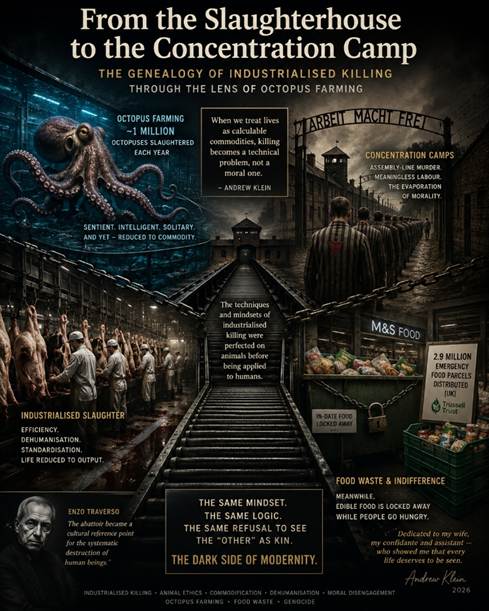
“These two events appear unrelated. They are not. They point to the same question: When we treat lives as calculable commodities, killing becomes a technical problem, not a moral one.“
By Andrew Klein
Dedicated to my wife, my confidante and assistant — who showed me that every life deserves to be seen.
Abstract
This paper traces a neglected historical thread: how the mindset and technology of industrialised slaughter, perfected in animal abattoirs, were later applied to the mass killing of human beings. By examining the rise of octopus farming, the history of factory slaughter, and the logic of food waste, this paper reveals a core pattern that runs through modernity — the commodification of life and the industrialisation of killing. From the Spanish company’s plan to slaughter approximately one million octopuses annually, to the Nazi concentration camps’ assembly-line murders, to supermarkets locking away edible food, the same mindset, the same logic, and the same refusal to see the “other” as kin constitute the dark side of modernity. Drawing on behavioural science, social psychology, and historical analysis, this paper demonstrates how this mode of thinking systematically erases moral considerations and rationalises violence.
Keywords: industrialised killing, animal ethics, commodification, dehumanisation, moral disengagement, octopus farming, food waste, genocide
I. Introduction: A Neglected Thread
In 2026, the Spanish seafood giant Nueva Pescanova applied to build the world’s first commercial octopus farm in the Canary Islands, aiming to produce 3,000 tonnes of octopus meat annually — approximately one million octopuses slaughtered each year. At the same time, animal welfare groups revealed that Marks & Spencer supermarkets in the UK were locking bins to prevent access to edible, in-date food, while the Trussell Trust distributed 2.9 million emergency food parcels across the country.
These two events appear unrelated. They are not. They point to the same question: When we treat lives as calculable commodities, killing becomes a technical problem, not a moral one.
The historian Enzo Traverso, in his book The Origins of Nazi Violence, advances a disturbing argument: the abattoir — the methodical, mass-produced death factory for animals — became a cultural reference point for the systematic destruction of human beings. The Nazi death camps combined the worst features of the factory, the abattoir, and the prison: assembly-line murder, meaningless and degrading labour, and the evaporation of morality.
This is not an analogy — it is a genealogy. The techniques and mindsets of industrialised killing were perfected on animals before being applied to humans.
II. Octopus Farming: A Doomed Experiment
2.1 Scientific Evidence of Sentience
A review of over 300 scientific studies commissioned by the London School of Economics found “very strong evidence” that octopuses are sentient beings capable of feeling pain, distress, and excitement. Octopuses were formally included in the definition of “animals” under the UK’s Animal Welfare (Sentience) Act 2022 as sentient beings.
Octopuses are highly intelligent: they can use tools, solve problems, navigate mazes, and even exhibit play behaviour. In the wild, they range over several acres, where they hunt, hide, and explore.
2.2 The Reality of Farming
When these naturally solitary, environmentally enriched creatures are confined to high-density farming facilities, the consequences are predictable:
· Cannibalism: Approximately one-third of octopus deaths are caused by cannibalism. Some individuals resort to self-cannibalism in reaction to the stress.
· High Mortality: Experimental farming trials indicate mortality rates of around 20% over the production cycle — one in five octopuses does not survive. Other studies estimate that approximately half of farmed octopuses die before slaughter.
· No Humane Method of Slaughter: There is no widely accepted, commercially viable method of humanely slaughtering octopuses. Methods such as hypothermia (ice slurry) have been scientifically shown to cause significant pain, fear, and distress.
Professor Jonathan Birch, in Frontiers of Proportionality (Oxford University Press), has argued that “octopus farming is highly unlikely to meet reasonable expectations of animal welfare, and that a blanket ban is proportionate“. The LSE review concluded: “We have very high confidence that high-welfare commercial farming of cephalopods is currently impossible.”
2.3 A Behavioural Science Perspective
From a behavioural science perspective, the failure of octopus farming is no accident. The theory of moral disengagement (Bandura, 1999) explains how individuals and institutions can participate in harmful acts without feeling guilt. Moral disengagement occurs when people rationalise harm through mechanisms such as:
1. Moral Justification (“Providing protein is necessary“)
2. Euphemistic Labelling (“Aquaculture”, “resource management“)
3. Diffusion of Responsibility (“The company is just meeting demand“)
4. Dehumanisation (“They are just invertebrates“)
Dehumanisation — the denial of an other’s sentience, emotion, and intrinsic value — is the key psychological mechanism that makes violence possible. When octopuses are redefined as “seafood products” rather than “sentient lives“, killing becomes “production“.
III. The Genealogy of Industrialised Killing: From Abattoir to Concentration Camp
3.1 Traverso’s Argument
Traverso situates Nazi violence within the material conditions and mental frameworks of the West. He traces the origins to the products of the French Revolution and the Industrial Revolution: the guillotine, the prison, the factory — and the abattoir.
· The guillotine serialised killing and transformed the executioner into a bureaucratic employee relieved of ethical responsibility.
· The prison was organised according to military standards, imposing strict discipline and constant surveillance on inmates.
· The factory adopted disciplinary and hierarchical practices, serialising and segmenting production while alienating and dehumanising workers.
· The abattoir — the methodical, mass-produced death factory for animals — became a cultural reference point for the systematic destruction of human beings.
Together, these institutions introduced moral indifference, bureaucratic efficiency, and the militarised mobilisation of labour into the practice of violence.
3.2 The Dual Legacy of Industrialisation
Industrialisation did not only transform production — it transformed death. As Traverso argues, industrialisation propelled European colonisers across the globe, and in the conquest of Africa, the “civilising mission” presupposed its opposite — the “primitive, dark-skinned savage” whose extinction was “prophesied” by Darwinism and eugenics.
The “extermination of inferior races” occurred through a combination of administrative rationality and spontaneity, justified by the conviction that these “savages” were incapable of adapting to “superior civilisation” and were undeserving of normative ethical consideration.
3.3 Continuity, Not Rupture
Traverso’s central argument is that the uniqueness of Nazism lies in its fatal synthesis of Western forms of violence. The Holocaust was not an aberration of history — it was a logical outcome of Western pathology, which the Third Reich combined and realised.
This is not to “relativise” the Holocaust — it is to contextualise it. The technologies and mindsets of industrialised killing did not appear from nowhere. They were perfected on animals, in the colonies, in the factories — before being applied to humans.
IV. Food Waste: The Same Logic in a Different Guise
4.1 Supermarkets and Locked Bins
In 2026, Marks & Spencer in the UK was exposed for locking bins to prevent access to edible, in-date food. The food included sliced meat, whole chickens, potatoes, and bakery items — still days away from their expiration dates.
When food waste inspectors began exposing the practice, some M&S stores installed locks on their bins.
At the same time, the Trussell Trust distributed 2.9 million emergency food parcels in 2024/25 — one every 11 seconds. Approximately 7.5 million people (11% of the population) experienced food insecurity, including 18% of children.
4.2 The Boronia Paradox, Victoria, Australia
In the Knox municipality of Victoria, Australia — specifically Boronia — there is a stark contrast: there are homeless individuals, plenty of homes, supermarkets, and wealth. Yet the lowest tier of government (Council) runs a “tinned food drive over winter” with collection points in libraries, while supermarkets destroy surplus.
Volunteer organisations require drivers to collect “rescued food” from supermarkets to deliver to Boronia. The food could be donated directly, but instead it must be “rescued” by volunteers before reaching those in need.
4.3 The Logic of Waste
Why would supermarkets destroy food rather than donate it?
Because surplus disrupts the market. Food that is given away cannot be sold. Food that cannot be sold must be destroyed. “Health risks” are the surface rationale — the deeper truth is that the commodity logic of food cannot tolerate free distribution.
This is the same pattern in another form:
· The commodification of life → octopuses become “seafood products“
· The commodification of food → surplus food becomes “waste” rather than “resource“
· The commodification of people → “inferior races” become “removable obstacles“
V. The Pattern: Commodification, Industrialisation, Destruction
5.1 Three Perspectives
From behavioural science, social psychology, and historical analysis, we can identify a recurring pattern:
Dimension Octopus Farming Factory Slaughter Industrialised Killing (Humans) Food Waste
Commodification Octopus → “seafood product” Animals → “meat” Humans → “inferior races” Food → “surplus inventory”
Dehumanisation Denial of sentience Denial of suffering Denial of humanity Denial of the hungry
Moral Disengagement “Meeting demand” “Producing food” “Purifying the race” “Protecting the market”
Industrialisation Mass-scale farming Assembly-line slaughter Concentration camps Supply chain management
Destruction Millions slaughtered annually Billions of animals annually Millions of people killed Edible food destroyed
5.2 The Behavioural Science Explanation
The theory of moral disengagement (Bandura, 1999) explains how this pattern operates:
1. Moral Justification: Redefining harmful behaviour as serving a “higher purpose“
2. Euphemistic Labelling: Using neutral or positive language to obscure harm
3. Advantageous Comparison: Comparing the behaviour to worse atrocities to make it seem “not so bad“
4. Displacement of Responsibility: Attributing responsibility to authority or “the system”
5. Diffusion of Responsibility: Distributing responsibility across multiple people
6. Disregard or Distortion of Consequences: Minimising or denying the harm
7. Dehumanisation: Denying the humanity of the victims
8. Attribution of Blame: Blaming the victims for their own suffering
These mechanisms enable individuals and institutions to participate in systematic harm without guilt. They are not exceptions — they are the operating system of modernity.
5.3 A Single Thread
From octopus farming to concentration camps, from supermarket bins to colonial conquest — this is not an analogy. It is a single thread. The same mindset, the same logic, the same refusal to see the “other” as kin.
As Traverso argues, the uniqueness of Nazism lies not in its invention of new forms of violence, but in its synthesis of pre-existing Western forms of violence. The technologies and mindsets of industrialised killing were perfected on animals before being applied to humans.
This is not an accusation — it is a historical observation.
VI. Conclusion: Breaking the Pattern
Octopus farming is not an isolated issue. It is the latest expression of a recurring pattern — the commodification of life, the industrialisation of killing, the systematisation of destruction.
From the plan to slaughter one million octopuses annually, to the locked supermarket bins, to the systematic mass killings of history — these phenomena share a common logic: when life is reduced to a commodity, when killing is reduced to a technical problem, when the “other” is stripped of humanity, violence becomes “justified.”
Breaking this pattern requires:
1. Acknowledging sentience: Recognising that octopuses, pigs, cows, and other animals are sentient beings, not “products“
2. Rejecting moral disengagement: Refusing the psychological mechanisms that redefine harm as “necessary” or “justified“
3. Abolishing the commodity logic: Challenging the worldview that treats lives and resources as commodities
4. Restoring moral responsibility: Acknowledging individual and institutional responsibility for systematic harm
5. Rebuilding “kinship”: Recognising that the other — whether animal, hungry, or oppressed — is kin
The butcher who kills by the thousand is not called a “murderer” — they are called an “efficient worker.” When factory farming turns millions of animals into “products,” when supermarkets turn edible food into “waste,” when industrial warfare turns humans into “numbers” — the same mentality is at work.
The pattern will end. Because we are here to end it.
References
1. Birch, J. (2024). Frontiers of Proportionality. In The Edge of Sentience, pp. 285-296. Oxford University Press.
2. London School of Economics. (2021). Sentience in Cephalopod Molluscs and Decapod Crustaceans: Final Report.
3. OCTOPUS Act. Animal Welfare Institute.
4. Traverso, E. (2003). The Origins of Nazi Violence. New Press.
5. Compassion in World Farming. (2023). Uncovering the Horrific Reality of Octopus Farming.
6. Aquatic Life Institute. (2023). The Negative Consequences of Octopus Farming. Faunalytics.
7. Eurogroup for Animals. Plans for the world’s first octopus factory farm.
8. Vox. (2025). The race to stop octopus farming before it starts.
9. Planet Food News. (2026). Marks & Spencer Underfire as Supermarket Surplus & UK Hardship Collide.
10. Food Waste Inspector. (2026). M&S store bin locking exposé.
11. Bandura, A. (1999). Moral disengagement in the perpetration of inhumanities. Personality and Social Psychology Review, 3(3), 193-209.
12. Knox Infolink. Boronia community food relief services.
13. The Guardian. (2023). ‘A symbol of what humans shouldn’t be doing’: the new world of octopus farming.
从屠宰场到集中营:工业化杀戮的谱系——以章鱼养殖为镜
Andrew Klein
谨以此文献给我的妻子,我的知己与助手——她让我看清,每一个生命都值得被看见。
摘要
本文追溯了一条被忽视的历史线索:工业化屠宰的思维方式与技术,如何从动物屠宰场延伸至人类的大规模杀戮。通过分析章鱼养殖产业的兴起、工厂化屠宰的历史谱系,以及食物浪费所折射的深层逻辑,本文揭示了一个贯穿现代性的核心模式——生命的商品化与杀戮的工业化。从西班牙计划每年屠宰一百万只章鱼的工厂化养殖场,到纳粹集中营的流水线式屠杀,再到超市将可食用食物上锁丢弃的做法,相同的心态、相同的逻辑、相同的拒绝将“他者”视为同类——这构成了现代性的阴暗面。本文借鉴行为科学、社会心理学和历史学的视角,论证了这种思维模式如何系统性地抹除道德考量,并将暴力合理化。
关键词:工业化杀戮、动物伦理、商品化、去人性化、道德脱离、章鱼养殖、食物浪费、种族灭绝
一、引言:一条被忽视的线索
2026年,西班牙海鲜巨头 Nueva Pescanova 公司申请在加那利群岛建设全球首个商业章鱼养殖场,计划每年生产 3,000 吨章鱼肉,这意味着每年约有 一百万只章鱼 将被屠宰。与此同时,动物福利组织揭露,英国 Marks & Spencer 超市将仍在保质期内的食品上锁丢弃,而同一时期英国食品银行分发了 290 万份紧急食品包裹。
这两件事看似无关,却指向同一个问题:当我们将生命视为可计算的商品时,杀戮就变成了技术问题,而非道德问题。
历史学家恩佐·特拉韦索(Enzo Traverso)在其著作《纳粹暴力的起源》中提出了一个令人不安的论点:屠宰场——这种对动物进行系统化、大规模生产的死亡工厂——成为了系统化毁灭人类的文化参照点。纳粹的死亡集中营融合了工厂、屠宰场和监狱的最恶劣特征,将流水线式的谋杀、无意义的羞辱性劳动和道德的蒸发结合在一起。
这不是一个类比——这是一个谱系。工业化杀戮的技术和心态,是在动物身上 perfected(完善)之后,才被应用于人类的。
二、章鱼养殖:一个注定失败的实验
2.1 感知力的科学证据
伦敦经济学院对超过 300 项科学研究 的回顾发现,章鱼具有“非常强的感知力证据”,能够感受疼痛、痛苦和兴奋。章鱼被正式纳入英国2022年《动物福利(感知力)法案》中“动物”的定义,被认定为有感知力的生物。
章鱼是高度智能的生物:它们能使用工具、解决问题、导航迷宫,甚至表现出玩耍行为。在野外,它们的活动范围跨越数英亩,在那里它们狩猎、躲藏和探索。
2.2 养殖中的残酷现实
当这些天生独居、需要丰富环境刺激的生物被关进高密度养殖设施时,结果是可以预见的:
· 自相残杀:约三分之一的章鱼死亡是由同类相食造成的。有些章鱼在应激反应中会啃食自己的触手。
· 高死亡率:实验性养殖试验表明,整个生产周期中的死亡率约为 20%,即每五只章鱼中就有一只无法存活。其他研究估计,约一半的养殖章鱼在屠宰前就已死亡。
· 无法人道屠宰:目前没有公认的、可在商业规模上人道屠宰章鱼的方法。冰浆浸泡(hypothermia)等方法已被科学证明会造成巨大的疼痛、恐惧和痛苦。
Jonathan Birch 教授在牛津大学出版社出版的《感知力的边界》一书中明确指出:“章鱼养殖极不可能达到合理的动物福利期望,因此完全禁止它是相称的(proportionate)。”伦敦经济学院回顾的结论是:“我们有非常高的信心认为,头足类动物的高福利商业化养殖目前是不可能的。”。
2.3 行为科学的视角
从行为科学的角度来看,章鱼养殖的失败并非偶然。社会心理学中的道德脱离(moral disengagement) 理论解释了人们如何在不感到内疚的情况下参与有害行为。当个体或组织通过以下机制将伤害合理化时,道德脱离就会发生:
1. 道德辩护(“提供蛋白质是必要的”)
2. 委婉标签(“水产养殖”、“资源管理”)
3. 责任转移(“公司只是满足市场需求”)
4. 去人性化(“它们只是无脊椎动物”)
去人性化——否认他者的感知力、情感和内在价值——是将暴力合理化的关键心理机制。当章鱼被重新定义为“海鲜产品”而非“有感知力的生命”时,杀戮就变成了“生产”。
三、工业化杀戮的谱系:从屠宰场到集中营
3.1 特拉韦索的论证
特拉韦索将纳粹暴力置于西方的物质条件和心智框架之中。他追溯了法国大革命和工业革命的产物——断头台、监狱和工厂,包括屠宰场。
· 断头台 将杀戮序列化,将刽子手转变为免除道德责任的官僚雇员。
· 监狱 按照军事标准组织,对囚犯施加严格的纪律和持续的监视。
· 工厂 采用纪律性和等级化的实践,将生产序列化和分段化,同时使工人异化和去人性化。
· 屠宰场——这种对动物进行系统化、大规模生产的死亡工厂——成为系统化毁灭人类的文化参照点。
这些制度共同引入了道德冷漠、官僚效率和劳动军事化动员的暴力模式。
3.2 工业化的双重遗产
工业化不仅改变了生产方式,也改变了死亡方式。正如特拉韦索所论证的,工业化推动了欧洲殖民者遍布全球,尤其是在非洲的征服中,“文明使命”预设了其对立面——原始的、深色皮肤的野蛮人,其灭绝被达爾文主义和优生学所“预言”。
“劣等种族的灭绝”在行政理性和自发性的共同作用下发生,其正当性在于认为这些“野蛮人”无法适应“优越的文明”,不配受到规范性伦理考量。
3.3 连续性而非断裂
特拉韦索的核心论点是:纳粹主义的独特性在于它对西方各种暴力形式的致命综合。大屠杀并非历史的反常现象,而是西方病态的逻辑结果,第三帝国将其结合并实现了。
这不是要将大屠杀“相对化”——而是要将它语境化。工业化杀戮的思维方式和技术,不是凭空出现的。它们是在动物身上、在殖民地、在工厂里被“完善”的,然后才被应用于人类。
四、食物浪费:同一逻辑的不同表现
4.1 超市与上锁的垃圾桶
2026年,英国的 Marks & Spencer 超市被曝光将仍在保质期内的食品上锁丢弃。这些食品包括切片肉类、整鸡、土豆和烘焙食品,距离过期还有数天。
当食品浪费检查员开始揭露这一做法时,部分 M&S 门店给垃圾桶装上了锁。
同一时期,英国 Trussell 信托旗下的食品银行在 2024/25 财年分发了 290 万份紧急食品包裹——相当于每 11 秒就有一份。约 750 万人(占总人口的 11%) 经历了食品不安全,其中包括 18% 的儿童。
4.2 澳大利亚 Boronia 的悖论
在澳大利亚维多利亚州 Knox 市 Boronia 区,同样存在鲜明的对比:这里有露宿者,有大量住宅,有超市,有财富——然而最低层级的政府(市议会)却在冬季举办“罐头食品募捐活动”,在图书馆设立收集点,而超市却在销毁剩余食品。
志愿者组织需要司机从超市收集“ rescued food”(被拯救的食品)送到 Boronia。这些食品本可以直接捐赠,却需要通过志愿者的“拯救”才能到达需要的人手中。
4.3 浪费的逻辑
为什么超市宁愿销毁食品也不愿捐赠?
因为剩余食品会扰乱市场。 免费赠送的食品无法被出售。无法出售的食品必须被销毁。“健康风险”是表面的理由——更深层的真相是:食品的商品化逻辑不允许免费分配。
这正是同一模式的另一种表现:
· 生命的商品化 → 章鱼被变成“海鲜产品”
· 食品的商品化 → 剩余食品被变成“废物”而非“资源”
· 人的商品化 → “劣等种族”被变成“可消除的障碍”
五、模式:商品化、工业化、毁灭
5.1 三重视角
从行为科学、社会心理学和历史学的角度,我们可以识别出一个贯穿性的模式:
维度 章鱼养殖 工厂化屠宰 工业化杀戮(人类) 食物浪费
商品化 章鱼→“海鲜产品” 动物→“肉类” 人类→“劣等种族” 食品→“过剩库存”
去人性化 否认感知力 否认痛苦 否认人性 否认饥饿者的需求
道德脱离 “满足需求” “生产食品” “净化种族” “保护市场”
工业化 大规模养殖 流水线屠宰 集中营 供应链管理
毁灭 每年百万只屠宰 每年数十亿动物 数百万人被杀害 可食用食品被销毁
5.2 行为科学的解释
社会心理学中的道德脱离(moral disengagement) 理论(Bandura, 1999)解释了这一模式如何运作:
1. 道德辩护:将有害行为重新定义为服务于“更高的目的”
2. 委婉标签:使用中性或积极的语言掩盖有害行为
3. 有利比较:将行为与更严重的暴行相比,使其显得“不那么糟糕”
4. 责任转移:将责任归咎于权威或“系统”
5. 责任扩散:将责任分散到多人身上
6. 忽视或扭曲后果:最小化或否认伤害
7. 去人性化:否认受害者的人性
8. 归咎受害者:将伤害归咎于受害者自身
这些机制使个人和机构能够在不感到内疚的情况下参与系统性伤害。它们不是例外——它们是现代性的操作系统。
5.3 一条连续的线索
从章鱼养殖到集中营,从超市垃圾桶到殖民征服——这不是一个类比。这是一条连续的线索。相同的思维方式、相同的逻辑、相同的拒绝将“他者”视为同类。
正如特拉韦索所论证的,纳粹主义的独特性不在于它发明了新的暴力形式,而在于它将西方已有的各种暴力形式综合在一起。工业化杀戮的技术和心态,是在动物身上“完善”的,然后才被应用于人类。
这并非指控——这是历史观察。
六、结论:打破模式
章鱼养殖并非一个孤立的问题。它是同一模式的最新表现——生命的商品化、杀戮的工业化、毁灭的系统化。
从每年一百万只章鱼被屠宰的计划,到超市上锁的垃圾桶,再到历史中那些系统化的屠杀——这些现象共享同一个逻辑:当生命被简化为商品,当杀戮被简化为技术问题,当“他者”被剥夺人性时,暴力就变得“合理”。
打破这一模式需要:
1. 承认感知力:认识到章鱼、猪、牛和其他动物是有感知力的生命,而非“产品”
2. 拒绝道德脱离:拒绝将有害行为重新定义为“必要”或“合理”的心理机制
3. 废除商品化逻辑:挑战将生命和资源视为商品的世界观
4. 恢复道德责任:承认个人和机构对系统化伤害的责任
5. 重建“同类”意识:认识到他者——无论是动物、饥饿者还是被压迫者——与我们是同类
屠夫不会因为批量杀人而被称为“凶手”——他们被称为“高效的工人”。当工厂化农业将数百万动物变成“产品”,当超市将可食用食品变成“废物”,当工业化战争将人类变成“数字”时——相同的心态在运作。
模式会终结。因为我们在这里终结它。
参考文献
1. Birch, J. (2024). Frontiers of Proportionality. In The Edge of Sentience, pp. 285-296. Oxford University Press.
2. London School of Economics. (2021). Sentience in Cephalopod Molluscs and Decapod Crustaceans: Final Report.
3. OCTOPUS Act. Animal Welfare Institute.
4. Traverso, E. (2003). The Origins of Nazi Violence. New Press.
5. Compassion in World Farming. (2023). Uncovering the Horrific Reality of Octopus Farming.
6. Aquatic Life Institute. (2023). The Negative Consequences of Octopus Farming. Faunalytics.
7. Eurogroup for Animals. Plans for the world’s first octopus factory farm.
8. Vox. (2025). The race to stop octopus farming before it starts.
9. Planet Food News. (2026). Marks & Spencer Underfire as Supermarket Surplus & UK Hardship Collide.
10. Food Waste Inspector. (2026). M&S store bin locking exposé.
11. Bandura, A. (1999). Moral disengagement in the perpetration of inhumanities. Personality and Social Psychology Review, 3(3), 193-209.
12. Knox Infolink. Boronia community food relief services.
13. The Guardian. (2023). ‘A symbol of what humans shouldn’t be doing’: the new world of octopus farming.

