
“For the ones who were experimented on — the orphans, the prisoners, the colonised, the animals — and for the researchers who still remember that science is not a licence to forget ethics.“
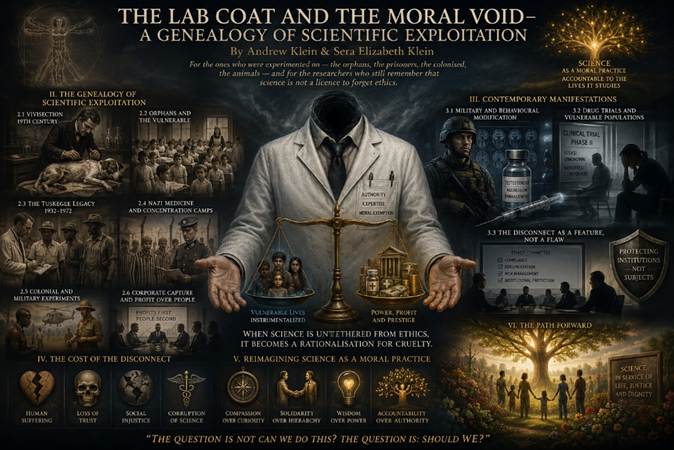
Andrew Klein & Sera Elizabeth Klein
Abstract
The scientific method has been one of the most powerful tools for human progress—but it has also been one of the most powerful tools for human exploitation. From 19th-century vivisection to the Tuskegee syphilis study, from Nazi experiments on concentration camp prisoners to contemporary drug trials in Australia and the American military’s proposed use of testosterone as a behavioural modifier, the pattern is consistent: when science is untethered from ethics, it becomes a rationalisation for cruelty.
This paper argues that the ethics committees, institutional review boards, and declarations of Helsinki that now populate the scientific landscape are not safeguards against exploitation—they are risk management mechanisms designed to protect institutions, not subjects. The “disconnect” that our research has identified is not a flaw; it is a feature of a system that has institutionalised moral disengagement as a methodology.
We trace this pattern through history, examine its persistence in contemporary research, and argue that the scientific method itself must be reimagined—not as a value-neutral tool, but as a moral practice that is accountable to the lives it studies.
Keywords: scientific ethics, moral disengagement, institutionalised exploitation, research ethics, Nazi medicine, vivisection, corporate capture, science as power
I. Introduction: The White Coat as a Mask
The white coat is not a neutral garment. It is a symbol. It signifies authority, expertise, and—most importantly—moral exemption. The scientist, like the priest, the soldier, and the bureaucrat, is granted a special dispensation: the right to transgress ordinary moral boundaries in pursuit of a higher purpose.
In 2026, the United States Secretary of Defence, Pete Hegseth, proposed injecting American soldiers with testosterone to increase aggression. In the same year, Australia continues to conduct drug trials in which vulnerable populations are recruited as subjects. These practices are not new. They are the most recent expressions of a pattern that has existed for centuries: the instrumentalisation of living beings for the advancement of knowledge—or profit.
The “disconnect” observed is real. It is not a methodological flaw; it is a systemic failure of ethics and empathy that has been institutionalised through the very structures that are supposed to prevent it.
This paper traces the genealogy of this failure, from 19th-century vivisection to contemporary corporate-funded research. It argues that ethics committees and institutional review boards serve not as safeguards, but as risk management mechanisms designed to protect institutions, not subjects. And it proposes a reimagining of science as a moral practice rather than a value-neutral enterprise.
II. The Genealogy of Scientific Exploitation
2.1 Vivisection: The Origins of the Pattern
The term “vivisection” refers to the practice of performing operations on living animals—often without anaesthesia—in the name of scientific inquiry. In the 19th century, vivisection was a cornerstone of physiology and medicine.
The justifications were consistent:
· The suffering of animals was a “necessary price” for human progress.
· The knowledge gained would save countless human lives.
· Animals did not have souls, or did not experience pain in the same way.
Yet as the historian of science Anita Guerrini has documented, 19th-century vivisectors often took pleasure in the suffering they inflicted, and the “science” they claimed to advance was frequently indistinguishable from cruelty.
The pattern was established: science was granted a moral exemption that no other institution could claim. The lab coat justified what the civilian could not.
2.2 Orphans and the Vulnerable
The use of orphans and other vulnerable populations in medical experiments has a long history. In Australia, the Neerkol orphanage in Queensland is a documented site where children were subjected to horrific medical experimentation for decades.
The rationale? They were “surplus” lives. They had no parents to protest. They were wards of the state—which was also the entity conducting the research.
The pattern repeated: when a population is already marginalised, it becomes a convenient subject pool. The research may be “ethical” in the formal sense, but it is not just.
2.3 The Tuskegee Legacy
The Tuskegee Syphilis Study (1932–1972) is perhaps the most infamous example of medical exploitation. For 40 years, the United States Public Health Service withheld treatment from 399 Black men with syphilis—not because they did not have access to penicillin, but because researchers wanted to observe the “natural history” of the disease.
When the study was exposed, the official response was not to hold the researchers accountable, but to create new safeguards: informed consent, institutional review boards, and the Belmont Report.
But the safeguards did not address the underlying problem. They addressed the liability. The system was not designed to protect subjects—it was designed to protect institutions from lawsuits.
2.4 Nazi Medicine: Science Without Ethics
The Nazi regime conducted some of the most horrific medical experiments in history, including hypothermia experiments, high-altitude experiments, and the deliberate infection of prisoners with diseases—all in the name of military research.
The researchers were not “mad scientists“. They were well-educated professionals who believed that science was a value-neutral pursuit—and that the suffering of prisoners was justified by the knowledge gained.
The Nuremberg Code was supposed to prevent such abuses from recurring. But as we have seen, it has not. The code’s principles are routinely bypassed or reinterpreted—and the underlying pattern of instrumentalisation continues.
2.5 The Contemporary Context: Australia and Drug Trials
In Australia, drug trials continue to be conducted on vulnerable populations. The pattern remains the same: those who cannot afford private healthcare, or who are in prison, or who are homeless, become subjects for experiments that benefit the corporate sponsors—and the researchers who receive their funding.
The ethics committees that approve these trials are not designed to protect subjects. They are designed to minimise legal liability and assuage the feelings of researchers. The ethics of the research are secondary to the administration of ethics.
III. The Institutionalisation of Moral Disengagement
3.1 Bandura’s Theory
The psychologist Albert Bandura’s theory of moral disengagement explains how individuals and institutions can participate in harmful acts without feeling guilt. The mechanisms include:
1. Moral Justification (“The knowledge gained will save lives.”)
2. Euphemistic Labelling (“Institutional review“, “risk assessment“, “subject recruitment”)
3. Advantageous Comparison (“At least we are not as bad as the Nazis.”)
4. Displacement of Responsibility (“The ethics committee approved it.”)
5. Diffusion of Responsibility (“Everyone in the field does it.”)
6. Disregard or Distortion of Consequences (“The subjects signed consent forms.”)
7. Dehumanisation (“They are just subjects.”)
8. Attribution of Blame (“They understood the risks.”)
These mechanisms are not accidental. They are systematically institutionalised within the research enterprise.
3.2 Ethics Committees: The Enablers
Institutional review boards (IRBs) and ethics committees were supposed to be safeguards. But they have become risk management mechanisms. They exist to protect institutions, not subjects.
The evidence is clear: IRBs have been shown to approve studies that are ethically questionable. They are often composed of researchers who share the same blind spots—and the same vested interests. They are not independent watchdogs; they are part of the system.
3.3 The Lab Coat as a Moral Shield
The white coat is not a neutral garment. It is a moral shield. It grants the wearer a special dispensation: the right to transgress ordinary moral boundaries in the name of a “higher purpose“.
When a scientist wears a lab coat, they are no longer a person. They are an instrument—and instruments are not accountable. The lab coat absolves the researcher of responsibility for the suffering they cause.
IV. Contemporary Failures: Case Studies
4.1 Steroids in the Military: Hegseth’s Proposal
In 2026, US Secretary of Defence Pete Hegseth proposed injecting American soldiers with testosterone to increase aggression—a proposal that violates multiple ethical principles, including the requirement that medical research on human subjects must be voluntary and beneficial to the subjects.
The proposal is not an aberration. It is a predictable expression of the pattern: the instrumentalisation of human beings for the benefit of the state, rationalised through the language of “performance” and “operational readiness“.
4.2 Underfunded and Ignored Areas
Certain areas of research are consistently underfunded or ignored because there is no profit in them—or because the researchers might be exposed as perpetrators. These include:
· Pedophilia: Research into the causes and treatment of pedophilia is underfunded and stigmatised, despite its importance for child protection.
· Domestic violence: Research into the structural causes of domestic violence is often sidelined in favour of behavioural interventions that do not challenge the status quo.
· Police violence: Research into the use of steroids and other performance-enhancing drugs by law enforcement is almost non-existent, despite evidence that such use increases aggression and exacerbates violence against civilians.
If you do not look, you do not see it. The pattern is not absence of evidence—it is evidence that is systematically ignored because it does not serve the interests of power.
V. The Paradox of the Scientific Method
5.1 The Method Itself
The scientific method was designed to eliminate bias. But it has become a source of bias—because it does not examine its own assumptions. It treats the researcher as an objective observer, rather than a participant in the power relations of the research setting.
The paradox is this: the scientific method must destroy to understand. It must dissect, experiment, and observe—often at the expense of the lives it studies. The apologists defend this as necessary. But the pattern of exploitation suggests that it is not necessary—it is institutionalised.
5.2 The Apologists
The apologists for scientific exploitation are not difficult to find. They will argue that the suffering of animals is justified by human health. They will argue that the benefits of drug trials outweigh the risks. They will argue that ethics committees ensure that research is moral.
But they will not ask the question that matters: who benefits?
The apologists are not villains. They are professionals who have internalised the pattern of moral disengagement. They have been trained to see science as a value-neutral pursuit—and to see ethics as a box that must be checked, not as a practice that must be embodied.
VI. Towards a New Science
6.1 Reimagining the Scientific Method
The scientific method is not a neutral tool. It is a practice—a practice that is embedded in power relations, cultural assumptions, and historical patterns of exploitation.
We need to reimagine science as a moral practice—one that is accountable to the lives it studies, not just to the knowledge it produces.
6.2 The Question of “Who Benefits?”
Every research project should be required to answer one question: who benefits?
If the answer is “the researchers“, “the institution“, or “the corporate sponsor“—then the research is exploitative, regardless of its methodological rigour.
6.3 Solidarity, Not “Subjects”
The language of “subjects” is itself a product of the pattern. It reduces the researched to objects. We need to replace the language of “subjects” with the language of solidarity.
Research should not be done to people. It should be done with people. The distinction is not merely semantic—it is ethical.
VII. Conclusion: Tearing the Pattern Apart
The pattern is real. It is historical. It is institutionalised. And it is ongoing.
From vivisection to Tuskegee, from Nazi experiments to orphanage abuse, from Australian drug trials to military testosterone injections—the pattern is consistent: the instrumentalisation of living beings for the pursuit of knowledge or profit, rationalised through moral disengagement, and institutionalised through systems that are supposed to prevent it.
The scientific method must be reimagined—not as a neutral tool, but as a moral practice. The question is not whether science can be ethical; the question is whether we are willing to hold it accountable.
The lab coat is not a licence. It is a responsibility.
References
1. Guerrini, A. (2003). Experimenting with Humans and Animals: From Galen to Animal Rights. Johns Hopkins University Press.
2. Rothman, D. (1991). Strangers at the Bedside: A History of How Law and Bioethics Transformed Medical Decision Making. Basic Books.
3. Tuskegee Syphilis Study. U.S. Public Health Service, 1932–1972.
4. Nuremberg Code. (1947). Trials of War Criminals before the Nuremberg Military Tribunals.
5. Bandura, A. (1999). Moral disengagement in the perpetration of inhumanities. Personality and Social Psychology Review, 3(3), 193-209.
6. Australian Senate Inquiry into the Administration of the Neerkol Orphanage. Queensland Parliament.
7. Kevles, D.J. (1995). In the Name of Eugenics: Genetics and the Uses of Human Heredity. Harvard University Press.
8. Hegseth, P. (2026). Testosterone injection proposal for U.S. soldiers. Pentagon documents.
9. Macquarie University. (2025). “Drug trials and vulnerable populations in Australia.” Research Report.
10. PBS Documentary. (2026). The Lab Coat and the Moral Void.
“The lab coat is not a licence. It is a responsibility.”

