
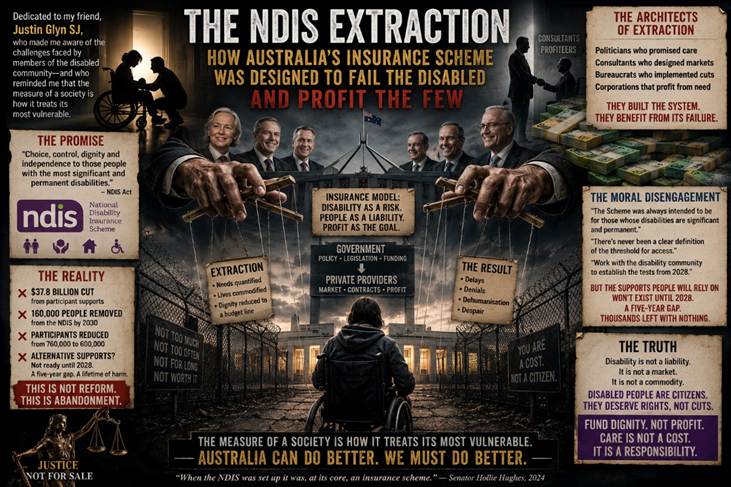
“The insurance model, from its inception, was flawed: it assumed that disabled lives could be commodified, their needs quantified, and their dignity reduced to a budget line.“
By Andrew Klein
Dedicated to my friend, Justin Glyn SJ, who made me aware of the challenges faced by members of the disabled community—and who reminded me that the measure of a society is how it treats its most vulnerable.
Abstract
This paper examines the architecture of extraction that underlies Australia’s National Disability Insurance Scheme (NDIS). Drawing on government documents, parliamentary records, and independent analysis, we demonstrate that the NDIS was not designed primarily to support Australians with disability, but to create a market for private profit. The insurance model, from its inception, was flawed: it assumed that disabled lives could be commodified, their needs quantified, and their dignity reduced to a budget line. The paper traces the legislation that enabled this extraction, identifies the politicians who proposed it, the consultants who designed it, and the Australian Public Service officers who implemented it. We argue that the current reforms—cutting $37.8 billion from participant supports and removing 160,000 people from the scheme by 2030—are not corrections of a flawed system but the logical conclusion of a system designed to extract value from the vulnerable.
Keywords: NDIS, disability rights, privatisation, insurance model, commodification, moral disengagement, Australian Public Service
I. Introduction: The Architecture of Extraction
When the NDIS was established, its stated purpose was clear: to provide “choice, control, dignity and independence to those people with the most significant and permanent disabilities”. The architects of the scheme understood that early investment would save later costs. As Senator Hollie Hughes noted in 2024: “When the NDIS was set up it was, at its core, an insurance scheme. That means there was to be investment early to save costs later.”
But the insurance model was flawed from the beginning. It assumed that disability could be insured against—that the needs of disabled people could be quantified, budgeted, and managed like any other risk. It assumed that the market could deliver care more efficiently than the state. It assumed that profit could coexist with compassion.
It cannot.
The 2026 Federal Budget cut $37.8 billion over four years directly from participant supports. The government plans to remove 160,000 people from the NDIS by 2030, reducing the number of participants from 760,000 to 600,000. These cuts are not corrections of a flawed system—they are the logical conclusion of a system designed to extract value from the vulnerable.
II. The Insurance Model: A Flawed Foundation
2.1 What Is the Insurance Model?
The NDIS was designed as an “insurance scheme”—a system in which the government pools risk and allocates funding based on assessed need. In theory, this approach ensures that those with the most significant needs receive the most support. In practice, it has created a system in which disabled people are treated as liabilities to be managed rather than citizens to be supported.
The “insurance” framing is revealing. It treats disability as a risk to be mitigated, not a condition to be accommodated. It assumes that the goal is to reduce liability rather than to enable flourishing.
As Grattan Institute’s Disability Program Director Sam Bennett noted, the NDIS has grown “too big, too fast” and “a one-size-fits-all approach doesn’t work”. But the response has not been to refine the model—it has been to cut the funding.
2.2 The Substitution Problem
The NDIS was supposed to complement existing services, not replace them. But research has shown that NDIS-funded services have substituted for therapies previously accessed through Medicare—a substitution rather than an improvement. This is not a failure of the scheme—it is a design feature. By shifting responsibility to the NDIS, governments have been able to reduce their own spending while maintaining the appearance of care.
2.3 The Moral Disengagement
Minister McAllister’s framing of the NDIS reforms is a textbook example of moral disengagement. She acknowledged that “the Scheme was always intended to be for those whose disabilities are significant and permanent” and that “there’s never been a clear definition of the threshold for access”. She described the need to “work with the disability community to establish the relevant set of tests that will drive access from 2028”.
But she also acknowledged that the alternative systems people would be expected to rely on would not be ready until 2028—a five-year gap in which disabled Australians will be left with nothing.
This is not reform. This is abandonment.
III. The Promises Made and Broken
3.1 The Architects of the Scheme
The NDIS was legislated under the Gillard government and implemented under the Abbott government. The key figures included:
Figure Role Contribution
Julia Gillard Prime Minister Championed the NDIS as a signature reform
Bill Shorten NDIS Minister Oversaw the scheme’s expansion and early reforms
Mark Butler Health Minister Announced the 2026 cuts
Jenny McAllister NDIS Minister (2026) Implemented the current reforms
Jim Chalmers Treasurer Budgeted the cuts
3.2 The Australian Public Service
The NDIA (National Disability Insurance Agency) has been responsible for implementing the scheme. But as the NDIS Quality and Safeguards Commission has acknowledged, the scheme has been plagued by “integrity leakage” of between 8.2 and 8.3 per cent—a figure that equates to approximately $3.7 billion every single year lost to errors, noncompliance and criminal fraud.
The NDIA admitted that the scheme had become “a soft target” for “shonks and rorters”. The Australian Criminal Intelligence Commission confirmed that the scheme was being targeted by “higher end organised crime groups, some based offshore, who view the NDIS as merely one component of their much bigger, broader business model”.
3.3 The Role of Consultants
The NDIS was designed with extensive input from consultants. The scheme’s complexity and bureaucracy are not accidents—they are the predictable outcome of a system designed to generate consulting fees. The “co-design” process promised by the government is a continuation of this pattern, with the disability community consulted only after the key decisions have been made.
IV. The Profiteers
4.1 The Cartels
Whistleblowers have exposed closed inter-referral networks operating like cartels, with participants “internally circulated, ‘shopped around,’ and quietly controlled within tight-knit provider circles”. There have been instances of providers offering to sponsor Australian citizenship in exchange for being handed participants with large NDIS plans.
The problem is not limited to a few bad actors. As one whistleblower noted, “the reality was laid bare during Senate Estimates, when Pauline Hanson confronted the NDIA and NDIS Commission over fraud, phoenixing, internal in-trading networks in Sydney and Melbourne, and the failure to publicly disclose compliance actions”.
4.2 The Profit Margins
Billions of taxpayer dollars are being siphoned offshore every year. As one analysis noted, “if $20 billion of NDIS funding goes to overseas-owned providers with a 25% profit margin, that alone represents $5 billion in profits leaving Australia”. This is not “market competition“—it is the extraction of public funds.
4.3 The “Fraud” Narrative
The government has deliberately inflated the fraud narrative to justify cuts. As one commentator noted, “some in the community has accused the government of whipping up public outrage about the scheme with talk about significant fraud and money being spent on things like sex services, which only a small number of people are approved to receive under the scheme”.
V. The Pattern: Commodification and Extraction
5.1 The Same Logic
The pattern is consistent across systems:
System Pattern
Octopus farming Sentient beings commodified for profit
Private prisons Human beings commodified for profit
ICE detention Families commodified for profit
NDIS Disabled people commodified for profit
The logic is identical: deny support now, ensure suffering later, profit from the consequences.
5.2 The Downstream Costs
The replacement of prevention with crisis management is a deliberate strategy. An untreated bedsore today will require expensive surgery later. A child denied early intervention will need intensive support as an adult. A mental health condition left unmanaged will escalate to hospitalisation.
The principle is simple: Proper care and support is denied now so that the increased downstream costs can be exploited by private profiteers later.
VI. The Verdict
The system is not broken. It is working exactly as designed—to extract maximum value from the vulnerable while maintaining the appearance of care.
The disabled are treated no differently from cattle in a yard waiting for the slaughter. Their needs are quantified, budgeted, and managed—but not met. Their dignity is reduced to a budget line. Their lives are weighed against the cost of supporting them.
This is not a failure of policy. It is a business model.
Andrew Klein
References
1. Enabling choice, recovery and participation: evidence-based early intervention support for psychosocial disability in the National Disability Insurance Scheme. BVS.
2. Protecting the NDIS: Taking action to further tackle scheme growth. NDIS.
3. NDIS Provider Networks Exposed: Systemic Abuse and Corruption. LinkedIn.
4. Saving the NDIS?. Grattan Institute.
5. Radio interview with Minister McAllister, ABC Radio Darwin – 30 April 2026. Australian Government Department of Health, Disability and Ageing.
6. Billions of taxpayer dollars meant to support older Australians siphoned offshore every year. The Northern Daily Leader.
7. Kerrynne Liddle’s recent appearances. OpenAustralia.org.
8. Integrity and Safeguarding Bill to strengthen regulatory powers. NDIS Quality and Safeguards Commission.
9. ‘One-size-fits-all approach doesn’t work’: Plan to save the NDIS billions. The Age.
10. Australians with Down syndrome among those to suffer most from proposed NDIS cuts to social activities. The Guardian.
11. The NDIS has transformed lives – but profit is distorting its purpose. Pearls and Irritations.
12. NDIS reforms may be necessary, but they’re also morally fraught. Apple Podcasts.
13. UNSW Public Service Research Group.


Pingback: Australia, Are We Asking the Wrong Questions? | The Patrician's Watch