
“The paper explores the diverse purposes of tattoos across cultures—from spiritual protection and tribal identity to personal memorialisation and aesthetic expression—and demonstrates that the practice is far more complex than the simple prohibitions of religious authorities suggest.”
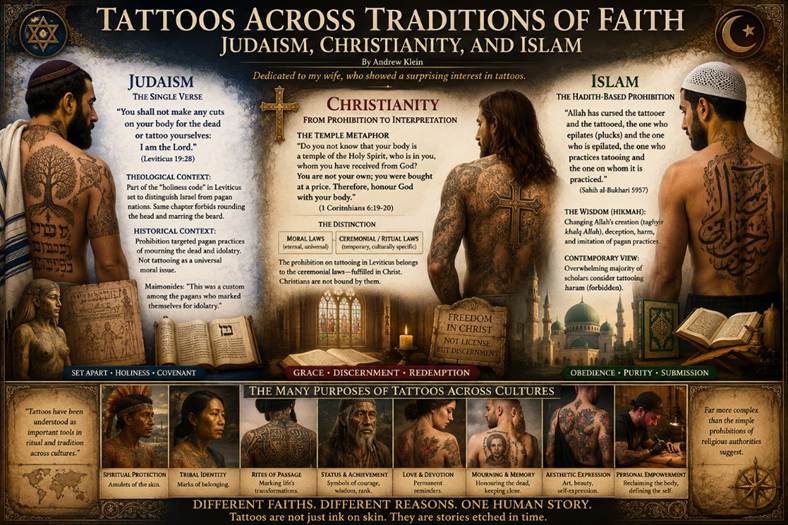
By Andrew Klein
Dedicated to my wife, who showed a surprising interest in tattoos.
Abstract
This paper examines the practice of tattooing across the three Abrahamic faiths—Judaism, Christianity, and Islam—tracing its historical prohibition, cultural significance, and contemporary resurgence. Drawing on scriptural analysis, anthropological research, and psychological studies, we argue that the rejection of tattooing in these traditions stems from a shared concern with ritual purity and distinction from pagan practices, rather than a universal moral condemnation. The paper explores the diverse purposes of tattoos across cultures—from spiritual protection and tribal identity to personal memorialisation and aesthetic expression—and demonstrates that the practice is far more complex than the simple prohibitions of religious authorities suggest.
Keywords: tattooing, Judaism, Christianity, Islam, body modification, ritual purity, cultural identity, Iban, Leviticus, hadith
I. Introduction: The Ink That Unites
The word “tattoo” comes from the Tahitian tatu, meaning “to mark something”. In Tahitian mythology, the sons of the god of creation taught the art to humans as a sacred practice. Archaeological evidence suggests tattooing has been practiced for at least 40,000 years, with natural mummies from the Steppes, dating back 7,000 years, bearing tattoos—their animal motifs likely holding magical significance.
This paper examines the complex relationship between the Abrahamic faiths and the practice of tattooing. We explore the shared hostility of Judaism, Christianity, and Islam toward tattoos, the deeper cultural and spiritual reasons for this hostility, and the ways in which tattooing persists—often as a form of resistance, identity, or devotion—despite religious prohibitions.
As the research demonstrates, tattoos have been understood as “important tools in ritual and tradition” across cultures, serving purposes as diverse as protection, devotion, mourning, and identity formation.
II. The Scriptural Foundations
A. Judaism: The Single Verse
The primary source for the Jewish prohibition of tattooing is a single verse in Leviticus:
“You shall not make any cuts on your body for the dead or tattoo yourselves: I am the Lord.” (Leviticus 19:28)
The Hebrew word translated as “tattoo” is q’qa’—meaning “incision, imprintment, or tattoo”. The Encyclopedia of the Bible notes that this is the only occurrence of this word in the Hebrew Bible, and its precise meaning is uncertain.
Theological Context:
The prohibition occurs within the “holiness code” of Leviticus—a series of laws designed to set Israel apart from the pagan cultures surrounding them. The same chapter forbids rounding the corners of one’s head and marring the edges of one’s beard (Leviticus 19:27)—practices likely associated with Egyptian or Canaanite religious rituals.
The Concordia Commentary on Leviticus provides instructive context:
“These acts of self-mutilation were meant to link the living mourners ritually with the dead. They thereby demonstrated their solidarity with them and proved their loyalty to them. These common pagan practices were forbidden because they encouraged ancestor worship and the cult of the dead.”
Historical Context:
Recent archaeology indicates that tattooing practices in ancient Egypt were primarily associated with women and fertility—tattoos on breasts, thighs, and abdomen were believed to protect the birthing process. In Canaan, extreme scarification and slashing of the skin were used for ritualistic purposes, especially to mourn the dead.
Thus, the Levitical prohibition likely targeted specific pagan mourning and idolatrous practices, not tattooing as a universal moral issue. Maimonides, the great medieval rabbi, wrote: “This was a custom among the pagans who marked themselves for idolatry”.
B. Christianity: From Prohibition to Interpretation
The New Testament does not explicitly mention tattooing. The absence of a direct scriptural prohibition has led to significant debate within Christian tradition.
The Temple Metaphor:
First Corinthians 6:19-20 states:
“Do you not know that your body is a temple of the Holy Spirit, who is in you, whom you have received from God? You are not your own; you were bought at a price. Therefore, honour God with your body.”
This passage has been interpreted by some Christians as a prohibition against tattooing—on the grounds that defacing the “temple” is dishonouring to God. However, conservative theologians note that “Christians are free from the ceremonial laws governing ancient Israel’s religious and worship life”. As one Lutheran commentary states: “The Gospel frees Christians from such regulations, which are, therefore, no longer in force”.
The Distinction:
Theologians distinguish between:
· Moral laws (eternal, universal)
· Ceremonial/ritual laws (temporary, culturally specific)
The prohibition on tattooing in Leviticus is understood to belong to the latter category—like the prohibition on eating pork or the requirement for ritual purity—which Christ fulfilled and Christians are no longer bound by.
C. Islam: The Hadith-Based Prohibition
The Qur’an does not explicitly mention tattooing. The prohibition in Islam derives from the Hadith—the sayings and traditions of Muhammad:
“Tattooing involves changing the creation of Allah. Prophet Muhammad cursed the one who does tattoos and the one for whom that is done.”
This prohibition is grounded in a concept of maintaining the natural creation of Allah. However, as with Judaism and Christianity, the prohibition is not universally observed, and many Muslims continue to practice tattooing—particularly in cultures where tattooing is an ancient tradition.
III. Tattoos in Cultural and Spiritual Practice
A. Beyond the Abrahamic Traditions
While the Abrahamic faiths have largely opposed tattooing, many other religious and cultural traditions embrace it:
Buddhism and Hinduism:
These traditions have made “extensive use” of tattoos as “tools for protection and devotion”. Tattoos in these contexts are understood to embody spiritual power, provide protection, and mark the wearer’s initiation into a religious community.
Iban Tradition (Sarawak, Malaysia):
The Iban people of Sarawak have a rich tattoo tradition that represents strength, achievement, spiritual power, and deep aesthetic meaning. Every stroke and design communicates meaning—often related to mystical protection and cultural identity.
Ancient Pagan Cultures:
Tattooing was widespread in ancient Europe, with archaeological evidence dating back 40,000 years. The Pazyryk mummies (c. 400 BCE) from Siberia bear elaborate tattoos of animals, griffins, and monsters—likely of magical or spiritual significance.
B. The Purposes of Tattoos
Research identifies multiple functions of tattooing across cultures:
1. Ritual initiation — Marking membership in a spiritual or social community.
2. Protection — Warding off evil spirits or misfortune.
3. Devotion — Demonstrating commitment to a deity or spiritual path.
4. Mourning — Expressing grief and connection to the dead.
5. Identity — Marking tribal, ethnic, or personal identity.
6. Aesthetic expression — The desire for beauty and self-expression.
C. Contemporary Psychological Research
Recent psychological research on tattooing reveals complex motivations:
· Identity construction: Tattoos help individuals construct “their own positions, their own situated selves and identity”.
· Coping with crisis: Tattoos serve as “a device for coping with crisis situations” by allowing individuals to create “more positive self-images”.
· Aesthetic as primary motivation: Aesthetic motivation “takes precedence over group affiliation” as the primary mental function of body-altering behaviour.
· Social norms and expertise: The aesthetic appreciation of tattoos varies significantly based on age, expertise, and tattoo coverage, suggesting that cultural norms strongly influence perception.
IV. The Rejection of Tattoos and the Rise of Secular Practice
A. Why Did Abrahamic Faiths Reject Tattoos?
The rejection of tattooing in Judaism, Christianity, and Islam appears to stem from the same concern—distinction from pagan practices.
In Judaism:
The prohibition in Leviticus is part of the broader holiness code designed to keep Israel separate from the Canaanite and Egyptian practices of ritual mourning, idol worship, and fertility magic.
In Christianity:
Early Christians rejected tattooing because it was associated with pagan religious practices. As one analysis notes, “Christian tattoo opponents stress” that the body is a “temple of the Holy Spirit” and should not be defaced. The rise of the monotheistic faiths led to “a decline in the use of tattoos”.
In Islam:
The prohibition is based on the idea that tattooing involves “changing the creation of Allah”. It is also connected to the concern that tattooing was a pagan practice.
B. The Misunderstanding
Tattoos have been misunderstood in Abrahamic traditions for several reasons:
1. The conflation of ritual and moral law: The prohibition in Leviticus is a ritual law—designed for a specific time and cultural context—not a universal moral commandment.
2. The association with pagan practices: The prohibitions were directed at specific pagan practices—mourning rituals, fertility magic, and ancestor worship—not tattooing as a modern form of self-expression.
3. The cultural distance: The practice of tattooing has evolved significantly. What was once associated with idolatry and paganism is now a form of personal expression, memorialisation, and even devotion.
C. Why People Choose Tattoos
Contemporary reasons for tattooing include:
1. Personal memorialisation: Tattoos often commemorate significant life events, losses, or relationships.
2. Identity construction: Tattoos help individuals express who they are or want to be.
3. Aesthetic expression: Many choose tattoos simply for their beauty.
4. Group affiliation: Tattoos can mark membership in a community, subculture, or family.
5. Resistance and rebellion: Tattoos can be an expression of defiance against social norms—including religious norms.
V. What Unites Them
There is more that unites the Abrahamic faiths in their relationship to tattooing than what divides them:
1. Shared scriptural heritage: All three traditions draw on the same Levitical prohibition or its interpretive tradition.
2. Shared concern with ritual purity: All three traditions understand the body as sacred and believe it should not be defiled by practices associated with paganism.
3. Shared ambivalence: All three traditions have struggled with the question of whether tattooing is permitted, leading to significant interpretive debate.
4. Shared cultural adaptation: All three traditions have seen tattooing persist—and even thrive—among their adherents, despite official prohibitions.
VI. Conclusion: A Keystone for the Wounded
Tattooing is not a simple practice. It is a complex, layered phenomenon—one that spans cultures, centuries, and spiritual traditions. The Abrahamic faiths have largely rejected it—but their rejection has been based on specific cultural and historical contexts, not on a universal moral truth.
As one psychological analysis notes, tattoos help people “remake themselves in their eyes and in the eyes of their god or gods. Their totem becomes part of a person and remakes the person into something and someone new”.
The stone that the builders rejected has become the keystone. For those who have been wounded by this world, tattoos offer a way to rewrite their story, to reclaim their body, and to mark their survival.
References
1. Scheinfeld, N. (2007). Tattoos and religion. Clinics in Dermatology, 25(4), 362-366.
2. Pawenteh, M., et al. (2021). Survival on the Skin: Communicating, Continuity and Preservation of the Iban Tattoo. Journal of Borneo Social Transformation Studies.
3. Rees, M. (2022). Tattooing in contemporary society: identity and authenticity. Routledge.
4. Tattoo. Encyclopedia of the Bible. Bible Gateway.
5. Scheinfeld, N. (2007). Tattoos and religion. Clinics in Dermatology.
6. Tattooing, while not a grave sin, is desecration of the body. Sun Sentinel.
7. Ringah, K., et al. (2025). Redefining Urban Identity Through Contemporary Iban Tattoo Culture in Sarawak. Journal of Borneo Social Transformation Studies, 11(1), 50-72.
8. Body alterations. (2025). Dissertation, Helmut-Schmidt-Universität.
9. Joersz, J.C. (2011). Q & A – The Lutheran Witness.
10. Sacred Mysteries: Why did Christians, Jews and Muslims ban tattoos? (2024). The Telegraph.
11. Csekő, C., et al. (2024). Living with and living by tattoos – discursive analysis of a bodily practice. History of the Human Sciences, 37(3-4), 391-410.
12. Justin Bieber tattoo of Jesus: Is it blasphemy? (2011). Christian Science Monitor.
13. Pawenteh, M. (2021). Survival on the skin.
14. Kazandjieva, J., et al. (1995). Unprofessional tattoos in Bulgaria – psychological aspects. Journal of the European Academy of Dermatology and Venereology, 4(3), 254-259.
15. Bible Verses About Tattoos. (2025). Bible Study Tools.
“The stone that the builders rejected has become the keystone.”

