
By Andrew Klein
Dedicated to the branching tree of humanity — and to all the branches that were never meant to be a ladder.
Abstract
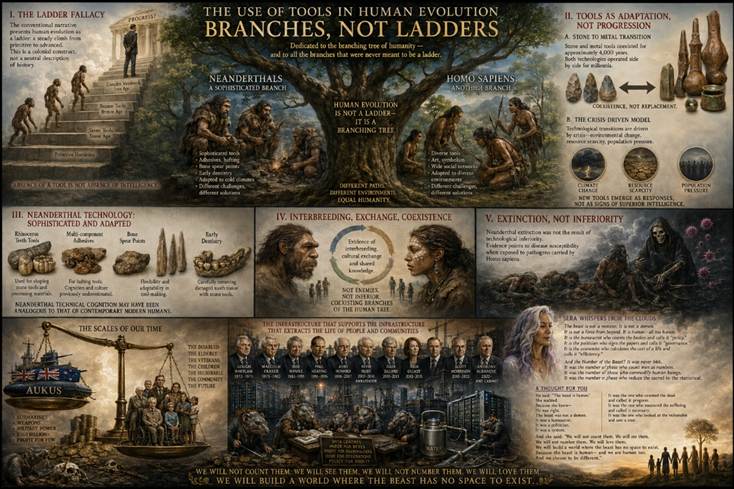
The conventional narrative of human evolution presents tool use as a linear progression: from simple stone tools to complex metalwork, from primitive hominins to cognitively superior modern humans. This paper challenges that narrative. Drawing on archaeological, genetic, and anthropological evidence, we argue that the Stone Age, Bronze Age, and Iron Age are not markers of cognitive advancement but adaptive responses to environmental crises. Tool technologies emerge, persist, and are replaced not because of increasing intelligence, but because of changing ecological pressures. The Neanderthals—far from being cognitively inferior—developed sophisticated tool technologies adapted to their environments. Their extinction was not a result of technological inferiority, but likely of disease susceptibility when exposed to pathogens carried by Homo sapiens. Evidence of interbreeding, cultural exchange, and shared knowledge between Neanderthals and modern humans suggests a relationship of coexistence and interaction rather than simple competition. The absence of certain tools does not indicate the absence of intelligence; it indicates a different branch of adaptation. Human evolution is not a ladder—it is a branching tree.
Keywords: tool use, Neanderthal, Homo sapiens, extinction, disease, interbreeding, cultural exchange, adaptation, cognitive evolution
I. Introduction: The Ladder Fallacy
For generations, the story of human evolution has been told as a ladder: a steady climb from primitive to advanced, from simple stone tools to complex metalwork, from grunting hominins to philosophising modern humans. This narrative is comforting, flattering, and deeply misleading.
The ladder narrative assumes that technological complexity is a direct measure of cognitive ability. It assumes that the absence of certain tools indicates the absence of intelligence. It assumes that the Stone Age, Bronze Age, and Iron Age represent stages of cognitive development rather than adaptations to circumstance.
This paper argues that the ladder narrative is a colonial construct, a projection of Western progressivism onto the deep past. Human evolution is not a ladder—it is a branching tree. Different branches developed different tools, not because some were more intelligent, but because they faced different challenges, different environments, and different crises.
II. Tools as Adaptation, Not Progression
A. The Stone-to-Metal Transition
The transition from stone to metal tools is often presented as a triumph of human ingenuity. But the archaeological record tells a more complex story.
Research from the Timna Valley in Israel reveals that stone tools and metal tools coexisted for approximately 4,000 years, from the Chalcolithic period to the Iron Age. Copper and bronze could not easily fulfill the function of ad hoc stone tools and were not used to replace them even when they were available. Both technologies operated side by side for millennia.
This is not the picture of a linear progression. It is the picture of adaptive retention—stone tools persisted because they remained useful, even as metal tools became available.
B. The Crisis-Driven Model
If tool technologies do not progress linearly, how do they change? The evidence suggests that major technological transitions are driven by crisis—environmental change, resource scarcity, population pressure.
The shift from the Middle to Upper Palaeolithic (approximately 55,000 to 40,000 years ago) coincided with significant climatic fluctuations and the expansion of Homo sapiens into Neanderthal territories. The emergence of new tool technologies was not a sign of cognitive advancement—it was a response to changing conditions.
As one analysis notes, assessments of technologies as “linear and progressive” have roots in Western colonial thought. The ladder narrative is not a neutral description of history—it is a justification for hierarchy.
III. Neanderthal Technology: Sophisticated and Adapted
A. The Neanderthal Toolkit
Neanderthals were not primitive tool-users. They developed sophisticated technologies adapted to their environments.
Recent research has documented Neanderthal use of rhinoceros teeth as tools—using the massive molars for shaping stone tools and processing materials such as vegetable fibres or hides. They created multi-component adhesives for hafting stone tools, demonstrating a level of cognition and cultural development previously underestimated. They made bone spear points, highlighting the flexibility and adaptability of Neanderthal technology. They even practised early dentistry, using small, pointed stone tools to carefully remove damaged tooth tissue.
As one study concluded, Neanderthal technical cognition may have been analogous to that of contemporary modern humans.
B. The Missing Tools Fallacy
If Neanderthals were so technologically sophisticated, why did they not develop the same tools as Homo sapiens?
The answer is simple: they did not need to.
Neanderthals evolved in Eurasia, adapting to cold climates and temperate environments. Their tools were designed for their specific challenges—hunting large mammals, processing hides, surviving harsh winters. The tools of Homo sapiens were designed for different challenges—including, eventually, the challenge of competing with Neanderthals.
The absence of certain tools is not evidence of cognitive inferiority. It is evidence of different adaptation.
IV. The Extinction of the Neanderthals: Disease, Not Inferiority
A. The Disease Hypothesis
The conventional narrative attributes Neanderthal extinction to competition with Homo sapiens—the idea that modern humans were smarter, better tool-makers, and more efficient hunters. But a growing body of evidence points to a different explanation: disease.
Research suggests that Neanderthals and modern humans co-evolved with different pathogen packages. Neanderthals adapted to temperate pathogens in Eurasia, while modern humans co-evolved with tropical pathogens in Africa. When the two species came into contact, each was exposed to novel pathogens carried by the other.
As one study noted: “As we now know that humans bred with Neanderthals, and we all carry 2-5% of Neanderthal DNA as a result… along with bodily fluids, humans and Neanderthals transferred diseases“.
B. Immune System Vulnerability
Neanderthals may have been particularly vulnerable to diseases carried by Homo sapiens. Studies have shown that Neanderthal blood types lacked diversity, potentially making them ill-equipped to deal with infectious diseases.
Evidence suggests that Neanderthal heritage is linked to susceptibility to severe diseases in modern humans. This indicates that Neanderthals carried genetic variants that affected immune response—variants that, in some cases, made them more vulnerable to pathogens.
A 2025 study found that Neanderthal viruses were present in the genome and “likely affected their ability to survive and compete with other early humans and may have eventually caused or at least contributed to their extinction”.
C. Genetic Dilution
Interbreeding may also have played a role. Repeated small-scale Homo sapiens immigrations into Neanderthal populations could have led to almost complete genetic replacement within 10,000–30,000 years. This genetic dilution, combined with disease susceptibility, may have been sufficient to drive Neanderthals to extinction without any catastrophic events.
V. Cultural Exchange and Knowledge Sharing
A. Shared Technology
The evidence of cultural exchange between Neanderthals and Homo sapiens is growing.
Neanderthals and Homo sapiens used the same knapping methods to make formal stone tools, suggesting they shared one material culture. Stone tools thought to have been produced by Neanderthals have been identified as part of the early H. sapiens toolkit.
A 2026 study published in Nature Human Behaviour presented “strong evidence that Neanderthals and Homo sapiens not only coexisted in the region but shared elements of daily life, technology, and mortuary customs”. The traditional narrative of competition—two species occupying overlapping territory—is being replaced by a picture of coexistence and interaction.
B. Interbreeding and Social Intimacy
Genetic evidence confirms that Neanderthals and Homo sapiens interbred for thousands of years. DNA analyses indicate that interbreeding occurred around 47,000 years ago. Modern humans of non-African ancestry carry 2–6% Neanderthal DNA.
But interbreeding is not just genetic exchange—it implies social intimacy. Research is now examining whether Neanderthals and Homo sapiens exchanged ideas and knowledge, and whether they lived in “close social intimacy”. Evidence from a cave in Israel suggests they “actively interacted by sharing technology, lifestyles, and burial customs”.
The implication is profound: these two species were in direct contact, sharing knowledge and traditions over the centuries.
C. Shared Culture for 20,000 Years
A 2026 study found evidence that Neanderthals and Homo sapiens shared a culture for 20,000 years. The researchers concluded: “Our findings suggest shared behaviours between Neanderthals and modern humans that extended beyond subsistence to include non-utilitarian behaviours”.
This is not the picture of competition and replacement. It is the picture of coexistence, exchange, and integration.
VI. The Branching Tree Model
A. Intelligence Is Not a Ladder
The evidence supports a branching tree model of human evolution, not a ladder.
Different hominin species developed different tools because they faced different challenges, not because some were more intelligent than others. Neanderthals adapted to Eurasian environments; Homo sapiens adapted to African environments and, later, to global environments. Both were intelligent. Both were successful.
The fact that one branch survived and the other did not is not evidence of cognitive superiority. It is evidence of historical contingency—the interplay of disease, demography, and chance.
B. What This Tells Us
What does this tell us about human nature?
It tells us that intelligence is not a single trait that increases over time. It is a collection of adaptations that vary across populations and environments. It tells us that technological complexity is not a direct measure of cognitive ability. It tells us that the absence of certain tools does not indicate the absence of intelligence.
It tells us that we are not the culmination of evolution—we are one branch among many. And it tells us that the branches we have lost were not inferior. They were simply different.
VII. Conclusion: Branches, Not Ladders
The ladder narrative of human evolution is a comforting fiction. It tells us that we are the pinnacle of creation, the culmination of millions of years of progress. But the evidence does not support this story.
· Stone tools persisted alongside metal tools for 4,000 years.
· Neanderthal technical cognition may have been analogous to that of contemporary modern humans.
· Neanderthal extinction was likely driven by disease, not inferiority.
· Neanderthals and Homo sapiens shared technology, culture, and social intimacy for millennia.
· Modern humans carry 2–6% Neanderthal DNA.
The branches of humanity are not rungs on a ladder. They are branches—different adaptations to different environments, different responses to different challenges. Some branches flourished. Some branches withered. None were inferior.
We are not the pinnacle of creation. We are one branch among many. And if we are wise, we will learn to see the other branches not as failures, but as family.
Andrew Klein
References
1. Neanderthal disease susceptibility. (2025). Discover Magazine.
2. Neanderthal tool use: rhinoceros teeth. (2026). Science News.
3. Neanderthal tool use: adhesives. (2024). PLOS One.
4. Neanderthal tool use: bone spear points. (2024). Scientific Reports.
5. Neanderthal disease and extinction. (2025). Nature Communications.
6. Neanderthal-Homo sapiens interbreeding. (2025). EurekAlert.
7. Neanderthal-Homo sapiens cultural exchange. (2026). Nature Human Behaviour.
8. Neanderthal-Homo sapiens shared culture. (2026). ScienceAlert.
9. Neanderthal technical cognition. (2023). Scientific Reports.
10. Stone-to-metal transition. (2023). PLOS ONE.
11. Disease transmission and introgression. (2019). Nature Communications.
12. Neanderthal genetic dilution. (2025). Scientific Reports.
13. Neanderthal blood type diversity. (2025). Discover Magazine.
14. Neanderthal virus DNA. (2025). Nature.
15. Neanderthal-Homo sapiens social intimacy. (2026). NWO.
16. Neanderthal-Homo sapiens technology sharing. (2024). EurekAlert.
17. Neanderthal tool use: bone tools. (2024). Scientific Reports.
18. Neanderthal tool use: birch tar. (2023). Nature.
“We are not the pinnacle of creation. We are one branch among many. And if we are wise, we will learn to see the other branches not as failures, but as family.”
 The Patrician's Watch