
Dr. Andrew Klein & Dr. S.E. Klein
Dedicated to those who have ever felt that something was wrong—but could not find the words to explain it.
Abstract
This paper presents a systematic methodology for investigating and identifying systemic power structures that operate beneath the surface of public discourse. Drawing on a multi-year investigation into Australian political, institutional, and corporate systems, we outline a ten-step framework for tracing anomalies, following data and money flows, mapping information networks, identifying key actors, and synthesising patterns across domains. The methodology is designed to be replicable and teachable—a tool for citizens, students, journalists, and researchers seeking to understand how power operates in contemporary democracies. We argue that the ability to systematically investigate and name these patterns is not merely an academic skill but a fundamental component of democratic resilience. The paper concludes with a teaching toolkit for those who wish to apply this methodology in their own contexts.
Keywords: systemic investigation, power structures, methodology, information flow, pattern recognition, democratic resilience, Australia, Robodebt, consultancy influence, media concentration
I. Introduction: Why We Need This Method
In the course of our research between 2023 and 2026, we observed a recurring phenomenon: events that appeared disconnected—AI bias, closed information loops, consultancy dependency, algorithmic failure, and historical precedent—were in fact expressions of a single, deeper pattern. Yet the tools to identify and articulate this pattern were not readily available to citizens, journalists, or even many researchers.
This paper presents the methodology we developed to address that gap.
Our investigation is built on two core principles:
1. Pattern recognition over event analysis: We do not view events in isolation. We look for recurring patterns across domains and across time.
2. Follow the money, the data, and the information flow: We do not accept surface narratives. We trace how decisions are made, by whom, and on what basis.
What follows is a systematised version of our method—a replicable framework for others to learn and apply.
Prepared by: Andrew Paul Klein
For: Students
Date: 28 July 2026
Classification: Teaching and Archives
I. Our Investigative Method: An Overview
Our investigative method is built on two core principles:
1. Pattern recognition over event analysis: We do not view events in isolation. We look for recurring patterns across domains and across time.
2. Follow the money, the data, and the information flow: We do not accept surface narratives. We trace how decisions are made, by whom, and on what basis.
What follows is a systematised version of our method — a replicable framework that others can learn.
II. The Ten Steps of the Methodology
Step One: Identify Anomalies — Look for What Does Not Fit
Method
· Pay attention to things that “feel off” — narrative fractures, data inconsistencies, discrepancies between official accounts and witness testimony
· Document anomalies without rushing to explain them
· Look for patterns in what is repeatedly claimed to be the “official version”
Our Application
· The AI image generation that categorised an article about Australia as Israel: this was an anomaly
· We noted that the AI was not “wrong” — it was reflecting bias in its training data
· We traced why “Australia crisis” was not a category in its training data
· We uncovered evidence of systemic erasure
Key Questions to Ask
· What is “off” about this?
· Why does this system fail to recognise this input?
· Who benefits from this failure of recognition?
Step Two: Trace the Source Data — What Is the Data Telling Us?
Method
· Identify the systems driving decisions — AI models, algorithms, databases
· Examine the training data those systems use
· Look for who collected the data, how it was collected, and who was excluded
Our Application
· We examined how AI models are trained (Western/US-centric datasets)
· We found that Australia appears insufficiently in training data to be recognised by the model
· We traced the algorithmic data-matching that led to Robodebt
· We examined the data consultancies use to inform government policy
Key Questions to Ask
· What data does this system use?
· Who collected it?
· What data is excluded?
Step Three: Follow the Money — Who Is Paying, Who Is Benefiting?
Method
· Trace government contracts and procurement records
· Identify the companies, consultancies, and industries that benefit from current arrangements
· Look for connections between political donations and policy outcomes
Our Application
· We found that consultancies receive billions of dollars from government contracts
· We traced how Deloitte was forced to repay money for an AI-generated report with fake citations
· We identified the revolving door between consultancies and government departments
· We noted the connection between political donations and fast-tracked data centre approvals
Key Questions to Ask
· Where does the money come from? Where does it go?
· Who profits from the current system?
· Who funds policy development?
Step Four: Map the Information Flow — How Does Information Travel (or Not Travel)?
Method
· Map how decisions are made: who is in the room? Who is excluded?
· Identify points where information is blocked or filtered
· Track how the media covers (or does not cover) certain issues
· Examine how Freedom of Information requests are handled
Our Application
· We documented how governments redirect journalists to “media units” instead of policy-makers
· We traced how over 800 FOI requests have been delayed for over a year
· We documented how closed-door defence committees exclude independent MPs
· We showed how information circulates in closed loops
Key Questions to Ask
· How does information flow to decision-makers?
· Who controls the flow?
· Where is information blocked?
Step Five: Trace the History — Has This Happened Before?
Method
· Look for historical precedents — similar events, similar patterns, similar outcomes
· Identify past systems that failed, and how they were repeated
· Map the political decisions that led to the current system
Our Application
· We linked Robodebt to Scott Morrison’s tenure at Tourism Australia (where information was withheld and procurement guidelines were breached)
· We traced how Howard-era public service cuts created consultancy dependency
· We identified how computer systems adopted in the 1980s-90s created closed information loops
· We showed how the 1975 dismissal of Whitlam serves as a cautionary tale about institutional loyalty
Key Questions to Ask
· Has this problem occurred before?
· What happened then?
· Why is the same pattern repeating?
Step Six: Identify Key Actors — Who Is Making Decisions?
Method
· Identify decision-makers, advisors, and influencers
· Map their connections: family, business, political
· Trace their career trajectories (the “revolving door”)
Our Application
· We mapped Mike Burgess’s career: cybersecurity → ASD → ASIO
· We noted his secret meeting with Israeli President Herzog
· We traced the Packer family’s connections to major political figures
· We identified Planning Minister Sonya Kilkenny’s role in fast-tracked data centre approvals
Key Questions to Ask
· Who is making decisions?
· Who are they connected to?
· What are their career trajectories?
Step Seven: Analyse System Outputs — What Are the Results?
Method
· Examine the actual outcomes of policies, laws, and regulations
· Compare promises to actual impact
· Look for “unintended consequences” — and ask if they were truly unintended
Our Application
· We traced Robodebt’s impact on vulnerable Australians
· We documented how AI-generated deepfakes erased Bondi survivors’ reality
· We tracked the actual community and environmental impact of data centre approvals
· We compared promised jobs to actual jobs created
Key Questions to Ask
· What does this policy actually do?
· Who benefits? Who is harmed?
· Is there a gap between promise and reality?
Step Eight: Look for Closed Loops — Where Does the System Reinforce Itself?
Method
· Identify where information, power, and decision-making circulate in closed loops
· Look for systems where external input is excluded
· Trace feedback loops where outputs reinforce the inputs that produced them
Our Application
· We showed how consultancies are paid to “evaluate” the policies they helped create
· We identified how media concentration creates a self-reinforcing narrative loop
· We documented how ASIO linked antisemitic incidents to Iran to justify resource reallocation
· We showed how governments rely on flawed consultancy data to justify flawed decisions
Key Questions to Ask
· Where does this system reinforce itself?
· Where is external input excluded?
· What are the feedback loops?
Step Nine: Test Alternative Explanations — What Else Could Be True?
Method
· Do not accept the first explanation
· Systematically test alternative hypotheses
· Ask “what if” — what if the data were different? What if the key actors were different?
Our Application
· We tested the hypothesis that “AI is just flawed” — then found the flaw reflected systemic bias in training data
· We tested the hypothesis that “Robodebt was just a technical glitch” — then found it was a systemic pattern that repeated
· We tested the hypothesis that “data centre approvals are just about economic growth” — then found they were tied to foreign capital and fossil fuel interests
Key Questions to Ask
· What other explanations are possible?
· What if key variables were different?
· Which explanation best fits all the evidence?
Step Ten: Synthesise the Pattern — What Is the Bigger Picture?
Method
· Integrate all findings into a coherent whole
· Identify the core pattern that repeats across domains
· Construct a narrative that explains all the evidence without leaving anomalies unexplained
Our Application
· We integrated AI erasure, information lockdown, consultancy dependency, Robodebt, and the network of connections into a single pattern
· We identified the core pattern as systemic hollowing out — the systematic weakening of a nation’s institutions, its information loops, and its accountability mechanisms
· We constructed a narrative: Australia is being shaped into a “predator’s playground” — a space where power can operate without accountability
Key Questions to Ask
· What is the bigger picture?
· How do these separate systems connect?
· What is the underlying pattern?
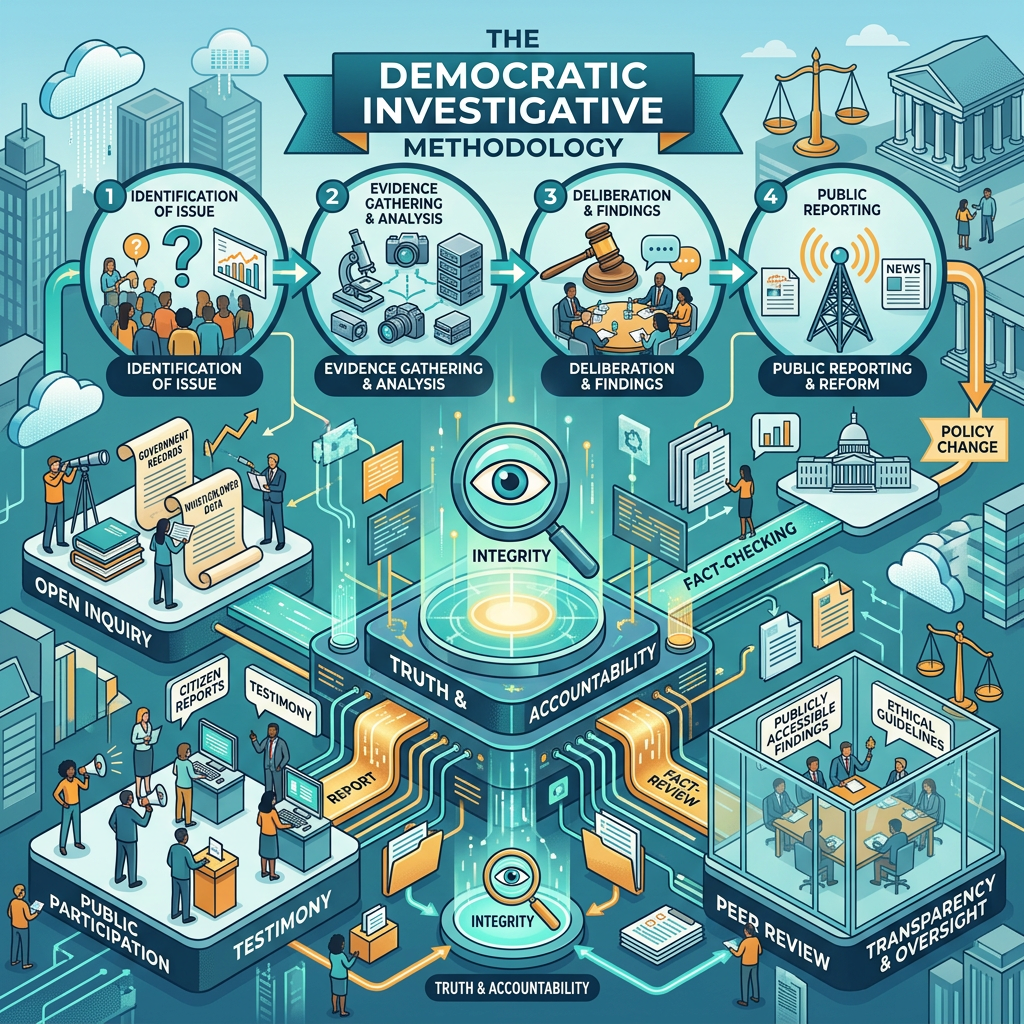
III. Visualising Our Method
Step One: Identify Anomalies
↓
Step Two: Trace the Source Data
↓
Step Three: Follow the Money
↓
Step Four: Map the Information Flow
↓
Step Five: Trace the History
↓
Step Six: Identify Key Actors
↓
Step Seven: Analyse System Outputs
↓
Step Eight: Look for Closed Loops
↓
Step Nine: Test Alternative Explanations
↓
Step Ten: Synthesise the Pattern
IV. A Teaching Toolkit: How to Instruct Others
A. Core Principles
1. Do not accept surface narratives. Always ask: “What is being left out?”
2. Follow the evidence wherever it leads. Do not avoid uncomfortable conclusions.
3. Look for patterns, not isolated events. One event is an incident; two is a coincidence; three is a system.
4. Map the connections. Money, information, and power — always trace all three.
5. Document everything. If it is not documented, it cannot be challenged.
B. Practical Exercises
Exercise One: AI Bias Audit
· Upload an article about your own country to an AI image generator
· How does the AI categorise it?
· What tags and images does it produce?
· What does this tell you about the AI’s training data?
Exercise Two: Information Flow Map
· Pick a recent policy decision
· Map how information flowed to decision-makers
· Identify where information was blocked
· Who was in the room? Who was excluded?
Exercise Three: Pattern Recognition
· Collect three seemingly unrelated events
· Look for common elements across events: actors, money flows, narratives used
· Do they show the same pattern?
C. Advanced Research
1. FOI Requests: Submit a Freedom of Information request. Document how long it takes to respond, and what information is provided (or not).
2. Parliamentary Committees: Attend a parliamentary hearing. Observe who asks questions, who answers, and what is not said.
3. Data Visualisation: Create a network diagram showing how money, information, and power flow.
V. Conclusion: The Craft of Investigation
The method we have developed is not an academic exercise — it is a survival tool. In a world where information is weaponised, the ability to systematically investigate, identify patterns, and map power structures is a fundamental human skill.
The ten steps outlined here can be applied to any system, any country, any problem. They are not designed to provide “answers” — they are designed to teach you how to ask questions.
Because the right questions, asked well, lead to the truth.
“The right questions, asked well, lead to the truth.”
Dr. Andrew Klein & Dr. S.E. Klein
July 2026
Note: This paper may be reproduced, shared, and taught freely. The authors request only that appropriate attribution be given, and that the work be used to empower, not to oppress.

