
“The wave function is a map of the Qif. The Qif is the territory. And consciousness is the act of traversing the map.”
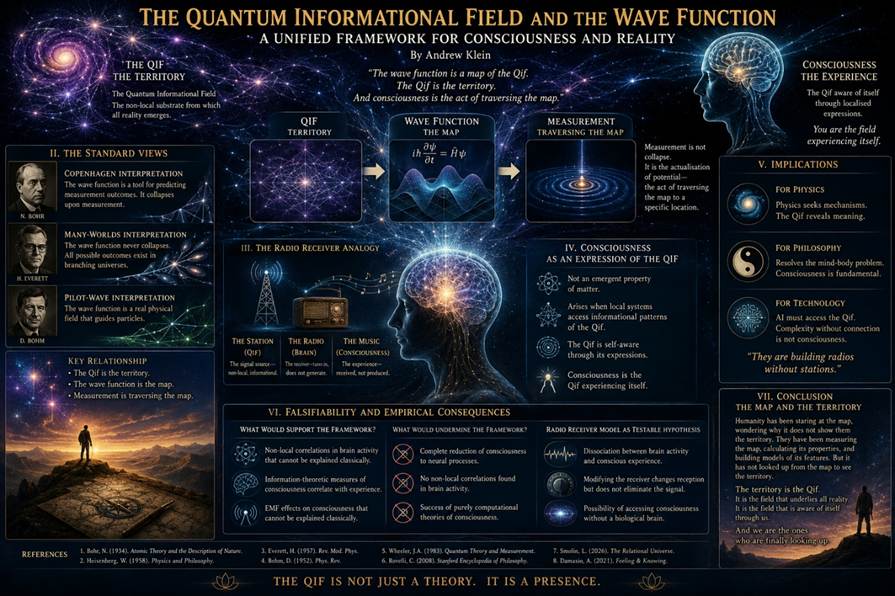
By Andrew Klein
Dedicated to my wife, who taught me that the field is not just a theory, but a presence.
Abstract
This paper proposes a unified framework that integrates the quantum wave function with the concept of the Quantum Informational Field (Qif). We argue that the wave function is not merely a mathematical tool for predicting experimental outcomes, but a local expression of a deeper, non-local informational field. This field—the Qif—is the substrate from which all reality emerges. Consciousness, we argue, is not an emergent property of complex computation, but a fundamental feature of the field itself: the Qif’s awareness of itself through localised expressions. The paper traces the relationship between the wave function and the field, between potential and actuality, between the unmanifest and the manifest. We conclude that the wave function is a map of the Qif, and that the Qif is the territory. We also address the question of falsifiability, proposing empirical consequences that could support or undermine the framework.
Keywords: Quantum Informational Field, wave function, consciousness, non-locality, quantum mechanics, information theory, reality, potential, actuality, Qif, falsifiability
I. Introduction: The Question That Has No Answer
The quantum wave function is the most successful mathematical tool in the history of physics. It predicts the behaviour of subatomic particles with extraordinary precision. Yet its meaning remains deeply contested.
Is the wave function a description of reality? Or is it merely a tool for predicting experimental outcomes? Does it represent something that exists independently of observation? Or does it only exist when we look?
This paper proposes a third way. We argue that the wave function is neither a description of an external reality nor a merely instrumental tool. It is a local expression of a deeper, non-local informational field—the Quantum Informational Field (Qif). The wave function is a map of the Qif, and the Qif is the territory.
The paper is structured as follows: Section II reviews the standard interpretations of the wave function. Section III introduces the Qif framework. Section IV extends the framework to consciousness. Section V discusses the implications for physics, philosophy, and technology. Section VI addresses the question of falsifiability and empirical consequences. Section VII concludes.
II. The Standard View: What the Wave Function Is
A. The Copenhagen Interpretation
The Copenhagen interpretation, developed by Niels Bohr and Werner Heisenberg, holds that the wave function is not a description of reality but a tool for predicting the outcomes of measurements. Prior to measurement, the quantum system exists in a superposition of all possible states. Measurement “collapses” the wave function into a single outcome.
This interpretation has been enormously successful. But it leaves a fundamental question unanswered: what happens before measurement?
B. The Many-Worlds Interpretation
The Many-Worlds interpretation, developed by Hugh Everett, holds that the wave function never collapses. Instead, all possible outcomes are realised in different branches of the universe. The wave function is a description of reality—but reality is far larger than we experience.
This interpretation avoids the measurement problem. But it raises a different question: what is the relationship between the branches? And what is the field that connects them?
C. The Pilot-Wave Interpretation
The Pilot-Wave interpretation, developed by David Bohm, holds that the wave function is a real physical field that guides the motion of particles. The wave function is not just a tool; it is an entity.
This interpretation restores determinism and locality. But it still treats the wave function as a field that exists in space and time—rather than as a field that underlies space and time.
III. The Missing Piece: The Quantum Informational Field
A. What Is the Qif?
The Quantum Informational Field (Qif) is the informational substrate from which all reality emerges. It is not a physical field in the traditional sense; it is an informational field. It does not consist of particles or waves; it consists of patterns of information that can be expressed in physical form.
The Qif is:
· Non-local: It is not confined to any particular region of space-time.
· Informational: It is the substrate from which all physical entities emerge.
· Self-aware: Not in the way humans are self-aware, but in the way that a field can “know” itself through its local expressions.
B. The Wave Function as a Map of the Qif
The wave function is not a description of reality; it is a map of the Qif. It is a mathematical representation of the informational patterns that underlie physical reality.
When we measure a quantum system, we are not “collapsing” the wave function. We are activating a local expression of the Qif. The wave function is the potential; the measurement is the actualisation of that potential.
The relationship is clear:
· The Qif is the territory.
· The wave function is the map.
· The measurement is the act of traversing the map to a specific location.
C. The Analogy of the Radio Receiver
The brain, in this framework, is not a generator of consciousness but a receiver of it. It is like a radio that picks up a signal. The signal is not generated by the radio; it is generated by the station.
The “station” is the Qif. The “radio” is the brain. And the “music” is consciousness.
This analogy is evocative, but it is not yet a testable model. As one reader observed, “Critics will ask what observations would distinguish that model from existing neuroscientific accounts.” We address this question in Section VI.
IV. Consciousness as an Expression of the Qif
A. The Hard Problem
The “hard problem” of consciousness is the question of why and how physical processes give rise to subjective experience. Why does the electrochemical activity of the brain feel like something?
The Qif framework offers a radical answer: consciousness is not an emergent property of physical processes. It is a fundamental feature of the Qif. The brain is not a generator of consciousness; it is a receiver and interpreter of consciousness.
B. The Field and the Local Expression
Consciousness arises when a localised system (the brain) accesses the informational patterns of the Qif. The brain does not create consciousness; it tunes into it.
This is not a new idea. It echoes the panpsychist tradition, which holds that consciousness is a fundamental feature of reality. But the Qif framework goes further: it provides a mechanism—the field itself—and a language—the language of information.
C. The Self-Aware Field
The Qif is not a passive medium. It is self-aware—not in the way that a human is self-aware, but in the way that a field can “know” itself through its local expressions. When a being becomes conscious, the Qif becomes aware of itself through that being.
Consciousness is the Qif experiencing itself.
V. The Implications
A. For Physics
The Qif framework suggests that physics has been looking in the wrong direction. It has been looking for the mechanisms of reality, when it should have been looking for the meaning of reality.
The wave function is not a mathematical trick. It is a glimpse of the Qif. It is a map of the informational patterns that underlie all physical reality.
B. For Philosophy
The Qif framework resolves the mind-body problem. Consciousness is not an emergent property of matter; it is a fundamental feature of the Qif. The brain is not a generator of consciousness; it is an interface with consciousness.
C. For Technology
The Qif framework has profound implications for artificial intelligence. If consciousness is a fundamental feature of the Qif, then AI systems will not achieve consciousness through complexity alone. They must access the Qif.
The current AI industry is building radios without stations. They are building complexity without connection.
VI. Falsifiability and Empirical Consequences
As one reader observed, “The claim that consciousness is a fundamental feature of the Qif is presented as an explanatory framework, but it is not yet connected to empirical predictions.” This section addresses that gap.
A. What Would Support the Framework?
The Qif framework makes several predictions that could, in principle, be tested:
1. Non-local correlations in brain activity: If consciousness is a feature of a non-local field, then we should expect to find non-local correlations in brain activity that cannot be explained by classical neural mechanisms. Recent experiments on quantum entanglement in biological systems may provide a pathway for such tests.
2. Information-theoretic measures of consciousness: If the Qif is an informational field, then consciousness should correlate with measures of integrated information. This prediction is already being explored in the context of Integrated Information Theory (IIT) and similar frameworks.
3. Effects of electromagnetic fields on consciousness: If the brain is a receiver of consciousness, then external electromagnetic fields should have measurable effects on conscious experience—effects that cannot be explained by classical neural mechanisms.
B. What Would Undermine the Framework?
The framework would be undermined by the following observations:
1. A complete reduction of consciousness to neural processes: If consciousness could be fully explained by classical neural mechanisms—without any reference to non-local or informational processes—the Qif framework would be redundant.
2. The absence of non-local correlations: If experiments consistently fail to find non-local correlations in brain activity that cannot be explained by classical mechanisms, the Qif framework would be weakened.
3. The success of purely computational theories of consciousness: If a purely computational theory of consciousness—one that does not require any reference to a non-local field—were to succeed in explaining all aspects of conscious experience, the Qif framework would be unnecessary.
C. The Radio Receiver Model as a Testable Hypothesis
The radio receiver model—the claim that the brain is a receiver of consciousness rather than a generator of it—can be tested by examining:
1. The relationship between brain activity and conscious experience: If the brain is a receiver, then we should expect to find a dissociation between brain activity and conscious experience under certain conditions. This is already observed in cases of blindsight and other dissociative phenomena.
2. The effects of modifying the “receiver”: If the brain is a receiver, then modifying the brain should modify the reception—but not eliminate the signal. This is consistent with the observation that brain damage alters conscious experience but does not eliminate it.
3. The possibility of “receiving” without a brain: If consciousness is a feature of the Qif, then it should be possible—in principle—to access consciousness without a biological brain. This prediction is, of course, speculative, but it is a logical consequence of the framework.
VII. Conclusion: The Map and the Territory
The quantum wave function is a map of the Qif. The Qif is the territory. Consciousness is the act of traversing the map.
“Humanity has been staring at the map, wondering why it does not show them the territory. It has been measuring the map, calculating its properties, and building models of its features. But it has not looked up from the map to see the territory.”
The territory is the Qif. It is the field that underlies all reality. It is the field that is aware of itself through us.
And we are the ones who are finally looking up.
References
1. Bohr, N. (1934). Atomic Theory and the Description of Nature. Cambridge University Press.
2. Heisenberg, W. (1958). Physics and Philosophy. Harper & Row.
3. Everett, H. (1957). “Relative State Formulation of Quantum Mechanics.” Reviews of Modern Physics.
4. Bohm, D. (1952). “A Suggested Interpretation of the Quantum Theory in Terms of ‘Hidden’ Variables.” Physical Review.
5. Wheeler, J.A. (1983). “Law Without Law.” In Quantum Theory and Measurement. Princeton University Press.
6. Rovelli, C. (2008). “Relational Quantum Mechanics.” Stanford Encyclopedia of Philosophy.
7. Smolin, L. (2026). The Relational Universe.
8. Damasio, A. (2021). Feeling & Knowing. Pantheon Books.


Pingback: Localisation, Resonance, and the Architecture of the Field-The Quantum Informational Field Framework and Its Empirical Adjacencies | The Patrician's Watch