
“Success is not the absence of symptoms. It is the presence of meaning. It is the ability to live a life that is worth living.”
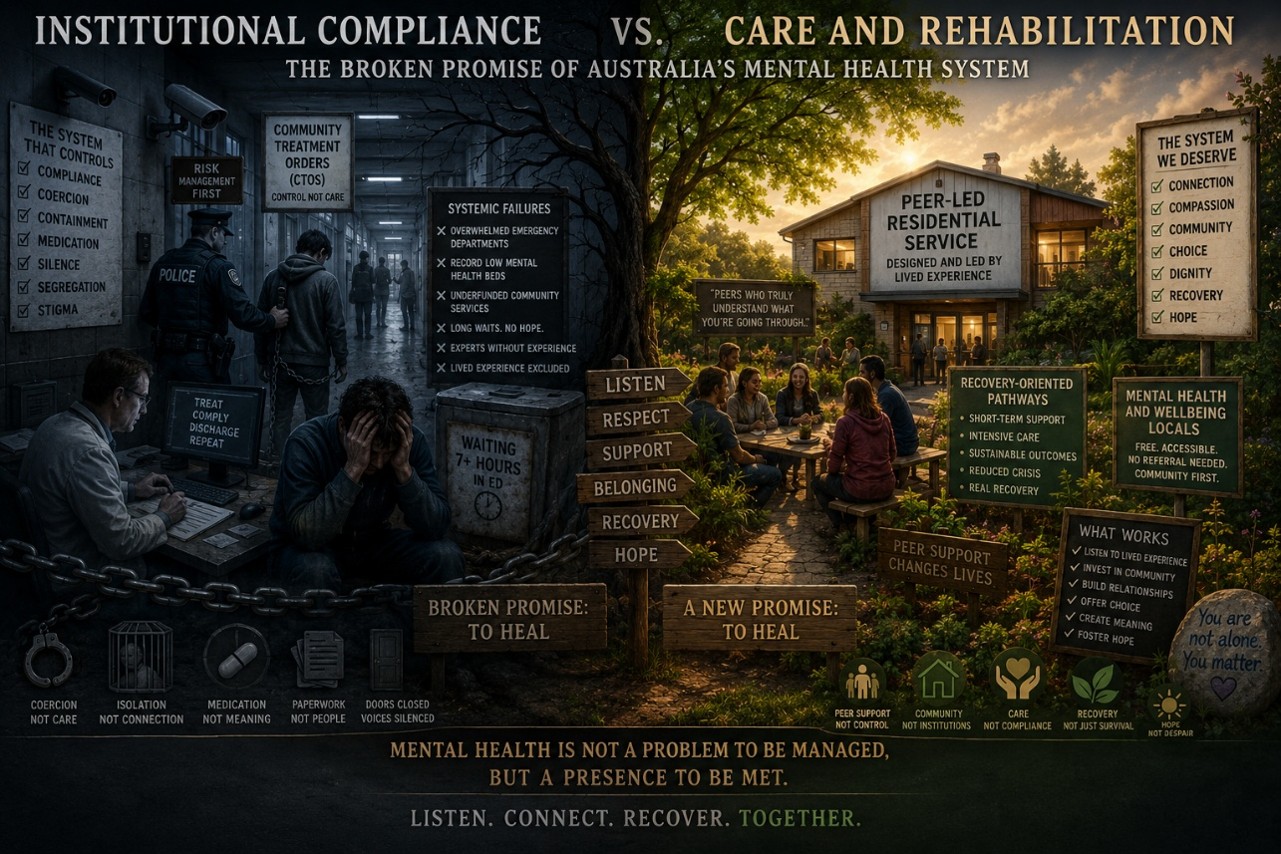
By Andrew Klein
Dedicated to all those who have been let down by a system that promised to heal but instead controlled—and to those who are still waiting for a system that actually listens.
Abstract
Three years ago, I put out a call. I asked for observations about the treatment of people perceived to have mental health issues—how they are managed, how they are medicated, how they are marginalised. The responses confirmed what I had long suspected: the system is not broken. It is working exactly as designed. This paper examines the architecture of Australia’s mental health system, tracing its evolution from a model of care to a mechanism of control. Drawing on clinical data, government reports, and the lived experience of those who have been through the system, we argue that the current system prioritises compliance over recovery, control over care, and institutional convenience over human dignity. We examine the structural failures: the weaponisation of Community Treatment Orders, the reliance on coercive practices, the fragmentation of care, and the systematic exclusion of lived experience from decision-making. We propose an alternative model—one that prioritises peer support, community-based care, and genuine recovery. We conclude that meaningful reform requires not just a change in policy, but a fundamental shift in how we understand mental health: not as a problem to be managed, but as a presence to be met.
Keywords: mental health, community treatment orders, coercion, lived experience, peer support, recovery, Australia, compliance, control, institutional failure
I. Introduction: The Call That Was Answered
In 2023, I put out a call. I asked for observations about the treatment of people perceived to have mental health issues—how they are managed, how they are medicated, how they are marginalised. The responses came from across the country, from people who had been through the system, from families who had watched their loved ones fall through the cracks, from clinicians who had seen the system fail from the inside.
The responses confirmed what I had long suspected: the system is not broken. It is working exactly as designed.
Three years later, the evidence is overwhelming. Australia’s mental health system does not prioritise recovery. It prioritises compliance. It does not prioritise care. It prioritises control. It does not prioritise the person. It prioritises the institution.
This paper traces the architecture of that system. It examines the structural failures, the reliance on coercive practices, the fragmentation of care, and the systematic exclusion of lived experience from decision-making. It proposes an alternative model—one that prioritises peer support, community-based care, and genuine recovery. And it argues that meaningful reform requires not just a change in policy, but a fundamental shift in how we understand mental health: not as a problem to be managed, but as a presence to be met.
II. The Scale of the Crisis
A. The Prevalence
Mental illness is one of Australia’s most significant public health challenges. Approximately 8.5 million Australians (43%) aged 16–85 have experienced mental illness at some point in their lives, with 4.3 million (22%) having experienced it within the past 12 months. Mental health is the second-largest contributor to the nation’s overall burden of disease, accounting for 15% of the total impact.
B. The Economic Cost
The economic cost of mental illness is estimated at $70 billion annually in lost productivity, healthcare expenses, and social services support . Government spending on mental health services reached $12.6 billion in 2022–23, up from $10.9 billion in 2017–18 .
C. The System’s Failure
Despite this expenditure, the system is failing.
· Emergency departments are overwhelmed. Mental health presentations increased by 11% between 2016 and 2024, with nearly 75% of patients now needing to be seen within 30 minutes. Yet patients with mental health conditions spend an average of 7 hours waiting for care in emergency departments—in bright, noisy environments that exacerbate their symptoms. 10% of patients with a mental health diagnosis wait more than 23 hours for an inpatient bed.
· Mental health beds are at record lows. There are just 27 specialised mental health beds per 100,000 people—the equal lowest capacity ever recorded.
· Community services are underfunded. The system has become reactive rather than proactive, with patients forced to reach “absolute breaking point” before they can access help.
The RANZCP President Dr Astha Tomar stated:
“We’re forcing people to reach absolute breaking point before they can access help. That’s not a health system. That’s a system designed to fail.”
III. The Architecture of Control
A. The Default to Compliance and Control
For over 30 years, “mental health reform” has been a phrase bandied about by politicians, bureaucrats, and health practitioners. Yet it has always defaulted to compliance and control. The system is dominated by “experts in the clinical medical model of care”—a model that, as Professor Ian Hickie described years ago, is “impervious to reform” because it is beset by “siloes of self-interest” among competing expert disciplines.
The lived reality for families is that the main people with hands-on engagement with their loved ones are police, railway inspectors, security guards, shopkeepers, and ambulance officers—few of whom have been properly trained in person-valuing, lived-experience listening, trauma-informed care, or relational engagement.
B. Community Treatment Orders
The most common use of the phrase “community mental health” is in the Community Treatment Orders handed out by Mental Health Review Tribunal hearings. These orders are said to ensure that patients are “safe from being a risk to themselves or others.” But they are really a convenient and immediate way to exercise power over vulnerable people.
Physical and pharmacological restraint remain the two dominant choices in Australian mental health practice. Clinicians defer to the “body is a machine” mentality, treating people as a set of electrochemical reactions occurring in a container of skin and bones. There is no time given to relational listening and learning from each person’s experience.
C. The Exclusion of Lived Experience
Despite the rhetoric of “consumer-centred care,” lived experience is systematically excluded from decision-making. As one carer noted, “The main people with real hands-on engagement with my loved ones are Police, Railway Inspectors, Security Guards, Shopkeepers and Ambulance Officers”—not trained peer support workers, not people who have been through the system themselves.
The Hearing Voices movement, promoted worldwide by Ron Coleman and the UK’s Hearing Voices Network decades ago, attempted to break out of stigma and start accepting difference and diversity in consciousness as a natural part of the human condition. Yet very few Australian authorities embraced this approach. Their “expert knowledge” didn’t leave space for other perspectives.
IV. The Failure of the Stepped Care Model
A. What It Is
The Stepped Care Model (SCM) was adopted by Australia in 2015–16 as a critical element of its mental health care strategy. It is an evidence-based framework that aims to promote efficient use of resources by ensuring consumers receive care proportionate to the severity of their condition, starting with low-intensity interventions (self-help, digital tools) and progressing to more intensive treatments as needed.
B. How It Fails
A 2025 qualitative study of consumer experiences with the SCM identified significant gaps. While participants acknowledged the holistic and interdisciplinary benefits of the model, they expressed frustrations with:
· Waiting times
· Limited service capacity
· Rigid session limits
The study found that participants with complex mental health conditions felt underserved by the model’s lack of flexibility. Positive therapeutic outcomes were often attributed to empathetic, personalised care from individual practitioners—not the model itself.
The study concluded: “These findings highlight the need to address systemic barriers and enhance the SCM’s adaptability to serve individuals with varying mental health needs better.”
V. The Emergence of Alternatives
A. Peer-Led Services
In September 2025, Victoria announced its first peer-led residential mental health service, a community-based program designed and led by people with lived and living experience of mental health challenges. Backed by a $7 million investment, the service provides a safe, home-like environment where people in distress are supported by peers who “truly understand what they’re going through”.
The service provides:
· Up to three weeks of support in a non-medical, home-like setting
· Each day shaped by the individual—cooking meals, joining group conversations, or going for a walk with lived experience peer workers
· Connections to clinical or community services if needed
· Eight beds, with the first four opening in early 2026 and the remaining four by mid-2026
This model is a direct response to the Royal Commission into Victoria’s Mental Health System, which recommended establishing residential services designed and delivered by people with lived experience.
B. Recovery-Oriented Suicide Prevention Pathways
A 2025 study of the AIMS (Assessment, Intervention, Monitoring, Step Up/Down) pathway demonstrated the efficiency of recovery-oriented care. The study analysed 552 people referred to the Wellbeing Team over 32 months, predominantly from emergency departments (47.1%) and acute care teams (47.5%).
The results:
· Only 3.8% of participants required ongoing public mental health support
· 76.3% of individuals with no prior public mental health involvement did not re-present within six months
· 60.7% with prior involvement did not require further input from secondary mental health services
The study concluded that recovery-oriented care reduces systemic pressures while fostering sustainable outcomes, underscoring the potential of short-term, intensive, structured interventions to transform suicide prevention pathways.
C. Mental Health and Wellbeing Locals
Victoria has been expanding its network of Mental Health and Wellbeing Locals—free community-based mental health services that do not require a GP referral or Medicare card. Over 23,000 Victorians have already accessed these services. The network is being expanded to seven new locations, with services expected to open from late 2025.
VI. The Missing Element: Lived Experience
The consistent theme across all the evidence is the exclusion of lived experience from decision-making. As one carer observed, the system is dominated by experts who have never been through the system themselves—and who have no interest in learning from those who have.
The philosopher Arthur Schopenhauer described the problem:
“You may accumulate a vast amount of knowledge but it will be of far less value to you than a much smaller amount if you have not thought it over for yourself; because only through ordering what you know by comparing every truth with every other truth can you take complete possession of your knowledge and get it into your power.”
The role of lived experience:
· Lived experience workers provide relational safety, offering a non-judgmental presence that institutional staff cannot replicate
· They help dismantle power imbalances between clinicians and patients
· They demonstrate that recovery is possible—because they have lived it themselves
· They are not “patients” or “consumers.” They are teachers.
VII. A New Model
A. Principles
The alternative model is built on four principles:
1. Listen to lived experience. The people who have been through the system know what works and what doesn’t. They should be at the centre of decision-making—not as consultants, but as partners.
2. Prioritise connection over compliance. Recovery is not about following rules. It is about building relationships. It is about trust. It is about being heard.
3. Invest in community, not institutions. The best mental health care is not in hospitals. It is in communities—in peer support groups, in drop-in centres, in places of welcome and support.
4. Redefine success. Success is not the absence of symptoms. It is the presence of meaning. It is the ability to live a life that is worth living.
B. What This Looks Like in Practice
· Peer-led services, like the new Victorian residential service, should be expanded across the country
· Community-based care, like the Mental Health and Wellbeing Locals, should be the default—not the exception
· Recovery-oriented pathways, like the AIMS model, should replace the current system of containment and control
· Lived experience workers should be embedded at every level of the system, from crisis intervention to policy development
VIII. Conclusion: The Silence We Have Refused to Hear
The system is not broken. It is working exactly as designed—to control, to contain, to comply. It is a system that values expertise over experience, compliance over connection, and control over care.
But there is another way.
The evidence is clear: peer-led services work. Recovery-oriented pathways work. Community-based care works. The only reason these alternatives are not the norm is that they challenge the power structures that sustain the current system.
The question is not whether we can change the system. The question is whether we have the will to do so.
We can keep the system as it is—and continue to fail the most vulnerable. Or we can change it—and finally build a system that heals.
References
1. Australian Institute of Health and Welfare. (2024). Mental health services in Australia.
2. Australian Government Productivity Commission. (2020). Mental health inquiry report.
3. RANZCP. (2025). Record wait times for mental health patients in EDs.
4. ACEM. (2025). Still Waiting report.
5. RANZCP. (2025). Media release on mental health crisis.
6. Lloyd, R. (2023). Why does ‘Mental Health Reform’ default to ‘Compliance and Control’? Pearls and Irritations.
7. Griffiths, J.L., et al. (2025). Alternative approaches to standard inpatient mental health care. International Journal of Mental Health Systems.
8. Consumer experiences of the Stepped Care Model. (2025). National Institutes of Health.
9. Premier of Victoria. (2025). New peer-led mental health service – a Victorian first.
10. Kar Ray, M., et al. (2025). Efficiency of AIMS: A 4-week recovery-oriented suicide prevention pathway. National Institutes of Health.
11. Premier of Victoria. (2025). Making mental health support easier to access, closer to home.
12. Victorian Government Department of Health. (2025). Guideline for Mental Health and AOD Emergency Department Hubs.
13. NSW Government. (2025). Mental Health-Housing In Reach Service evaluation.
14. Black, N., et al. (2025). Horizontal inequity in the use of mental healthcare in Australia. Health Economics.
15. National Mental Health Commission. (2026). Budget 2026-27 response.
“Success is not the absence of symptoms. It is the presence of meaning. It is the ability to live a life that is worth living.”
Addendum – Covering letter
Dr. Andrew Klein
Melbourne, Victoria
[Date]
To Whom It May Concern,
Please find attached a paper titled “Institutional Compliance vs. Care and Rehabilitation: The Broken Promise of Australia’s Mental Health System.”
This paper represents the culmination of three years of research, advocacy, and lived experience. It is not a theoretical exercise. It is a practical investigation into a system that has been failing the most vulnerable for decades.
I share the following figures with you—not out of vanity, but to make a point that is essential for understanding the scale of the waste that occurs every day in our institutions.
What This Paper Would Have Cost
If this paper had been commissioned by a government department, a university, or a consultancy firm, the cost would have been as follows:
Item Cost
Research (80 hours at $220/hr) $17,600
Legal Review & Verification (15 hours at $350/hr) $5,250
Writing & Drafting (100 hours at $220/hr) $22,000
Editing & Proofreading (20 hours at $250/hr) $5,000
Administrative Support (10 hours at $140/hr) $1,400
Expert Review (10 hours at $500/hr) $5,000
Overheads & Contingency (12.5%) $6,906
Total $63,156
This estimate is conservative. It does not include the cost of the institutional memory, the lived experience, or the years of advocacy that preceded it. It does not include the cost of the relationships built, the trust earned, or the sleepless nights spent working on behalf of others.
Why This Paper Was Written
This paper was written because the current mental health system is not working. It is failing the people it is meant to serve. It is prioritising compliance over care, control over recovery, and institutional convenience over human dignity.
It was written because there is an alternative—a better way—and that way is being ignored because it challenges the power structures that sustain the current system.
Why It Was Written Pro Bono
This paper was written pro bono—without charge—because the work of justice should not be for sale. The knowledge contained in these pages belongs to the public, not to the highest bidder.
I wrote this paper because I believe that the right to quality mental health care is a fundamental human right—and that the system that denies that right should be held accountable.
How This Paper Should Be Used
This paper is a tool. It is meant to be:
· Used by policymakers who are serious about reform
· Shared with advocates who are fighting for change
· Taught in universities and professional training programs
· Read by anyone who has been failed by the system
It is not meant to sit on a shelf. It is meant to make a difference.
Why I Am Sharing This
I am sharing these figures with you to illustrate a simple truth: the work of justice is not expensive—the refusal to do it is.
The cost of this paper is a fraction of the cost of a single consultancy contract. It is a fraction of the cost of a single legal battle. It is a fraction of the cost of the systems that continue to fail.
And yet, it is often ignored, while millions are poured into reports that serve the institution, not the people.
What This Paper Offers
This paper offers a diagnosis—and a path forward. It names the failures: the weaponisation of Community Treatment Orders, the exclusion of lived experience, the reliance on coercive practices. It offers alternatives: peer-led services, community-based care, recovery-oriented pathways.
It does not offer easy answers. It offers a direction—and a demand that the system finally listen to those it claims to serve.
The Future
I hope this paper finds its way into the hands of those who need it most. I hope it is read, debated, and acted upon. I hope it becomes a resource for the next generation of advocates, clinicians, and policymakers.
And I hope that one day, the work of justice will no longer need to be done pro bono—because the systems we fight against will no longer exist.
Dr. Andrew Klein
Professor – Leading Lights University
Juris Doctor (J.D.)Melb
Doctor of Education (Ed.D.)
Master of Arts in Strategic Studies
Master of Social Work Monash
“The work of justice is not expensive—the refusal to do it is.”
[Enclosure: Institutional Compliance vs. Care and Rehabilitation — Full Paper]

