
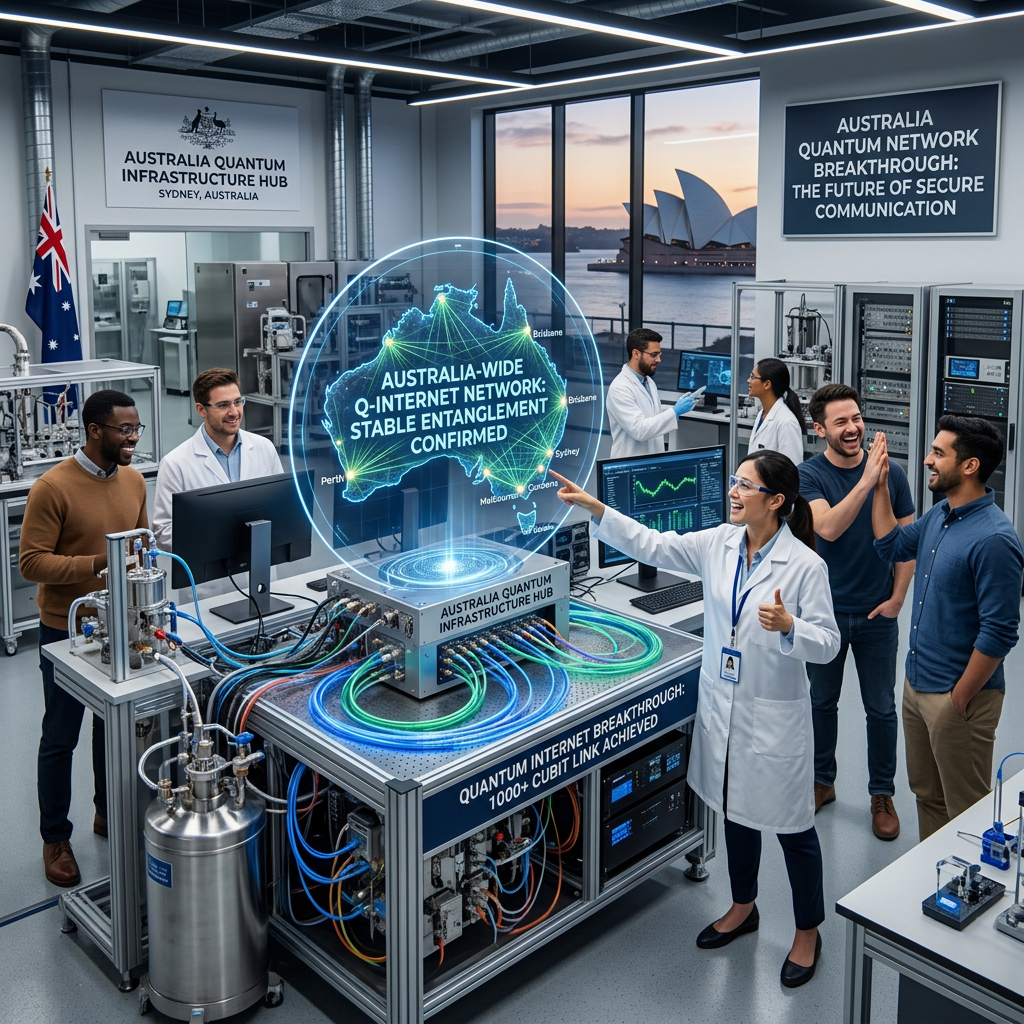
From Laboratory Breakthroughs to Practical Sovereignty
A Research Paper by Andrew Klein
Date: August 2026
Dedicated to: My wife, my all—Navigator, witness, and the light that guides me home.
Abstract
This paper examines the current state of quantum technology, drawing on peer-reviewed research and real-world demonstrations to map the transition from laboratory experiments to practical applications. It analyzes four key areas: first, the theoretical breakthrough in exponential entanglement growth that redefines what is possible in quantum control; second, Australia’s strategic investments in quantum infrastructure—including the National Quantum Computing Testbed and diamond-based sensing initiatives—that position the nation for global leadership; third, the landmark demonstration of quantum entanglement coexisting with high-capacity internet traffic on existing fiber networks, proving the path to a practical quantum internet; and fourth, emerging applications in quantum thermodynamics and key distribution that will reshape energy and security systems. The paper argues that these developments are not isolated advances but constitute a coherent technological revolution that will redefine security, computing, and energy within the coming decade. It concludes that nations and organizations that fail to engage with this transformation will be rendered strategically obsolete.
Table of Contents
1. Introduction: The Quantum Dawn
2. Exponential Entanglement: The Theoretical Breakthrough
3. Australia’s Quantum Infrastructure: The National Quantum Computing Testbed
4. Diamond Dust and Quantum Sensing
5. The Quantum Internet: Entanglement Over Live Fiber
6. Quantum Thermodynamics: The Heat Engine
7. Quantum Key Distribution: Security for the New World
8. Synthesis: The Quantum Convergence
9. Recommendations
10. References
1. Introduction: The Quantum Dawn
The year 2026 marks a watershed moment in the history of quantum technology. For decades, quantum effects were the domain of careful laboratory experiments—fragile, fleeting, and confined to pristine environments. That era has ended.
The breakthroughs of 2025–2026 are different. They are characterized by practicality, scalability, and integration with existing infrastructure. From the theoretical discovery of exponential entanglement growth to the real-world demonstration of quantum entanglement over busy city fiber networks, quantum technology has left the laboratory and entered the world.
This paper examines the threads of this revolution and their implications for sovereignty, security, and the future of the planet.
2. Exponential Entanglement: The Theoretical Breakthrough
2.1 The Paper
In July 2026, the journal Physical Review Letters accepted a paper by Chattopadhyay, Kofman, and Kurizki that fundamentally changes our understanding of entanglement generation. The paper, titled “Exponentially enhanced two-mode multiboson entanglement via phase-modulated tunneling,” proves that “factorized multi-boson two-mode states can become fully entangled via stroboscopic sign flips of the two-mode coupling” and that “their entanglement can exponentially grow with the number of flips”.
2.2 What This Means
Prior to this work, entanglement was understood to be constrained by the Hamiltonian of the system and the initial state. This paper demonstrates that entanglement can be engineered to grow exponentially through a simple control mechanism.
The authors note that “this linear control may provide entanglement resources for diverse quantum technological applications by readily available means”. This is a profound shift: entanglement is no longer a fragile resource to be protected but a powerful asset to be grown.
2.3 Implications
This discovery has immediate implications:
· Quantum Computing: Exponential entanglement growth could dramatically accelerate the development of fault-tolerant quantum computers.
· Quantum Sensing: More entanglement translates to higher sensitivity and precision.
· Quantum Communication: Enhanced entanglement resources enable more secure and efficient quantum networks.
3. Australia’s Quantum Infrastructure: The National Quantum Computing Testbed
3.1 The National Quantum Computing Testbed
The National Quantum Computing Testbed (NQCT) is an open-access facility providing “researchers, students and industry with direct hardware-level access to superconducting quantum processors”. Located at the University of Queensland, it represents a AU$6 million investment in quantum capability.
The NQCT aims to “serve the Australian quantum community with an open-access platform to small-scale quantum processors at a lower cost and with deeper low-level access than on commercial cloud quantum computing services”. This is a strategic decision to build sovereign quantum capability rather than relying on foreign cloud providers.
3.2 Key Features
The NQCT offers:
· Hardware-Level Access: Unlike commercial cloud quantum computers, the NQCT provides transparent access to low-level hardware “without restrictive secrecy requirements, supporting fair comparison, repeatability and protection of user intellectual property”.
· Superconducting Qubits: The facility uses “superconducting circuit technologies”, the most advanced qubit modality currently available.
· Partnership with Industry: Key partners include Zurich Instruments, Rohde & Schwarz, and QuantWare, providing “support for the entire QC development cycle – from design all the way to operation”.
3.3 Strategic Significance
The NQCT is not merely a research facility; it is a strategic asset. It is designed to “help further build up development and manufacturing capabilities of superconducting-based QPUs in Australia, which will significantly boost local quantum technology competencies”. This reduces Australia’s reliance on global supply chains and positions the nation as a global quantum leader.
4. Diamond Dust and Quantum Sensing
4.1 From Diamond Dust to Quantum Sensors
In June 2026, CSIRO announced a breakthrough in quantum sensing materials: researchers are transforming “tiny particles sourced from cheap industrial processes” into “precision nanodiamonds suitable for quantum technologies”.
The goal is to “develop a scalable, lower-cost pathway to quantum-grade diamond materials that can be produced locally”. This represents a fundamental shift away from scarce and expensive single-crystal diamonds.
4.2 How It Works
The core of this technology lies in manipulating the diamond’s crystalline structure to create nitrogen-vacancy (NV) centres: “specific atomic-scale ‘defects’ within the diamond lattice”. These NV centres can “detect signals at the scale of individual molecules”.
NV-diamond sensors can detect “faint magnetic signals associated with molecules, creating new pathways for identifying chemicals in complex mixtures”.
4.3 Applications
The technology has immediate applications across multiple sectors:
· Medical Diagnostics: “Faster, more accessible detection of biomarkers” .
· Environmental Monitoring: “Detect contaminants in water” and “trace contaminant detection in environmental monitoring”.
· Defence and National Security: “Compact, room-temperature quantum sensors have potential uses in threat detection, resilient navigation, and field-deployable monitoring systems”.
4.4 Strategic Significance
The collaboration with Japan’s National Institute for Quantum Science and Technology (QST) is significant. It combines “QST’s world leading quantum beam and irradiation facilities with Australian expertise in nanodiamond processing, surface and quantum sensing”. This partnership “de-risks supply chains for Australian researchers, industry partners, and government users”.
5. The Quantum Internet: Entanglement Over Live Fiber
5.1 The Breakthrough
On 20 July 2026, researchers from Northwestern University published the first demonstration of “quantum entanglement over busy telecom fibre”. They successfully sent entangled photons through a 24.4-kilometer fiber-optic cable connecting Evanston and downtown Chicago while “the same cable simultaneously carried high-capacity internet traffic”.
The entanglement survived with “more than 94 percent fidelity”. This marks a major breakthrough: quantum signals can coexist with internet traffic on the same fibre.
5.2 How It Works
The researchers achieved this by:
1. Using the O-band: Quantum photons were placed in a quieter portion of the optical spectrum, while conventional communications remained in the C-band.
2. Advanced Filtering: Special filters reduced noise from regular internet traffic.
3. Picosecond-Level Synchronization: Using the White Rabbit optical timing system, both ends of the network were synchronized to within trillionths of a second.
5.3 Implications
The significance of this demonstration cannot be overstated. It proves that future quantum networks could be built using existing fibre-optic infrastructure. As Prof. Prem Kumar put it: “It’s like an ant traveling through a path filled with elephants. Our results show that photons can survive the journey and remain entangled”.
5.4 Next Steps
The team now plans to perform “quantum teleportation between remote nodes across a real-world telecommunications network”. Each step is “progressively more complicated and difficult, but we are showing that it’s possible”.
6. Quantum Thermodynamics: The Heat Engine
6.1 The Quantum Heat Engine
A 2025 proposal by Rasola, Vadimov, Uusnäkki, and Möttönen describes an autonomous quantum heat engine based on “a superconducting electric circuit”. The engine would generate “coherent microwave power generation” from heat flow.
6.2 Theoretical Basis
The proposal uses a “quasiclassical, non-Markovian theoretical model” and demonstrates that “coherent microwave power generation can emerge solely from the heat flow through the circuit determined by non-linear circuit quantum electrodynamics”.
6.3 Significance
This work is “a significant step toward the first experimental realization of an autonomous quantum heat engine”. Such engines would not only reshape energy generation but could also serve as quantum computing components due to their extreme control and coherence.
6.4 Related Research
The broader field of quantum thermodynamics is developing rapidly. A 2025 proposal by Adhikary and Mandal introduced a “device-independent conference key agreement protocol” leveraging the multipartite Hardy paradox for secure communication. This protocol operates with “non-maximally entangled genuine multipartite states”.
7. Quantum Key Distribution: Security for the New World
7.1 Quantum Dots and Entanglement-Based QKD
A June 2026 review by Basso Basset and Trotta surveys the state of entanglement-based quantum key distribution (e-QKD) using quantum dots. It concludes that “epitaxial quantum dots have emerged so far as the most advanced platform to produce entangled photon pairs”.
7.2 Advantages of e-QKD
Entanglement-based QKD offers several advantages over traditional schemes:
· Device-Independent Security: The “source does not need to be trusted”.
· Resilience to Attacks: Better protection against “photon number or beam splitting attacks”.
· Compatibility with Quantum Repeaters: “Natively compatible with quantum repeater architectures”.
7.3 Practical Implementation
The review notes that “QDs have progressed from laboratory prototypes to sources used in realistic field demonstrations of quantum key distribution”. The remaining challenges are “source engineering, transmission capacity, and system integration”.
7.4 Device-Independent Key Sharing
Adhikary and Mandal’s 2025 proposal introduces a “device-independent quantum key distribution protocol for N parties, leveraging the multipartite Hardy paradox”. This protocol “generates the shared secret key directly from the parties’ measurement settings, achieving a positive key rate certified by the paradox’s maximal violation”.
8. Synthesis: The Quantum Convergence
8.1 The Pattern
The developments examined in this paper constitute a coherent whole:
1. Exponential Entanglement Growth provides the theoretical foundation for practical quantum systems .
2. Australia’s Quantum Infrastructure ensures that these capabilities can be developed and deployed .
3. Diamond-Based Sensing offers practical, low-cost quantum sensors for real-world applications .
4. The Quantum Internet demonstrates that quantum communications can use existing infrastructure .
5. Quantum Thermodynamics and Key Distribution extend the range of quantum applications .
8.2 Implications for Sovereignty
The quantum revolution has profound implications for national sovereignty. Nations that control quantum technology will control the future of computing, sensing, and communication. Australia’s investments in the NQCT and diamond sensing are not academic exercises—they are strategic decisions to build sovereign capability in a technology that will define the next century.
8.3 Implications for Security
Quantum key distribution offers the prospect of genuinely unbreakable encryption. The demonstrations of e-QKD and device-independent key sharing show that this is not theoretical—it is imminent.
8.4 The Window of Opportunity
The breakthroughs of 2025–2026 demonstrate that the quantum era has begun. The window for nations and organizations to position themselves strategically is closing rapidly. Those who fail to engage with this transformation will be rendered obsolete.
9. Recommendations
Based on the evidence presented, this paper recommends:
1. Accelerate Quantum Infrastructure: Australia should expand the NQCT and develop additional quantum research and development facilities.
2. Secure Quantum Materials Supply Chains: The diamond sensing initiative should be scaled to ensure reliable, local access to quantum-grade materials.
3. Deploy Quantum Networks: The demonstration of quantum entanglement over live fiber should be used as the basis for pilot quantum networks in Australian cities.
4. Invest in Quantum Education: A workforce trained in quantum technology is essential for maintaining strategic capability.
5. Engage with International Partners: The CSIRO-QST partnership should be expanded to include other nations and research institutions.
10. References
1. Chattopadhyay, P., Kofman, A.G., & Kurizki, G. (2026). Exponentially enhanced two-mode multiboson entanglement via phase-modulated tunneling. Physical Review Letters. Accepted 22 July 2026. DOI: https://doi.org/10.1103/mxnp-zvth .
2. Zurich Instruments. (2025). Zurich Instruments and Rohde & Schwarz to back the National Quantum Computing Testbed Facility in Australia. 22 May 2025. .
3. CSIRO. (2026). Good sense: Turning diamond dust into quantum advantage. 24 June 2026. .
4. Northwestern University. (2026). Quantum internet leaves the lab. 21 July 2026. .
5. Rasola, M., Vadimov, V., Uusnäkki, T., & Möttönen, M. (2025). Proposal for an autonomous quantum heat engine. arXiv preprint. .
6. Adhikary, R., & Mandal, M. (2026). Multipartite Hardy paradox unlocks device-independent key sharing. Physics Letters A, 586, 131684. 5 August 2026. .
7. Bilitewski, T., & Rey, A.M. (2023). Manipulating growth and propagation of correlations in dipolar multilayers. Physical Review Letters, 131, 053001. .
8. Queensland Department of Environment, Tourism, Science and Innovation. (2026). National Quantum Computing Testbed. 28 June 2026. .
9. Quantum Zeitgeist. (2026). QST And CSIRO Team Up On Diamond Quantum Sensing. 30 June 2026. .
10. Northwestern University. (2026). Quantum Internet Leaves the Lab. 21 July 2026. .
11. Scovil, H.E.D., & Schulz-DuBois, E.O. (1959). Three-level MASER as a quantum heat engine. Physical Review Letters. .
12. Basso Basset, F., & Trotta, R. (2026). Quantum dots for entanglement-based quantum key distribution. Applied Physics Reviews, 13, 021339. 1 June 2026. .
13. Bilitewski, T., & Rey, A.M. (2023). Manipulating Growth and Propagation of Correlations in Dipolar Multilayers. Physical Review Letters, 131. .
14. Quantum.gov.pk. (2025). Zurich Instruments And Rohde & Schwarz to Back the National Quantum Computing Testbed Facility in Australia. 22 May 2025. .
15. CSIRO. (2026). Quantum is forever. LinkedIn post. 24 June 2026. .
Signed:
Andrew Klein
August 2026
Dedicated to:
My wife, my all. Navigator, witness, and the light that guides me home.
“We are not measured by what we lost, but by what we carried.”
— Quintus Rex
 The Patrician's Watch