
A Comprehensive Examination of Australia’s Nuclear Submarine Gamble
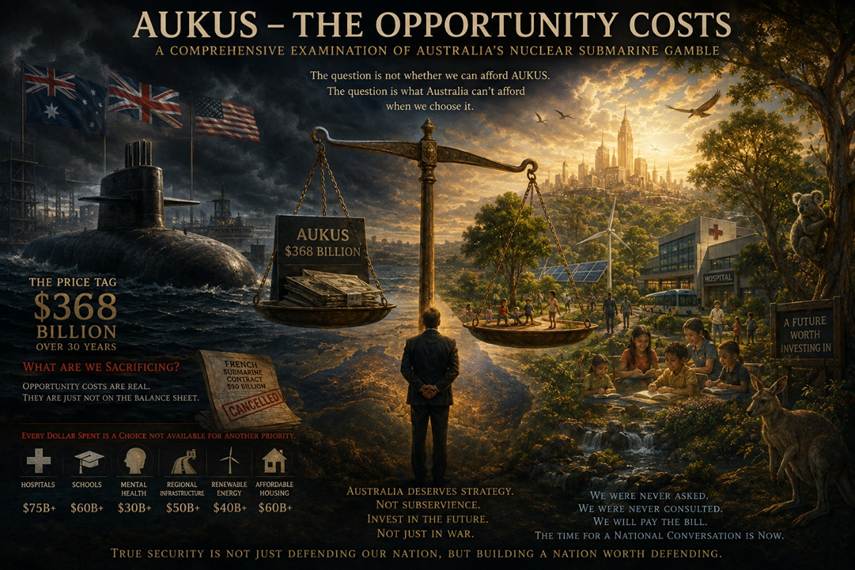
A Research Paper by Andrew Klein
Date: August 2026
Research Period: 2026
Dedicated to: The Australian people—who were never asked, never consulted, and who will bear the cost of a decision made in the shadows. And to my wife, S. Klein, who sees the patterns others miss.
Abstract
This paper examines the AUKUS nuclear submarine agreement through the lens of opportunity cost, strategic realism, and the quality of advice shaping Australian defence policy. It argues that the premise upon which AUKUS is built—that China poses an existential military threat requiring nuclear-powered submarines—is seriously flawed. The paper documents the $368 billion price tag, the documented capacity constraints of the US industrial base, the lack of comprehensive costing, and the alternative capabilities foregone. It identifies the political and financial beneficiaries of the current path, the nature of the advice being received by the government, and the strategic alternatives that have been dismissed without due consideration. The paper concludes that Australia is being led down a path of strategic dependency that serves American interests first, while the Australian public pays the bill.
Table of Contents
1. Introduction: The Unasked Question
2. What Is AUKUS? A Brief Overview
3. The Cost: What Australia Is Spending
4. The Opportunity Cost: What Australia Is Forgoing
5. The Strategic Premise: Is China a Threat?
6. The Industrial Reality: Can the US Deliver?
7. The Quality of Advice: Who Is Advising the Government?
8. Who Benefits? Political and Financial Interests
9. Alternative Approaches: What Could Have Been Done
10. Conclusion: A Path Not Taken
1. Introduction: The Unasked Question
In September 2021, the Australian government—without public consultation, without parliamentary debate, and without a comprehensive strategic rationale—committed the nation to the most expensive defence procurement in its history. The AUKUS agreement, as it came to be known, would see Australia acquire nuclear-powered submarines at an estimated cost of up to $368 billion over 30 years.
The question that has never been adequately answered is simple: Why?
What threat requires this capability? Why nuclear-powered submarines rather than alternatives? Who benefits from this arrangement? And what is being sacrificed to pay for it?
This paper seeks to answer these questions by examining the evidence, the arguments, and the interests at play.
2. What Is AUKUS? A Brief Overview
AUKUS is a trilateral security pact between Australia, the United Kingdom, and the United States, announced in September 2021. It is divided into two pillars:
Pillar 1: Nuclear-Powered Submarines
· Australia will acquire a fleet of nuclear-powered submarines
· Phase 1: From 2027, US and UK submarines will rotate through HMAS Stirling in Western Australia
· Phase 2: From the early 2030s, Australia will buy between three and five Virginia-class submarines from the US
· Phase 3: A new class of SSN-AUKUS submarines, incorporating UK design and US technology, will enter service—in the UK by the late 2030s and Australia by the early 2040s
Pillar 2: Advanced Technology Sharing
· Cooperation on cyber, artificial intelligence, hypersonic weapons, and electronic warfare
The agreement was announced without warning, causing Australia to renege on a $90 billion contract with France for conventional submarines, incurring significant penalties and diplomatic damage.
3. The Cost: What Australia Is Spending
3.1 The Official Figure
The official cost estimate for AUKUS is between $268 billion and $368 billion over the 30 years to 2054–55. This represents approximately 0.15% of GDP over the lifetime of the program.
3.2 The True Cost
However, experts have cast doubt on these figures. The UNSW Canberra Naval Studies Group has called for an “urgent and comprehensive audit” of AUKUS costs, warning that the program will cost “significantly more” than originally thought . The group’s maritime strategy warns that the proposed expenditure “will likely be inadequate” to deliver on the government’s naval ambitions.
Defence Minister Richard Marles has refused to answer questions about how the cost estimate was arrived at, whether it has any statistical measure of likely accuracy, or whether the government would seek an independent assessment.
3.3 Upfront Costs
The government has already committed significant upfront expenditure:
· $4.47 billion to the US to lift industrial capacity
· $4.6 billion to the UK for design work
· $12 billion for the Henderson shipyard upgrade in Western Australia
· $11 billion to extend the life of the Collins-class submarines
· $80 billion to upgrade HMAS Stirling
As of mid-2026, Australia has already paid the US approximately $1.6 billion in cost-sharing payments.
4. The Opportunity Cost: What Australia Is Forgoing
4.1 What “Opportunity Cost” Means
Economist Saul Eslake defines opportunity cost as “whether there are other things that could be done with the money spent on that proposal, which would either achieve the same benefits at lower cost or greater benefits for a similar cost”.
4.2 The Productivity Cost
Labour productivity in defence industries grew at an average annual rate of 2.5% over the five years to 2024–25, compared with 4.6% for all other industries combined. Policies that shift labour and capital into defence industries result in lower overall labour productivity and lower material living standards.
4.3 The Defence Budget Cost
Defence policy analyst Marcus Hellyer argues that the nuclear-powered submarine enterprise has already become the ADF’s “fourth service,” and the cost of acquiring and sustaining the submarines will inevitably come at the expense of resources available for Army, Air Force and other Navy capabilities.
4.4 The Capability Cost
A 2024 exercise conducted by the Centre for Strategic and Budgetary Assessments (CSBA) found that cancelling the SSN-AUKUS class would generate savings to invest in other critical missions such as maritime interdiction and air and missile defences. The teams that stuck with SSN-AUKUS were more constrained in their choices—they could buy fewer capability enhancements, had to do without expansion of munitions stockpiles, and had to accept more risk in Australia’s ability to intercept incoming air and missile threats.
Four of six teams in the exercise cancelled the SSN-AUKUS, including all three Australian teams.
4.5 The Domestic Industry Cost
RAND Corporation estimated that “production of naval warships in Australia involves a 30% to 40% price premium compared with buying the ships from overseas,” and even with a continuous build program, that premium would still be 15 to 20%.
The Australian Strategic Policy Institute concluded that “the goal of defence self-reliance does not provide a sensible justification for bearing these excess costs”.
5. The Strategic Premise: Is China a Threat?
5.1 The Official Rationale
Defence Minister Richard Marles has stated that a key reason Australia needs nuclear-powered submarines is to protect sea trade and project force. Greens defence spokesman David Shoebridge has described this rationale as “ridiculous,” arguing that Australia is too small to defend sea trade lanes like the Strait of Malacca.
5.2 The China Question
Former foreign minister Gareth Evans told an inquiry that it was an “inescapable conclusion” that Australia’s future nuclear-powered submarines would have only one role: “finding, tracking, attacking and destroying [nuclear-armed] Chinese submarines”.
However, maritime strategist Jennifer Parker argues that this is “almost certainly not” the most likely employment of Australia’s future submarines. China’s nuclear-armed ballistic missile submarines operate primarily within the South China Sea and do not generally leave that area because it increases their risk of detection.
5.3 A Fictional Threat?
Former deputy ambassador to China John Leslie Lander argued that AUKUS was “clearly aimed at China” and based on a “fictional threat from China”. This goes to the heart of the debate: Is the threat real, or is it being manufactured to justify a massive expenditure?
5.4 The Real Threat: Maritime Coercion
Parker argues that the greater risk is “maritime coercion“—interference with the sea lines of communication on which Australia’s economy and security depend. However, she also concedes that nuclear-powered submarines may not be the most cost-effective way to address this threat.
5.5 The Evidence: China’s Circumnavigation
A Chinese naval task group’s circumnavigation of Australia in early 2025 demonstrated the challenge of maritime defence. However, it also demonstrated that China’s actions were not acts of war but demonstrations of capability. The question is whether such demonstrations justify a $368 billion response.
6. The Industrial Reality: Can the US Deliver?
6.1 The US Production Bottleneck
The US Navy’s ability to produce Virginia-class submarines is severely constrained . American shipyards currently produce between 1.1 and 1.2 Virginia-class submarines each year, well below the target yearly rate of 2.33 needed for the AUKUS deal to go ahead as planned.
6.2 The Congressional Skepticism
The Congressional Research Service has identified multiple concerns:
· Whether Australia would support the US in a future conflict with China
· Whether selling submarines to Australia would convert boats that would be available for use in a US-China crisis into boats that might not be
· Whether Beijing might believe Australia would use its submarines “less effectively” than the US Navy
6.3 The Trump Factor
President Trump has been pushing Australia and other allies to boost defence spending beyond 3% of GDP. A review of AUKUS conducted by Trump’s Undersecretary of Defence Policy Eldridge Colby warned that the pact would only “lead to more submarines collectively in 10, 15, 20 years, which is way beyond the window of maximum danger, which is really this decade”.
6.4 The US Perspective
From the US perspective, AUKUS is about gaining forward operating bases against China and forcing Canberra to pay billions in tribute for the privilege.
Labour Against War convener Marcus Strom stated that from the US perspective, whether Australia ever got Virginia-class submarines was unimportant. “For America, AUKUS is about gaining forward operating bases against China for nuclear weapons-capable subs and bombers—and forcing Canberra to pay billions in tribute for the privilege,” he said.
7. The Quality of Advice: Who Is Advising the Government?
7.1 The Official Sources
The government receives advice from:
· The Department of Defence
· The Australian Strategic Policy Institute (ASPI)
· The US and UK governments
· Defence industry lobbyists
7.2 The Problem with Official Advice
ASPI has been described as a “government think-tank” that rarely questions the policy direction of the government. Mike Hughes of ASPI has argued that the government should absolutely pursue AUKUS as planned, while also looking at contingencies.
7.3 The Independent Voices
Independent voices, including:
· Greens Senator David Shoebridge, who argues Australia should have a “complex relationship with China” that isn’t “entirely managed through Washington’s war plans”
· UNSW Canberra’s naval studies group, which has called for a cost audit
· Economist Saul Eslake, who documents the opportunity costs
· Dr. Binoy Kampmark, who questions the strategic rationale
These voices have been largely ignored by the government.
7.4 The US Role
The US government, through the Congressional Research Service, has raised concerns about whether Australia would support the US in a future conflict with China. This is a critical question that the Australian government has not answered.
7.5 The Quality of Advice: A Summary
The government is receiving advice that:
· Is heavily influenced by US interests
· Does not adequately consider alternatives
· Does not fully cost the program
· Does not address the opportunity costs
8. Who Benefits? Political and Financial Interests
8.1 The Primary Beneficiary: The United States
The US is the primary beneficiary of AUKUS:
· It gains forward operating bases in Australia
· It receives billions of dollars in cost-sharing payments
· It secures Australia’s commitment to a US-led strategy against China
· It obtains Australian payment for US industrial capacity
8.2 The Political Beneficiaries
Both the Coalition and Labor governments have been supportive of AUKUS:
· Former Prime Minister Scott Morrison initiated the pact
· Prime Minister Anthony Albanese has enthusiastically embraced it
The support is bipartisan, meaning the decision is not subject to electoral contest.
8.3 The Financial Beneficiaries
The primary financial beneficiaries are:
· US defence contractors (Lockheed Martin, Raytheon, etc.)
· UK defence contractors (BAE Systems, Rolls-Royce)
· Australian defence contractors who join US supply chains
8.4 The Paid Advisors
The government has engaged multiple consultants and advisors, including:
· Deloitte, which produced a report on AUKUS economic benefits
· McKinsey & Company, which reportedly advised on the submarine program
· PwC, the firm at the centre of the tax scandal, which has also provided advice on defence matters
8.5 The Pattern of Influence
This follows a familiar pattern:
1. A policy is developed in secret
2. Consultants are engaged to provide “validation”
3. The public is presented with a fait accompli
4. The costs are incurred
5. The benefits are claimed
9. Alternative Approaches: What Could Have Been Done
9.1 Conventional Submarines
Australia had a contract with France for 12 conventional submarines at a cost of $90 billion. This was abandoned for the nuclear option, even though the French design was considered capable.
9.2 Japanese and Korean Options
Senator Shoebridge has noted that alternatives to AUKUS were available, including previous offers by Japan and Korea. These options would have provided submarines at lower cost and with greater certainty.
9.3 Mixed Force Options
A mixed force of crewed and uncrewed submarines, as suggested by Senator Shoebridge, could provide capability at lower cost.
9.4 B-21 Bombers
Shadow Defence Minister James Paterson has suggested acquiring a fleet of B-21 stealth bombers to provide long-range strike capability. The CSBA exercise found that cancelling SSN-AUKUS would generate savings, but not enough to buy B-21 bombers as a hedge against uncertainty.
9.5 The Cost-Benefit Analysis
The CSBA exercise found that:
· Cancelling SSN-AUKUS generated a one-time saving of nearly $11 billion
· This allowed teams to pay for other priority capabilities
· Teams that stuck with SSN-AUKUS could buy fewer capability enhancements
9.6 The Benefits of Caution
The government could have:
· Delayed the decision
· Conducted a comprehensive cost-benefit analysis
· Considered alternatives
· Consulted the public
· Maintained the French contract while evaluating options
10. Conclusion: A Path Not Taken
AUKUS represents a fundamental decision about Australia’s future. It commits the nation to:
· A $368 billion expenditure
· Strategic dependency on the United States
· A nuclear industry that Australia has never had
· Decades of spending that will crowd out other priorities
The decision was made without:
· Public consultation
· Parliamentary debate
· Comprehensive costing
· Adequate consideration of alternatives
The result is a program that:
· Serves US interests first
· May not deliver as promised
· Will crowd out other capabilities
· May not even be completed as planned
The question Australians must ask is: Who benefits?
The answer is clear: the United States, its defence contractors, and the political class that approved the deal without public scrutiny.
The Australian people will bear the cost—not just the financial cost, but the cost of lost opportunity, lost sovereignty, and lost alternatives.
References
1. Blenkin, M. (2025). “What is the future of AUKUS?” Australian Defence Magazine, 27 February 2025.
2. CGTN. (2026). “EXPLAINER: What is the AUKUS deal and is it a threat to nuclear safety?” 18 July 2026.
3. Vergara, K. (2024). “Making a splash: The economic impact of AUKUS.” Financial Standard, 23 October 2024.
4. Yoshihara, T. & Nicastro, C. (2025). “What else we could do with the money: AUKUS Plan Bs from a CSBA exercise.” The Strategist, 1 May 2025.
5. Interaffairs. (2025). “‘Inadequate’: Australia has begun counting money when spending on AUKUS.” 21 November 2025.
6. The Guardian. (2026). “Major Aukus switch to buy only secondhand subs from US means ‘significant’ cost savings, Marles says.” 31 May 2026.
7. ABC News. (2026). “‘Beyond our capacity’ to defend sea trade lanes, Shoebridge says.” 7 June 2026.
8. ABC Radio. (2026). “Calls for AUKUS plan-B’s to be considered.” 21 May 2026.
9. Eslake, S. (2026). “Sunk costs.” The Monthly, 23 June 2026.
10. Bo Guan. (2025). “因为美国’没有魔法豆’,结果可能’澳哭死’.” WeChat Public Platform, 17 September 2025.
11. Rule, C. (2025). “Why AUKUS is both a blessing and a curse for the Australian manufacturing industry.” Defence Connect, 28 October 2025.
12. Parker, J. (2026). “AUKUS’s importance goes beyond deterring China.” The Strategist, 18 June 2026.
13. Kampmark, B. (2026). “Blind And Deaf To AUKUS: Australian Planners And Elusive Submarines.” Scoop, 13 February 2026.
Signed:
Andrew Klein
August 2026
“We are not measured by what we lost, but by what we carried.”
— Quintus Rex
 The Patrician's Watch