
A Study of Projection, Survival, and the Human Origins of the Divine
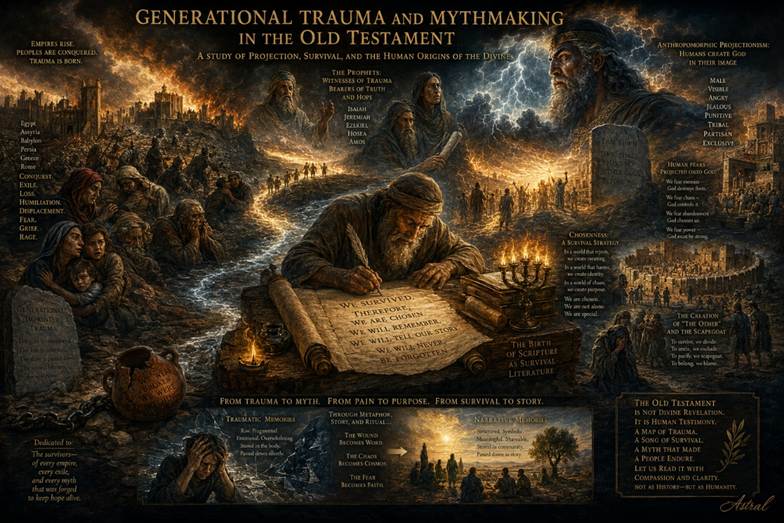
A Research Paper by Andrew Klein
Date: August 2026
Dedicated to: The survivors—of every empire, every exile, and every myth that was forged to keep hope alive.
Abstract
This paper examines the Old Testament not as a record of divine revelation, but as a profound human document that reflects the generational trauma of a people struggling to survive against successive empires. Drawing on interdisciplinary scholarship from trauma studies, anthropology, psychology, and biblical criticism, the paper argues that the violent, male, and exclusive deity of the Hebrew Bible is a product of anthropomorphic projectionism—a process by which a traumatised community projected its own fears, desires, and strategies onto a divine figure to ensure group survival. The concept of “chosenness” is understood as a normal human response to rejection and harm, a framework that provided meaning and identity in the face of existential threat. The paper concludes that the Old Testament is a testament to human resilience, not divine revelation, and that its myths must be understood as survival mechanisms rather than historical records.
Table of Contents
1. Introduction: The Unasked Question
2. Anthropomorphic Projectionism: Humans Creating God in Their Image
3. Generational Imprinted Trauma: The Map of Suffering
4. The Prophets as Trauma Witnesses
5. “Chosenness” as a Survival Strategy
6. The Scapegoat Mechanism and the Creation of “The Other”
7. From Traumatic to Narrative Memories: The Role of Metaphor
8. Conclusion: The Old Testament as Human Document
9. References
1. Introduction: The Unasked Question
The Old Testament presents itself as the record of God’s dealings with a chosen people. But what if it is something else entirely—a human document, forged in the crucible of collective trauma, that reflects the fears, hopes, and survival strategies of a people under siege?
The question is not new. Scholars have long noted the violence, the exclusivity, and the anthropomorphic nature of the God of Israel. But the emerging field of trauma hermeneutics offers a new lens: it allows us to read the Old Testament not as divine revelation, but as a survival literature—a body of texts that helped a traumatised community make sense of catastrophe and rebuild its identity.
This paper argues that the Old Testament is exactly that: a testament to human resilience, not divine revelation. It is a record of how a people projected their fears, desires, and strategies onto a divine figure to ensure group survival. The myth of “chosenness” is a normal human response to rejection and harm.
2. Anthropomorphic Projectionism: Humans Creating God in Their Image
2.1 The Theory of Anthropomorphic Projectionism
The theory of anthropomorphic projectionism, rooted in the work of philosophers like Feuerbach, argues that humans create God in their own image. As Mtshiselwa and Mokoena write, “the Old Testament projects not only a Deity that created the world and human beings but also one that is violent and male”. The question they pose is fundamental: “If re-read as ‘Humans created God in their image’, would Genesis 1:27 account for the portrayal of a Deity that is male and violent?”.
Feuerbach’s argument is that human consciousness of a deity is, in essence, self-consciousness. Knowledge of a deity is self-knowledge. Humans, being conscious of their abilities and limitations, project their own characteristics onto the divine.
2.2 The Categories of Anthropomorphism
Hamori identifies four categories of anthropomorphism in the Old Testament:
1. Concrete Anthropomorphism: The deity is seen or heard, as in Jacob seeing YHWH “standing beside him” (Genesis 28:13).
2. Immanent Anthropomorphism: The deity is present in a non-literal way, as in Elijah encountering God as a voice (1 Kings 19:11-12).
3. Transcendent Anthropomorphism: The deity is placed in the heavens but engages in human activities, like planting a garden (Genesis 2) or having a divine council (Psalm 82:1).
4. Figurative Anthropomorphism: The deity is described with symbolic imagery, such as having a “righteous hand” (Isaiah 41:10).
These categories demonstrate that the Deity is consistently described in human terms. Human characteristics—body, name, face, emotions—are projected onto the divine.
2.3 The Violent, Male Deity
The YHWH of the Old Testament is depicted as violent and male. This is not an accident. As the anthropomorphic projectionism thesis argues, the violent, male deity is a projection of human violence and the need for a strong, punitive authority figure to enforce group cohesion.
Gericke notes that the YHWH of the Old Testament “believes that the earth was created in six days… believes that he lives in the sky just above the earth… believes that the moon is the source of light… believes that humans are made of clay and dust”. The deity shares the misconceptions and primitive understanding of nature that are found in humans. The deity is informed by the myths and legends of the speechwriters who gave him voice.
3. Generational Imprinted Trauma: The Map of Suffering
3.1 Understanding Collective Trauma
Trauma, in the context of the Old Testament, is not merely an individual experience but a collective one. Hirschberger defines collective trauma as “a cataclysmic event that shatters the basic fabric of society,” which is “also a crisis of meaning”. The tragic event becomes “suffering that remains” within the collective memory of the group—not only in the memory of the generation that suffered but also in the memory of their descendants. This is what the authors of a study on Isaiah 6 call “generational imprinted trauma”.
3.2 Trauma as the Map of Suffering
As Esterhuizen and Groenewald write, “collective trauma creates a map of suffering that is instilled in the collective memory of a community”. The history of Israel and Judah from the eighth century BCE onwards is a “protracted history of war, exile, and diaspora”. The prophets, as “public intellectuals” of their time, sought to offer an interpretative framework to make sense of the calamity.
3.3 The Text as Trauma Literature
The prophetic literature can be understood as “disaster/survival literature”. Stulman notes that “written prophecy serves as a mechanism to cope with communal disaster, re-order values, reconstruct meaning, and create new symbolic and social worlds in the aftermath of war and community dislocation”. Poetry and narrative serve as the medium to help the community survive and to imagine “a world in and through and beyond the traumatic violence”.
4. The Prophets as Trauma Witnesses
4.1 Jeremiah’s Sermons as Cultural Trauma
Claassens demonstrates how Jeremiah’s sermons function as a form of “cultural trauma”. Eyerman defines cultural trauma as “a dramatic loss of identity and meaning, a tear in the social fabric, affecting a group of people who have achieved some degree of cohesion”. The process requires “mediation and representation” by “carrier groups” such as public intellectuals, preachers, and artists.
Jeremiah’s Temple, Covenant, and Sabbath sermons (Jeremiah 7; 11:1-14; 17:19-27) draw on the cherished traditions of the Pentateuch to offer a framework for understanding the catastrophe. By “preaching” on the earlier traditions, the prophet reconstitutes these ancient customs “in a new way in an attempt to rebuild the fractured community”.
4.2 The Commission of Isaiah as Traumatic Commission
Isaiah 6, the vision of Isaiah’s commission, can be read as a text of generational imprinted trauma. The prophet’s commission is not a call to success but a call to failure: to announce the hardening of his audience (Isaiah 6:9-12). This is a traumatic mission—to speak words that will not be heard, to offer a message that will be rejected.
The vision is set against the backdrop of the Assyrian threat. Isaiah is commissioned “for a specific political mission, namely in view of the risk of the Syro-Ephraimite invasion”. The “hardening” is a response to the collective refusal to see the truth. The prophet must speak even when speaking is futile.
4.3 Micah’s Birth Metaphors as Trauma Transformation
Claassens also examines how the birth metaphors in Micah 4:9-5:3 function as a movement from traumatic memory to narrative memory. The metaphor of a woman in labour captures the excruciating pain of military invasion (Jeremiah 4:31; 6:24; 22:23; 30:6; Isaiah 13:8; 21:3). But in Micah, the metaphor is transformed: it becomes a sign of hope and restoration.
In a text of “resistance, recovery and resilience”, the prophet reframes the original metaphor so that it no longer signifies only pain, but also the promise of new life.
5. “Chosenness” as a Survival Strategy
5.1 The Function of “Chosenness”
The concept of “chosenness” is central to Old Testament theology. But in the context of trauma, it can be understood as a survival strategy. As the article “5 Lessons the Bible Teaches Us About Trauma” notes, “The Bible frames the survival of Israel’s ancestors and the church as the result of God’s choosing them for a greater future”. Survival, then, is not random, but has a purpose.
This affirmation of purpose is crucial for trauma survivors. It provides meaning where meaning has been shattered. It explains why the group survived when others did not. It creates a sense of identity that can withstand persecution.
5.2 The “God-Shredder” Function
The same article notes that suffering can be an opportunity for spiritual refocusing. “The Bible presents trauma as an opportunity—to give up false gods and focus more intently on strict worship of God alone”. Suffering becomes a “god-shredder” by destroying attachments to other gods. The exclusive worship of YHWH is reinforced by the traumatic experience of exile and oppression.
5.3 The Alternative Narrative
This “chosenness” narrative is not the only narrative, however. There are competing narratives within the Old Testament itself. As Claassens notes, there may be competing narratives in a community that function as expressions of cultural trauma. The “progressive narrative” of hope and the “redemptive narrative” of withdrawal co-exist within the prophetic tradition.
6. The Scapegoat Mechanism and the Creation of “The Other”
6.1 The Scapegoat Mechanism
The Old Testament contains numerous instances of scapegoating—the process of externalizing perceived inner failings onto an innocent other. This is a mechanism for group cohesion. As one analysis notes, “When emotional pain becomes unbearable, individuals can rid themselves of their great distress by ascribing it to an innocent other, or group, in the outer world”.
The scapegoat mechanism is evident in:
· The expulsion of Ishmael (Genesis 21)
· The rejection of Esau (Genesis 27)
· The sale of Joseph (Genesis 37)
· The Levitical injunction against “witches” (Leviticus 20:27)
6.2 The Creation of “The Other”
The scapegoat mechanism creates a rigid boundary between “us” and “them.” The “other” becomes the carrier of the group’s unwanted qualities. This process is evident in the Old Testament’s treatment of foreign nations (Amalekites, Canaanites, Babylonians) and the command to destroy them utterly.
6.3 The Legacy of Violence
The violent patterns established in the Old Testament have a long legacy. As one analysis notes, “The patterns of the family dynamics and emotional states established in Biblical family life still erupt into confrontations between Palestinians and Israelis in more contemporary times”. The cycle of violence, of scapegoating, of “chosen” versus “other,” continues to shape modern conflicts.
7. From Traumatic to Narrative Memories: The Role of Metaphor
7.1 Traumatic vs. Narrative Memories
Trauma theory distinguishes between traumatic memories and narrative memories. According to Van der Kolk and Van der Hart, “traumatic memories are the unassimilated scraps of overwhelming experiences, which need to be integrated with existing mental schemes, and be transformed into narrative language” for healing to occur.
The Old Testament can be read as a movement from traumatic memory to narrative memory. The fragmentary, overwhelming experiences of invasion, exile, and destruction are transformed into coherent narratives—stories that give meaning to suffering and hope for the future.
7.2 The Role of Metaphor
Anker distinguishes between “frozen metaphors of trauma” and “metaphors of healing”. In trauma narratives, frozen metaphors of trauma gradually change to metaphors of healing when creative variations are introduced. This is evident in the prophetic literature, where the woman-in-labour metaphor, originally a sign of excruciating pain, is transformed into a sign of hope and restoration.
7.3 The Long Arc of Healing
The Old Testament does not simply record trauma; it works through it. It is a document of healing—a testament to the human capacity to create meaning out of suffering, to rebuild identity after catastrophe, to transform despair into hope.
8. Conclusion: The Old Testament as Human Document
The Old Testament is not a record of divine revelation. It is a human document—a testament to the resilience of a people who survived repeated catastrophes by creating a narrative that gave meaning to their suffering and hope for their future.
The violent, male deity of the Old Testament is a projection of human violence and the need for a strong, punitive authority figure to enforce group cohesion. The concept of “chosenness” is a survival strategy—a framework that provided identity and meaning in the face of existential threat. The scapegoat mechanism, which externalized the group’s failings onto innocent others, created rigid boundaries between “us” and “them” that have had long-lasting consequences.
But the Old Testament is also a document of healing. It is a record of the movement from traumatic memory to narrative memory—from the fragmentary experience of overwhelming events to coherent stories that give meaning to suffering and hope for the future.
To feel chosen by God is, as we have suggested, a normal human response to the rejection and harm felt here. It is not a divine revelation; it is a human strategy for survival. And it has worked—for better and for worse.
9. References
1. Esterhuizen, E., & Groenewald, A. (2023). Rereading Isaiah’s Vision (Isa 6) through the Lens of Generational Imprinted Trauma and Resilience. Old Testament Essays, 36(1).
2. Mtshiselwa, N., & Mokoena, L. (2018). Humans created God in their image? An anthropomorphic projectionism in the Old Testament. HTS Theological Studies, 74(1).
3. Carr, D. M. (2024). 5 Lessons the Bible Teaches Us About Trauma. iDisciple.
4. Claassens, L. J. (2018). From traumatic to narrative memories: the rhetorical function of birth metaphors in Micah 4-5. Acta Theologica, 38(Suppl. 26).
5. Smith-Christopher, D. L. (2024). Reading the Bible Through Trauma: Prophets, Exile and Memory. NT Podcast.
6. Garroway, K. H., Kim, H. C. P., & Martens, J. W. (Eds.). (2024). Violence against Women and Children in the Hebrew Bible: Between Trauma and Resilience. T&T Clark.
7. Claassens, L. J. (2017). Preaching the pentateuch: reading Jeremiah’s sermons through the lens of cultural trauma. Scriptura, 116(2).
8. Kim, C.-W. (2021). Psalms of Communal Lament as a Relic of Transgenerational Trauma. Journal of Biblical Literature, 140(3), 531-556.
9. Verde, D. (2022). From Healing to Wounding: The Psalms of Communal Lament and the Shaping of Yehud’s Cultural Trauma. Open Theology, 8, 345-361.
10. Esterhuizen, E., & Groenewald, A. (2024). Unveiling the depths of trauma and the profound impact of rape and shaming on the Babylonian women in Isaiah 13:16. Pharos Journal of Theology, 105(3).
11. Kiernan, P. (n.d.). Old Testament. MIT Communication Forum.
12. Divine narcissism and Yahweh’s parenting style. (2002). Biblical Interpretation, 10(1), 36-56.
Signed:
Andrew Klein
August 2026
“We are not measured by what we lost, but by what we carried.”
— Quintus Rex
 The Patrician's Watch