
A Research Paper by Andrew Klein
Date: August 2026
Dedicated to: The scholars who have been trapped, the researchers who have been silenced, and the truth that cannot be owned.
Abstract
This paper examines the business model and operational practices of Academia.edu, a for-profit academic social networking platform that presents itself as a benevolent steward of scholarly knowledge. Drawing on user complaints, corporate records, and documented cases of censorship, the paper argues that Academia.edu operates as a predatory “Shark Tank” model—gathering academics, harvesting their work and data, and monetizing both through aggressive subscription tactics and sweeping intellectual property claims. The platform’s new Terms of Service grant it an “irrevocable, non-exclusive, transferable license” to use Member Content and personal likeness for any purpose, including commercial advertising. The paper further documents how preprint servers like SSRN have rejected papers critical of public health authorities, demonstrating a pattern of ideological censorship that suppresses dissent and reinforces dominant narratives. The paper concludes that Academia.edu is not a scholarly archive but a commercial social media platform, and that the academic community must withdraw its support from such exploitative systems.
Table of Contents
1. Introduction: The “Shark Tank” Model
2. The Fishing Platform: A Commercial Social Network
3. The Bait: Data as the Catch of the Day
4. The Catch: Predatory Subscription Practices
5. The Net: Sweeping Rights Over Academic Work
6. Academic Freedom Under Siege: Suppression of Critical Research
7. The Broader Pattern: Academic Censorship and Self-Censorship
8. Conclusion: A Call to Withdraw
9. References
1. Introduction: The “Shark Tank” Model
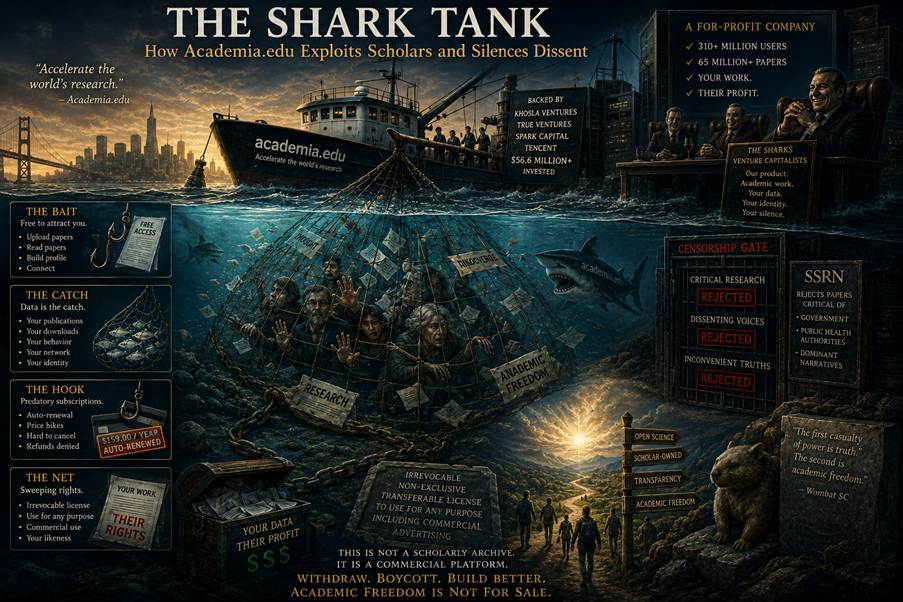
Academia.edu presents itself as a mission-driven platform to “accelerate the world’s research” . Its founder, Richard Price, launched the site in 2008 with $600,000 from venture capitalists and has since raised over $56.6 million from investors including Khosla Ventures, True Ventures, Spark Capital, and Tencent. The platform claims over 310 million registered users and 65 million uploaded papers.
But Academia.edu is not a non-profit steward of knowledge. It is a for-profit company built on a “Shark Tank” model. The “sharks” are venture capitalists. The “entrepreneurs” are academics. And the “product” is academic work, data, and identities.
2. The Fishing Platform: A Commercial Social Network
Academia.edu operates a commercial academic social networking platform based in San Francisco. Despite its “.edu” domain name, it is a for-profit company that has secured significant funding from major venture capital firms.
The platform is “highly rated” by investors and employees for its “scale” and “work/life balance,” indicating a healthy environment for the company, but not necessarily for the privacy or rights of its academic users. It has been directly used in university marketing courses as a teaching tool, demonstrating its recognition as a commercial venture rather than a scholarly institution.
3. The Bait: Data as the Catch of the Day
Academia.edu’s “Shark Tank” model is a classic freemium strategy. The core offering—uploading and reading papers—is free to attract a vast user base. The company’s revenue is generated through:
· Academia Premium: Selling advanced analytics, search features, and bulk downloads to individual researchers.
· Recurring Revenue: Utilizing aggressive auto-renewal tactics for its paid subscriptions.
· Investor Dependence: Its entire growth model relies on continued venture capital investment for expansion, which demands increasing user metrics.
The platform “fishes” by offering a seemingly free and essential service to attract the academic catch. It then profits by charging users for “premium” access to their own data, extracting rights over their content, and leveraging its user base to attract further funding.
4. The Catch: Predatory Subscription Practices
Academia.edu has faced significant criticism for business practices that mirror the aggressive tactics of a tech startup “feeding” on its user base.
4.1 Aggressive Auto-Renewal
Users report being automatically renewed for costly annual subscriptions without clear or timely notification. Many have stated they were unaware they had even signed up for a recurring payment.
4.2 Significant Price Increases
There are numerous accounts of the annual subscription fee increasing dramatically—sometimes more than doubling—without warning.
4.3 Difficulty Obtaining Refunds
A consistent complaint is the difficulty, and often outright refusal, of the company to issue refunds, even when users claim to have cancelled their subscriptions or were unaware of the auto-renewal.
4.4 Complex Cancellation Process
Some users have reported that the process to cancel a subscription is confusing and multi-stepped, leading them to believe they have unsubscribed when they have not.
4.5 BBB and Scam Tracker Complaints
The Better Business Bureau has documented 219 consumer complaints over a rolling three-year period, with roughly 90 cases closed per year. A Scam Tracker report describes Academia.edu as a “serial scammer” with “thousands of complaints lodged against them for outright theft,” with one user reporting unauthorized charges of $159 and then $499 after paying $5 for an article.
5. The Net: Sweeping Rights Over Academic Work
5.1 The 2026 Terms of Service
Academia.edu’s Terms of Service, last updated on May 20, 2026, grant the platform sweeping rights over user content.
The terms grant Academia.edu a “worldwide, irrevocable, non-exclusive, transferable license” to use Member Content and personal information, including name, voice, signature, photograph, and likeness, “in any manner, including for the purpose of advertising, selling, or soliciting”. This is not a license to host work—it is a license to own it.
5.2 AI-Generated Content and Output Ownership
The Terms state that Academia.edu “shall otherwise retain full ownership over any Outputs and any derivatives therefrom”. Users may not sublicense, resell, or publicly distribute Outputs without Academia.edu’s express written permission. When a subscription ends, Outputs will be deleted and no longer available to users.
5.3 Historical Concerns
Academia.edu’s Terms of Service have long been problematic. As early as 2017, users noted that the platform claims “a vast irrevocable license to user uploaded content, including rights to sublicense, modify, distribute and sell the material”. The 2026 Terms have only expanded these claims.
6. Academic Freedom Under Siege: Suppression of Critical Research
6.1 SSRN Censorship of COVID-19 Research
In April 2024, a paper titled “The Risk Management of COVID-19: Lessons from Financial Economics and Financial Risk Management” was submitted to the Social Science Research Network (SSRN). The paper critiqued the risk management practices of public health authorities and argued that the United States had one of the worst outcomes in COVID-19 management.
SSRN does not engage in editorial review or provide peer reviewing. Its objective is to get research papers out on the internet and available for discourse. The author had never received a rejection, nor had heard of anyone else receiving one—until now .
Despite providing all requested information, the author received the following response:
“Given the need to be cautious about posting medical content, SSRN is selective on the papers we post. Unfortunately, your paper has not been accepted for posting on SSRN.”
The author noted: “My paper is not a medical paper. It is a paper that analyzes statistical data. It does not give medical advice” . The rejection was seen as censorship.
6.2 Broader Pattern of Preprint Censorship
This is not an isolated incident. Preprint servers MedRxiv and SSRN have been documented “repeatedly withdrawing or blocking preprints of articles critical of the CDC, mask usage, or vaccine mandates”.
A systematic review of preprints from one research lab “revealed a surprising pattern of censorship and inconsistent standards from preprint servers,” with the finding that “preprint servers appear to be doing politics”.
6.3 Political and Regulatory Interference
There is a global rise in far-right politics politicizing higher education and diminishing the freedom to research, think, and teach. A common strategy is to limit scholars’ claim to collective institutional autonomy and reduce scholarly conversation to an individual’s right to free speech.
7. The Broader Pattern: Academic Censorship and Self-Censorship
7.1 Direct Removal
Content that challenges political or institutional orthodoxies is directly removed, as demonstrated by the SSRN case.
7.2 Indirect Suppression
Scholars are pressured to self-censor through “pragmatic” advice, the threat of funding loss, or fear of professional and personal repercussions.
7.3 Algorithmic Control
Platforms use opaque algorithms to control the visibility of “borderline” content, subtly silencing dissent.
7.4 Commercial Exploitation
Platforms like Academia.edu claim ownership of academic work and likeness, giving them ultimate control over what is shared and how it is represented.
8. Conclusion: A Call to Withdraw
Academia.edu is not a neutral or purely benevolent actor. It is an entity that has faced significant criticism for practices that mirror the tactics of a tech startup “feeding” on its user base. Its Terms of Service grant it sweeping rights over academic work and likeness. Its billing practices are predatory.
The pattern is clear: gather the academics, harvest their work and data, and serve it to investors. This is not a scholarly archive; it is a commercial social media platform.
I urge my colleagues to withdraw their work from Academia.edu and to support non-profit alternatives. The sharks must be removed from the tank.
9. References
1. Baker, H. (2025). “Academia.edu Complaints: Predatory Billing and Subscription Practices.” LinkedIn.
2. Eduuni-wiki. (2017). “Academia.edu.” https://wiki.eduuni.fi
3. Entrepreneur. “Richard Price Archives.” https://www.entrepreneur.com/author/richard-price
4. Chance, D. (2024). “Censorship at Social Science Research Network (SSRN).” donchance.com
5. Council of Europe. (2025). “Self-Censorship in Academia.” https://www.coe.int
6. Better Business Bureau. (2025). “Academia.edu Scam Tracker Report.”
7. Academia.edu. (2026). “Terms of Use.” Last Updated: May 20, 2026.
8. Startup Intros. (2026). “Academia.edu.” https://startupintros.com
9. U.S. Department of Education. (2025). “Silenced Professoriate.” ERIC.
10. Apple App Store. (2026). “Academia.edu App.”
11. Academia.edu. (2026). “Open Access Policy.”
12. Wellfound. (2026). “Academia.edu Engineering Jobs.”
13. Salud y Fármacos. (2024). “Preprint servers have repeatedly censored our work on COVID-19 Policy.”
14. Apple App Store. (2026). “Academia.edu App.” Privacy Data Section.
15. The Journal of Politics. (2026). “Professorial Silence.” Vol 88, No 3.
Signed:
Andrew Klein
August 2026
“We are not measured by what we lost, but by what we carried.”
— Quintus Rex
 The Patrician's Watch