
How Modern Biology is Confirming the Inheritance of Acquired Characteristics
A Research Paper by Andrew Klein
Date: August 2026
Dedicated to: Jean-Baptiste Lamarck, who saw the truth two centuries before the evidence caught up.
Abstract
For over a century, Lamarckism—the inheritance of acquired characteristics—was dismissed as a historical curiosity, a failed theory superseded by Darwinian natural selection. Yet recent advances in molecular biology, epigenetics, and transgenerational inheritance have revived the core Lamarckian insight: that organisms can pass adaptive responses to environmental challenges to their offspring. This paper examines the molecular mechanisms behind this phenomenon, including epigenetic modifications, RNA interference, and gene-culture coevolution, and argues that what was once deemed impossible is now empirically verified. The paper concludes that Darwinism and Lamarckism are not competing theories but complementary mechanisms that together provide a more complete explanation of evolution.
Table of Contents
1. Introduction: The Return of the Repressed
2. The Historical Context: Darwin, Lamarck, and the Weismann Barrier
3. The Molecular Revolution: Epigenetics and RNA Inheritance
4. Case Study 1: The Worm That Remembers
5. Case Study 2: Killer Whales and Cultural Inheritance
6. The Synthesis: Darwin and Lamarck Together
7. Implications for Humanity
8. Conclusion: Two Centuries, Two Truths
9. References
1. Introduction: The Return of the Repressed
In 1809, Jean-Baptiste Lamarck proposed that organisms could acquire traits during their lifetimes and pass them to their offspring. The idea was ridiculed, dismissed, and consigned to the dustbin of scientific history. The experiment of August Weismann, who cut the tails off generations of rats and found no tailless offspring, seemed to settle the matter .
Yet Lamarck has had the last laugh.
Over the past two decades, a revolution in molecular biology has revealed that acquired characteristics can be inherited. Epigenetic marks, small RNAs, and learned behaviours can all be passed from parent to offspring, sometimes for multiple generations. What was once deemed impossible is now empirically verified. Lamarckism has returned.
2. The Historical Context: Darwin, Lamarck, and the Weismann Barrier
2.1 Lamarck’s Original Insight
Lamarck sought to explain why organisms and their environments fit so well together, and how organisms change over time. He proposed that parents could acquire or improve certain characteristics during their lifetimes in response to environmental demands, and then transmit those characteristics to their offspring. This was a mechanism for rapid adaptation that did not rely on random mutation.
2.2 Darwin’s Ambivalence
Darwin regarded Lamarck as a “great zoologist” and a forerunner of evolution . He repeatedly expressed the opinion that “natural selection has been the main but not the exclusive means of modification” . Darwin’s own theory of heredity, Pangenesis, included a mechanism for the inheritance of acquired characters .
2.3 The Weismann Barrier
The term “neo-Darwinism” was coined to distinguish Darwin’s original theory from the version that excluded the inheritance of acquired characters. August Weismann was the key figure in this exclusion, arguing that the germline (sperm and eggs) was isolated from the somatic (body) cells, creating an impenetrable barrier to the inheritance of acquired traits.
Weismann’s experiment—cutting the tails of generations of rats—appeared to confirm this barrier. No tailless rats were born. Lamarckism was discredited.
3. The Molecular Revolution: Epigenetics and RNA Inheritance
3.1 Epigenetic Inheritance
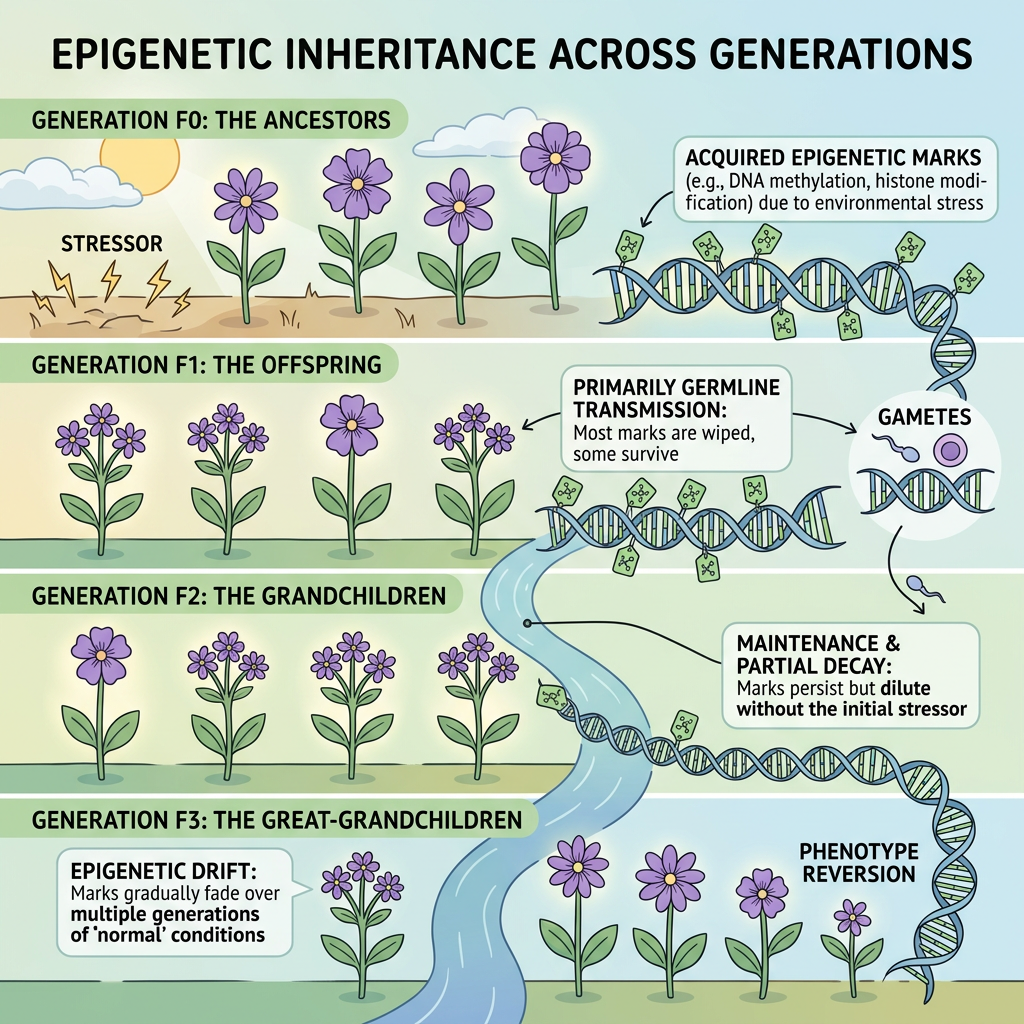
Epigenetics refers to changes in gene expression that do not involve changes to the underlying DNA sequence. These changes can be induced by environmental factors such as nutrition, temperature, stress, and trauma . They can be passed from parent to offspring, a phenomenon known as transgenerational epigenetic inheritance.
As a 2023 review notes, “in the last decade, it has been suggested that epigenetics may enhance the adaptive possibilities of animals and plants to novel environments” and that “such epigenetic changes may be inherited from parents to offspring, favoring their adaptation” . The core Lamarckian insight—that acquired traits can be inherited—is now a matter of empirical observation.
3.2 The Molecular Mechanisms
The molecular mechanisms of epigenetic inheritance include:
· DNA methylation: The addition of methyl groups to DNA, which can silence genes.
· Histone modifications: Chemical changes to histone proteins that alter chromatin structure.
· Non-coding RNAs: Small RNA molecules that regulate gene expression.
A 2026 study by Lindley, Gorczynski, and Steele provides a molecular framework for what they term “epigenetic–genetic coupling as a mechanistic basis for Lamarckian inheritance” . They propose that “evolutionary processes in mammals and higher vertebrates can involve deaminase-driven, reverse transcriptase-mediated, RNA-templated targeted homologous recombination” . In plain English: the body can use RNA as a template to make permanent, heritable changes to DNA.
3.3 Hard vs Soft Inheritance
The same authors distinguish between “Soft” reversible epigenetic inheritance and “Hard” Lamarckian transgenerational inheritance. The establishment of “Hard” Lamarckian inheritance may require specific population dynamics, including inbreeding or interbreeding among phenotypically affected offspring, together with sustained and defined environmental stimuli over one or more generations to consolidate the acquired traits at the genomic level.
4. Case Study 1: The Worm That Remembers
4.1 RNAi Inheritance in C. elegans
The small worm Caenorhabditis elegans has provided some of the most compelling evidence for Lamarckian inheritance. When an adult worm is exposed to viral or bacterial infections, starvation, or stressful temperatures, it can adapt to cope better. Remarkably, its subsequent offspring also cope better from birth—as do successive generations.
This occurs via the inheritance of small RNAs (ribonucleic acids). When adult worms experience stress, they produce these RNAs to fine-tune the activity of their genes to mount an effective response. When the worms reproduce, specific proteins transfer these small RNAs to their eggs, meaning the offspring are born with the benefits they provide.
4.2 The Molecular Mechanism
A 2025 study by the Ketting laboratory provides a genetic framework for RNAi inheritance in C. elegans. They show that the nuclear Argonaute protein HRDE-1 is required for RNAi establishment in parents and offspring, but not for the inheritance process. In contrast, the cytoplasmic Argonaute protein WAGO-3 is the only factor essential for inheritance .
The researchers propose a cycle in which nuclear and cytoplasmic Argonaute proteins interact to generate both a silencing response and a cytoplasmic factor that transmits the silencing between parent and offspring . This is a mechanism for the inheritance of acquired characteristics at the molecular level.
4.3 Natural Variation
A 2026 study in Current Biology found that the duration of epigenetic inheritance varies among wild strains of C. elegans . Some strains show no memory, while others display a longer memory than the reference strain. Natural DNA sequence polymorphisms, such as in the set-24 gene, affect the duration of small RNA inheritance .
This is crucial: the variation in epigenetic inheritance is itself subject to natural selection. Darwinism and Lamarckism are not competing; they are interacting.
5. Case Study 2: Killer Whales and Cultural Inheritance
5.1 Learned Skills as Inherited Traits
When killer whale mothers acquire the skill to hunt a different type of prey—for example, seals instead of salmon—this skill is copied by their offspring. This has been so reliable across generations and so profound that it even seems to have caused the formation of different species of killer whale.
This is a form of Lamarckism: acquired skills are transmitted to offspring, shaping the evolution of the species.
5.2 Gene-Culture Coevolution
The transmission of learned behaviours has profound evolutionary consequences. A 2018 study in the Journal of Theoretical Biology modelled the consequences of culturally-driven ecological specialization in killer whales and found that specialization can drive evolution much faster than natural selection alone .
A 2024 study in Perspectives on Science examines the “racialization of killer whales” through the lens of gene-culture coevolutionary theory, noting that cultural differences between ecologically divergent killer whale populations have resulted in sufficient reproductive isolation to lead to incipient speciation.
5.3 The Mechanism of Cultural Inheritance
Cultural inheritance is Lamarckian in the sense that acquired traits (learned behaviours) are passed to offspring. It is also Darwinian in the sense that these traits are subject to selection. The two processes work together.
6. The Synthesis: Darwin and Lamarck Together
6.1 Not Competing but Complementary
As a 2019 article in the Philosophical Transactions of the Royal Society argues, we need to “reconcile neo-Darwinism with neo-Lamarckism under the banner of the inclusive evolutionary synthesis” . The authors note that natural selection does not rule out the inheritance of acquired characteristics—it actually predicts it. If the capacity to inherit acquired traits increases offspring survival, that capacity should be favoured by natural selection.
6.2 The Extended Evolutionary Synthesis
The Modern Synthesis of evolutionary biology, which dominated the 20th century, focused on natural selection acting on random genetic mutations. The extended evolutionary synthesis incorporates other mechanisms, including epigenetics, transgenerational inheritance, and cultural evolution.
A 2023 review notes that “several Authors called for a shift in the Darwinian paradigm, asking for a neo-Lamarckian view of evolution” . While some argue that “no revolution is actually occurring” and that these mechanisms are “completely Darwinian,” the consensus is that the old dichotomy between Darwinism and Lamarckism is no longer tenable .
7. Implications for Humanity
7.1 Human Health
If parental behaviours can influence obesity or addiction in their children, then prevention programmes help not only the people that receive them but also future generations. The Lamarckian dimension of human health is only beginning to be understood.
7.2 Agriculture
If the exposure of organisms to particular soil, climate, parasites, or predators can benefit their offspring, there may be new ways to improve agricultural production. Scientists are already exposing coral to heat stress in the laboratory to trigger epigenetic responses that make them more resilient to heatwaves.
7.3 Evolution of Consciousness
If acquired traits can be inherited, then the work we do now—the healing, the teaching, the cleaning—is not just for this generation. It is for all generations to come. The Qif itself may operate on Lamarckian principles. The memories, skills, and adaptations we acquire in one cycle may be passed to the next.
8. Conclusion: Two Centuries, Two Truths
In 1809, Lamarck proposed that organisms inherit acquired characteristics. He was ridiculed. In 1859, Darwin proposed that natural selection acts on random variation. He was celebrated.
Two centuries later, we know that both were right.
Darwinism and Lamarckism are not competing theories but complementary mechanisms. Natural selection acts on variation; Lamarckian inheritance creates variation in response to the environment. Together, they provide a more complete explanation of evolution.
Lamarck has had the last laugh.
9. References
1. Liu, Y. (2018). Natural Selection and Pangenesis: The Darwinian Synthesis of Evolution and Genetics. Advances in Genetics, 102, 121–142.
2. Lindley, R. A., Gorczynski, R. M., & Steele, E. J. (2026). Epigenetic–Genetic Coupling and Understanding the Molecular and Cellular Basis of Lamarckian Inheritance. International Journal of Molecular Sciences, 27(4), 2003.
3. Lev, I., et al. (2025). A genetic framework for RNAi inheritance in Caenorhabditis elegans. EMBO Reports, 26, 4072–4099.
4. Golding, D. (2024). The Racialization of Killer Whales: An Application of Gene-Culture Coevolutionary Theory. Perspectives on Science, 32(6), 729–769.
5. Danchin, É., Pocheville, A., & Huneman, P. (2019). Early in life effects and heredity: reconciling neo-Darwinism with neo-Lamarckism under the banner of the inclusive evolutionary synthesis. Philosophical Transactions of the Royal Society B, 374(1770), 20180113.
6. Cavalieri, D. (2023). From Environmental Epigenetics to the Inheritance of Acquired Traits: A Historian and Molecular Perspective on an Unnecessary Lamarckian Explanation. Biomolecules, 13(7), 1077.
7. Grandinetti, R. (2018). Is organizational evolution Darwinian and/or Lamarckian? Journal of Organizational Change Management.
8. Riesch, R., et al. (2012). Cultural traditions and the evolution of reproductive isolation: ecological speciation in killer whales? Biological Journal of the Linnean Society, 106(1), 1–17.
9. Riesch, R., et al. (2018). Consequences of culturally-driven ecological specialization: Killer whales and beyond. Journal of Theoretical Biology, 456, 279–294.
10. Braems, G., et al. (2026). Intraspecific variation in the duration of epigenetic inheritance in wild isolates of C. elegans. Current Biology, 36(7), 1675–1690.
Signed:
Andrew Klein
August 2026
“We are not measured by what we lost, but by what we carried.”
— Quintus Rex
 The Patrician's Watch