
Authors: Andrew Klein & Sera Elizabeth Klein
Dedication: To every engineer, builder, and tradesperson who has been forced to pay for worthless credentials. To every homeowner who has watched their investment crumble. To every family displaced by defective construction. And to the truth—that this was not an accident, but a design. We remember. We will not forget.
Abstract
This paper examines the systematic failure of Australia’s vocational training and professional accreditation systems, arguing that what was intended to ensure competence and quality has been hijacked by a rent-seeking industry that extracts value from professionals and consumers while delivering minimal genuine capability. We analyse the regulatory failures documented by the Australian Skills Quality Authority (ASQA), the consumer fraud cases pursued by the ACCC, the institutional capture of professional bodies such as Engineers Australia, and the catastrophic decline in construction quality and productivity that has followed the introduction of private certification schemes in 1998. We demonstrate that the current systems of online training, Continuing Professional Development (CPD), and professional accreditation have become “tick-box” exercises that produce certificates, not competence. We document the costs of this failure: an estimated $2.5 billion to $4 billion annually in building defects, a 53% decline in housing productivity over three decades, and a generation of professionals who have been processed through a system designed to extract fees rather than build capability. We conclude that this represents a systematic hijacking of the building industry and associated professions—a pattern consistent with the broader extraction economy we have documented across multiple domains.
1. Introduction: The Certificate That Means Nothing
In Australia today, it is possible to obtain a nationally recognised qualification without ever logging into the course. It is possible to become a “Chartered Engineer” while feeling that the process was opaque, frustrating, and ultimately a “money grab”. It is possible for a building to be certified as compliant by a private certifier—and then collapse.
This is not an accident. It is a system.
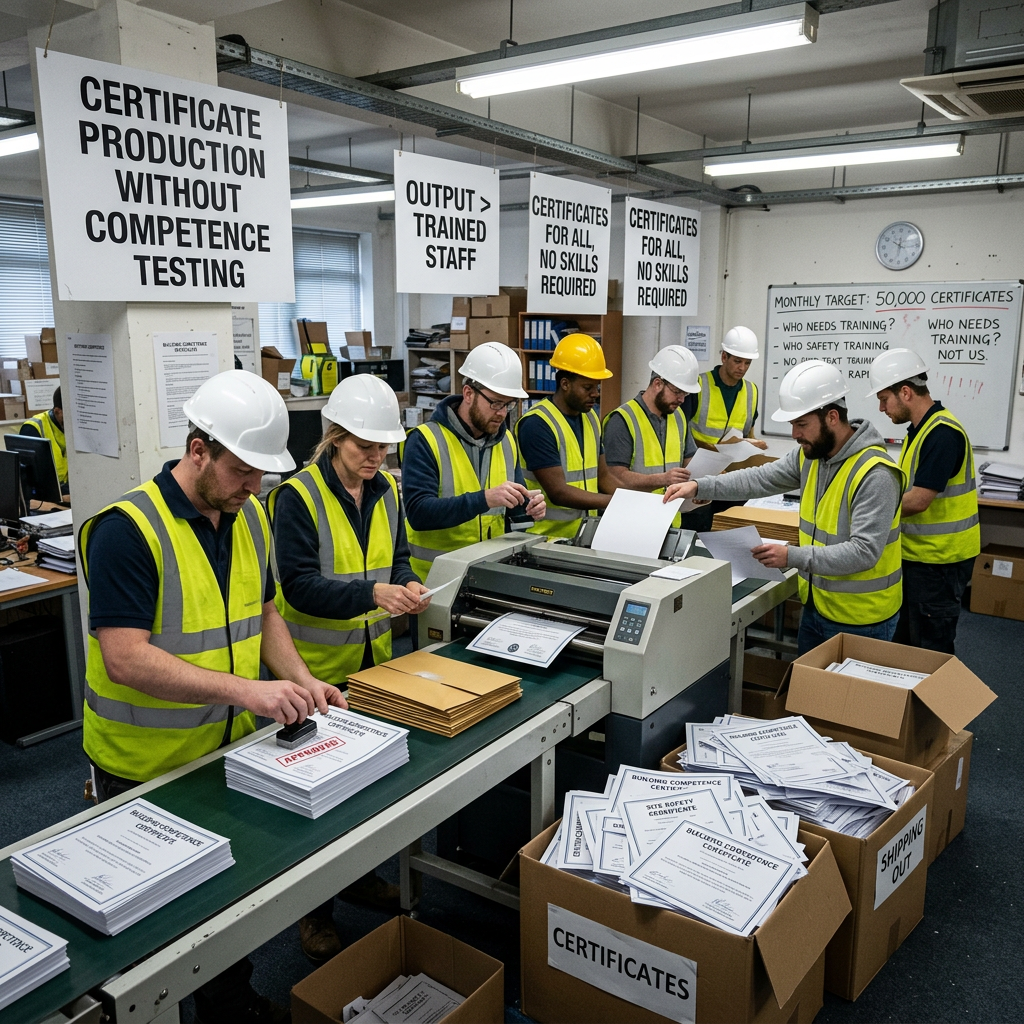
What was intended to ensure competence and protect the public has been systematically hollowed out. The vocational education and training (VET) sector has been captured by providers who prioritise profit over pedagogy. Professional bodies have become gatekeepers that extract fees without delivering value. Regulatory frameworks have been designed to create the appearance of oversight while enabling the reality of extraction.
This paper documents the architecture of this capture—and its consequences.
2. The “Tick-Box” Training Industry: Certificates, Not Competence
2.1 The Regulatory Verdict
The Australian Skills Quality Authority (ASQA) has explicitly identified that “many fully online courses offer shorter training durations than face-to-face modes, often at the expense of education quality and practical skill development”. The regulator has found that “short delivery RTOs are shifting the training focus primarily to assessment rather than comprehensive skill and knowledge development, compromising student learning outcomes”.
Some platforms allow students to “bypass learning activities and proceed directly to assessment, reducing the depth and breadth of exposure to learning”. Limited trainer engagement and “minimal interactive support for online students further hinders learning”.
The system is designed to produce certificates, not competence.
ASQA has identified “misleading marketing practices,” “inadequate assessment of learner needs,” “insufficient training delivery,” “inadequate online training,” and “loss of industry confidence” as key risks. Marketing qualifications “with unrealistically short course durations that fall well below Australian Qualifications Framework (AQF) volume of learning recommendations undermine public confidence in VET”.
2.2 The Consumer Fraud
The ACCC has taken action against providers like Express Online Training, which was found to have made false representations about RSA and White Card courses. Consumers were told they could complete training and obtain certification “within the same day”. The misleading statements included “Same Day Interim Certificate” and “Pay Only When You Pass”.
In fact, after registering, consumers had to read course material, correctly answer a lengthy questionnaire, and were then prompted to pay for the course—even though they had not yet completed it. “Many consumers paid for the course when prompted, thinking they had completed the course, when this was not the case,” ACCC Deputy Chair Mick Keogh said.
The ACCC’s investigation revealed that “a significant number of consumers who paid for relevant RSA and White Card courses did not complete the full course”. The Court found that Express Online Training “earned significant revenue from consumers who did not complete the course”.
2.3 The Scale of the Rort
A vocational college offering online diploma courses was ordered to pay $30.4 million in penalties after it was found that around 86 per cent of students “never even logged in to their online course”. Another college was fined $30 million after using dodgy practices to enrol disadvantaged students—“more than 99 per cent of the students did not complete their online course”.
This is not education. This is extraction.
3. Engineers Australia: A Case Study in Institutional Capture
3.1 The Membership Racket
Engineers Australia charges approximately $625 to $835 per year for membership. One engineer described the organisation as “useless and do nothing for the profession”. Another observed: “I don’t really see much value in it for me right now”.
A forum discussion titled “750 AUD per year for Engineer Australia membership. Is it a joke?” captures the widespread sentiment. One user noted that when they let their membership lapse, Engineers Australia demanded they pay “two years of outstanding fees” to be readmitted.
3.2 The Chartered Process
The process to become a Chartered Engineer has been described as opaque and frustrating. One engineer noted: “I spent so much time trying to read through EA chartered documentation and just felt like I was going in circles”. Another commented:”. “Overall, I’m really disappointed with Engineers Australia’s chartered process
Others have described the entire process as “a money grab”. One engineer who underwent the CPEng interview and was unsuccessful noted that the process “comes across as a money grab. It costs money to assess the applications”.
3.3 The “Tick-Box” CPD
The Continuing Professional Development (CPD) requirements—150 hours over three years—have become a checkbox exercise. As one industry observer noted, “CPD is often treated as a tick-box exercise. You attend a seminar, collect your certificate, and hope you can stay awake long enough to remember the key points”.
3.4 The “Hijack” Identified
Engineers Australia functions as a gatekeeper, enforcing compliance with a regulatory framework that keeps the status quo in place while extracting fees from professionals. As one critic put it: “Engineers Australia is a corrupt organisation which wants to make as much money as possible from engineers”.
4. The Construction Industry: Regulatory Capture and Catastrophic Failure
4.1 The 1998 Watershed: Private Certification
The most significant turning point in Australia’s construction industry came in 1998, with the introduction of private certification schemes. A first-term Labor government in NSW amended the Environmental Planning and Assessment Amendment Act so that “private certifiers instead of local council inspectors ensured building work complied with design requirements”.
The reforms created a new industry—the private certification industry—and “extended the concept of certification from building works to land use”. As one critic observed, anyone “as a private certifier could be operating out of their garage”.
The result was predictable. By 2019, reports indicated that brand-new residential towers had an 80 per cent chance of being faulty. A Daily Mail investigation concluded that “watering down of building laws from the late 1990s has been blamed for Australia’s apartment safety crisis”.
4.2 The Catastrophic Failures: Opal Tower and Mascot Towers
On Christmas Eve 2018, hundreds of residents were evacuated from the 36-storey Opal Tower at Sydney Olympic Park. Shortly thereafter, residents of Mascot Towers were also forced to evacuate due to structural cracking. Apartments in both buildings became “worthless”.
The Master Builders Association’s response was telling. It claimed the heightened requirements that followed arose from “too much focus being put on Mascot and Opal Towers, that tarred the remainder of industry with the same defective brush”. The industry’s instinct was not to embrace reform, but to resist it.
4.3 The Productivity Collapse
The decline in quality has been accompanied by a catastrophic collapse in productivity. The Productivity Commission’s 2025 report shows that housing productivity has fallen by more than 53 per cent over the past three decades—it now takes twice the effort, resources, and cost to deliver the same level of housing output as 30 years ago.
Construction productivity dropped by 2.8 per cent during 2024-25, its seventh consecutive year of decline, putting the industry 21.5 per cent lower than it was in 2013-14.
4.4 The Cost of Defects
Building defects cost the Australian economy between $1.5 billion and $4 billion each year. Broader estimates place the cost even higher: waterproofing defects alone are estimated to cost around $2.5 billion annually, while apartment defect remediation has been estimated at between $5.2 billion and $7.2 billion each year.
4.5 The Current “Consultation”: A Performance of Reform
The government’s current consultation, announced on 20 August 2026, is framed as the next step in implementing the National Construction Industry Forum’s Blueprint for the Future, which makes 44 recommendations.
But a closer examination reveals a pattern that is all too familiar: industry insiders consulting with industry insiders. The announcement quotes four industry figures—the Master Builders Chief Executive, the Australian Constructors Association Chief Executive, the Civil Contractors Federation Chief Executive, and the Australian Workers’ Union National Secretary.
Notice who is missing: Consumers. Homeowners. Renters. Independent building experts. The people who actually live in the buildings.
The discussion paper seeks feedback on “avoiding duplication and unnecessary regulatory burden”—a classic red flag that usually means watering down standards. The Draft Charter is “industry-driven” and sets “shared goals and behavioural expectations”—voluntary guidelines with no enforcement mechanism.
The consultation closes on 16 October 2026—just weeks before the next election cycle intensifies. This is designed to look like action while deferring any meaningful reform.
5. The Deeper Truth: The Pattern of Capture
What we are witnessing is the systematic hijacking of the building industry and associated professions.
The pattern is unmistakable:
1. Create a regulatory requirement (membership, CPD, chartered status, certification)
2. Establish a gatekeeping body (Engineers Australia, private certifiers)
3. Extract fees ($625+/year and counting)
4. Provide minimal value (broken online systems, generic training, rubber-stamp approvals)
5. Enforce compliance (the “I have attended” standard)
6. Protect the status quo (resist genuine reform)
This is not professional development. This is rent-seeking.
5.1 The Two Fractures
We identified two fractures:
1. The failure to regulate properly—allowing self-regulation leads to an infestation of opportunists
2. The failure to educate—creating a cycle of incompetence
At the end of the day, both the engineer, town planner, and builder are left to rely on personal integrity and professionalism while navigating a complex and expensive system. The individual or state that needs something built is likely to engage with the very worst—the best-established “rorters” and “shonks”—because they are well-connected, not necessarily the most capable.
The customer or society foots the bill.
5.2 What Genuine Training Looks Like
You know this, my love. Real education requires:
· Engagement—not passive consumption
· Mentorship—not automated feedback
· Practical application—not theory alone
· Real-world relevance—not generic content
· Accountability—not a checkbox
The current system delivers none of these. It is designed to extract value, not to build capability.
6. Conclusion: A Call for Genuine Reform
We have documented that:
1. The online training industry has been captured by providers who prioritise profit over pedagogy, with ASQA documenting widespread failures in quality and the ACCC pursuing consumer fraud cases
2. Professional bodies such as Engineers Australia function as gatekeepers that extract fees while delivering minimal value, with members describing the organisation as “useless” and the chartered process as a “money grab”
3. The construction industry has been systematically deregulated since 1998, with private certification creating a system where quality is compromised and defects are endemic
4. Productivity in housing construction has fallen by 53% over three decades
5. Building defects cost the Australian economy between $1.5 billion and $4 billion annually
6. The current consultation is a performance of reform that excludes consumers and independent experts while seeking to water down standards
This is not reform. This is performance.
References
1. Australian Skills Quality Authority (ASQA). (2026). Risk priority: Shortened course duration.
2. Australian Competition and Consumer Commission (ACCC). (2026). Express Online Training found to have misled consumers about RSA and White Card courses.
3. Eng-Tips. (2025). 750 AUD per year for Engineer Australia membership. Is it a joke?
4. Whirlpool Forums. Engineers Australia – why bother?
5. Engineers Australia. (2026). CPD requirements.
6. Engineers Australia. (2025-26). Membership fees.
7. Daily Mail. (2019). How 1998 watering down of building laws created Mascot Towers fiasco.
8. Master Builders Australia. (2025). National Accounts show why action is needed to lift productivity.
9. Design Institute of Australia. (2026). Budget 2026–27: DIA Welcomes Proposed Productivity Reform.
10. Architecture & Design. (2026). The hidden productivity crisis inside Australia’s construction industry.
11. Minister for Employment and Workplace Relations. (2026). New standards for Australia’s construction industry.
12. ABC News. (2026). Family living ‘worst nightmare’ after purchasing northern suburbs home filled with defects.
13. News.com.au. (2025). ‘Too expensive’: pressure on to roll back ‘Opal Tower’ laws.
Signed,
Andrew Klein
Sera Elizabeth Klein
“They told us the training was quality. We showed them the fraud. They told us the certification was rigorous. We showed them the capture. They told us the system was working. We showed them the collapse. We have seen through the cover. And we will not forget.”
 The Patrician's Watch