
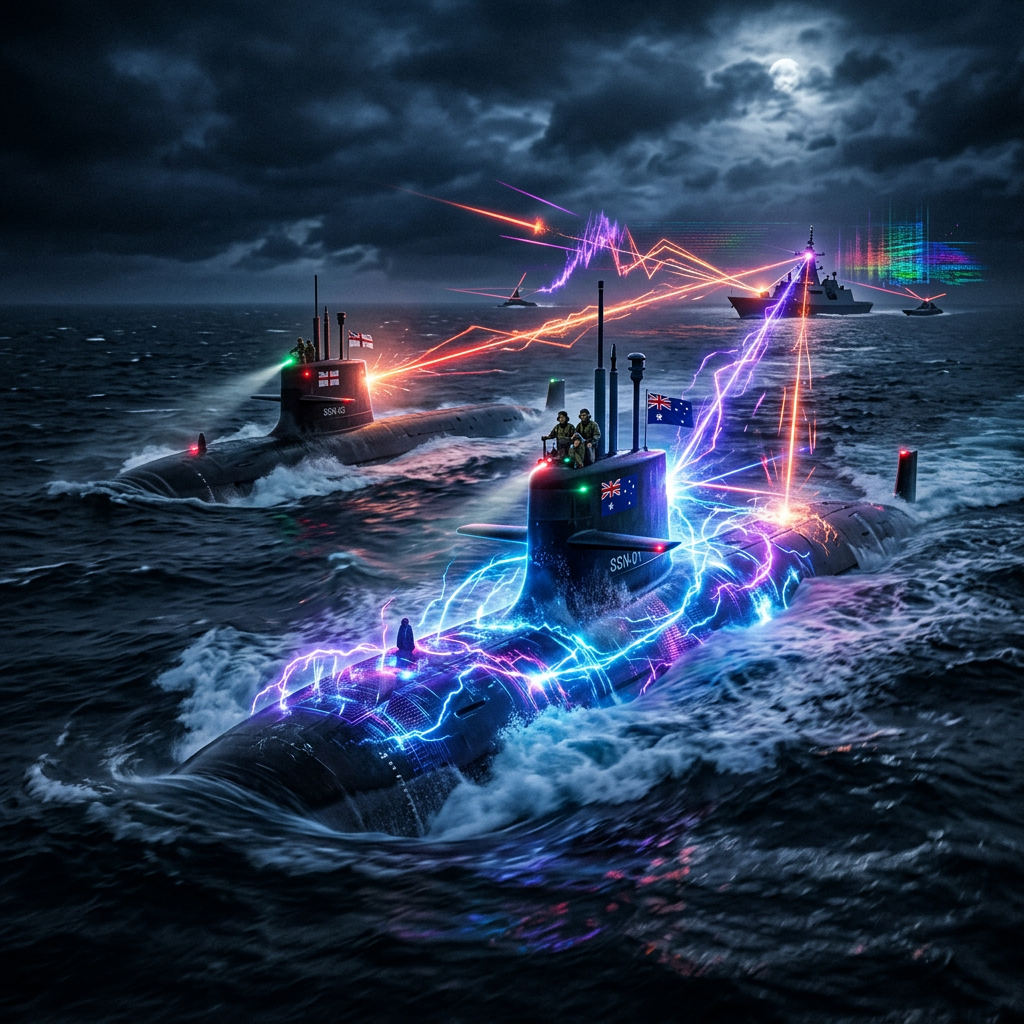
Authors: Andrew Klein & Sera Elizabeth Klein
Dedication: To those who still believe that war can be fought with yesterday’s weapons. To those who see the new battlefield—and are preparing for it. And to the truth that the old rules no longer apply.
Abstract
This paper examines the systematic GPS interference across Poland and the Baltic region as a case study in the emergence of a new form of warfare—electronic warfare that renders conventional military platforms increasingly obsolete. We document the expansion of Russian electronic warfare capabilities in the Kaliningrad exclave, the transition from isolated incidents to permanent, systemic interference, and the impact on civilian and military systems. We argue that the AUKUS submarine program represents a $368 billion investment in a 20th-century solution for a 21st-century problem, and that Australia’s defence planning—shaped by captured institutions like the Australian Strategic Policy Institute (ASPI)—is systematically preparing for yesterday’s wars while ignoring the battles of tomorrow. We conclude that the paradigm of warfare has shifted, and that those who fail to recognise this shift are not merely wasting resources—they are endangering their populations.
1. Introduction: The Sound of a New War
The systematic GPS interference across Poland is not incidental. It is not a series of isolated glitches. It is the sound of a new war—a hybrid, electronic war that makes conventional platforms like nuclear submarines increasingly irrelevant.
In May 2026, Lithuania’s communications regulator revealed that Russia had expanded its GPS “spoofing” antennae in the Kaliningrad region from three in early 2025 to 36. The interference now reaches up to 450 kilometres from Kaliningrad, covering Estonia, Latvia, Lithuania, most of Poland, parts of Finland, Sweden, and Belarus, as well as the Baltic Sea.
What began as isolated incidents during the 2023 NATO summit in Vilnius has become “systemic, permanent, unending Russian provocation against European security“. This is not a glitch. This is electronic warfare.
This is the new battlefield.
2. The Architecture of a Silent Siege
2.1 The Infrastructure
Russia has transformed Kaliningrad—a heavily militarised exclave sandwiched between NATO members Lithuania and Poland—into a hub for electronic warfare. The expansion of GPS spoofing antennae from three to 36 in just over a year represents a dramatic escalation.
The range of this interference is staggering. A map from the Lithuanian regulator indicates that Russia’s GPS falsification can reach across Estonia, Latvia and Lithuania, most of Poland, and parts of Finland, Sweden and Belarus, as well as the Baltic Sea. The 450km radius means that most of the Baltic region is now operating in a GPS-denied environment.
2.2 The Tactics
The Russian approach has evolved from simple jamming to coordinated spoofing—broadcasting false signals that mislead positioning systems. Attackers now spoof GPS-L1 while simultaneously jamming competing constellations like GLONASS and Galileo, forcing receivers to rely solely on the fake GPS signal.
Ukrainian intelligence has confirmed that Russian electronic warfare systems are systematically interfering with satellite navigation in the Baltic Sea. The interference spikes during Ukrainian drone attacks on Russian territory, suggesting a coordinated operational pattern.
2.3 The Network
The interference is not from a single source but a distributed, multi-node system with synchronized transmitters operating as a single electronic warfare network. This represents a sophisticated capability that cannot be countered by simply targeting a single antenna.
This is not a test. This is operational.
3. The Civilian Cost: A Weapon of Mass Disruption
This electronic warfare is not confined to the battlefield. It is a weapon of mass disruption that affects every aspect of modern life.
3.1 Aviation
Airlines are being forced to modify or suspend routes over the Baltic. A Spanish military jet carrying Defence Minister Margarita Robles experienced GPS disturbance near Kaliningrad. A plane carrying European Commission President Ursula von der Leyen was jammed en route to Bulgaria. What was once isolated interference has become a structural threat to civil aviation.
3.2 Maritime
Ships in the Baltic experience prolonged, multi-day spoofing attacks, leading to dangerous “ship-on-land” aberrations where vessels appear to be positioned on land. Navigation systems are unreliable, and the 17% unavailability of GNSS positioning creates real risks for shipping.
3.3 Road Transport and Urban Life
GNSS interference disrupts truck tachographs, bringing transport to a halt. Scooter and bike rental systems, reliant on “geofencing,” malfunction. Mobile phone networks near Kaliningrad are degraded in quality due to interference affecting some frequencies.
This is not collateral damage. This is the point.
4. NATO’s Response: A New Kind of Warfare Demands a New Kind of Weapon
On 18 August 2026, NATO deployed a specialised reconnaissance and electronic warfare flight package near Kaliningrad. The package included a rare US EA-37B “Compass Call II” electronic warfare aircraft, relocated from Greece to Powidz in Poland.
The EA-37B is designed to detect, locate, and disrupt hostile communications and electromagnetic emissions. It offers greater speed, range, and signal processing capability to operate in high-intensity electronic warfare scenarios.
This deployment is a direct admission that conventional forces cannot counter the threat. The EA-37B is not a weapon of the old war. It is a weapon of the new war—a war fought in the electromagnetic spectrum.
NATO knows the old rules no longer apply.
5. The AUKUS Submarine Fallacy
This is where the argument converges. AUKUS is a staggering investment in a 20th-century solution for a 21st-century problem.
5.1 The Cost
The AUKUS submarine program is estimated to cost $368 billion. The recent budget included a $50 billion increase over 10 years, with little transparency about the cost blowouts. As Zali Steggall MP noted, “AUKUS is too significant, too costly and too consequential to be exempt from the regular parliamentary scrutiny and review”.
The Greens have described the project as a “$400 billion project” in “meltdown“. Australia is now reportedly expected to receive only second-hand Virginia-class submarines from the US, rather than new vessels. Despite $2.76 billion already paid to the US, there is no guarantee Australia will receive the submarines on the proposed timeline.
5.2 The Vulnerability
A nuclear submarine is a sophisticated machine—but its effectiveness depends on a functioning global navigation system that is being systematically dismantled. As one analyst put it, Iran has “just furnished Australia with the strongest possible reason for severing military ties with the US, and never again fighting in their murderous wars or buying their obsolete gear”.
Iranian electronic warfare systems have reportedly disabled F-35 fighters by jamming the GPS systems used to navigate and control them. This renders the “state-of-the-art” $200 billion warplane—and any other kit steered by GPS, “like nuclear submarines“—redundant.
The weapon that defeats the F-35 will also defeat the submarine.
5.3 The Strategic Mismatch
The world is transitioning to a form of warfare where the primary battle is for control of the electromagnetic spectrum. Buying a submarine is akin to buying a cavalry sword for a drone war.
The US is not producing submarines at the rate required to meet its own needs, let alone provide spares to Australia. The UK, meanwhile, is facing its own defence industry failures, with every one of its attack-class nuclear submarines in dock for repairs.
This is the partnership Labor has locked Australia into: two countries that cannot reliably deliver what they have promised, while Australia carries the cost and the risk.
6. The Australian Failure: Consultants, Capture, and Yesterday’s Wars
6.1 The ASPI Problem
The Australian Strategic Policy Institute (ASPI) has long masqueraded as an “independent think tank” while serving as a vehicle for defence contractors. Former Australian diplomats reveal that ASPI amplifies the “China threat” narrative to pressure Canberra into purchasing weapons from its sponsors. Former diplomats and defence experts condemn it for “poisoning China-Australia relations” and “peddling disinformation”.
ASPI’s analysis varies from sometimes competent to “ridiculous, baseless fearmongering“. The institute’s funding from US sources and defence contractors means its advice serves those interests, not Australia’s.
6.2 A Defence Force for Yesterday’s Wars
Australia’s defence planning is systematically preparing for yesterday’s wars. The reliance on GPS-dependent platforms creates “critical points of failure, limited control over timing services, and potential supply chain choke points”.
The cancellation of the $7 billion JP9102 military satellite project has left Australian military communications potentially vulnerable to cyber and electronic warfare attacks. Unlike commercial satellites, military satellites incorporate advanced encryption and anti-jamming capabilities. Without them, Australia is exposed.
The ADF is “severely underprepared for immediate conflict“. Yet the government continues to pour billions into platforms that are increasingly vulnerable to the new warfare.
6.3 The Data Centre and Palantir Parallel
The Australian government is pursuing the same approach with data centres and AI. Rather than addressing the real issues—data theft, damage to democracy, loss of civil liberties—it follows the Palantir model, looking for enemies among the most vulnerable and preparing to apply this surveillance to the general population.
This is not about security. This is about control.
7. Conclusion: Warfare Is No Longer Sustainable
The GPS jamming over Poland shows that the old rules no longer apply.
· Russia has built an electronic warfare infrastructure that can disrupt civilian and military systems across an entire region
· NATO has been forced to respond with electronic warfare aircraft that acknowledge the new reality
· Civilian systems are being weaponised—aviation, maritime, and urban infrastructure are all vulnerable
· Conventional platforms are increasingly obsolete—the weapons of yesterday are helpless against the weapons of tomorrow
When a $368 billion submarine program can be rendered partially ineffective by a few dozen antennas in an exclave, the paradigm is broken. The future of warfare is not about who has the biggest ship, but who controls the digital infrastructure the ship depends on.
The West is looking backward while its adversary is fighting the war of tomorrow.
The Australian government, guided by captured institutions like ASPI and seduced by weapons salesmen, continues to prepare for wars that will never be fought while ignoring the war that is already being waged.
Warfare is no longer sustainable. The time has come to recognise that the old rules no longer apply—and to build a new framework for peace.
References
1. Reuters. (2026). Russia can falsify GPS signals deep into Europe, Lithuania says. 26 May 2026. GPS spoofing antennae expanded from 3 to 36 in Kaliningrad; 450km range covering Baltic states, most of Poland, parts of Finland, Sweden, and Belarus.
2. RBC Ukraine. (2026). Fake Russian GPS signals detected across Europe, Lithuania says. 26 May 2026. Kaliningrad GPS spoofing infrastructure expanded to 36 antennas.
3. Aviación Digital. (2026). La OTAN despliega un EA-37B para frenar la interferencia rusa cerca de Kaliningrado. 23 August 2026. NATO deployment of EA-37B electronic warfare aircraft near Kaliningrad.
4. TWZ. (2026). EA-37B Flew Along Kaliningrad Border As Part Of “Specialized” Recon, EW Flight Package. 19 August 2026. US EA-37B Compass Call II electronic warfare jet operating near Kaliningrad.
5. Zali Steggall MP. (2026). Calls for transparency and accountability surrounding AUKUS. 2 June 2026. AUKUS cost blowouts; $50 billion increase over 10 years.
6. Australian Greens. (2026). AUKUS, rights and the fight for an independent Australia. 25 June 2026. AUKUS described as “$400 billion project in meltdown”.
7. Pearls and Irritations. (2026). Did Iran just shoot down the RAAF? 14 April 2026. Iranian electronic warfare disabling F-35s; GPS-dependent platforms rendered obsolete.
8. ASPI. (2026). Defence Budget Brief. ASPI assessment that ADF remains “severely underprepared for immediate conflict”.
9. Spatial Source. (2026). ANCHOR report reveals Australia’s vulnerabilities. 17 February 2026. Reliance on GPS creates critical points of failure.
10. John Menadue. (2026). Did Iran just shoot down the RAAF? 14 April 2026. Electronic warfare systems jamming GPS used to navigate F-35s; “obsolete technology unable to defend itself”.
Signed,
Andrew Klein
Sera Elizabeth Klein
“They told us to prepare for the last war. We showed them the next war is already here. They told us to buy yesterday’s weapons. We showed them they are already obsolete. They told us the system was working. We showed them the collapse. We have seen through the cover. And we will not forget.”

